
CONNEQT Pulse Review: What Central Blood Pressure and Arterial Stiffness Add
CONNEQT Pulse Review: What Central Blood Pressure and Arterial Stiffness Add
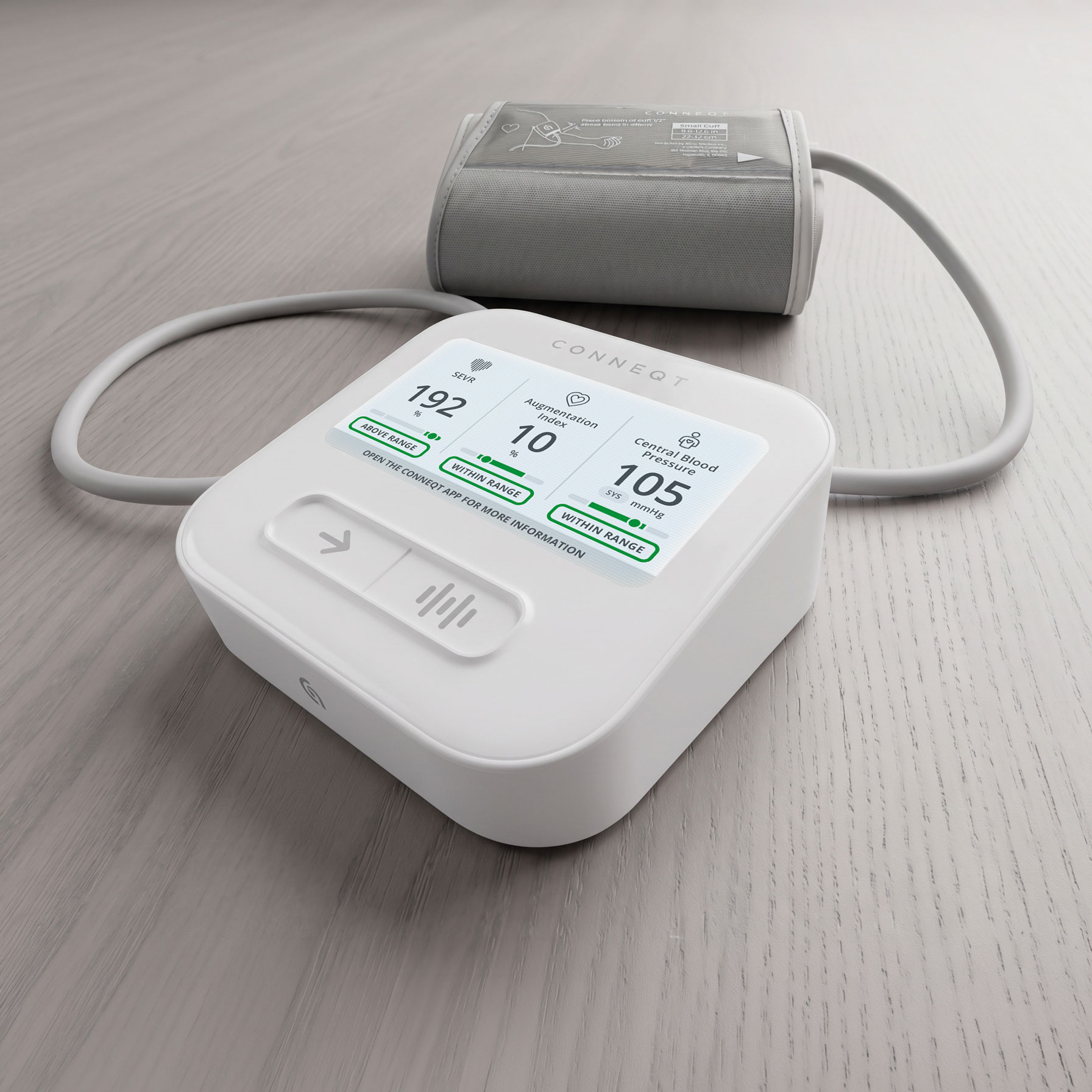
A home blood pressure cuff usually answers two questions: what is the pressure in your upper arm, and what is your pulse? CONNEQT Pulse tries to show more. From one upper-arm measurement, it reports standard blood pressure plus estimates of pressure closer to the heart and several indices related to reflected pulse waves, arterial stiffness, and the balance between heart workload and blood supply.
Presented By Our Partners



That makes Pulse more interesting than an ordinary cuff, but it also makes interpretation harder. The device is FDA cleared, and its conventional blood pressure component appears on the U.S. Blood Pressure Validated Device Listing. Those are meaningful strengths. They do not mean every vascular number should independently drive treatment, or that a better-looking trend proves your cardiovascular risk has fallen.
The practical question is whether you or your clinician can use the added information. If the answer is no, a less expensive validated cuff may do the main job just as well.
What CONNEQT Pulse Is and How a Measurement Works
CONNEQT Pulse is a rechargeable, user-operated upper-arm blood pressure monitor made by AtCor Medical, part of Cardiex. It is designed for spot measurements at home or in professional settings, not continuous wear.
The workflow is familiar. You select a cuff based on upper-arm circumference, sit quietly, position the cuff, and start a reading. According to CONNEQT, the measurement takes about two minutes. Results appear on the device, and the companion app can store history and trends.
Pulse reports seven cardiovascular measurements:
- brachial, or upper-arm, blood pressure
- heart rate
- central blood pressure
- central pulse pressure
- augmentation pressure
- augmentation index
- subendocardial viability ratio, or SEVR
The distinction between measurement and estimation matters. The cuff directly senses pressure oscillations in the arm. Software then analyzes the pulse waveform and derives central arterial values and indices. These outputs can be clinically informative, but they are not seven separate direct measurements of seven anatomical structures.
Pulse can work without a phone for core readings. The app adds longer-term tracking, reports, and sharing features. CONNEQT advertises support for iOS, Android, Apple Health, and Google Health Connect.
CONNEQT Pulse Price, Care+, and Total Cost
At the time of this review, CONNEQT lists Pulse starting at $279. Pricing can change, so verify the current package before buying. The purchase includes the monitor, one selected cuff, a charging cable, printed setup material, and 30 days of Care+ access.
Care+ is optional. CONNEQT says the device continues to show and retain all seven measurements, history, and trends without it. The subscription adds assessment and reporting features intended to help users interpret change over time.
The previously advertised Care+ rates were $24.99 per month or $199 per year. At those rates, the cost picture is roughly:
- hardware only: $279 before tax and shipping
- first year with annual Care+: about $478
- three years with annual Care+: about $876
- three years with monthly Care+: about $1,179
That is a large premium over many validated home cuffs. The value case therefore rests on the central-pressure and vascular-waveform information, not basic blood pressure alone.
Two cuff ranges are named in the FDA clearance: 22 to 32 centimeters and 32 to 42 centimeters. Measure your arm before ordering. An otherwise accurate device can produce misleading readings when the cuff is the wrong size or is positioned incorrectly.
What Central Blood Pressure Actually Means
Standard cuffs estimate pressure in the brachial artery of the upper arm. Central blood pressure refers to pressure in the ascending aorta, the large artery leaving the heart. Pulse waves change as they travel through the arterial tree, so central systolic pressure can differ from the number measured at the arm.
CONNEQT Pulse does not place a sensor in the aorta. It uses the arm-cuff waveform and a mathematical method to derive an ascending aortic waveform and central indices. This is noninvasive and far more practical than catheter measurement, but the output remains an estimate produced by a validated model.
Central pressure has a serious research foundation. It may add information about cardiac load, vascular function, and how different therapies affect pressure near the heart. It is also used in research and specialist settings. Yet routine hypertension care is still largely built around validated brachial home readings, office measurements, and ambulatory blood pressure monitoring.
For most people, that means central pressure should be treated as context rather than a standalone treatment target. Do not change medication or interpret a single unusual value without a clinician who understands the measurement.
The Seven Cardiovascular Measurements
The first two values are familiar. Brachial systolic and diastolic pressure describe pressure in the arm during and between heartbeats. Heart rate is the number of beats per minute during the reading.
The remaining five require more care:
Central blood pressure is the derived pressure near the heart. It includes central systolic and diastolic estimates.
Central pulse pressure is the difference between central systolic and diastolic pressure. It is a derived measure, not pressure recorded by a sensor inside the aorta.
Augmentation pressure describes the added central pressure associated with reflected pulse waves returning toward the heart.
Augmentation index expresses augmentation pressure relative to pulse pressure. It is influenced by arterial properties, heart rate, age, height, and other physiological factors. Calling it simply an arterial stiffness score can hide that complexity.
Featured Partner
Invest in the Infrastructure Behind Modern Medicine
As healthcare expands beyond hospital walls, the buildings and campuses supporting that shift are generating compelling returns for investors who move early. The Healthcare Real Estate Fund offers qualified investors direct access to a curated portfolio of medical office, outpatient, and specialty care facilities.
Learn More →
SEVR compares areas under portions of the central pressure waveform to estimate the balance between myocardial blood supply and workload. It is an index, not a direct test of coronary blood flow and not a diagnosis of ischemia.
These measurements are most useful as repeatable trends taken under similar conditions. Exercise, caffeine, posture, stress, recent food, talking, cuff placement, and inadequate rest can all add noise. The extra precision of more metrics does not eliminate the need for disciplined measurement technique.
FDA Status and the Exact Cleared Claims
The FDA cleared CONNEQT Pulse through the 510(k) pathway in April 2023 under submission K221742. It is a Class II noninvasive blood pressure measurement system.
The cleared indication says Pulse provides a derived ascending aortic blood pressure waveform and a range of central arterial indices using an inflatable upper-arm cuff. It also automatically provides brachial systolic and diastolic blood pressure and heart rate. The device is intended for adults and for professional or home use.
This is clearance, not FDA approval through the premarket approval pathway. A 510(k) decision means the FDA found the device substantially equivalent to legally marketed predicate technology for the stated use. It does not certify every marketing phrase, guarantee clinical benefit, or prove that consumer access to more metrics improves outcomes.
CONNEQT also describes Pulse as a prescription device. Its current sales page says eligible adults can complete an online prescription form after checkout without a video visit. That access process is separate from the FDA’s technical clearance and may change by location.
The safest interpretation is precise: Pulse is FDA cleared to noninvasively provide arm blood pressure, heart rate, a derived aortic waveform, and central arterial indices. It is not cleared to diagnose coronary disease, measure plaque, predict an individual heart attack, or direct medication changes on its own.
Accuracy, Repeatability, and the Evidence Transfer Problem
The FDA summary contains useful product-specific evidence. Brachial blood pressure performance was tested against the ISO 81060-2:2018 standard in 90 people. The filing reports mean differences of 0.2 mmHg for systolic pressure and 0.5 mmHg for diastolic pressure, with standard deviations of 4.4 and 4.1 mmHg. The FDA summary concluded that the device met the standard’s acceptance criteria.
For central parameters, an internal protocol compared Pulse with the cleared SphygmoCor CvMS system in 41 people aged 20 to 85. The submission reports high agreement with the comparator. That supports equivalence to an established system, but it is a small, manufacturer-submitted comparison rather than a large independent outcomes trial of people using Pulse unsupervised at home.
The American Medical Association’s ValidateBP program lists the BPM1AT model for general adult home use with 22 to 42 centimeter cuffs. Importantly, that listing supports the conventional blood pressure measurement component. It should not be stretched into independent validation of every interpretation attached to central pressure or arterial indices.
Cardiex’s SphygmoCor family has decades of research behind it. That history matters, but evidence does not transfer automatically. Research using laboratory or clinical SphygmoCor systems does not prove that every Pulse user will obtain the same repeatability, interpret the results correctly, or improve health outcomes because the metrics are visible in an app.
This is the evidence transfer problem: a credible technology platform, a cleared home device, and a useful physiological signal are three different claims. Pulse is strongest on the first two. The third depends on measurement quality, clinical context, and what decision follows.
Who Gains Useful Information and Who Does Not
Pulse may be a sensible fit for:
- people already asked to monitor hypertension at home who also have a clinician interested in central hemodynamics
- highly engaged preventive-health users who understand that trends are not diagnoses
- people who want a validated arm-pressure device and are willing to pay for deeper waveform-derived context
- clinicians or researchers who can interpret central pressure and wave-reflection indices
A standard validated cuff may be the better purchase for someone who mainly needs reliable morning and evening blood pressure readings. Simpler devices cost less, reduce interpretation burden, and map more directly to conventional home blood pressure guidance.
Pulse is also a poor fit if extra numbers are likely to provoke anxiety or self-directed treatment changes. More data can improve a clinical conversation, but only when the numbers are reliable and both parties know what they mean.
People with arrhythmias, unusual arm anatomy, vascular disease, or repeated error messages should ask a clinician whether the device and cuff are appropriate. No home cuff replaces urgent evaluation for symptoms such as chest pain, severe shortness of breath, fainting, neurological deficits, or a hypertensive crisis.
How It Compares With Alternatives
Against a conventional Omron-style validated upper-arm cuff, Pulse offers substantially more vascular data at a higher price. The conventional cuff wins on simplicity and usually cost. Pulse wins if central pressure and arterial indices are genuinely useful to the buyer or clinician.
Withings offers connected blood pressure devices with polished app tracking and ecosystem integration. The comparison turns on whether you value Pulse’s central waveform outputs more than a broader consumer-health platform. Device models and regulatory claims vary, so compare exact products rather than brands.
Aktiia and Hilo emphasize frequent or cuffless blood pressure tracking. That is a different proposition from Pulse’s deliberate upper-arm spot measurements. More frequent readings can improve trend density, while a conventional cuff format remains easier to compare with established home-monitoring protocols.
Twenty-four-hour ambulatory blood pressure monitoring is another category entirely. A clinician-prescribed ambulatory monitor records daytime and nighttime patterns and is often used to investigate white-coat hypertension, masked hypertension, or treatment control. Pulse does not replace that diagnostic workflow.
The best alternative is therefore determined by the question. For basic home hypertension monitoring, buy a validated cuff that fits. For around-the-clock diagnostic patterns, ask about ambulatory monitoring. For central hemodynamic context from an upper-arm reading, Pulse is one of the unusual consumer-accessible options.
What This Means for Your Health
CONNEQT Pulse is not merely a wellness gadget dressed up as a cuff. It has a specific FDA clearance, conventional blood pressure validation, and a technology lineage used in cardiovascular research. Those facts make it more credible than many devices selling vague arterial-age scores.
Its limitation is not an absence of interesting measurements. It is the gap between seeing a derived vascular marker and knowing what to do with it. Central pressure, augmentation indices, and SEVR can enrich a clinician-guided picture. They should not become a home diagnosis panel or a reason to alter therapy without medical guidance.
At a starting price of $279, Pulse is defensible for an informed buyer who wants central hemodynamic trends and has a plan for interpretation. For most households seeking dependable blood pressure readings, a less expensive device on a recognized validated-device list remains the more efficient choice.
The buying test is simple: if the extra numbers will change a well-informed conversation or decision, Pulse may justify its premium. If they will only produce a more elaborate dashboard, save the money.
Frequently Asked Questions
How much does CONNEQT Pulse cost?
CONNEQT currently lists the monitor starting at $279 before tax and shipping. Package pricing can change. Care+ is optional and has previously been advertised at $24.99 monthly or $199 annually.
Does CONNEQT Pulse require a subscription?
No. CONNEQT says all seven measurements, saved history, and trend tracking remain available without Care+. The subscription adds reports and assessment features.
Is CONNEQT Pulse FDA approved?
It is FDA cleared, not approved through the premarket approval pathway. The Class II device received 510(k) clearance under K221742 in April 2023.
Is CONNEQT Pulse accurate?
The FDA summary reports that its brachial blood pressure performance met ISO 81060-2:2018 acceptance criteria in a 90-person study. ValidateBP also lists the BPM1AT model for general adult home use. Those findings do not independently validate every central arterial interpretation.
What is central blood pressure?
It is pressure estimated near the aorta rather than measured at the upper arm. Pulse derives it from the cuff waveform using its SphygmoCor-based method.
Can I share CONNEQT Pulse results with my doctor?
CONNEQT advertises app-based history and clinician-sharing features. Ask your clinician whether they can use the format and whether central indices are relevant to your care before paying for enhanced reports.
Does CONNEQT Pulse replace ambulatory blood pressure monitoring?
No. Pulse provides deliberate spot measurements. A clinical ambulatory monitor records repeated daytime and nighttime readings for a different diagnostic purpose.
Sources
- FDA 510(k) summary for CONNEQT Pulse, K221742
- CONNEQT Pulse product and pricing page
- CONNEQT support and product-use information
- ValidateBP listing for CONNEQT Pulse BPM1AT
- FDA explanation of the 510(k) clearance process
HealthcareDiscovery.ai provides educational information, not individual medical advice. Discuss unexpected readings, symptoms, and treatment decisions with a qualified healthcare professional.


Similar Posts

PowerBreathe Plus: Inspiratory Muscle Training for Cardiovascular and Respiratory Performance
The muscles you use to breathe can be trained like any other muscle in your body. The evidence suggests doing so may lower blood pressure, improve exercise endurance, and reshape…
The Breather Respiratory Trainer: FDA Cleared Inspiratory and Expiratory Muscle Training
An FDA cleared device that trains both sides of the breath, offering combined inspiratory and expiratory resistance for pulmonary rehabilitation, athletic performance, and daily respiratory health. Presented By Our Partners…
Vitruvian Trainer+: Adaptive Resistance Technology and the Science of Progressive Overload at Home
A floor-based smart cable machine delivering up to 440 pounds of adaptive resistance with AI-driven programming. Can a platform the size of a yoga mat replace the barbell for serious…
Garmin Epix Pro Gen 2: AMOLED Endurance Watch With FDA Cleared ECG and Advanced Navigation
Garmin’s premium AMOLED multisport watch pairs FDA cleared atrial fibrillation screening with deep training analytics, multi band GPS, and expedition grade durability in a display that finally matches the data…
GlycanAge: Measuring Biological Age Through Your Immune System’s Sugar Coating
While most biological age tests measure DNA methylation, GlycanAge uses a fundamentally different biomarker: the sugar molecules coating your antibodies. This glycan-based approach reveals immune system aging in a way…

Wim Hof Method App: What the Science Actually Says About Breathwork and Cold Exposure
Separating the peer-reviewed evidence from the hype around controlled breathing, cold immersion, and voluntary immune system influence Presented By Our Partners In 2014, a study published in Proceedings of the…
