
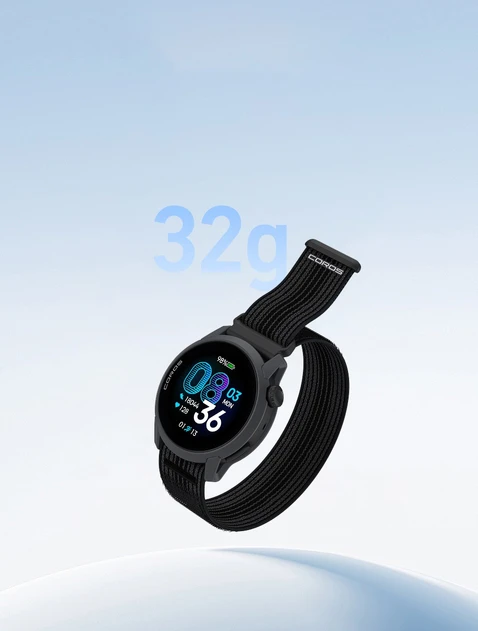
COROS PACE 4: Ultralight AMOLED Running Watch With Long Battery and Training Analytics at $249
COROS’s lightest GPS watch combines an AMOLED display, 38 hour GPS battery, and comprehensive training analytics in a 37 gram package that redefines what runners can expect at $249 with no subscription.
Presented By Our Partners



The democratization of running technology follows a predictable pattern. Features debut on $1,000 flagship watches, migrate to $500 premium models within a year or two, and eventually arrive at the $250 price point where the majority of serious runners actually shop. Dual frequency GPS, training load management, HRV based recovery scoring, and AMOLED displays were all $500 or more features two years ago. The COROS PACE 4 collapses this timeline, delivering all four at $249 with no subscription.
For the broader running community, price has always been the gatekeeper between basic step counting and genuine training analytics. The data that helps runners avoid injury, optimize their training, track their cardiovascular fitness trajectory, and make evidence based decisions about when to push and when to rest has historically been locked behind $400 to $600 price tags. The PACE 4 argues that it does not have to be.
What Is the COROS PACE 4?
The COROS PACE 4 is COROS Wearables’ ultralight GPS running watch, designed for runners, triathletes, and cyclists who want premium training features in the lightest and most affordable package COROS offers. At approximately 37 grams, it is the lightest GPS watch with an AMOLED display on the market, lighter than the Garmin Forerunner 265 (47g), Polar Pacer Pro (41g), and nearly every competitor with comparable features.
The 1.3 inch AMOLED touchscreen display delivers vibrant color, high contrast, and excellent readability in all lighting conditions. The sensor suite includes COROS’s optical heart rate sensor for continuous HR and HRV monitoring, and dual frequency GPS support (available in select activity modes) for improved position accuracy. Health features include HRV analysis, sleep staging, menstrual cycle tracking, daily stress monitoring, training load management, recovery scoring, and base fitness estimation.
The watch includes built in navigation with route following, voice memo recording via a built in microphone, and offline maps (with reduced detail compared to the APEX and VERTIX lines). Battery life reaches up to 38 hours in standard GPS mode, approximately 26 hours with the AMOLED display in always on mode during GPS activities. The watch supports ANT+ and Bluetooth external sensors. It retails at $249 with no subscription required for any feature.
The Science Behind It: Accessible Training Science and Cardiovascular Health
The PACE 4’s most important contribution is not a specific sensor or algorithm. It is accessibility. The training science that was previously available only to athletes willing to invest $500 or more in a GPS watch is now available at a price point that opens the door for recreational runners, beginners starting their fitness journey, and budget conscious athletes who have been relying on smartphone apps or basic trackers.
VO2 max tracking, the metric most strongly associated with all cause mortality in the exercise physiology literature, is included. The 2018 study by Mandsager et al. in JAMA Network Open (122,007 participants) demonstrated that cardiorespiratory fitness is among the most powerful modifiable predictors of longevity. Every runner who gains access to VO2 max trending gains the ability to see, over months and years, whether their training is actually improving the cardiovascular fitness metric that most directly connects to healthspan.
HRV based recovery monitoring, informed by the European Society of Cardiology’s established clinical guidelines on HRV and autonomic function, helps runners balance training stress against recovery capacity. For recreational runners who often lack coaching guidance, the simple question “should I push hard today or take it easy?” can be answered by physiological data rather than guesswork.
Menstrual cycle tracking adds a dimension of health monitoring that most GPS watches have been slow to address. Research published in the British Journal of Sports Medicine has demonstrated that menstrual cycle phase affects exercise performance, recovery rate, and injury risk. By integrating cycle tracking into the training analytics platform, the PACE 4 enables female athletes to contextualize their training data within their hormonal cycle, a capability that was largely absent from GPS watches until recently.
That is the science. Here is how the COROS PACE 4 applies it.
What the COROS PACE 4 Does Well
The PACE 4’s combination of weight, display quality, battery life, and price is unmatched. No other GPS watch delivers an AMOLED display, 38 hour GPS battery, training load analytics, and dual frequency GPS support at 37 grams and $249. Each individual specification has competitors; the combination does not.
The AMOLED display is a transformative upgrade at this price point. Data rich training screens, heart rate zone indicators, and recovery metrics are rendered with clarity and vibrancy that budget watches have never offered. For runners who review mid run data frequently, the display quality directly impacts the utility of the information.
Battery life of 38 hours in GPS mode at $249 significantly exceeds what competitors offer at this price. The Garmin Forerunner 165 ($299.99) offers approximately 17 hours of GPS life. The Apple Watch SE ($249) lasts approximately 7 hours in GPS workout mode. The PACE 4 provides more than double the GPS endurance of most competitors at equal or lower prices.
Voice memo recording, inherited from the APEX line, provides a differentiated feature that no competitor at this price offers. Runners can log training notes, course observations, or post run reflections without stopping to type on a tiny screen. For coached athletes reviewing training logs, voice memos add context that data alone cannot capture.
Featured Partner
Invest in the Infrastructure Behind Modern Medicine
As healthcare expands beyond hospital walls, the buildings and campuses supporting that shift are generating compelling returns for investors who move early. The Healthcare Real Estate Fund offers qualified investors direct access to a curated portfolio of medical office, outpatient, and specialty care facilities.
Learn More →
Pricing, Access, and Practical Realities
The COROS PACE 4 retails at $249 with no subscription required. COROS Training Hub and all analytics features are free. First year and all subsequent years cost $249 total. For comparison: the Garmin Forerunner 165 costs $299.99, the Garmin Forerunner 265 costs $449.99, and the Polar Pacer Pro costs $349.90. The PACE 4 undercuts all three while offering comparable or superior specifications in key areas.
The watch works with both iOS and Android via the COROS app. No platform specific feature restrictions exist.
Regarding regulatory status: general wellness classification. No FDA clearances, no ECG, no cardiac screening. At $249, the Fitbit Charge 6 ($159.95) and Samsung Galaxy Watch FE ($199.99) offer FDA cleared ECG at lower prices, making the PACE 4’s lack of cardiac screening a notable trade off for health focused buyers.
HSA/FSA eligibility has been confirmed by COROS for the PACE 4, providing potential reimbursement for health conscious purchasers with qualifying accounts.
Who the COROS PACE 4 Is Best For
The PACE 4 is ideal for runners who want premium training features without premium pricing. It serves recreational and competitive runners training for 5K through marathon distances, triathletes who want lightweight multisport support, female athletes who want integrated menstrual cycle tracking alongside training analytics, and budget conscious athletes upgrading from a basic fitness tracker or smartphone app to their first serious GPS watch.
It is also an excellent secondary device for athletes who own a premium watch (Garmin Fenix, COROS VERTIX) for races and long efforts but want a lighter, more comfortable daily training watch that uses the same COROS ecosystem and data platform.
Who may want to skip it: anyone needing ECG or cardiac screening should consider the Fitbit Charge 6 ($159.95) or Samsung Galaxy Watch FE. Trail runners who need full offline maps should step up to the COROS APEX 4 ($429). Ultra endurance athletes needing 50+ hours of GPS should choose the VERTIX 2S. Users who want smartwatch features with apps, payments, and rich notifications should consider Apple Watch SE or Google Pixel Watch.
How It Compares
Against the Garmin Forerunner 165 ($299.99), the PACE 4 saves $50 while offering longer GPS battery life (38 vs 17 hours), lighter weight (37g vs 39g), and dual frequency GPS support that the Forerunner 165 lacks. Garmin counters with a more polished user interface, deeper Garmin Connect analytics, and a larger app ecosystem. For value and specifications, COROS wins. For software maturity and ecosystem, Garmin wins.
Compared to the Fitbit Charge 6 ($159.95), the PACE 4 costs $90 more but offers GPS, AMOLED display, training load analytics, and running dynamics that the Charge 6 lacks entirely. Fitbit counters with FDA cleared ECG at a lower price and a more health focused feature set. For training and running, the PACE 4 is far superior. For cardiac screening at the lowest cost, Fitbit wins.
Against the Polar Pacer Pro ($349.90), the PACE 4 saves $100 while offering an AMOLED display and comparable battery life. Polar counters with deeper Training Load Pro analytics, Nightly Recharge recovery, and a barometric altimeter. For value and display quality, COROS wins. For training science depth, Polar wins.
Limitations and Open Questions
COROS’s training analytics, while functional, are less sophisticated than Garmin’s and Polar’s established platforms. Runners who deeply engage with training data analysis, periodization, and recovery optimization may find the PACE 4’s analytics framework less satisfying than what Garmin Connect or Polar Flow provide.
No ECG at $249 positions the PACE 4 behind the Fitbit Charge 6 ($159.95), which offers FDA cleared ECG at $90 less. For health focused buyers who prioritize cardiac screening, this is a significant gap.
The PACE 4’s offline maps, while available, are less detailed than those on the APEX 4 and VERTIX 2S. Trail runners should evaluate whether the PACE 4’s map quality meets their navigation needs or whether stepping up to the APEX 4 is warranted.
As with all COROS products, the app ecosystem and community are smaller than Garmin’s. Fewer users, fewer third party integrations, and a developing software platform may matter to runners who value community features and data sharing.
What This Means for Your Health
The most powerful health intervention available without a prescription is consistent cardiovascular exercise. Running, specifically, builds VO2 max, the biomarker that the broader medical research community has identified as among the strongest modifiable predictors of all cause mortality. Every person who starts running, and keeps running consistently, is making a direct investment against cardiovascular disease, the first of the Four Villains.
The COROS PACE 4 removes the cost barrier between that investment and the data that makes it visible. At $249 with no subscription, it provides VO2 max tracking that connects daily runs to long term cardiovascular health trajectory. It provides HRV based recovery monitoring that prevents the overtraining that derails consistency. It provides training load management that ensures each week’s running builds on the last rather than simply accumulating fatigue.
The Five Pillars remain the foundation. Consistent Movement through running. Seven to nine hours of Sleep for recovery. Whole food Nutrition to fuel adaptation. Breathwork for stress management and parasympathetic recovery. Mindset to maintain the discipline that turns occasional runs into a lifelong practice. The PACE 4 does not replace any of these. It makes the Movement pillar more visible, more manageable, and more accessible to the widest possible audience of runners.

Explore the full wearable guide
See how the COROS PACE 4 compares with smart rings, watches, ECG devices, and other connected health hardware across the full Healthcare Discovery wearables guide.
Frequently Asked Questions
How much does the COROS PACE 4 weigh?
Approximately 37 grams, making it the lightest GPS watch with an AMOLED display on the market. For comparison, the Garmin Forerunner 265 weighs 47 grams and the Garmin Forerunner 965 weighs 53 grams. The ultra light weight makes the PACE 4 virtually unnoticeable during running.
How long does the COROS PACE 4 battery last?
Up to 38 hours in standard GPS mode and approximately 26 hours with the AMOLED display in always on mode during GPS activities. In daily use with regular training, the watch lasts approximately 12 to 14 days between charges. The $249 price includes all features with no subscription required.
Does the COROS PACE 4 have ECG?
No. The PACE 4 is classified as a general wellness device with no FDA clearances. It does not include ECG or atrial fibrillation detection. Runners who want cardiac screening at a budget price should consider the Fitbit Charge 6 ($159.95), which offers FDA cleared ECG.
Does the COROS PACE 4 have maps?
The PACE 4 includes basic offline maps and route following capability, but with reduced detail compared to the COROS APEX 4 and VERTIX 2S. For detailed topographic navigation on trails, the APEX 4 ($429) is the recommended upgrade. For road running with occasional route following, the PACE 4’s navigation is adequate.
Is the COROS PACE 4 good for triathlon?
Yes. The PACE 4 includes multisport profiles for triathlon and duathlon with automatic transition detection. It tracks open water swimming with GPS, pool swimming by lap count, cycling with power meter support, and running with full dynamics. At $249, it is one of the most affordable triathlon capable GPS watches available.
Does the COROS PACE 4 track menstrual cycles?
Yes. The PACE 4 includes menstrual cycle tracking that integrates with training analytics, helping female athletes contextualize recovery scores and training readiness within their cycle phase. This feature reflects growing research on the impact of menstrual cycle phase on exercise performance and injury risk.
COROS PACE 4 at a glance
- Hardware price
- $249
- Subscription
- None required
- First year total
- $249
- Form factor
- Ultralight GPS watch
- FDA status
- Wellness device, no clearance
- HSA/FSA
- Eligible
Measures GPS, HR, HRV, Menstrual cycle tracking, Navigation, Recovery, Sleep, Training load
Maintained in the Healthcare Discovery device database and updated automatically.


Similar Posts

GLP-1 Intelligence Hub: Verify the Claim Before You Trust It
A source-backed verification hub for decoding GLP-1 claims, checking telehealth transparency, understanding compounded-product risks, and finding accountable care.
The FDA’s New AI Experiment Asks a Better Question: Did the Patient Get Better?
The FDA and CMS are testing a new bridge from AI-enabled chronic-care technology to Medicare payment, real-world evidence, and measurable patient outcomes. The promise is real. The proof is not…
Google Pixel Watch 2: Continuous Stress Monitoring and Loss of Pulse Detection
Chronic stress kills slowly and silently, remodeling the cardiovascular system, suppressing immune function, and accelerating every major disease of aging. A smartwatch that measures it continuously could change the way…

Your Thymus Didn’t Retire: Two Nature Studies Show This Overlooked Organ Predicts 50% Lower Death Risk
Two papers published in Nature in March 2026 used AI-powered CT analysis across 27,000 adults to show that thymic health predicts 50% lower all-cause mortality, 63% lower cardiovascular death, and…

Everlywell Metabolic Panel: Accessible At-Home Blood Testing for Metabolic Health
A widely available at-home blood and urine testing platform that puts basic metabolic screening in reach for anyone who wants to check their HbA1c, cholesterol, thyroid, and cortisol without a…
BioTelemetry MCOT Patch: 30-Day Continuous ECG for Arrhythmia Detection
When a two-week cardiac monitor is not enough, the BioTelemetry MCOT Patch extends the diagnostic window to 30 continuous days of real-time ECG surveillance. Presented By Our Partners In 2019,…
