
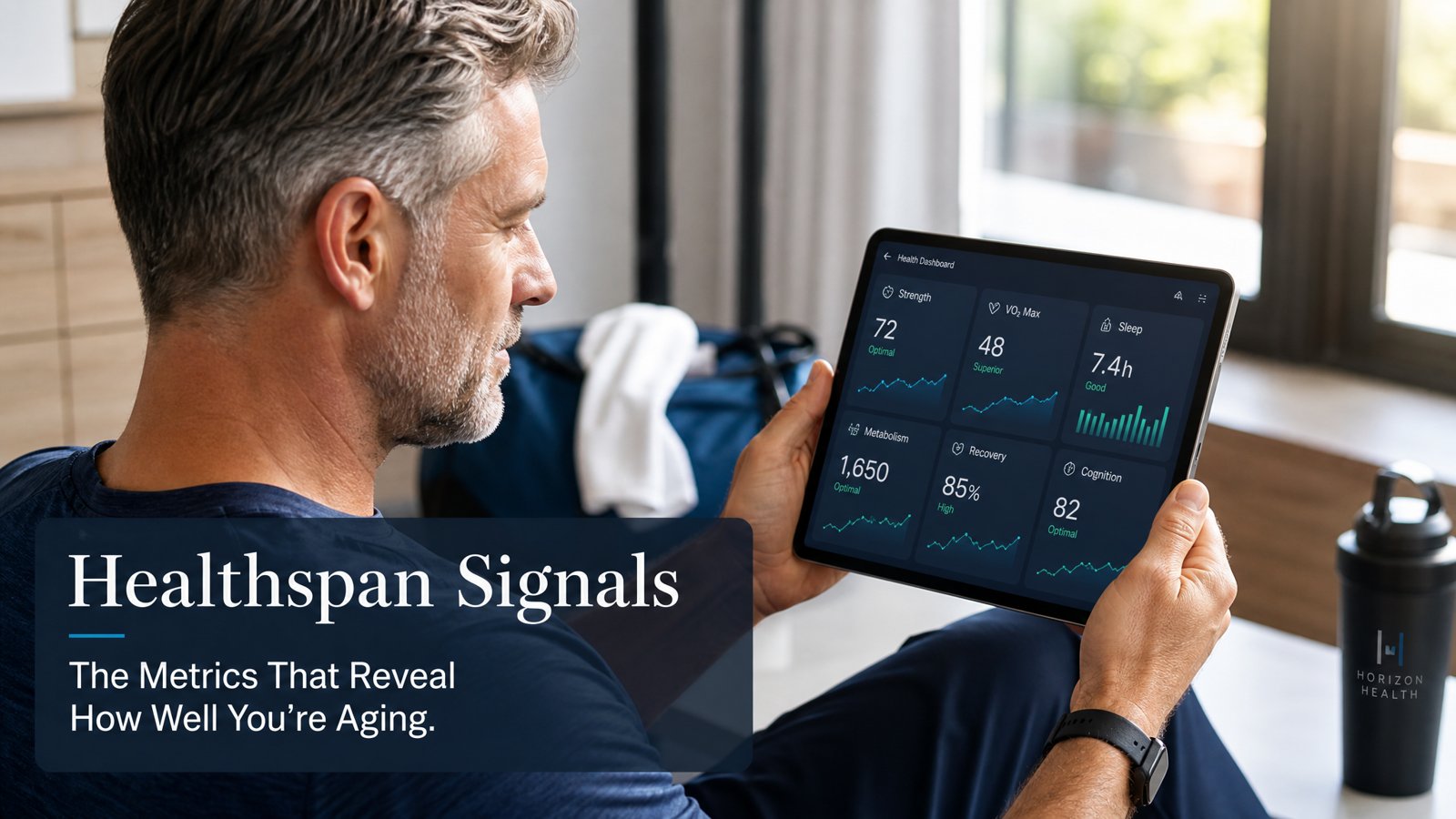
Healthspan Signals: The Metrics That Reveal How Well You’re Aging
The first warning rarely arrives as a diagnosis.
Presented By Our Partners



It arrives as a signal.
A resting heart rate that creeps upward. A waistline that expands while the scale barely moves. A night of sleep that looks long enough but never feels restorative. A flight of stairs that suddenly asks more of the lungs. A grip that weakens almost imperceptibly, until the jar will not open, the suitcase feels heavier, and the nervous system begins whispering what the bloodwork has not yet said.
This is where the future of healthspan is quietly taking shape: not in one heroic intervention, not in one miracle molecule, but in the ability to read the body before the body has to shout.
For most of modern medicine, health has been organized around events. A scan finds something. A lab value crosses a line. A symptom becomes impossible to ignore. The system responds when the problem is visible enough to name.
Healthspan asks a different question. What if the most important information appears earlier, in the weak signals that accumulate across strength, sleep, metabolism, circulation, cognition, and recovery? What if aging is not just something measured in birthdays, but something that can be watched in the changing behavior of the body’s core systems?
That is the promise—and the danger—of healthspan signals.
The body has a dashboard
Every body is producing data all the time. Some of it is obvious: body weight, blood pressure, resting heart rate, sleep duration. Some of it requires a device: heart rate variability, continuous glucose patterns, sleep regularity, recovery trends. Some of it comes from simple physical tests that are older than the quantified-self movement by decades: grip strength, gait speed, balance, waist-to-height ratio, cardiorespiratory fitness.
None of these signals tells the whole story. That is the first rule.
A high VO₂ max does not make someone invincible. A low heart rate variability score after a stressful week does not mean the body is broken. A glucose spike after dinner is not a moral failure. A wearable’s recovery score is not a medical diagnosis.
But patterns matter. Direction matters. Context matters. A single signal is a snapshot. A trend is a story.
And when multiple signals begin pointing in the same direction, the body may be revealing something important before conventional disease has fully arrived.
Strength is a nervous-system signal
Grip strength looks almost too simple to matter. Squeeze a dynamometer. Record the number. Move on.
Yet grip strength has become one of the most quietly powerful measures in aging research because it is not only about the hand. It is a crude but useful proxy for muscle quality, nervous-system output, frailty risk, and the body’s ability to interact with the physical world.
The hand is just the visible tip of a deeper system. Underneath are motor neurons, tendons, connective tissue, mitochondrial capacity, protein status, inflammation, training history, and the simple fact that bodies designed to push, pull, carry, climb, and stabilize tend to deteriorate when those demands disappear.
Grip strength is not destiny. But when it declines, it often signals that something larger than the hand is changing.
VO₂ max is a ceiling on possibility
VO₂ max measures how much oxygen the body can use during hard effort. In plain language, it is a measure of the engine: heart, lungs, blood vessels, mitochondria, and working muscle all cooperating under stress.
That cooperation matters. The ability to move oxygen is not just athletic trivia. It is one of the clearest windows into cardiorespiratory fitness, and cardiorespiratory fitness is one of the strongest predictors of long-term health.
Featured Partner
Invest in the Infrastructure Behind Modern Medicine
As healthcare expands beyond hospital walls, the buildings and campuses supporting that shift are generating compelling returns for investors who move early. The Healthcare Real Estate Fund offers qualified investors direct access to a curated portfolio of medical office, outpatient, and specialty care facilities.
Learn More →
There is a reason a staircase can feel like a truth serum. The body under load reveals what the body at rest can hide.
The good news is that VO₂ max is trainable. Zone 2 work builds the base. Intervals raise the ceiling. Strength training protects the machinery. Recovery allows adaptation to stick. The signal can move, sometimes dramatically, because the system behind it is alive.
Sleep is not downtime
Sleep used to be treated like absence: the part of the day when nothing productive was happening.
That view is collapsing.
Sleep is when the brain changes its chemistry, the immune system recalibrates, hormones pulse, memory consolidates, and metabolic control resets. Sleep regularity—the consistency of sleep and wake timing—may be one of the most underrated signals because it reflects whether the body’s internal clocks are being reinforced or confused.
A perfect sleep score is not the goal. The goal is rhythm. Darkness at night. Light in the morning. Enough time in bed. Fewer late-night insults from alcohol, heavy meals, stress loops, and glowing rectangles pretending to be harmless.
If healthspan has a foundation, sleep is poured into the concrete.
Metabolism leaves tracks
Metabolic health is often discussed as if it lives inside a single number. Glucose. Insulin. Weight. Cholesterol. Body fat. Each matters, but each can also mislead when isolated from the rest of the system.
A fasting glucose value may look normal while insulin is working overtime. A scale may stay stable while visceral fat rises and muscle falls. A continuous glucose monitor may capture spikes that are meaningful in one context and basically harmless in another. ApoB may reveal cardiovascular risk that standard cholesterol shorthand misses.
The point is not to turn every meal into a courtroom drama. The point is to understand that metabolism leaves tracks. Those tracks can show whether the body is handling fuel cleanly, storing energy safely, and recovering after stress.
The fundamentals remain stubbornly powerful: protein, fiber, resistance training, walking after meals, sleep, less ultra-processed food, and enough consistency to let the signal emerge from the noise.
Recovery is a pattern, not a number
Heart rate variability became famous because wearables made it visible. That visibility created a problem. A subtle signal became a daily verdict.
HRV is not a personality score. It is not a morality score. It is not a guarantee of readiness. It is a window into autonomic flexibility: the body’s ability to shift between stress and recovery, effort and restoration, sympathetic drive and parasympathetic brake.
That window is useful. It can also be noisy. Illness, alcohol, travel, training load, emotional stress, dehydration, medications, menstrual cycle phase, and measurement quirks can all move the number.
What matters is the pattern. If recovery signals degrade while resting heart rate rises, sleep quality falls, mood worsens, and training feels harder, the body may be asking for a different input. Not panic. Not obsession. Adjustment.
The anti-neurotic rule
The quantified body can become a trap.
Measure too little, and preventable decline can hide in plain sight. Measure too much, and life becomes a spreadsheet with a pulse. The goal is not to outsource self-trust to devices. The goal is to use signals as feedback, then return to the actual work of living well.
Healthspan signals are most useful when they are treated as instruments, not idols.
They should point attention toward better questions:
- Is my cardiovascular capacity improving, stable, or quietly sliding?
- Am I preserving strength as I age?
- Does my sleep have rhythm?
- Is my metabolism handling ordinary life without excessive strain?
- Do I recover from stress, or only accumulate it?
- Are my numbers helping me act, or just making me anxious?
The signals that matter most
A practical healthspan dashboard does not need to be complicated. The strongest signals usually fall into a few domains.
Capacity
VO₂ max, resting heart rate, walking pace, exercise tolerance, and blood pressure reveal how well the cardiovascular system supports movement and stress.
Strength
Grip strength, muscle mass, power, balance, and gait speed reveal whether the body can still generate force, stabilize itself, and move through the world safely.
Metabolism
Waist-to-height ratio, fasting insulin, glucose patterns, triglycerides, HDL, ApoB, and body composition reveal how the body manages fuel and cardiovascular risk.
Recovery
Sleep regularity, HRV trends, resting heart rate, mood, soreness, libido, and perceived energy reveal whether the system is adapting or simply enduring.
Cognition
Reaction time, memory, attention, mood stability, and subjective mental clarity reveal whether the brain is thriving under the demands being placed on it.
The best dashboard is not the one with the most numbers. It is the one that changes behavior in the right direction.
The future is earlier
The next era of healthcare discovery will not be defined only by better drugs, better diagnostics, or better artificial intelligence. It will also be defined by better timing.
Earlier awareness. Earlier course correction. Earlier recognition that aging is not one thing, but a network of systems drifting, adapting, compensating, and sometimes failing.
Healthspan signals do not promise control over everything. Biology is too complex for that. Genetics matter. Environment matters. Luck matters. Access to care matters. Disease can arrive despite discipline.
But signals give the body a voice before crisis gives it a microphone.
That voice is not always loud. It is not always obvious. It lives in the trend line, the repeated measurement, the quiet mismatch between how life looks on paper and how the body performs under load.
Listen well enough, and the future may become negotiable sooner than we thought.


Similar Posts
The Cardiac Amyloidosis Revolution: How ATTR Therapies Are Rewriting Heart Failure Treatment in 2026
For decades, cardiac amyloidosis was a diagnosis cardiologists whispered and patients rarely heard. In 2026, tafamidis, acoramidis, RNA silencers, and a CRISPR gene editing therapy are transforming ATTR care and…

The Cold Plunge Reckoning: What 20 Years of Research Reveal About Cold Water Immersion, Brown Fat, and Recovery Science
Twenty years of peer reviewed research has clarified what cold water immersion actually does to the human body. Inside the Šrámek 530 percent norepinephrine study, the Søberg Danish winter swimmer…

The AI Scientists Are Already Running the Lab: How Autonomous Multi-Agent Systems Are Reinventing Drug Discovery
A new generation of AI systems does not just assist scientists; it organizes itself into research teams, designs experiments, debates hypotheses, and identifies drug candidates at speeds no human laboratory…

Resistance Training Is Medicine for Your Brain: What 2026 Research Reveals About Strength Training, Depression, and Cognitive Decline
A growing body of clinical evidence shows that resistance training reduces depression symptoms as effectively as frontline medications, slows cognitive decline in aging adults, and triggers neurobiological changes that no…

Grip Strength: The Underrated Vital Sign That Predicts Healthspan Better Than Blood Pressure
A 140,000 person Lancet study and the UK Biobank both confirm what longevity researchers have been quietly noting for a decade: a hand squeeze predicts mortality better than blood pressure….

Walking for Longevity: The 7,000 Step Sweet Spot, Brisk Cadence, and the Underrated Power of the Post Meal Walk
A wave of large cohort studies, including the I-Min Lee Harvard analyses, the Paluch JAMA Internal Medicine meta-analysis, and a 2025 Lancet Public Health update, is reshaping the way clinicians…
