
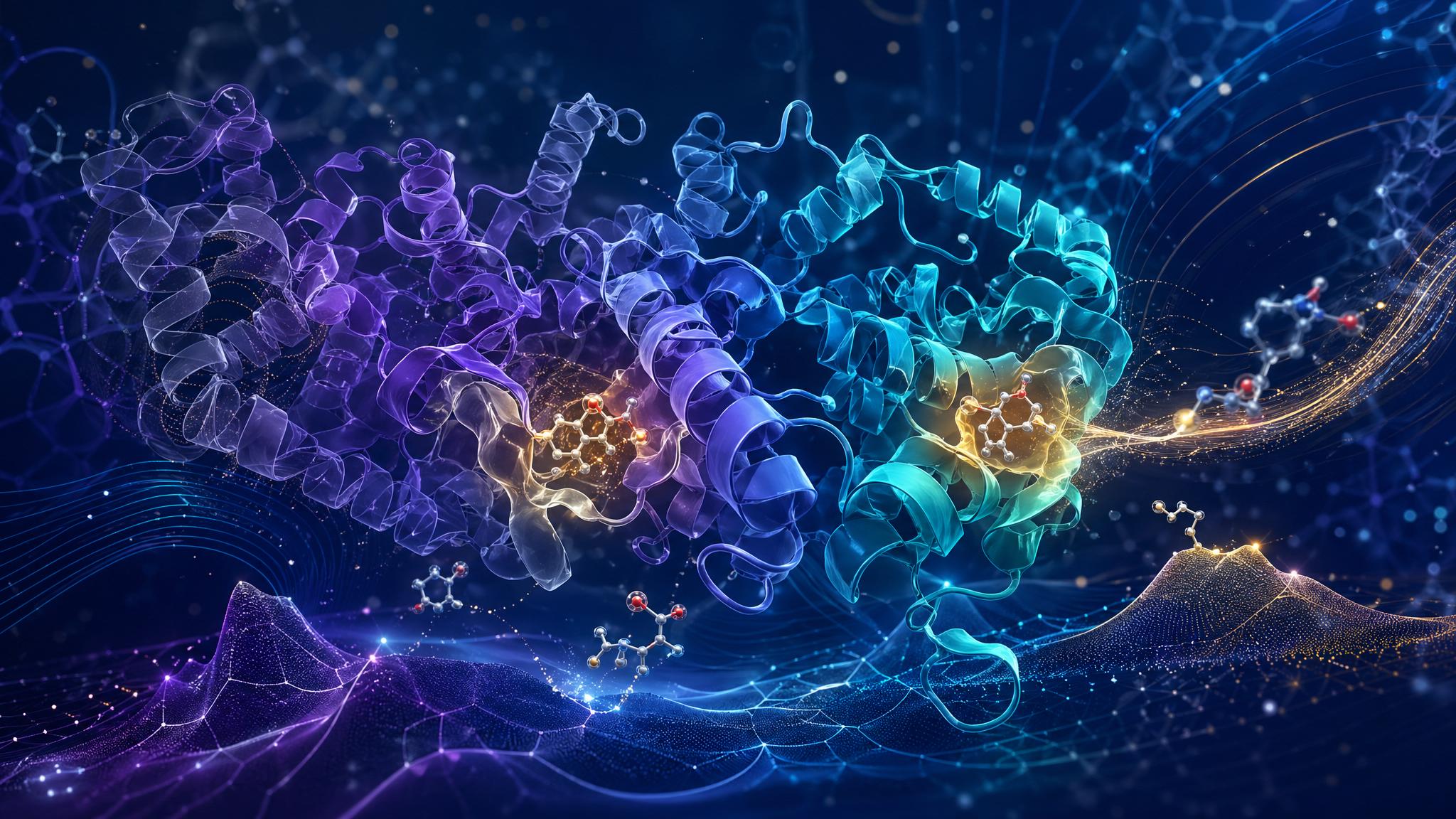
MIT, ASU, and the New Frontier of Protein Motion: Why Drug Discovery Is Moving Beyond Static Structure
Two advances from MIT and ASU point to the next chapter in AI-enabled drug discovery: designing and understanding proteins by how they move, not just how they look.
Presented By Our Partners



For the last few years, protein AI has largely been a story about structure.
That made sense. Predicting a protein’s three-dimensional form was one of the great unsolved problems in biology, and tools such as AlphaFold changed the field by making high-quality structural prediction far more accessible. But structure was never the whole story.
Proteins are not statues. They are machines.
They bend, breathe, vibrate, hinge, twist, and shift between conformations as they carry out the chemistry of life. Enzymes open and close around substrates. Receptors change shape when signals arrive. Allosteric proteins communicate across long molecular distances. Many of the most therapeutically relevant behaviors in biology depend not just on what a protein is, but on how it moves.
That is why two recent university-led advances, one from MIT and one from Arizona State University, are worth reading together.
They were developed independently, but they converge on the same deeper idea: the future of drug discovery may depend on learning to model, simulate, and eventually design protein dynamics with the same fluency that today’s systems model structure.
MIT is pushing from the design side. ASU is pushing from the simulation side. Together, they sketch the outline of a much bigger shift.
MIT’s VibeGen: Designing Proteins by Motion
In a March 2026 report on research published in Matter, MIT described a new AI system called VibeGen, developed by Bo Ni and Markus J. Buehler. The core idea is both elegant and radical: instead of asking what structure a protein sequence will fold into, VibeGen asks what sequence will produce a desired pattern of motion.
That inversion matters.
Most protein design systems begin with structure as the main design target. VibeGen treats dynamics (the vibrational or motion profile of a protein) as the blueprint, then generates sequences expected to realize that behavior. According to MIT and the associated repository for the paper, VibeGen uses an agentic dual-model architecture: a “designer” model proposes sequences aimed at a target motion profile, and a “predictor” evaluates whether the candidates are likely to move as intended. The two models iterate until the design improves.
This is not just protein generation. It is dynamics-conditioned protein generation.
The implications are significant. If researchers can specify not only a protein’s shape but also how flexibly it opens, how strongly it vibrates, or how readily it shifts between states, then proteins start to look less like passive molecular objects and more like programmable molecular devices.
MIT also reported that the generated proteins were largely de novo, with no significant similarity to natural proteins, and that full-atom molecular simulations supported the claim that the resulting proteins reproduced the targeted vibrational behavior. One especially provocative result is what the authors describe as functional degeneracy: multiple very different sequences and folds may satisfy the same motion target. That suggests biology may occupy only a narrow slice of the possible design space.
For drug discovery, that could become powerful.
A therapeutic protein that can change shape at the right time, or bind with the right flexibility, could be more selective and potentially safer than one designed around a static lock-and-key assumption. Dynamic design could also matter for enzyme engineering, biosensors, smart biologics, and responsive biomaterials that behave more like living systems than inert molecules.
ASU’s Advance: Faster Access to Protein Conformational Landscapes
If MIT is asking how to design proteins with desired movement, ASU is asking how to observe and characterize meaningful movement faster.
Featured Partner
Invest in the Infrastructure Behind Modern Medicine
As healthcare expands beyond hospital walls, the buildings and campuses supporting that shift are generating compelling returns for investors who move early. The Healthcare Real Estate Fund offers qualified investors direct access to a curated portfolio of medical office, outpatient, and specialty care facilities.
Learn More →
In late March 2026, ASU highlighted work from the lab of Matthias Heyden in the School of Molecular Sciences, published in Science Advances, showing a way to identify low-frequency vibrations that help govern slow protein conformational changes. The problem they are tackling is well known in molecular simulation: proteins often function through transitions between states, but simulating those transitions can be painfully expensive because the relevant timescales are long and the right “collective variables” for enhanced sampling are difficult to identify.
The ASU team’s contribution is to extract useful, reproducible low-frequency vibrational information from relatively short simulations, then use those vibrations as guide rails for enhanced sampling. The method was demonstrated across five proteins of varying complexity, where it consistently improved sampling of conformational transitions and their associated free-energy surfaces.
That may sound technical, but the practical meaning is straightforward: researchers can get to functionally relevant protein motion faster and with less guesswork.
ASU reported that by using GPUs on the university’s Sol supercomputer, meaningful protein shape changes could be observed in less than a day, compressing workflows that previously could take weeks or months. That speed matters not only for basic science but for translational research, where iteration cycles determine what gets tested, funded, and eventually developed.
The downstream implications are broad. Better dynamic sampling could improve the study of allostery, where a molecule binding at one site changes behavior at another site. It could support better drug design for proteins whose medically relevant conformations are rare or transient. It could also generate richer conformational datasets for the next wave of machine-learning models that aim to connect sequence, structure, and dynamics rather than stopping at structure alone.
Why This Matters Beyond AlphaFold
AlphaFold was a historic breakthrough, but even strong reviews of the field now acknowledge an important limitation: most current prediction systems are strongest at giving a high-quality structural snapshot, not a full account of the shifting conformational landscape that underlies real biological function.
That limitation shows up repeatedly in the literature. Reviews of AlphaFold’s strengths and weaknesses note that while it dramatically improves structure prediction, it still struggles with flexible regions, ligand-bound states, transient assemblies, and the broader problem of dynamic conformational behavior. Separate reviews on protein allostery and conformational dynamics make the same point from the biology side: changing a protein’s free-energy landscape changes not only structure but also the amplitudes and rates of motion that govern function.
That is the gap MIT and ASU are each attacking from opposite ends.
MIT is effectively saying: make motion a design parameter.
ASU is saying: make motion a tractable simulation target.
Put those together and you get something potentially transformative: a workflow in which researchers can identify useful dynamic states, learn from them, simulate them faster, and then design entirely new proteins that deliberately exploit those same dynamic principles.
Why Universities Matter Here
There is another reason this story is bigger than two papers.
Universities are uniquely good at building the layered ecosystems needed for breakthroughs like this. Not just one lab, one model, one paper, but an entire pipeline that links basic science, computation, engineering, clinical translation, and real-world deployment.
MIT and ASU each offer a version of that model.
At MIT, the Center for Biomedical Innovation explicitly frames collaboration as a way to solve complex problems in biologic medicines by bringing together academia, industry, and government. Its programs focus on biologics manufacturing, delivery, and access, exactly the downstream infrastructure needed if protein innovation is going to matter beyond the paper stage.
At ASU, the Biodesign Institute frames innovation in similarly translational terms. ASU emphasizes partnerships with health systems, research institutes, and external organizations including Mayo Clinic, Banner Health, TGen, and Barrow Neurological Institute. The point is not just discovery for discovery’s sake. It is discovery embedded in a network that can test, refine, and translate ideas into diagnostics, therapeutics, biomaterials, and clinical tools.
This is how modern health innovation increasingly works.
A frontier method emerges in a university lab. It is refined through computational science and interdisciplinary engineering. It gets stress-tested through collaboration with clinicians, hospital systems, translational institutes, or industry partners. Then it either dies in the valley of death or becomes a platform.
The most important healthcare discoveries of the next decade will likely come from universities that know how to do both parts: deep science and collaborative translation.
What This Could Mean for the Future of Healthcare Discovery
If these lines of work keep maturing, several implications stand out.
Drug discovery becomes more dynamics-aware.
The old picture of a drug binding to a fixed protein target is giving way to a more realistic one: proteins populate ensembles of states, and therapeutics often work by stabilizing, shifting, or exploiting those states.
Allosteric drug discovery could accelerate.
Allostery has always been attractive because it offers subtler control than brute-force active-site inhibition. But it has been hard to exploit because the relevant pathways are dynamic and often hidden. Faster sampling and better motion-aware design could make allosteric opportunities easier to find.
Generative biology may move from shape generation to behavior generation.
VibeGen hints at a future in which researchers do not just ask for a fold; they ask for a useful behavior: flexibility, responsiveness, gating, or a programmed conformational cycle.
Better dynamics datasets could unlock better models.
ASU’s work matters partly because the field lacks rich, scalable datasets of protein dynamics. If universities can generate conformational ensembles more efficiently, they can help train models that go beyond static protein intelligence.
Translation will still take time.
This is not an overnight cure story. Computational validation is not wet-lab validation. Proteins designed for interesting motion still have to be expressed, stabilized, manufactured, tested for immunogenicity, and evaluated in real biological systems. The regulatory path may get more complex before it gets simpler.
But that is not a reason to downplay these advances. It is a reason to see them clearly: as enabling technologies that may reshape the foundation of early-stage drug discovery.
The Bigger Takeaway
The most interesting healthcare AI stories are no longer just about prediction. They are about control.
Can we move from predicting what biology looks like to understanding how it behaves? Can we move from describing molecules to engineering them? Can we build models that do not merely recover nature, but navigate design spaces nature never explored?
MIT’s VibeGen and ASU’s work on fast conformational sampling suggest the answer may be yes, but only if the field learns to treat protein motion as first-class biology.
The future of healthcare discovery may not belong only to better maps of biology’s static parts. It may belong to the institutions and platforms that learn to model life in motion.
Sources
- MIT News: MIT engineers design proteins by their motion, not just their shape
- Matter (DOI): VibeGen research paper
- VibeGen GitHub Repository
- ASU News: Understanding protein motion could greatly aid new drug design
- Science Advances: Fast Sampling of Protein Conformational Dynamics
- arXiv: Fast Sampling of Protein Conformational Dynamics (preprint)
- PMC: AlphaFold strengths and limitations review
- PMC: Protein Allostery and Conformational Dynamics
- MIT Center for Biomedical Innovation
- ASU Biodesign Institute: Clinical Partnerships


Similar Posts
Upright GO 2 Posture Trainer: Wearable Biofeedback for Spinal Alignment
The average office worker spends over 10 hours per day seated. The cumulative biomechanical toll of that posture, compounded across years and decades, is one of the most underappreciated threats…
Everlywell Metabolic Panel: Accessible At-Home Blood Testing for Metabolic Health
A widely available at-home blood and urine testing platform that puts basic metabolic screening in reach for anyone who wants to check their HbA1c, cholesterol, thyroid, and cortisol without a…

The Daily Rounds: Longevity & Health Care Brief | April 5, 2026
🧬 Cellular Reprogramming Enters Human Trials — Life Biosciences has launched the first FDA-approved partial de-aging trial, translating Sinclair's epigenetic reprogramming research from animal models to human medicine. 🧠 Gut-Brain Axis Reverses Memory Loss — Stanford's Nature study shows that correcting age-related gut bacteria shifts restores youthful cognitive performance by reactivating vagus nerve signaling to the hippocampus. 🤖 AI Drug Discovery Reaches Clinical Scale — 173+ AI-designed drug candidates are now in clinical trials, and longevity medicine is being advised to prepare for AI therapeutics to arrive in clinical practice imminently. 🦠 Gut Microbiome as Active Immune Regulator — New research reveals gut bacteria actively inject proteins into cells to modulate immunity, and a microbiome-derived molecule doubled lung cancer immunotherapy response rates in mice. 😴 Circadian Fragmentation Doubles Dementia Risk — A large Neurology journal study found that weak or late-peaking daily activity rhythms more than double the risk of dementia, making circadian optimization a key prevention target.

What the World’s Oldest Person Reveals About the Biology of Extreme Longevity
A landmark Cell Reports Medicine study analyzed the genome, epigenome, microbiome, and metabolome of Maria Branyas Morera, the world’s oldest verified person. The findings reveal that extreme longevity results from…
Vitruvian Trainer+: Adaptive Resistance Technology and the Science of Progressive Overload at Home
A floor-based smart cable machine delivering up to 440 pounds of adaptive resistance with AI-driven programming. Can a platform the size of a yoga mat replace the barbell for serious…

The Polygenic Era: How Risk Scores Built From Millions of Genetic Variants Are Reshaping Preventive Medicine in 2026
For two decades after the Human Genome Project, the promise of personalized medicine outran the data. In 2026, that gap is finally closing. Polygenic risk scores built from millions of…
