
Hilo Core Blood Pressure Wearable: What the U.S. System Actually Does
The short verdict
Hilo Core is one of the most interesting blood-pressure wearables to reach the U.S. market because it tries to solve a real limitation of conventional monitoring: a handful of cuff readings rarely captures how blood pressure changes across ordinary days and nights.
Presented By Our Partners



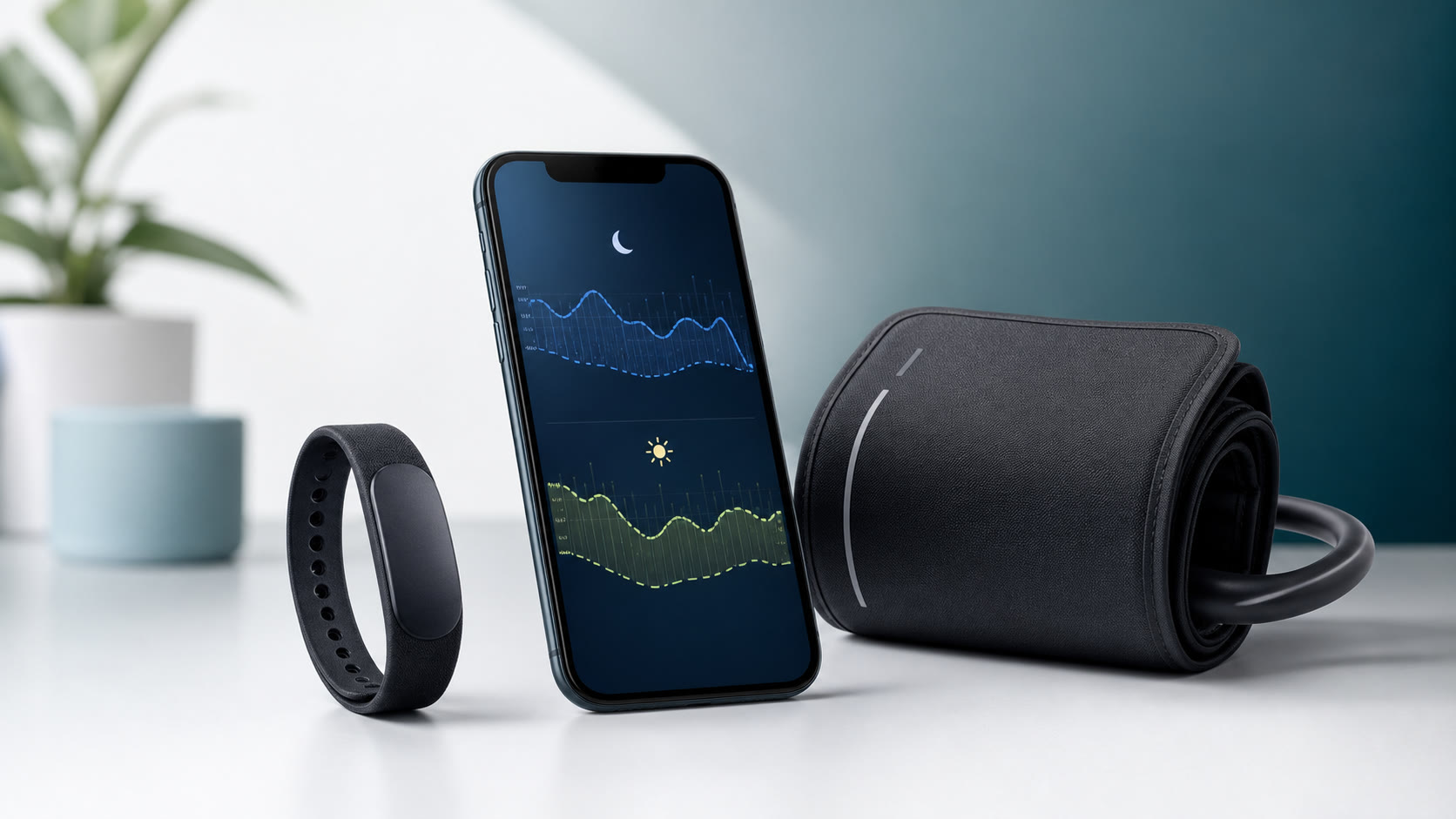
But the product requires unusually precise language. Hilo Core is not simply an FDA-cleared cuffless wristband that replaces a medical blood-pressure monitor. The U.S. package combines three layers: an optical wristband for long-term wellness trends, an FDA-cleared upper-arm cuff for reference measurements, and a subscription app that processes and organizes the data.
That distinction does not make the product uninteresting. It makes the product easier to understand honestly. Hilo Core may be valuable for adults who want a low-friction picture of longer-term patterns and who will still use the cuff as directed. It is not a substitute for diagnosis, treatment decisions, or clinical monitoring.
Hilo Core at a glance
- Product: Hilo Core blood-pressure health system
- Company: Hilo by Aktiia, Switzerland
- U.S. launch: July 21, 2026
- Hardware price: $89.99
- Required annual subscription: $149.99
- First-year total: $239.98
- Renewal: Company product page lists $149 per year after the included first year
- Included: optical wristband, upper-arm cuff, app membership, charger, reports, and software updates
- Band battery: up to 15 days
- Water resistance: IP68
- Compatibility: iOS 16 or later; Android 8 or later; Bluetooth 5.0+
- Availability: Hilo.com and Amazon
- HSA/FSA: company says the system is pre-approved as eligible
- HDAI hands-on status: not tested by HealthcareDiscovery.ai
What is Hilo Core?
Hilo Core is a connected blood-pressure system built around the technology previously known under the Aktiia name. It joins the broader landscape mapped in HealthcareDiscovery.ai’s complete guide to wearable health technology. It is designed to create a longer view of blood-pressure patterns than a person typically gets from occasional home-cuff readings or measurements during office visits.
The screenless wristband resembles a minimalist fitness tracker. It uses optical photoplethysmography, or PPG, to collect pulse-wave signals at the wrist. Hilo’s software uses those signals, together with periodic cuff-based reference measurements, to estimate blood-pressure patterns when the wearer is still and at rest.
The absence of a screen is intentional. Hilo is not designed around checking a number every few minutes. Data moves to the companion app, where users can review daytime and nighttime patterns, averages, heart rate, sleep duration, steps, notes, medication changes, and downloadable reports.
How the band, cuff, and app work together
Hilo describes the wristband as its wellness layer. The band collects optical signals in the background and attempts measurements multiple times throughout the day and night, primarily when its accelerometer determines that the wearer is still. It does not take a reading on a fixed schedule, and the number of successful readings can vary with activity and wear conditions.
The upper-arm cuff is the reference-measurement layer. Users take cuff readings during setup, repeat calibration approximately every 30 days, and can use the cuff whenever they want an on-demand measurement. Hilo’s U.S. materials explicitly distinguish exact cuff readings from the band’s longer-term trend information.
The app is the third essential component. Hilo says it can display individual data, daytime and nighttime averages, longer-term patterns, sleep and activity context, medication or lifestyle notes, and shareable PDF reports. Reports become available after at least seven days of data and may cover weekly, monthly, or six-month periods.
The system therefore does more than a basic cuff, but it also depends on more infrastructure: a compatible phone, Bluetooth, cloud processing, a recurring subscription, periodic calibration, and consistent wear.
What Hilo Core appears to do well
The strongest feature is friction reduction. Traditional ambulatory blood-pressure monitoring can provide valuable around-the-clock information, but inflatable cuff readings throughout the day and night can be uncomfortable and disruptive. A lightweight optical band can gather many more resting observations with less effort.
Nighttime visibility may be especially interesting. Blood pressure does not behave as a single fixed number, and nighttime patterns can carry information that office measurements miss. Hilo’s ability to gather readings during sleep could help users notice patterns worth discussing with a clinician—provided those patterns are treated as context, not self-diagnosis.
The product also makes the cuff part of the system instead of pretending calibration is optional. That is a practical strength. The included cuff provides a familiar reference point, can capture an exact on-demand reading, and remains usable for one-off measurements even if the subscription is canceled.
Finally, Hilo’s reports may make longitudinal data easier to bring into a medical conversation. The useful question is not whether a clinician wants hundreds of wrist readings; it is whether summarized patterns, cuff references, medication notes, and day/night changes help focus the visit.
Evidence and clinical validation
Hilo says the underlying technology has been evaluated across eight clinical studies and used by more than 200,000 people globally. Those figures come from the company and should not be mistaken for independent proof that every marketed outcome has been established.
There is peer-reviewed evidence behind the Aktiia optical approach. A 2021 study published in Scientific Reports evaluated 91 adults across four weeks and compared wrist-derived estimates with auscultatory reference measurements in several body positions. Mean differences were relatively small in several conditions, but precision varied by position. The authors concluded that persistent wearable monitoring was feasible while also stating that its prognostic value for cardiovascular events and target-organ damage required further longitudinal research.
That is a useful but bounded finding. It supports the plausibility and measurement performance of the underlying approach under the study protocol. It does not establish that consumers should use Hilo Core to diagnose hypertension, change medication, or replace validated cuff measurements and professional care.
Featured Partner
Invest in the Infrastructure Behind Modern Medicine
As healthcare expands beyond hospital walls, the buildings and campuses supporting that shift are generating compelling returns for investors who move early. The Healthcare Real Estate Fund offers qualified investors direct access to a curated portfolio of medical office, outpatient, and specialty care facilities.
Learn More →
The company’s 2026 launch announcement also cites a real-world analysis of more than 30,000 users in which more engaged users experienced larger systolic-blood-pressure reductions. This is an association reported by Hilo, not proof that the wearable caused the improvement. People who engage more with a health app may also differ in treatment adherence, lifestyle changes, motivation, or medical follow-up.
The FDA status needs a careful explanation
The regulatory story is more nuanced than the headline “FDA-cleared cuffless blood-pressure wearable.”
In July 2025, the FDA cleared Aktiia’s G0 Blood Pressure Monitoring System under 510(k) K250415. The clearance record describes a Class II noninvasive blood-pressure measurement system comprising a wrist-worn bracelet, oscillometric cuff, mobile app, and cloud backend. The stated indication is for spot-checking adult patients at home.
The Hilo Core now sold in the United States is positioned differently in its own current materials. Hilo calls Core a subscription-based wellness system, labels the wristband as the wellness layer, identifies the cuff as the FDA-cleared reference-measurement device, and states that Hilo Core itself is not cleared for diagnosis, treatment, clinical monitoring, or clinical decision-making.
The safest conclusion is straightforward: buyers should not interpret the FDA language as permission to replace a clinician-recommended cuff, ambulatory monitor, or treatment plan with wristband trends. The included cuff provides reference measurements; the band adds longitudinal wellness context.
It is also more accurate to say FDA-cleared, not FDA-approved. A 510(k) clearance is a substantial-equivalence pathway, not a blanket endorsement of every marketing claim or use.
Price, subscription, and the real ownership cost
Hilo Core launches at $89.99 for the hardware plus a mandatory $149.99 annual subscription, bringing the first-year total to $239.98. The company’s product page says the subscription renews at approximately $149 annually.
That pricing is reasonable relative to premium wearables, but it changes how the low hardware price should be interpreted. The subscription is not merely an optional analytics upgrade. Hilo says an active membership is required to use the band and access ongoing blood-pressure data.
If a user cancels, the company says there is a 30-day period of limited access showing only the most recent 24 hours. After that, new band measurements and insights stop. Historical data remains stored, the user keeps the hardware, and the upper-arm cuff can still take one-off readings.
The first-year cost is therefore not the main decision. The question is whether the longitudinal reports, app interpretation, and low-friction pattern collection remain worth roughly $150 every year.
Who Hilo Core is best for
Hilo Core may fit adults who:
- want more context than occasional cuff readings provide;
- are willing to wear a screenless band day and night;
- will complete setup and monthly cuff calibration;
- value summarized trends and clinician-shareable reports;
- understand the difference between wellness patterns and medical measurements;
- accept a required annual subscription.
It may be less compelling for someone who only needs occasional home measurements, wants a device with no recurring fee, dislikes cloud-dependent products, or expects a smartwatch replacement with notifications, workouts, and a display.
Hilo says the system may not be appropriate during pregnancy, for people with implanted electronic devices such as pacemakers or defibrillators, for damaged skin at the wear site, or for conditions that interfere with signals at the wrist or arm. Anyone uncertain about suitability should ask a healthcare professional.
How it compares with alternatives
The closest alternatives fall into three groups.
Validated upper-arm cuffs remain the simplest and least expensive path for many households. They provide intentional, point-in-time measurements and often work without subscriptions, but they do not automatically capture day/night patterns.
Ambulatory blood-pressure monitors remain the clinical reference for repeated measurements across a day and night in many diagnostic contexts. Their inflatable cuffs can be disruptive, and access often runs through a clinician. Clinical cuffless systems such as the Biobeat BB-613 occupy a different regulated-use category from Hilo Core’s U.S. wellness positioning.
Smartwatches and wellness wearables may provide cardiovascular context such as heart rate, sleep, activity, ECG, or notifications. Apple and Samsung continue to develop blood-pressure-related capabilities, but availability, calibration requirements, and U.S. regulatory status vary. Hilo’s differentiation is its dedicated blood-pressure pattern system rather than a multipurpose smartwatch.
Privacy and practical considerations
Hilo says data transmission is encrypted and data is stored securely in the cloud. The system can integrate with Apple Health and Android Health Connect. Those are useful baseline statements, but buyers handling longitudinal cardiovascular data should still review the current privacy policy, retention terms, account-deletion process, and any research or third-party data-sharing permissions during setup.
Practical details are otherwise strong: the band weighs about 0.6 ounces, carries an IP68 water-resistance rating, and offers up to 15 days of battery life with approximately 90-minute charging. Two strap sizes cover a stated wrist range of 5.2 to 10 inches, while the cuff fits upper arms from 8.7 to 16.5 inches.
Final verdict
Hilo Core is a thoughtful attempt to occupy the space between a traditional blood-pressure cuff and a consumer wellness wearable. Its potential value is not that it abolishes the cuff. It is that the cuff anchors a less intrusive stream of resting wrist measurements that can reveal longer-term patterns.
The product becomes less impressive when described carelessly as an FDA-approved continuous medical monitor. It becomes more credible when described accurately: a subscription wellness system with an optical trend band, an FDA-cleared reference cuff, and a growing clinical evidence base that still has meaningful limits.
For people who want longitudinal blood-pressure awareness and will use the system within those boundaries, Hilo Core deserves consideration. For diagnosis, medication decisions, or exact on-demand measurements, the cuff and the clinician remain central.
Frequently asked questions
Is Hilo Core FDA approved?
No. The relevant term is FDA-cleared, not approved. FDA 510(k) K250415 covers Aktiia’s G0 Blood Pressure Monitoring System. Hilo’s current U.S. materials position the Core wristband as a wellness trend layer and the included upper-arm cuff as the FDA-cleared reference-measurement layer.
Does the Hilo band replace an upper-arm cuff?
No. Hilo Core includes an upper-arm cuff for setup, approximately monthly calibration, and exact on-demand reference measurements. Wristband trends should not replace clinician-recommended measurements or care.
Does Hilo Core measure blood pressure continuously?
The band collects data in the background and attempts multiple readings during still, resting periods throughout the day and night. It does not measure on a fixed schedule, and Hilo primarily presents patterns and averages rather than treating every moment as a clinical reading.
How much does Hilo Core cost?
At the July 2026 U.S. launch, hardware costs $89.99 and the required annual subscription costs $149.99, for a first-year total of $239.98.
What happens if the subscription is canceled?
Hilo says band measurements and app insights eventually stop, although the user keeps the hardware and can continue using the included cuff for one-off readings.
Can Hilo data be shared with a doctor?
The app can generate downloadable reports containing trends, daytime and nighttime data, cuff references, heart rate, sleep, steps, and user notes. Whether a clinician uses those data for decision-making depends on the clinical context.
Is Hilo Core HSA/FSA eligible?
Hilo states that the U.S. system is pre-approved for HSA and FSA eligibility. Buyers should confirm eligibility with their own plan administrator when necessary.
Source map
- Hilo Core U.S. product page: https://us.hilo.com/products/hilo-core
- Hilo U.S. “How it works”: https://us.hilo.com/pages/how-it-works
- FDA 510(k) K250415: https://www.accessdata.fda.gov/cdrh_docs/pdf25/K250415.pdf
- Hilo U.S. launch announcement, July 21, 2026: https://www.prnewswire.com/news-releases/hilo-launches-the-worlds-first-blood-pressure-health-system-turning-snapshots-into-patterns-302829835.html
- Peer-reviewed Aktiia validation study: https://pmc.ncbi.nlm.nih.gov/articles/PMC8526831/
Last fact review: July 21, 2026


Similar Posts

ZRT Laboratory Hormone Kits: Saliva and Blood Spot Testing From a Pioneer in At-Home Diagnostics
Before the wave of consumer fertility monitors and direct-to-consumer testing startups, one Oregon laboratory was quietly building the scientific foundation for at-home hormone testing that practitioners would come to rely…

Creatine for Longevity: What 2026 Research Reveals About Muscle, Brain, and Healthy Aging
For decades creatine was framed as a supplement for lifters. In 2026, new research on cognition, mood, bone density, and sarcopenia is repositioning creatine as a foundational tool for healthy…

The Protein Threshold for Aging Muscle: Why Adults Over 40 Need More Than Government Guidelines Suggest
Twenty years of research from Stuart Phillips, Donald Layman, and the PROT-AGE consortium has produced one of the cleanest signals in nutrition science: adults over 40 need more protein than…

The 12-Hour Calm: What the 2025 Cold Water Immersion Evidence Really Says About Stress, Sleep, and Recovery
A 2025 PLOS One meta-analysis shows cold water immersion can cut stress for about 12 hours and aid sleep and recovery. Here is what the science says and how to…
ResMed AirSense 11 AutoSet CPAP: FDA-Cleared Sleep Apnea Treatment with Connected Monitoring
Untreated obstructive sleep apnea shortens life expectancy by an estimated 8 to 18 years. For the 80% of sufferers who remain undiagnosed, the most dangerous thing about their sleep is…

The Daily Rounds: Longevity & Health Care Brief | April 24, 2026
🧬 SuperAgers Grow Twice as Many New Neurons — Adults over 80 with 50-year-old-level memory generate up to 2.5 times more new neurons than peers, redefining what is biologically possible for the aging brain. 🤖 AI Drug Discovery Reaches Scale — Novo Nordisk joins OpenAI while NVIDIA commits $1 billion alongside Lilly, as 173-plus AI-discovered drug programs advance through clinical trials simultaneously. ⌚ Wearables Achieve Clinical-Grade Metabolic Prediction — The WEAR-ME study confirms consumer wearables predict insulin resistance with 80% accuracy, enabling population-scale metabolic screening without lab visits. 🌙 Circadian-Aligned Eating Extends Lifespan by 35% — A Science study shows that timing meals within the optimal circadian window delivers lifespan gains far beyond caloric restriction alone. 💪 Muscle Mass Is Metabolic Medicine — Every 10% gain in muscle mass reduces insulin resistance by 11%, with men who skip strength training 2.4 times more likely to develop metabolic disease.
