
Why the Breakthrough You Read About Never Became a Treatment
Every new medicine approved in the United States over a recent six year stretch traces back to publicly funded science. Most discoveries never travel that far, and the reason usually has nothing to do with whether the research was any good.
Presented By Our Partners



You remember the headline. A research team found a mechanism, reversed something in mice, published in a serious journal. Five years later there is no treatment, no trial you can join, and nothing your physician has heard of.
The intuitive explanation is that the finding was overhyped or quietly failed to replicate. Sometimes that is exactly what happened. But a great deal of the time the science held up perfectly well and the discovery died anyway, inside institutional machinery that almost nobody writes about and that has more influence over what reaches your medicine cabinet than any single laboratory result.
Every modern drug rests on public science
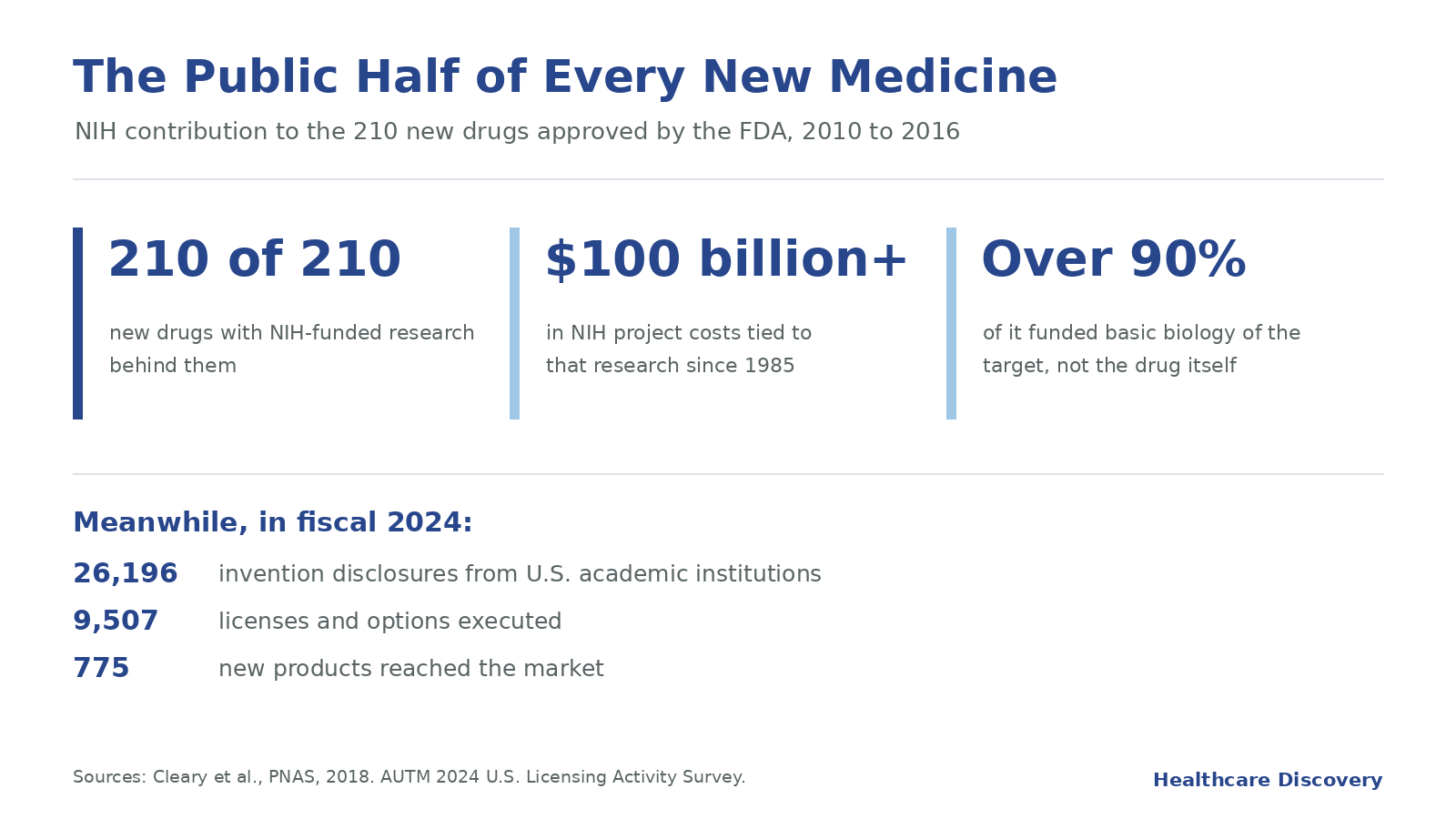
Start with a finding that reframes the whole conversation. Researchers at Bentley University examined all 210 new molecular entities approved by the Food and Drug Administration between 2010 and 2016, then traced the published research behind each one. Their analysis, published in the Proceedings of the National Academy of Sciences in 2018, identified more than two million relevant publications covering the drugs themselves and their 151 known biological targets.
Roughly 29 percent of those publications, more than 600,000 papers, were associated with projects funded by the National Institutes of Health. That support represented over 200,000 fiscal years of grant funding and more than $100 billion in project costs. Every single one of the 210 approvals had NIH-funded research somewhere in its lineage.
The detail that matters most is where that money went. More than 90 percent of it funded basic research into the biological target rather than the drug itself. Public money buys the understanding of the mechanism. Private capital builds the molecule that acts on it. The handoff between those two is where this story actually lives.
Where discoveries stall on the way to patients
Now look at the volume moving through that handoff. In fiscal 2024, American academic institutions spent $109.7 billion on research and reported 26,196 invention disclosures, the formal notices a scientist files when something looks potentially useful. Those disclosures produced 9,507 executed licenses and options, 7,968 issued patents, 941 new companies, and 775 products that actually reached the market.
Roughly one disclosure in thirty four becomes a product a person can use.
That attrition is not primarily a story about bad science. A disclosure has to clear a chain of custody, and a break anywhere in the chain ends it. Someone at a technology licensing office has to evaluate it, usually with a caseload measured in hundreds. The institution has to decide whether to spend real money on patent prosecution, often tens of thousands of dollars per family with no revenue in sight. A licensee has to be found who wants that specific asset. And somebody has to be willing to fund years of development against an uncertain endpoint.
A discovery can be entirely correct and still fail at any one of those gates. Nothing about the underlying biology changes when it does.
The seventeen year figure deserves a closer look
Anyone who spends time around translational medicine has heard that it takes seventeen years for research to reach clinical practice. It is the single most repeated statistic in the field.
Featured Partner
Invest in the Infrastructure Behind Modern Medicine
As healthcare expands beyond hospital walls, the buildings and campuses supporting that shift are generating compelling returns for investors who move early. The Healthcare Real Estate Fund offers qualified investors direct access to a curated portfolio of medical office, outpatient, and specialty care facilities.
Learn More →
It is worth knowing where it came from. The number traces to a 2011 review in the Journal of the Royal Society of Medicine by Zoe Slote Morris, Steven Wooding, and Jonathan Grant, who set out to survey the literature quantifying translational time lags. They found 23 papers, and their central conclusion was not that translation takes seventeen years. It was that the available studies measured different things, at different points, using different definitions, and were largely not comparable to one another. They judged the state of knowledge to be of limited practical use to the people responsible for research and development, and warned that it leaves investment decisions effectively blind.
In other words, medicine’s most cited translation statistic comes from a paper arguing that we do not actually know the number. That is not a reason to dismiss the delay, which is real and long. It is a reason to be careful with anyone who quotes a precise figure with confidence, in either direction.
What the system asks of the scientist
There is a human layer underneath the institutional one. When a university licenses an invention, the income is split, and the inventor’s share is smaller than most people assume.
Stanford, after recovering its licensing office costs and unreimbursed legal expenses, allocates 33.34 percent of patent income to the inventor, with the remainder divided among department, school, and the research office. The University of Connecticut uses a comparable one third share. Two institutions have moved in the other direction recently. Yale restructured in 2022 so that 100 percent of net income from new technologies is distributed to inventors and their academic units, raising the top tier inventor share to 30 percent and adding fixed allocations to the originating laboratory and department. Arizona State revised its policy in 2023 to give inventors between 40 and 50 percent of net royalties on a scale that rises with the number of listed inventors.
The direction of travel is worth noticing. Institutions competing for faculty who want to translate their work are raising the inventor’s cut, which suggests the constraint is not money in the abstract. It is scientists willing to spend three to five years on commercialization instead of on the next grant cycle, in a career system that rewards publication far more reliably than it rewards products.
How much these shares actually change behavior is genuinely unsettled. The strongest natural experiment comes from Norway, which in 2003 shifted ownership of academic inventions from researchers to universities, with one third of net income returned to inventors. Economists Hans Hvide and Benjamin Jones found that startup formation and patenting by Norwegian academics fell by roughly half afterward. That was a change in who holds title, though, not simply a change in percentage, and it does not settle how sensitive American researchers are to their royalty share specifically.
What This Means for You
The practical value here is in how you read the next breakthrough headline. Three questions separate research that might reach you from research that almost certainly will not, at least not soon.
Has it been tested in humans, or only in cells and animals? The overwhelming majority of promising animal results do not survive contact with human physiology, and this single question filters out most of what makes headlines.
Is there a company or a licensee attached to it? An invention with no commercial owner has no one funding its next step. This is public information for anything at the trial stage and it tells you whether the chain of custody is intact.
What phase is it in, and when did it start? A compound entering Phase I is a decade from your pharmacy under good conditions. One in Phase III is a genuinely different proposition.
There is a broader point underneath the practical one. While translation grinds through this machinery on a timescale measured in decades, the interventions with the strongest evidence behind them are the ones already sitting in front of you, requiring no patent, no licensee, and no approval. Nutrition, sleep, movement, breath, and mindset are not a consolation prize for people waiting on biotechnology. They remain the best characterized tools available against the four chronic disease threats that determine most healthspan outcomes, and their evidence base does not depend on anyone deciding to file a patent.
Frequently Asked Questions
How long does it take for medical research to reach patients?
The commonly cited figure is seventeen years, but the review that produced it concluded the underlying estimates were inconsistent and not comparable. Long delays are well documented. A single reliable number is not.
Do most scientific discoveries become treatments?
No. In fiscal 2024, American academic institutions filed 26,196 invention disclosures and 775 new products reached the market, roughly one in thirty four. Most attrition happens for institutional and commercial reasons rather than scientific ones.
Who pays for the basic research behind new drugs?
Largely the public. NIH-funded research was associated with every one of the 210 new drugs approved by the FDA between 2010 and 2016, representing more than $100 billion in project costs, over 90 percent of it directed at basic target biology rather than the drugs themselves.
What is an invention disclosure?
A formal notice a researcher files with their institution when a discovery may have commercial application. It is the first administrative step in commercialization and the point at which most discoveries enter, and later leave, the pipeline.
What does a technology transfer office do?
It evaluates disclosures, decides which inventions to patent, markets them to potential licensees, and negotiates licensing agreements. It is the gatekeeper between a laboratory result and any company that might develop it.
Why do universities patent research the public already paid for?
The Bayh-Dole Act of 1980 allows nonprofit institutions and small businesses to retain title to inventions arising from federally funded research. The rationale was that exclusive rights give companies enough incentive to fund the expensive development stages. Whether it delivers on that promise is actively debated.
Should I ignore early stage research entirely?
No, but calibrate it. Early findings are how you learn where a field is heading. They are a poor basis for changing what you do this year, particularly when interventions with mature evidence are already available to you.
For the capital allocation view of this same funnel, including what the fight over federal indirect cost rates settled, see the companion analysis at Healthcare Venture Capital Fund. For a look at what happens when academic scientists move into privately funded research instead, read our feature on George Church and the supercentenarian genome project.


Similar Posts
GLP-1 Drugs and the Brain: Why the Biggest Alzheimer’s Trial Failed but the Science Is Far From Over
The EVOKE and EVOKE+ trials of oral semaglutide in 3,808 Alzheimer’s patients failed their primary endpoints, but stunning biomarker data, positive liraglutide brain volume results, and consistent real-world evidence from…

Study Reveals the Three Waves of Aging: When Your Body Shifts Gears at 44, 50, and 60
Two landmark studies reveal that human aging is not gradual. Your body undergoes three distinct molecular upheavals around ages 44, 50, and 60, with blood vessels leading the decline. Here…
FDA AI in Urology: The Smaller Surgical Side of Medical AI
FDA AI in urology is still early, with the current FDA list showing a smaller Gastroenterology-Urology category shaped by endoscopy, surgical robotics, and procedural vision.

Your Brain Ages Faster When You Sleep Poorly: What 27,000 Brain Scans Reveal About Deep Sleep and Cognitive Longevity
A landmark study of 27,500 brain scans from the UK Biobank reveals that poor sleep accelerates brain aging by up to a full year, with systemic inflammation as the mediating…

Genetic Mosaicism: Why No Two Cells in Your Body Are Identical
Genetic mosaicism is the condition of having different DNA in different cells of the same body. Every adult has it. A clear guide to mosaicism, chimerism, microchimerism, and the surprising…
Longevity’s Reprogramming Moment: AI Drugs, Cellular Epigenetics, and Gut Microbiome Science Converge
Three landmark breakthroughs in longevity reprogramming research 2026 are reshaping what science knows about human aging. An AI-designed drug proves itself in clinical trials, the first human epigenetic reprogramming trial…
