
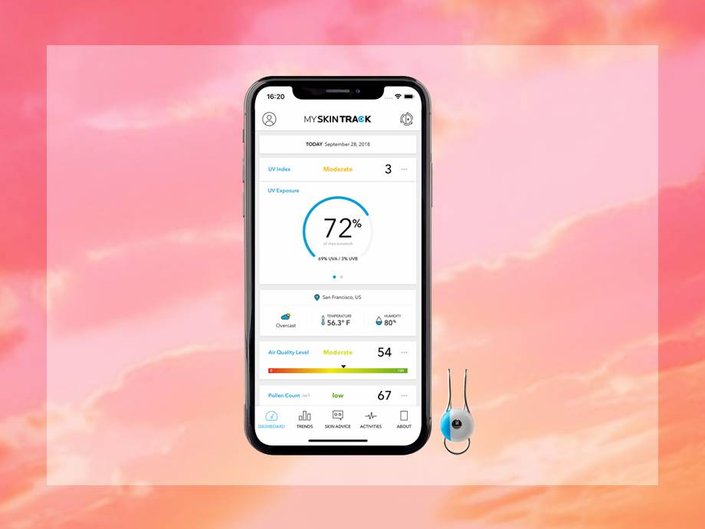
La Roche-Posay My Skin Track UV Review: What It Did, What to Use Now
A battery-free sensor once promised to show you how much sun you actually absorbed. It now looks hard to find, but the problem it tried to solve still matters, because people who share the same sun can take in very different doses.
Presented By Our Partners



In March 2016, a small group of volunteers in Rio de Janeiro spent a morning in and around a swimming pool with tiny UV sensors stuck to their fingernails. Same sky, same pool, same four hours. By noon, their readings varied roughly tenfold from one person to the next (Science Translational Medicine, 2018).
The test was sponsored by La Roche-Posay, the brand behind My Skin Track UV, the battery-free UV sensor L’Oreal launched under its La Roche-Posay skincare label in the United States in November 2018. As of October 2026, it appears discontinued or hard to find: we found no current US retail listing. So this review covers what it did, what the science says, and what to use instead.
La Roche-Posay My Skin Track UV is a wearable ultraviolet dosimeter: a tiny sensor that adds up the UV light that reaches it, with a smartphone app that reads the total and pairs it with local environmental information. It has no battery and nothing to charge. You tap your phone to it and it reports. That tenfold spread among swimmers sharing one pool is the strongest argument for this kind of device. Whether you can still buy one is another matter.
The short answer: La Roche-Posay My Skin Track UV was a clever, battery-free UV sensor from L’Oreal, launched in 2018. As of October 2026 it appears discontinued or very hard to find: we found no current US listing. The science behind personal UV tracking is sound, but no trial shows the device itself prevented sunburn or skin cancer. Sunscreen, shade and clothing still do the protecting.
- Best for: readers who already own one and want to know what its numbers mean, and anyone curious about how personal UV dosimetry works.
- Not for: anyone shopping for a sensor they can buy and rely on today, or anyone hoping a gadget will screen for skin cancer.
- Price (October 2026): no current US retail listing found; we could not confirm a launch or current price, and only apparent secondhand marketplace pages surfaced.
- Regulatory status: not FDA regulated as a medical device; sold as a consumer skincare and wellness product, and we found no FDA clearance.
- Evidence: Limited; the sensor design passed small field tests sponsored by L’Oreal, but no study shows the product changed behavior or reduced skin cancer.
What is La Roche-Posay My Skin Track UV, and is it still sold?
La Roche-Posay My Skin Track UV is a battery-free wearable UV sensor that L’Oreal launched in the United States in November 2018, sold through Apple at launch and later rolled out to other markets, including the UK. As of October 2026, we found no current US retail listing, so treat it as discontinued or hard to find.
The launch made headlines for an unusual pairing: a beauty company selling an electronic wearable in Apple stores. L’Oreal billed it as the first battery-free wearable for sun safety. Its app tracked UV exposure alongside pollution, pollen and humidity, which made it as much a skincare companion as a health tool. Earlier in 2018, the same brand had unveiled a sibling device, the La Roche-Posay UV Sense, a battery-free sensor designed to sit on a thumbnail.
Here is what we could and could not confirm. The coverage we found dates to the 2018 launch and the international rollout that followed. Our searches turned up no current product page, no 2025 or 2026 retail listing, and no current price, only what appeared to be secondhand marketplace pages. We also found no discontinuation announcement from L’Oreal, so “discontinued” is our inference, not the company’s word. We could not confirm whether the companion app still works on current phones, which matters: a battery-free sensor without its app is a sticker.
The brand’s digital work did continue. La Roche-Posay later introduced a follow-on product called My Skin Track pH, which suggests the company shifted its sensor effort to other measurements rather than abandoning the category.
How does My Skin Track UV work without a battery?
In the battery-free design that L’Oreal scientists helped publish, the sensor works like a rain gauge for sunlight. A light detector turns incoming UV into a tiny electric current that charges a storage component, and the charge builds with every minute of exposure. When you tap your phone to the sensor, the phone’s near-field communication (NFC) signal powers it for an instant, reads the stored charge, and converts it into a dose.
We found no published teardown of the retail device, but the engineering of this battery-free approach is laid out in a 2018 Science Translational Medicine paper by Northwestern University engineers and scientists from L’Oreal’s Tech Incubator, including Guive Balooch, with field tests sponsored by La Roche-Posay. Their design uses a photodiode tuned to a slice of the UV spectrum, a supercapacitor wired alongside it, a small chip with NFC built in, and an antenna. Light falling on the photodiode produces a current proportional to its intensity. That current trickles into the supercapacitor, so the voltage that builds up reflects the total dose, not just a snapshot. A phone tap reads the voltage, a calibration factor converts it to energy per square centimeter, and a reset empties the reservoir for the next measurement.
This design has a quiet advantage over most battery-powered UV meters. Those devices sample intensity at intervals and estimate the gaps, which can miss quick changes as you move between sun and shade or in and out of water. The accumulation design never stops collecting: every photon that reaches the detector adds to the total. The research prototypes were tiny. The single-band UVA version measured 8.0 mm across, 1.1 mm thick, and weighed 51.2 milligrams. In one durability test, ten encapsulated sensors survived 35 minutes in a washing machine at 40 degrees C and still worked.
Why measure UV this carefully? Because sunburn is a radiation dose, and the two UV bands that reach your skin do different damage. UVB, from 280 to 315 nanometers, is the burning band; the paper’s authors note that it is about 1,000 times more effective at reddening skin than UVA, even though the ozone layer leaves roughly 100 times less UVB than UVA at ground level. UVA, from 315 to 400 nanometers, is the more plentiful band, and it carries on working long after you have gone inside.
That last point is the unsettling part of the physiology. The signature DNA lesion of sun damage, the cyclobutane pyrimidine dimer, forms when two neighboring DNA letters fuse after absorbing a UV photon, and it usually forms within picoseconds. But in a 2015 Science study, Yale researchers found that in pigment cells exposed to UVA in the lab, these lesions kept forming for more than three hours after the light was switched off. Energy from damaged fragments of the pigment melanin was transferred to DNA in the dark. These “dark” lesions made up the majority of the total. Your skin keeps paying for a beach afternoon well into the evening, which is why reducing the dose beats reacting to a burn.
The app layered other information on top of the UV reading: pollution, pollen and humidity. The published sensor design measures light and temperature, not air quality. Those environmental figures most likely came from local data rather than the sensor itself, but we could not confirm that.
How accurate is personal UV dosimetry? What the research shows
In company-sponsored field tests, this battery-free sensor design tracked a commercial research dosimeter closely in most conditions and less well at steep sun angles. Separate studies show that people badly misjudge their own sun exposure. No study we found shows that wearing My Skin Track UV reduced sunburn or skin cancer.
The field tests. In the Rio rooftop trial, nine volunteers wore the sensor on a thumbnail or fingernail while a commercial dosimeter sat on the same-side wrist, from 9 a.m. to 4 p.m. The two agreed closely, with a linear fit of 0.94 where 1.0 would be perfect agreement. In a second test in St. Petersburg, Florida, 13 volunteers wore four skin-mounted sensors each while walking a 4-mile square route in the morning, afternoon and evening. Agreement with the reference device was good in the morning (0.80) and evening (0.88) but weaker in the afternoon (0.67). The authors traced this to the high midday sun striking the flat sensor at a steep angle, where the reference device’s light diffuser captured light more efficiently. Four sensors failed during the afternoon walk. In Rio, 14 of 20 nail-mounted sensors stayed firmly attached over four days.
Who ran these tests matters. The Rio study was approved by L’Oreal’s internal ethics committee and sponsored by La Roche-Posay and L’Oreal’s California research center, and several authors were L’Oreal employees. That is normal for device development and does not make the results wrong. It does mean that independent validation of the commercial product, as opposed to the research platform, is missing. A 2021 review in the International Journal of Biometeorology found 13 wearable UV sensors on the market for personal or research use, ranging from electronic to photochromic, with large differences in price, data, accuracy and precision.
Featured Partner
Invest in the Infrastructure Behind Modern Medicine
As healthcare expands beyond hospital walls, the buildings and campuses supporting that shift are generating compelling returns for investors who move early. The Healthcare Real Estate Fund offers qualified investors direct access to a curated portfolio of medical office, outpatient, and specialty care facilities.
Learn More →
Why measurement matters: people forget their sun. The case for a dosimeter rests on a well-documented failure of memory. In a 2019 PLOS ONE study from Northwestern, 39 melanoma survivors wore a UV sensor on the chest while outdoors for 10 consecutive summer days and reported their time outdoors each evening. Across 269 analyzed days, they under-reported their sun exposure on 51 percent of days. Under-reporting was most common for outings that began between noon and 1 p.m., near the peak of UV intensity, and second most common between 5 and 6 p.m. These were people with every reason to be careful, and they still could not reliably recall when the sun had reached them.
Does feedback change behavior? This is the question that decides whether any UV sensor is worth wearing, and the evidence is thin. The best direct test we found is a 2022 randomized trial in Brazil that gave 59 healthy volunteers one of three apps for three days: a basic UV index app, an app with personalized advice and overexposure alerts, or that app plus a Bluetooth wearable. Skin redness, measured with a reflectance instrument, rose by an average of 55.8 units in the basic group, 40.3 with personalized alerts, and 37.1 with alerts plus the wearable, without lowering vitamin D (Photochemical and Photobiological Sciences, 2022). That is encouraging. It was also three days long and small, it tested a different product built around real-time overexposure alerts, and its authors included employees of the app’s developer and of BASF’s personal care business.
The honest summary: the battery-free sensor measures what it claims, with caveats about angle and placement. The need for objective measurement is real. Whether a scan-to-read sensor like My Skin Track UV changes what people do in the sun has not been tested. Our explainer on what “clinically validated” actually means explains why “it measures accurately” and “it improves health” are different claims.
What My Skin Track UV got right
My Skin Track UV got the core problem right: UV dose is personal, invisible and badly remembered, so measuring it at the body beats guessing from a weather forecast. Its battery-free design, sealed against water in the published research version, also removed the charging and maintenance that make most wearables end up in a drawer.
It measured dose, not forecast. A UV index tells you how strong the sun is where you are. A dosimeter tells you how much reached you. The tenfold spread among swimmers sharing one Rio pool is the clearest illustration of why that difference matters. Two people under the same forecast can take in very different doses depending on shade, clothing, water and time outside.
It never needed charging. The researchers note that limited battery life, recharging, and vulnerability to heat and water typically lead people to abandon wearables. A sensor powered by the light it measures and read by a phone tap removes all of that. For a device meant to go to the beach and the pool, that was the right trade.
It counted continuously. Because the reservoir fills nonstop, quick moves in and out of shade or water are captured rather than missed between samples, a real advantage over interval-sampling meters during active outdoor exercise.
It came from serious science. Few beauty gadgets arrive with a peer-reviewed engineering paper describing their sensing principle, calibration and failure modes. This one did, and the paper is candid about its limits.
Where My Skin Track UV falls short
The biggest problem with My Skin Track UV in 2026 is that you probably cannot buy it, and its app support is uncertain. Beyond availability, a battery-free sensor cannot warn you in real time, a single sensor cannot represent your whole body, and no study shows it reduced sunburn or skin cancer.
Availability and app risk. A connected device lives or dies by its software. We found no current listing and could not confirm that the app still supports today’s phones. If you find a secondhand unit, assume it may not work until you have confirmed the app installs and reads it.
No real-time warning. A battery-free NFC sensor reports only when you tap your phone to it. It cannot buzz at 12:15 to tell you that you have had enough. Given that people under-report exactly those midday outings, a sensor you have to remember to check has an obvious gap. The 2022 trial that did show less redness used real-time alerts, which this design cannot provide.
One spot is not your whole body. The paper’s authors are explicit: the sensor measures exposure at one small spot, while sunlight across the body is uneven and shifts through the day. Citing earlier work, they note that a person standing outdoors receives the most UV on the top of the head, with the shoulders getting 81 percent and the nose 27 percent of ambient radiation. A sensor shaded by your sleeve, your bag strap, or your own body tells you about that spot, not your shoulders.
Angle sensitivity. The Florida tests showed weaker agreement when the sun was high and struck the sensor at a steep angle. Midday is when UV peaks, so this weakness falls at an awkward time.
No outcome evidence. We found no published study showing that My Skin Track UV users burned less, protected themselves more, or developed fewer skin cancers. The marketing promise, sun safety, was never tested as a health outcome.
A cosmetics company’s advice. The app was built by a skincare company, and its recommendations naturally sat alongside its own products. That is not a scandal, but it is a reason to treat the advice as guidance rather than medicine.
My Skin Track UV vs La Roche-Posay UV Sense vs the UV index vs color-changing UV indicators
My Skin Track UV and UV Sense are battery-free sensors that measure personal dose at one spot, read by a phone tap. A UV index forecast is free and always available but describes the sun, not you. Photochromic indicators change color with exposure and give a rough visual cue. Today, the forecast plus consistent protection is the practical default. For the thumbnail sensor specifically, our La Roche-Posay UV Sense review covers its nail-mounted field tests and why one fingernail cannot stand in for your whole body.
| Feature | La Roche-Posay My Skin Track UV | La Roche-Posay UV Sense | UV index forecast (weather app or National Weather Service) | Photochromic UV indicator |
|---|---|---|---|---|
| What it tells you | Cumulative UV dose at the sensor | Cumulative UV dose at the thumbnail | Expected sun intensity for your area | Rough exposure, shown by a color change |
| Measures your personal dose | Yes, at one spot | Yes, at one spot | No | Roughly |
| Power | None; read by phone NFC tap | None; read by phone NFC tap | Not applicable | None; chemical reaction |
| Real-time warning | No; you must scan | No; you must scan | Forecast in advance | Visible at a glance |
| Availability (October 2026) | No current US listing found | Not confirmed; check before buying | Free and widely available | Varies by product |
| Evidence | Small company-sponsored field tests of the sensor design | Same battery-free approach; nail-worn research prototypes tested in Rio | Standard public forecast; does not track you | Wide variation in accuracy across sensors |
The La Roche-Posay UV Sense is the obvious sibling: the same battery-free approach in a thumbnail-mounted form, and the Rio field test included nail-worn sensors. Check current availability before you plan around it, because we could not confirm it either. The UV index is the free, dependable baseline. The National Weather Service publishes UV index information, and many weather apps show the daily forecast. Use it to plan the day, not to measure it. If the environmental side of My Skin Track UV was what appealed to you, a dedicated air monitor such as the IQAir AirVisual Pro or Awair Element measures air quality directly rather than borrowing local data. And if body heat during outdoor training is your concern, a sensor like the CORE body temperature sensor tracks a different summer risk. Browse more in our skin, temperature and environmental device reviews.
How much does My Skin Track UV cost, and is it covered or HSA/FSA eligible?
As of October 2026, there is no current US retail price because we found no current retail listing. We could not confirm the original launch price either. Secondhand units may turn up on marketplaces, but their price, condition and app compatibility are unknown.
Insurance generally does not cover consumer UV sensors, and we found nothing indicating My Skin Track UV was HSA or FSA eligible. It was sold as a skincare and wellness product, not a medical device. If you are buying secondhand, the real cost question is risk: confirm the companion app installs and reads the sensor on your phone before you pay. Otherwise you may be buying an attractive piece of plastic.
The protection that actually lowers risk is inexpensive. A daily broad-spectrum sunscreen, a hat, sun-protective clothing and a habit of finding shade at midday cost little and are backed by much stronger evidence than any sensor, as the next sections show.
Who should use My Skin Track UV, and who should skip it?
If you already own a working My Skin Track UV, it can still be a useful teaching tool for learning how your daily habits translate into UV dose. If you are shopping, skip the hunt: plan with the UV index, protect consistently, and see a dermatologist for skin checks if you are at higher risk.
Reasonable candidates:
- Current owners whose sensor and app still work, especially to learn which routines (a lunchtime walk, weekend sports, a commute) carry the most dose.
- Outdoor exercisers who want to see how shade, timing and clothing change their exposure, and who will act on the numbers.
- Researchers and educators demonstrating how dose differs from forecast.
Better served by something else:
- New buyers: no current listing means no warranty, support or guarantee the app works.
- Anyone who wants an alert before overexposure: a scan-to-read sensor cannot warn you in the moment.
- People with a history of skin cancer, many moles, or a changing spot: no sensor replaces a skin examination, and the Healthcare Discovery doctor directory lists dermatologists by state.
- Anyone hoping for a diagnosis: UV sensors measure light, not skin.
What this means for you
Skin cancer is the Rogue Hijacker’s most visible work and among its most preventable. Ultraviolet light fuses DNA letters together in skin cells; most of those lesions are repaired, a few become mutations, and over decades some of those mutations become cancer. The numbers are large. A 2015 JAMA Dermatology analysis estimated 5,434,193 nonmelanoma skin cancers in the United States in 2012, in 3,315,554 people, and the Melanoma Research Alliance reports that more than 112,000 Americans are estimated to be diagnosed with invasive melanoma in 2026. Our pillar on the Four Villains of Health and Longevity places cancer alongside the other threats to a long healthspan.
The good news is that dose control works, and the best evidence for it is a trial, not a gadget. In Nambour, Australia, 1,621 adults were randomly assigned in 1992 to daily or discretionary sunscreen on the head and arms until 1996. By 2006, the daily group had 11 new primary melanomas and the discretionary group 22, a hazard ratio of 0.50, a result just short of conventional statistical significance (P = .051). Invasive melanomas fell more clearly, 3 versus 11 (Journal of Clinical Oncology, 2011). The same trial found that daily sunscreen users showed no detectable increase in skin aging over 4.5 years, with 24 percent less aging than the discretionary group (Annals of Internal Medicine, 2013). Burns matter at every age: a 2008 meta-analysis of 51 study populations found that melanoma risk rose with the number of sunburns in childhood, adolescence and adulthood alike. And artificial UV counts: a 2014 meta-analysis of 31 studies found that people who had ever used tanning beds had 16 percent higher odds of melanoma, rising to 34 percent with more than 10 sessions.
Through the Five Pillars, sun safety lives mostly in Movement and Mindset. Movement, because outdoor exercise is one of the best things you can do for every villain on the list, and it is also where most adults collect their UV. Do not trade one for the other: train early or late, choose shaded routes, and dress for the sun. Mindset, because the Northwestern study showed that memory fails exactly when the sun is strongest, so rely on habits rather than recall. Nutrition has a cautionary footnote: in the Nambour trial, beta-carotene supplements had no overall effect on skin aging. No pill replaces shade.
My Skin Track UV was built to turn an invisible dose into a number. That goal still makes sense, even if the device has faded from shelves. The Rio swimmers who shared one pool and took home tenfold different doses are the lesson to keep. Your exposure is personal, and your protection should be too. Check the forecast, cover up when it is high, and let a dermatologist look at what the sun has already written.
Frequently asked questions
Is La Roche-Posay My Skin Track UV still available?
As of October 2026, we could not find a current US retail listing for La Roche-Posay My Skin Track UV. The coverage we found dates to its November 2018 US launch and its later rollout to other markets, and the only listings that surfaced appeared to be secondhand. L’Oreal has not announced a discontinuation in anything we found, so treat it as discontinued or hard to find, and confirm the companion app still works before buying a used unit.
Is My Skin Track UV worth it?
For new buyers, probably not, because it appears discontinued and its app support is uncertain. The idea behind it is sound: people misjudge their own sun exposure, and a personal dosimeter measures what actually reached the sensor. But no study shows the device reduced sunburn or skin cancer. If you already own a working one, it is a useful way to learn which daily habits carry the most UV.
How does My Skin Track UV work without a battery?
In the battery-free design its maker’s scientists published, a light detector turns incoming UV into a tiny current that charges a storage component, so the charge builds like water in a rain gauge as exposure accumulates. When you tap an NFC-enabled phone to the sensor, the phone powers it briefly, reads the stored charge, and converts it into a UV dose. Because it needs no battery, there is nothing to charge, but it also cannot send real-time alerts.
My Skin Track UV vs La Roche-Posay UV Sense: which is better?
Both use the same battery-free approach and are read by tapping a phone. UV Sense was designed to sit on a thumbnail, while My Skin Track UV was a separate small wearable whose app also showed pollution, pollen and humidity. Neither sends real-time alerts, and we could not confirm current availability for either as of October 2026. Check that the app still works before choosing either one.
Can a UV sensor prevent skin cancer?
Not on its own. A UV sensor measures exposure; it does not block UV or examine your skin. Prevention comes from reducing dose: in a randomized Australian trial, daily sunscreen use was linked to fewer invasive melanomas over about 14 years. A sensor can help if it changes your habits, but that has not been shown for this device. Anyone with a new or changing spot should see a dermatologist.
What can I use instead of My Skin Track UV?
Start with the free UV index forecast from the National Weather Service or a weather app, and plan outdoor time, shade and clothing around it. La Roche-Posay UV Sense uses the same battery-free sensing approach, but check that you can actually buy it. Color-changing photochromic UV indicators give a rough visual cue. For lowering risk, consistent sunscreen, hats, sun-protective clothing and midday shade matter far more than any sensor.
Sources
- Heo SY, et al. Wireless, battery-free, flexible, miniaturized dosimeters monitor exposure to solar radiation and to light for phototherapy. Science Translational Medicine, 2018. DOI
- Premi S, et al. Chemiexcitation of melanin derivatives induces DNA photoproducts long after UV exposure. Science, 2015. DOI
- Henning A, Downs NJ, Vanos JK. Wearable ultraviolet radiation sensors for research and personal use. International Journal of Biometeorology, 2021. DOI
- Alshurafa N, et al. Assessing recall of personal sun exposure by integrating UV dosimeter and self-reported data with a network flow framework. PLOS ONE, 2019. DOI
- Young AR, et al. Innovative digital solution supporting sun protection and vitamin D synthesis by using satellite-based monitoring of solar radiation. Photochemical and Photobiological Sciences, 2022. DOI
- Rogers HW, et al. Incidence estimate of nonmelanoma skin cancer (keratinocyte carcinomas) in the U.S. population, 2012. JAMA Dermatology, 2015. DOI
- Green AC, et al. Reduced melanoma after regular sunscreen use: randomized trial follow-up. Journal of Clinical Oncology, 2011. DOI
- Hughes MCB, et al. Sunscreen and prevention of skin aging: a randomized trial. Annals of Internal Medicine, 2013. DOI
- Dennis LK, et al. Sunburns and risk of cutaneous melanoma: does age matter? A comprehensive meta-analysis. Annals of Epidemiology, 2008. DOI
- Colantonio S, Bracken MB, Beecker J. The association of indoor tanning and melanoma in adults: systematic review and meta-analysis. Journal of the American Academy of Dermatology, 2014. DOI
- L’Oreal. L’Oreal launches La Roche-Posay My Skin Track UV, the first battery-free wearable for sun safety (company announcement), November 2018. L’Oreal Finance
- L’Oreal. L’Oreal advances its commitment to promoting sun safety with La Roche-Posay UV Sense (company announcement), January 2018. L’Oreal Finance
- Melanoma Research Alliance. Over 112,000 Americans estimated to be diagnosed with invasive melanoma in 2026. Melanoma Research Alliance
- National Weather Service. UV index. weather.gov
La Roche-Posay My Skin Track UV at a glance
- Subscription
- None required
- Form factor
- Wearable UV dosimeter (clip-on)
- FDA status
- Wellness device, no clearance
- HSA/FSA
- Not confirmed
Measures Humidity, Pollen levels, Pollution, UV exposure
Pricing verified October 20, 2026. Maintained in the Healthcare Discovery device database and updated automatically.


Similar Posts

The Four Villains of Health and Longevity
Four diseases will kill almost everyone you love. They are not random. They are not inevitable. And they are coming. The framework, science, and tools for the fight ahead.

Vivoo Urine Wellness Test: AI-Powered Daily Metabolic Tracking
How daily urine biomarkers reveal the invisible accelerators of aging—oxidative stress, metabolic drift, and nutritional gaps—that blood tests miss. Presented By Our Partners The Silent Accelerator: Why Oxidative Stress Matters…

The Art of Not Aging: New Science Reveals That Museums, Music, and Reading Slow Your Biological Clock as Powerfully as Exercise
A landmark UCL study of 3,556 adults finds that regular arts engagement, such as reading, music, museum visits, and theater, slows biological aging by 4%, an effect size identical to…

The Nobel Ensemble: Inside the Lab Trying to End Disease
Five Nobel laureates are quietly orbiting Isomorphic Labs, the Alphabet-backed company trying to use artificial intelligence to end the world’s deadliest diseases. What they are building would have been science…

The Daily Rounds: Longevity & Health Care Brief | June 5, 2026
🤖 Daraxonrasib Nearly Doubles Pancreatic Cancer Survival — A pivotal Phase 3 NEJM trial showed the first RAS inhibitor extending median survival from 6.7 to 13.2 months, cutting death risk by 60% in a cancer with historically grim odds. 🦠 Colon Cancer Immunotherapy Achieves 33-Month Remission — NEOPRISM-CRC showed pre-surgery pembrolizumab kept 59% of MMR-deficient patients cancer-free at nearly three years, with zero recurrences among responders. 🔬 4-Week Diet Shift Reduces Biological Age Markers in Older Adults — A low-fat, plant-forward diet reduced biological age estimates across 20 biomarkers in adults aged 65 to 75 after just four weeks. 🥗 GLP-1 Drugs Trigger Nutritional Deficiencies Within 12 Months — Major health organizations now recommend structured dietary monitoring for all GLP-1 patients to prevent protein, vitamin D, and mineral deficits that may offset weight-loss benefits. 😴 Circadian Amplitude Is the New Sleep Treatment Target — Updated guidelines shift focus from sleep duration alone to strengthening biological clock signal strength through light exposure, meal timing, and new pharmacological tools.
The Daily Rounds: Longevity & Health Care Brief | March 31, 2026
🧠 - Heidelberg scientists have identified a protein pairing that acts as a molecular "death switch" in Alzheimer's disease, and a new compound can break it apart, protecting neurons even as it reduces amyloid. 🧬 - The first-ever human trial of partial epigenetic reprogramming is now enrolling, with Life Biosciences testing ER-100 in patients with retinal degeneration in a trial that could redefine what it means to treat aging at the cellular level. 💊 - GLP-1 receptor agonists do not cause disproportionate muscle loss, and new data shows they actually increase mitochondrial proteins in skeletal muscle, suggesting metabolic benefits that go well beyond weight reduction. 🦠 - Gut bacteria are actively injecting proteins into human intestinal cells via molecular syringes, and this mechanism appears more prevalent in people with Crohn's disease, pointing to a new pathway for understanding and treating chronic gut inflammation. ⌚ - ARPA-H's new Delphi program is funding wearable biosensors that can continuously track cytokines and hormones in real time, a potential leap from tracking symptoms to detecting the earliest biological signals of disease and aging.
