
Your Blood Can Map the Biological Age of Every Organ in Your Body. Here Is What Stanford’s Landmark Study Found.
A Stanford University study of 44,498 people and 2,916 blood proteins has produced one of the most precise maps of biological aging ever constructed, and it reveals that two organs determine whether you live long and well: your brain and your immune system.
Presented By Our Partners



Your birth certificate records one number for your age. Your biology tells a different story entirely. The heart of a 55-year-old endurance runner may behave like a 40-year-old organ. The brain of a sedentary smoker at 50 may carry the biological burden of someone two decades older. Until recently, separating these trajectories organ by organ required invasive procedures or expensive imaging that most people never receive. A landmark study from Stanford University, published in Nature Medicine, has changed that calculus permanently.
By analyzing the levels of 2,916 proteins circulating in the blood of 44,498 participants in the UK Biobank, a team led by Stanford neurobiologist Tony Wyss-Coray and colleagues has built biological aging clocks for 11 distinct organs and tissues. The results, validated across up to 17 years of follow-up, answer one of longevity medicine’s most pressing questions: which organs age fast, and which ones determine whether you reach old age healthy or not at all.
How the Science Works: Reading Organ Age from a Blood Draw
Every organ in the body secretes proteins into the bloodstream as it functions. Some of these proteins are produced at predictably higher or lower levels as tissues age. By identifying which proteins cluster around specific organ systems, the Wyss-Coray lab and collaborators trained machine learning models to estimate how biologically “old” each organ appears based on its protein signature alone.
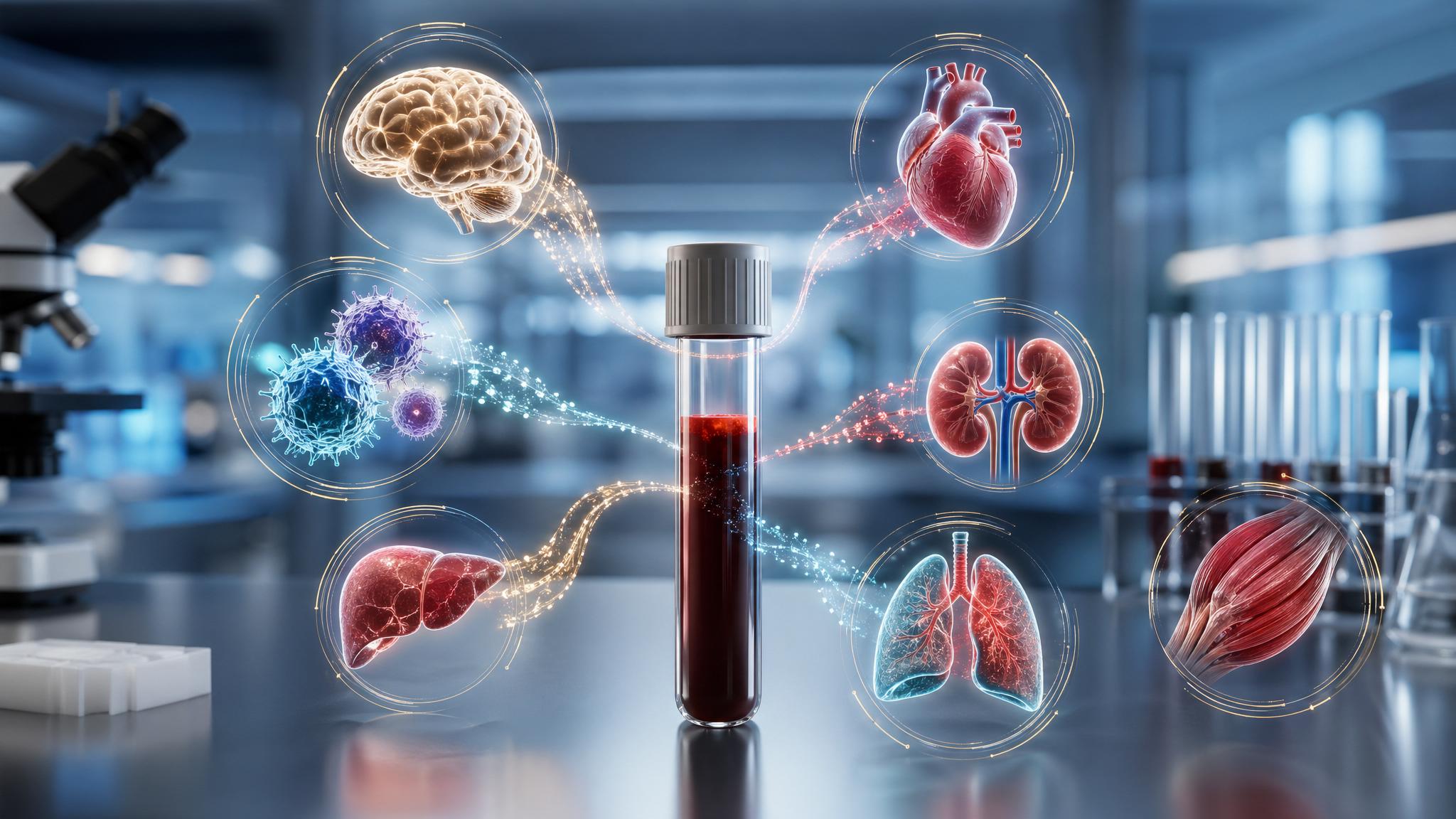
The organs mapped in this study include the brain, immune system, heart, liver, kidney, lung, intestine, muscle, fat, pancreas, and vasculature. For each organ, the researchers identified a set of proteins that serve as biological age indicators. A person could have a chronological age of 60 but a brain protein profile consistent with someone who is 45, or one that looks more like 75. That gap, the difference between chronological age and biological organ age, turns out to predict disease onset and death with striking precision.
The scale of the data makes these findings unusually robust. Most longevity studies struggle to recruit more than a few thousand participants. The Stanford team worked with nearly 45,000 individuals, tracked over nearly two decades, and validated findings against independent cohorts. This is not a pilot study. It is one of the largest and most carefully designed investigations into biological aging ever published.
The Organ That Matters Most for Survival: Your Brain
The single most consequential finding from this study is deceptively simple: a biologically young brain is your most powerful longevity asset. A biologically old one may be your greatest risk.
Having an especially aged brain in the analysis carried a hazard ratio of 3.1 for developing Alzheimer’s disease, making it statistically comparable to carrying a single copy of APOE4, currently the strongest known genetic risk factor for sporadic Alzheimer’s. That comparison is striking because APOE4 status is fixed at birth. Brain biological age, the study suggests, is not.
The protective side of the finding is equally compelling. Individuals with a youthful brain biological age carried a hazard ratio of just 0.26 for Alzheimer’s disease, a level of protection similar to carrying two copies of APOE2, the variant associated with dramatically reduced Alzheimer’s risk. Critically, this protective effect held independent of APOE genotype. In other words, people without the genetic advantage of APOE2 could still achieve similar protection through maintaining a biologically younger brain, pointing directly to lifestyle and modifiable factors as the lever.
Mortality risk followed a similar gradient. A youthful brain was associated with a hazard ratio of 0.60 for all-cause mortality, meaning individuals with biologically young brains had roughly 40 percent lower mortality risk during the study period. This single organ contributed more to longevity outcomes than any other system examined.
The Immune System: The Second Pillar of Longevity
If the brain takes top ranking in brain-specific outcomes, the immune system runs a close parallel in the broader longevity picture. A youthful immune system biological age was associated with a hazard ratio of 0.58 for mortality, nearly identical in magnitude to a youthful brain.
The real power emerged when the two were combined. Individuals who maintained both a biologically young brain and a biologically young immune system achieved a hazard ratio of just 0.44 for mortality, meaning they were 56 percent less likely to die during the study’s follow-up period compared to those with aged profiles in both systems. This synergy between neural and immune aging is one of the study’s most clinically significant insights, suggesting that longevity interventions targeting both systems simultaneously may have multiplicative rather than additive effects.
The immune-aging connection aligns with a growing body of literature on inflammaging, the slow, chronic elevation of inflammatory markers that accompanies immune system aging. As immune cells become less efficient and more inflammatory in their baseline state, they send damaging signals throughout the body and brain. The Stanford study adds large-scale epidemiological confirmation to a mechanism researchers have suspected for years.
Featured Partner
Invest in the Infrastructure Behind Modern Medicine
As healthcare expands beyond hospital walls, the buildings and campuses supporting that shift are generating compelling returns for investors who move early. The Healthcare Real Estate Fund offers qualified investors direct access to a curated portfolio of medical office, outpatient, and specialty care facilities.
Learn More →
The Compounding Math of Organ Aging: Why Small Gaps Add Up Fast
One of the study’s most striking findings involves what happens when multiple organs age faster than their chronological counterparts. The relationship is not linear. It compounds.
Individuals with two to four biologically aged organs carried a hazard ratio of 2.3 for mortality compared to those with none. Five to seven aged organs pushed that number to 4.5. Individuals with eight or more biologically aged organs carried a hazard ratio of 8.3, meaning they were more than eight times as likely to die during the study period. This compounding effect underscores a core principle that longevity medicine is increasingly built around: the goal is not to fix one thing. The goal is to maintain the coordination and relative youth of the entire biological system.
The study also showed that organ age estimates predicted disease onset with organ-specific precision. Heart biological age was associated with future heart failure at a hazard ratio of 1.83. Kidney biological age predicted type 2 diabetes onset (HR = 1.58). Lung biological age predicted chronic obstructive pulmonary disease (HR = 1.39). Brain biological age predicted Alzheimer’s disease (HR = 1.81 per the organ-specific clock model). These are not correlations found after the disease had already appeared. They are prospective predictions, made from protein data taken years before diagnosis.
Lifestyle Is the Variable: What Moves the Needle on Organ Age
The most actionable dimension of this research is that organ biological age is not a fixed destiny. The Stanford team specifically examined which lifestyle factors and medical interventions were associated with younger or older organ profiles, and the findings map closely onto practices that evidence-based medicine has recommended for decades.
Smoking emerged as one of the strongest accelerants of biological organ aging, particularly for the brain and pancreas. Regular physical exercise, by contrast, was associated with younger biological organ profiles across multiple systems. Hormone replacement therapy in postmenopausal women was associated with younger organ ages in certain tissue-specific analyses. Even supplement use registered as a modifying factor in some organ age profiles, though the mechanisms and specific compounds were not fully characterized in this study.
These findings land in the same territory as earlier work from the Wyss-Coray lab. In 2023, the group published “Organ aging signatures in the plasma proteome track health and disease” in Nature, establishing the conceptual framework for reading organ-specific aging from blood proteins. The 2025 Nature Medicine publication expands that work dramatically in scale, adds prospective disease outcomes, and delivers the clearest evidence yet that modifiable behaviors are among the strongest determinants of which organs age fast and which stay young.
What the Convergence of Organ Clock Research Tells Us
The Stanford study is not alone in this territory. A parallel investigation, also published in Nature Aging, used plasma proteomics in a UK Biobank sample of 43,616 individuals, with additional validation in cohorts from China (n = 3,977) and the United States (n = 800), to build organ-specific aging clocks with cross-cohort accuracy correlations above 0.93. That study’s findings reinforced the same core message: accelerated organ aging predicts disease onset and mortality beyond what clinical risk factors and genetic data alone can explain, and unhealthy behaviors are associated with accelerated aging, especially in the brain and pancreas, while greater adherence to a healthy lifestyle is linked to slower aging in organs such as the brain and intestine.
Together, these studies represent a methodological shift in how aging can be measured. For decades, the primary tools for assessing biological age were blunt: chronological age itself, a few blood biomarkers, or population-level risk scores. The emergence of high-throughput proteomics platforms capable of measuring thousands of proteins simultaneously, combined with large biobank cohorts, has created something qualitatively new: a biological age readout at organ-level resolution that is sensitive to what you do, what you eat, whether you exercise, and whether you smoke.
This matters for medicine because it creates a potential feedback loop. If a clinician can tell a 52-year-old that their brain protein profile looks 63, and that this gap is associated with sharply higher Alzheimer’s risk, and that exercise and metabolic health interventions measurably reduce that gap, then the abstract conversation about “taking care of yourself” becomes a concrete, measurable, trackable intervention. That shift from abstract to measurable is where behavior change research consistently shows the greatest gains.
The Road to a Clinical Organ Age Blood Test
The natural question after reading this research is whether a blood test measuring organ biological age will become standard medical practice. The answer is: it is moving in that direction, but with important caveats.
The platforms used in the UK Biobank research, including SomaScan and the Olink proteomics panel, measure thousands of proteins simultaneously and remain expensive for routine clinical deployment. A single comprehensive proteomics panel may cost several hundred to over a thousand dollars per sample, depending on the platform and the number of proteins measured. This is not yet compatible with routine primary care at scale.
However, the science is accelerating on two tracks simultaneously. The first track is cost reduction. High-throughput proteomics platforms are undergoing the same cost curve that transformed genomic sequencing from a billion-dollar enterprise to a consumer product in two decades. Several companies, including SomaLogic and Olink Proteomics (now part of Thermo Fisher Scientific), are actively developing more targeted, cost-effective panels that capture the most clinically predictive proteins rather than the entire detectable proteome.
The second track is algorithmic refinement. As more cohorts are added to the training data for organ age models, and as more disease outcomes are linked to specific protein profiles, the predictive precision of these clocks continues to improve. Researchers at Stanford and collaborating institutions are already working on identifying which specific proteins in the brain aging signature are most actionable, and whether pharmacological or lifestyle interventions can demonstrably shift those proteins in a younger direction.
For the consumer-facing longevity market, this research provides a scientific anchor for biological age testing products that have proliferated in recent years. Companies offering epigenetic clock tests, metabolomic age assessments, and multi-omics aging panels now have stronger scientific footing for their core value proposition: that a single blood draw can reveal information about your health trajectory that a standard physical exam cannot.
What This Means for You
The Stanford organ biological age study is, at its core, a scientific validation of what Healthcare Discovery’s foundational framework has argued from the beginning: that the four fundamentals of nutrition, movement, sleep, and breath are not wellness abstractions. They are the primary inputs that determine whether your organs age faster or slower than the clock on your wall.
Smoking accelerates brain and pancreatic aging according to the data. Regular exercise is associated with younger biological organ profiles across multiple tissues. These are not marginal effects. They are effects large enough to match or exceed the impact of carrying one of the most powerful genetic risk factors for Alzheimer’s disease.
For the five pillars that underpin everything at Healthcare Discovery: nutrition and metabolic health directly govern the pancreatic and liver organ age profiles identified in this research. Sleep is the mechanism through which the brain clears the proteins associated with neurodegenerative disease, including the amyloid and tau proteins that the brain aging clock’s protein signature partly reflects. Movement and exercise appear across multiple organs as the single most consistent lifestyle factor associated with younger biological age. Breathwork and stress regulation modulate the chronic inflammatory activation that drives immune system aging. Mindset, purpose, and social connection are increasingly linked to neuroinflammatory and neuroendocrine pathways that feed directly into the brain aging trajectory.
If you want to know where to invest your health attention, the Stanford research offers a precise answer: keep your brain young and keep your immune system young. The biology of how to do that is not mysterious. It maps almost exactly onto what the evidence-based longevity literature has been building toward for the past two decades. Move consistently. Sleep deeply. Eat in ways that stabilize blood sugar and reduce systemic inflammation. Manage stress through practices that activate the vagus nerve and lower cortisol. Stay connected to people and purpose.
What the Stanford organ clock research adds to this picture is not a new prescription. It is a new kind of precision: a way to measure, years before symptoms arrive, whether what you are doing is actually working at the organ level. That kind of biological feedback loop may be one of the most powerful tools medicine has ever produced for motivating and sustaining the behaviors that determine how long, and how well, you live.
Primary Source: Oh, H.S., Le Guen, Y., Rappoport, N., et al. (2025). Plasma proteomics links brain and immune system aging with healthspan and longevity. Nature Medicine. doi:10.1038/s41591-025-03798-1
Related Study: Organ-specific proteomic aging clocks predict disease and longevity across diverse populations. Nature Aging. doi:10.1038/s43587-025-01016-8
Earlier Framework Study: Wyss-Coray Lab / Stanford University. (2023). Organ aging signatures in the plasma proteome track health and disease. Nature. doi:10.1038/s41586-023-06802-1


Similar Posts

GI-MAP: The Functional Medicine Gold Standard for Comprehensive Stool Analysis
What quantitative PCR technology reveals about gut pathogens, digestive function, and immune markers that consumer microbiome tests cannot detect Presented By Our Partners In clinical gastroenterology, the gap between consumer…

Peri: First Wearable Device Purpose-Built for Perimenopause Symptom Tracking
A palm-sized adhesive sensor worn on the upper abdomen that continuously tracks hot flashes, night sweats, anxiety, sleep patterns, menstrual cycles, and activity levels to give women objective biometric data…

Your Cells Have a Mechanical Age, and AI Can Now Read It to Predict Breast Cancer Risk
A UC Berkeley and City of Hope team published a landmark AI platform called MechanoAge in Lancet’s eBioMedicine that measures the physical stress-response of individual breast cells to identify cancer…

From Prediction to Navigation: The AI Shift Healthcare Has Been Waiting For
Clinical AI has spent years predicting risk. The next test is harder: whether AI can help patients and clinicians choose the right next action and complete the path to care.

When AI Finds the Signal, Medicine Still Has to Finish the Job
The next serious test for healthcare AI is not whether it can notice something humans might miss. It is whether the health system can turn that notice into completed care.

The Zombie Cell Resistance: Why Senolytic Drugs Keep Failing, and the 2026 Mitochondrial Discovery That Could Change That
A landmark 2026 Nature Aging study reveals why senescent cells resist the drugs designed to kill them: the toughest zombie cells keep their mitochondria pristine. Inside the senolytics reckoning, the…
