The Mosaic Body: How Your Cells Are Quietly Mutating, and Why It’s Rewriting Medicine
A new picture of the human body is emerging from the world’s genome sequencers, and it is not the one most of us were taught. We are not single, settled creatures. We are mosaics, quietly evolving from the inside out, every day of our lives.
Presented By Our Partners


The man was sixty-four when his doctors finally found the answer.
For years, he had moved through the medical system like a ghost. Recurrent fevers no one could explain. Painful inflammation of the cartilage in his ears. Skin eruptions that came and went without pattern. A stubborn anemia that ground him down. Rheumatologists, hematologists, dermatologists. Each specialty had a partial story; none had the whole one. He carried the kind of file that makes physicians sigh and reach for the next page.
In 2020, a multidisciplinary team at the National Institutes of Health, led by the clinical geneticist David Beck, took a different approach. Rather than chase symptoms, they sequenced the DNA of 2,560 adults with unexplained inflammation. Three of them, all older men, shared a single mutation in a gene called UBA1, on the X chromosome, in a particular set of cells in their bone marrow. The team named what they had found VEXAS syndrome, and published the discovery in The New England Journal of Medicine.
The strangest part was not that they had identified a new disease. It was where the mutation lived.
The man had not been born with it. His parents had not passed it down. He could not pass it to his children. The mutation existed only in some of his blood-forming stem cells, acquired sometime during his life, in a single cell, which had then divided and divided until its mutated descendants colonized a meaningful fraction of his bone marrow. Those rogue cells were now driving the inflammation that was slowly killing him.
For practical purposes, he had two genomes. So, it turns out, do you.
The body we thought we had
For most of the modern era, medicine has operated on a simple, useful, and slightly false assumption. Each of us, the story went, is built from a single set of genetic instructions. You inherit a genome at conception, half from each parent, and that genome is faithfully copied into every cell in your body. The skin on your hand and the neuron in your hippocampus and the muscle in your heart all carry the same DNA, the same recipe, executed differently in different tissues. Disease is what happens when the recipe is wrong from the start, or when the environment grinds the body down over time.
It is the picture you absorbed in high school biology. It is the picture much of clinical medicine still relies on. And it is roughly the picture our diagnostic categories were built to fit.
It is also incomplete in ways that matter.
Your body is composed of something on the order of thirty trillion cells. Every time one of those cells divides, it must copy roughly three billion base pairs of DNA. The copying machinery is astonishingly accurate, but it is not perfect. Errors creep in. Environmental insults, ultraviolet light, tobacco smoke, the byproducts of normal metabolism, all leave their fingerprints on the genome. The cumulative result, scientists now estimate, is that your body acquires trillions of new mutations every day. Most are inert. Some are quietly useful. A small minority will, over decades, change the trajectory of your health.
“You are a slightly different genetic version of yourself today from yesterday, and will be different yet again tomorrow,” the science journalist Roxanne Khamsi writes in Beyond Inheritance, her recent book on this emerging picture of biology. The line lands like a small earthquake. Read it twice and you start to feel the ground shift.
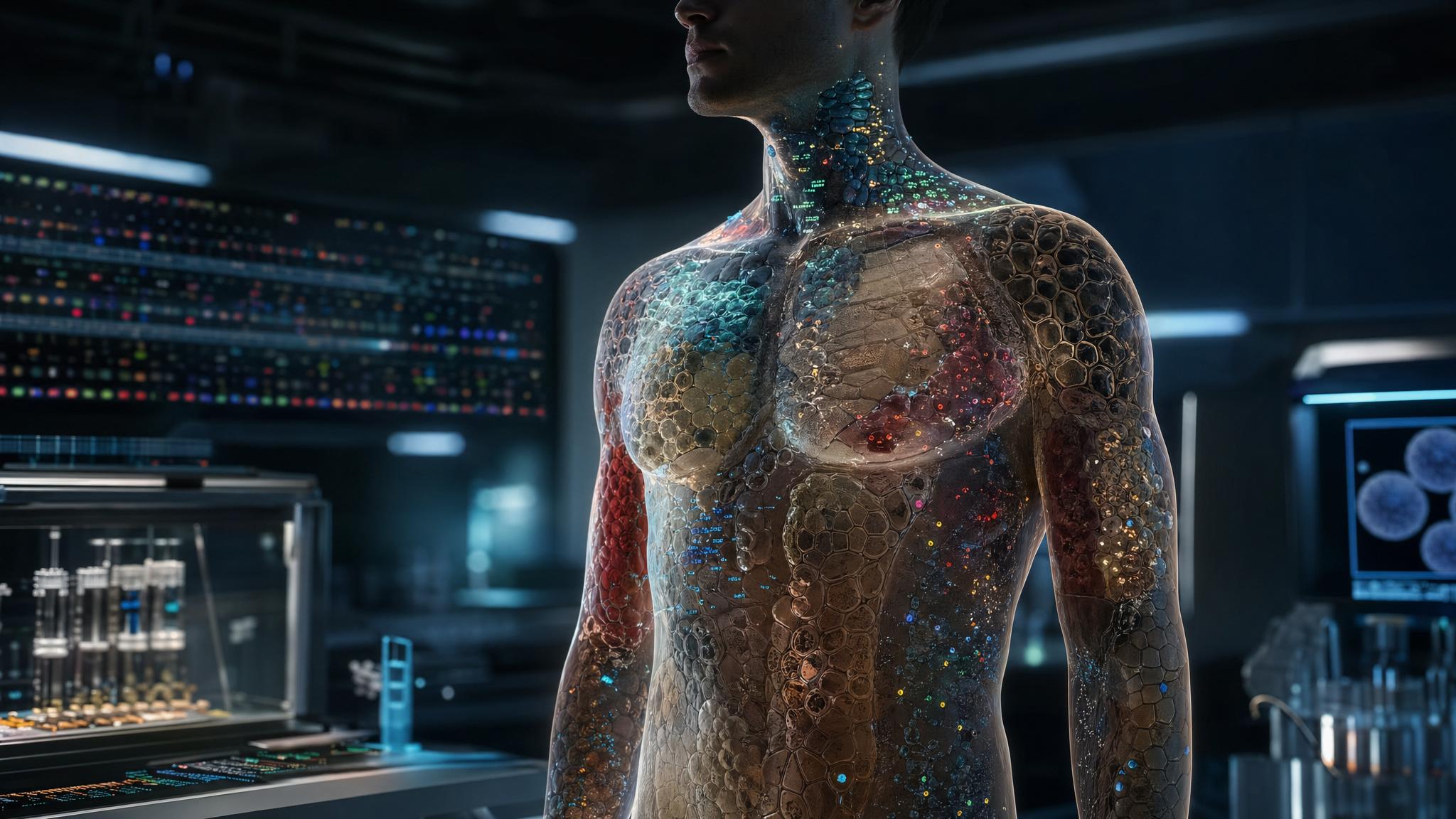
Call it the Mosaic Body. It is not a metaphor. It is the literal architecture revealed by the last decade of single-cell sequencing, and it is in the process of rewriting our understanding of cancer, autoimmunity, aging, and the limits of inheritance itself.
An old idea, freshly visible
The intuition is older than DNA. In 1881, the German embryologist Wilhelm Roux published a curious little book called Der Kampf der Theile im Organismus, “The Struggle of Parts in the Organism,” in which he proposed that Darwinian competition did not stop at the boundary of a single body. Inside us, Roux argued, cells and tissues themselves were locked in a quieter form of natural selection. Strong cells outgrew weak ones. Resources flowed to whichever populations could best hold them. The body, in this view, was less a single organism than a federation, perpetually negotiating its own coherence.
Roux’s idea charmed a generation, then faded. With the rediscovery of Mendelian genetics around 1900, biology fixed its gaze on the gene as a stable, heritable unit, and the within-body evolution Roux had described slipped to the margins. For most of the twentieth century, the genome was treated as an architectural blueprint: drawn up at conception, occasionally copied with errors, but fundamentally fixed.
Three things have brought Roux’s intuition back, with vastly more evidence behind it.
The first is single-cell sequencing, which over the last fifteen years has made it possible to read the genome of individual cells rather than the smudged average of a tissue. The second is duplex and single-molecule sequencing, technologies such as the Wellcome Sanger Institute’s NanoSeq, which can detect a mutation present in only a few cells in a thousand. (NanoSeq, in its current form, has an error rate of fewer than five errors per billion base pairs, which is roughly the difference between catching one typo in a single book and catching one in a small library.) The third is sheer scale. In July 2025, a consortium of laboratories announced the Somatic Mosaicism across Human Tissues Network, a project to build a reference catalogue of acquired mutations across nineteen tissue sites in 150 healthy donors. For the first time, we will have a baseline for what a normal mosaic body actually looks like.
The picture coming back from those instruments is consistent and a little disorienting. Healthy tissues are not genetically uniform. They are patchworks. By middle age, the lining of your esophagus is dotted with clones of cells carrying mutations in genes you would normally associate with cancer, including NOTCH1 and TP53, and most of those clones never become tumors. Your blood is colonized by small populations of stem cells carrying acquired mutations in genes such as DNMT3A and TET2. Your skin keeps a running ledger of every sunny afternoon you ever had. Your liver carries the chemical signatures of every drink. None of this is disease, exactly. It is biography.
“We are all mosaics,” the cardiologist and writer Eric Topol observed recently, summing up a long conversation with Khamsi about her book. The phrasing is plain. The implication is not.
Featured Partner
Invest in the Infrastructure Behind Modern Medicine
As healthcare expands beyond hospital walls, the buildings and campuses supporting that shift are generating compelling returns for investors who move early. The Healthcare Real Estate Fund offers qualified investors direct access to a curated portfolio of medical office, outpatient, and specialty care facilities.
Learn More →
How a single cell takes over
To see what makes the Mosaic Body important rather than merely interesting, it helps to understand how a single mutated cell can come to dominate a tissue, and what that domination does to a person.
Most somatic mutations are passive. They sit in a cell, do nothing useful or harmful, and disappear when the cell dies. A small fraction confer what biologists call a fitness advantage. The mutated cell divides slightly faster than its neighbors, or resists the signals that normally tell a cell to stop dividing, or evades the immune patrols that scrub the body of misbehaving cells. Over years, these tiny advantages compound. The mutated cell’s descendants slowly outnumber the unmutated ones. Biologists call this clonal expansion, and it is now understood to be one of the most fundamental processes in human biology.
In some tissues, clonal expansion is a step on the road to cancer. In others, it produces what physicians are beginning to call clonal disorders, conditions caused by a population of mutated cells without ever crossing the threshold into a tumor.
The clearest example, and the one likely to enter mainstream medicine soonest, is clonal hematopoiesis of indeterminate potential, known by the acronym CHIP. By age seventy, somewhere between ten and twenty percent of people carry detectable populations of blood stem cells with acquired mutations in genes such as DNMT3A, TET2, or JAK2. For most, this is asymptomatic. But large epidemiological studies have now shown that people with CHIP have roughly twice the risk of cardiovascular disease compared to age-matched peers without it, and the elevated risk is independent of cholesterol, blood pressure, and the other classical metrics. The mutated immune cells appear to drive low-grade inflammation that accelerates atherosclerosis. A blood test that quietly measures the aging of your immune system, in other words, may turn out to be one of the most useful cardiovascular risk markers we have. A deeper look at CHIP is forthcoming in this cluster.
VEXAS syndrome, with which we began, is the same idea in a different tissue. A single bone marrow stem cell acquires a mutation in UBA1. Its descendants outcompete the rest. The result is not cancer but a punishing inflammatory disease that disguises itself as a half-dozen other conditions. Recent prevalence estimates suggest VEXAS may affect about one in 4,000 men over fifty, which is to say it is not rare; it has simply been hiding.
The most consequential extension of this logic, however, arrived in April 2026, when researchers at the Wellcome Sanger Institute and Cambridge University used NanoSeq to look inside the immune cells of patients with autoimmune thyroid disease. What they found was published in Nature and may, in time, mark a paradigm shift in how we understand autoimmunity itself.
The autoimmune paradigm cracks open
Autoimmune diseases, the umbrella under which conditions like Hashimoto’s thyroiditis, Graves’ disease, lupus, type 1 diabetes, and rheumatoid arthritis sit, have always carried a certain mystery. They are common. They tend to cluster in families. They affect women more than men. And they involve the body’s own immune system attacking healthy tissue, as if the security forces had decided to torch the city they were sworn to protect.
The standard explanation has been a mixture of genetic predisposition and environmental trigger. Some people, by virtue of their inherited HLA genes and other factors, are more vulnerable. An infection, a hormonal shift, a period of stress, then tips them across the line. The model has been useful but imprecise. It struggles to explain why one identical twin develops Hashimoto’s and the other does not, or why most people with the genetic risk variants never develop the disease at all.
The Sanger team sequenced the immune cells of patients with thyroid autoimmunity at unprecedented depth. They found that the rogue B cells driving the disease were carrying acquired somatic mutations in genes that act as brakes on the immune system. The mutations had not been inherited. They had emerged during the patient’s life, in single B cells, and their mutated descendants had clonally expanded into a population large enough to attack the thyroid. A deeper look at this study and its implications is forthcoming.
If the finding holds up, and other autoimmune diseases turn out to follow the same pattern, we will need a new mental model. Hashimoto’s may not be a disease you are born predisposed to so much as a disease your immune system mutates its way into. The clinical implications are significant. Treatments that broadly suppress the immune system, the current standard of care, leave patients vulnerable to infection. Treatments that specifically eliminate the mutated rogue clones, similar in principle to how oncologists now target the molecular drivers of certain cancers, would be more precise and far less debilitating.
This is what it looks like when the Mosaic Body view of biology starts to redraw the map of disease. Conditions that seemed to belong to entirely separate medical specialties (cardiology, hematology, rheumatology, oncology) begin to share a deeper structure. They are all, in part, stories about cellular evolution.
The mutations that save us
The most surprising chapter in Beyond Inheritance, and one of the most important contributions of the new mosaic biology, is that not all of these mutations are bad. Some, in fact, save lives.
Consider the children with severe combined immunodeficiency, the rare condition once called “bubble-boy disease,” in which a genetic defect leaves the immune system so crippled that ordinary infections become lethal. Most affected children require bone marrow transplants or experimental gene therapy. But every so often, clinicians have observed something extraordinary. A patient’s immune system spontaneously begins to recover. Sequencing reveals what happened. Somewhere in the bone marrow, a single immune cell acquired a second mutation that compensated for the original defect. That cell’s descendants then outcompeted the broken ones, and the child was, in effect, cured by their own internal evolution.
The same logic appears in tyrosinemia, a metabolic disorder in which a missing enzyme causes a toxic protein byproduct to accumulate in the liver. Without intervention, infants die. But in some patients, microscopic patches of liver cells acquire compensating mutations and gradually expand, repopulating the organ with healthier tissue. Researchers are now studying these spontaneous repairs in the hope of mimicking them therapeutically.
The same machinery that produces cancer also produces, in immune cells, the diversity of antibodies that protects you from infection. The process, called somatic hypermutation, deliberately introduces mutations into the DNA of B cells so they can generate new variants, some of which will bind a previously unseen pathogen with exquisite precision. Without this controlled, internal mutagenesis, vaccines would not work. Neither would your defense against the next respiratory virus.
The lesson Khamsi draws, and the one we are determined to carry through this cluster, is that the Mosaic Body is not a horror story. It is a more honest portrait of how living things actually work. We are constantly evolving inside our own skin. Some of that evolution kills us slowly. Some of it saves us. Most of it does nothing at all. The job of the next era of medicine is to learn to read the patterns and intervene where it matters.
Aging as mosaic
The newest, and in some ways most consequential, extension of this thinking is in the science of aging.
For decades, the dominant theories of aging have treated the body as a single decaying system, ticking down toward failure as cellular damage accumulates. The hallmarks of aging frameworks (telomere attrition, mitochondrial dysfunction, cellular senescence, and the rest) are typically applied to the body as a whole. But a 2010 paper by the Emory neurologist Lary Walker introduced a different idea, one that has now begun to gather serious experimental support. Walker called it mosaic aging: the observation that organs and tissues do not age in lockstep. Your heart and your liver and your brain are running on subtly different clocks, and the pace at which each ages is shaped by its own particular pattern of accumulated mutations, environmental exposures, and clonal dynamics.
In April 2026, the evolutionary biologists Pol Burraco and Jelle Boonekamp published a preprint extending the mosaic-aging framework into a unified theory of why we die. Their argument: in the vast majority of natural deaths, a single critical organ fails first, and that organ is whichever one had been aging fastest. The implication is striking. If we want to extend healthspan, we may not need to slow aging across the body uniformly. We may need to identify and shore up each individual’s weakest tile. A full piece on the Burraco-Boonekamp framework is forthcoming.
This dovetails with one of the most provocative findings in modern aging science. In 2022, a Sanger-led team sequenced the colonic crypts of sixteen mammalian species, from mice to giraffes to naked mole rats, and discovered that somatic mutation rate scales inversely with lifespan with remarkable consistency. The animals that live longest are the ones whose cells mutate slowest. Whatever mechanisms restrain the mosaic accumulation of damage in long-lived species look, increasingly, like a central engine of longevity.
If that is true, the goal of longevity medicine begins to shift. The question is no longer only how to repair aging tissue, but how to slow the rate at which the mosaic itself fragments.
What this means for your health
The Mosaic Body view does not overturn what we already know about how to live well. It deepens it.
The major drivers of harmful somatic mutation are familiar. Tobacco smoke. Excess ultraviolet exposure. Chronic inflammation. Oxidative stress. Disrupted sleep, which compromises DNA repair. Metabolic dysfunction, which spikes the production of damaging reactive oxygen species. Each of these pushes mutation rates up. Each accelerates the clonal expansion of cells you would rather not have expanding.
The five foundational practices we have long argued for, what we call the Five Pillars of healthspan, look different through this lens. Whole-food nutrition stabilizes the metabolic milieu in which your cells are dividing. Sleep gives your DNA repair machinery the runway it needs. Movement reduces chronic inflammation and improves the immune surveillance that catches dangerous clones early. Breathwork and stress regulation lower the cortisol and inflammatory tone that act as fertilizer for clonal disease. Mindset and community, by reducing chronic stress and supporting the behaviors above, shape the long-term mutation environment of every cell in your body.
The fundamentals are not, in this picture, decoration on top of the science. They are the science. Each of them is a small, daily intervention into the mosaic.
The frontier, meanwhile, is rushing toward us. Within the next five to ten years, we expect to see clinical-grade tests for clonal hematopoiesis become common in cardiovascular risk assessment. We expect mutation-burden assays to enter cancer screening. We expect targeted therapies that eliminate specific rogue clones in autoimmune disease. We expect mosaic-aging biomarkers to begin to identify which of your organs is on the fastest decline curve, and to direct interventions there. The Somatic Mosaicism Network’s reference catalogue will be the foundation on which much of this is built.
We will be covering each of these threads as they unfold. The Mosaic Body is not a passing news cycle. It is the conceptual frame within which a great deal of twenty-first-century medicine is going to be written.
You are not the genetic version of yourself you were a year ago. Your cells have moved on without you. The question, as the next decade of biology opens, is whether we learn to move with them.
Frequently asked questions
What is the Mosaic Body?
The Mosaic Body is the emerging scientific picture of the human body as a patchwork of cells carrying subtly different genomes, rather than a single uniform genome inherited at conception. Recent advances in single-cell and ultra-accurate sequencing have shown that healthy tissues contain populations of cells with acquired DNA changes, called somatic mutations, that arise throughout life and shape our health, disease risk, and aging.
What are somatic mutations?
Somatic mutations are DNA changes that occur in the body’s cells after conception, rather than being inherited from a parent. They arise from copying errors during cell division and from environmental exposures such as ultraviolet light, tobacco smoke, and oxidative stress. Most somatic mutations are inert, but some drive cancer, autoimmune disease, and the gradual decline of tissues with age.
Are we all genetic mosaics?
Yes. By middle age, every human body contains populations of cells with subtly different genomes, including cells in the blood, esophagus, skin, and liver carrying mutations in genes commonly associated with cancer. Most of these mutated clones never cause disease, but their existence represents the universal biological reality of genetic mosaicism.
How is the Mosaic Body different from inherited genetics?
Inherited genetics refers to the genome you receive at conception from your parents and pass on to your children. The Mosaic Body refers to the genetic diversity that develops within your body during your lifetime through somatic mutations, which cannot be inherited or transmitted to offspring but can profoundly influence your individual health.
What diseases are linked to somatic mutations?
Cancer is the most established example, but recent research has implicated somatic mutations in cardiovascular disease through clonal hematopoiesis (CHIP), in autoimmune diseases such as Hashimoto’s thyroiditis, in inflammatory disorders like VEXAS syndrome, and in conditions including endometriosis, certain forms of epilepsy, and long QT syndrome. The list is growing rapidly.
Can lifestyle reduce harmful somatic mutations?
Yes. The major drivers of harmful somatic mutation include tobacco smoke, excess ultraviolet exposure, chronic inflammation, oxidative stress, disrupted sleep, and metabolic dysfunction. Foundational practices including whole-food nutrition, adequate sleep, regular movement, stress regulation, and strong social connection each reduce these drivers and slow the accumulation of damaging mutations over time.
An ongoing series at Healthcare Discovery explores the Mosaic Body in greater depth, with pieces on clonal hematopoiesis and cardiovascular risk, the new science of somatic mutations in autoimmune disease, the emerging framework of mosaic aging, and Roxanne Khamsi’s Beyond Inheritance.


Similar Posts
The Youth Tax: Scientists Prove the Same Gene That Accelerates Growth Is Shortening Life
A landmark Nature Communications study from Hebrew University of Jerusalem delivers the first causal genetic proof that a single gene trades early-life advantages for accelerated aging and cancer, confirming a…
The Daily Rounds: Longevity & Health Care Brief | March 30, 2026
❤️ New ACC/AHA guidelines recommend cardiovascular screening starting at age nine and statin consideration at 30, with evolocumab cutting first heart attacks by 31 percent in diabetes patients. 🤖 Eli Lilly's $2.75 billion deal with Insilico Medicine marks the largest AI drug discovery partnership ever, as over 173 AI-discovered drugs advance through clinical trials toward the first potential FDA approval. 🦠 A gut bacteria compound called Bac429 doubled cancer immunotherapy response in resistant lung tumors and is now being prepared for human testing. 😴 A study of nearly 39,000 adults proved that combining morning sunlight, time-restricted eating, Zone 2 exercise, and five minutes of breathwork significantly improves sleep, fitness, and nervous system resilience. ⛰️ Multi-biomarker wearables combining glucose, heart, temperature, and activity sensing are launching in 2026, while the first needle-free CGM has received FDA clearance.

How Marinka Zitnik Is Teaching AI to Find Hidden Treatments for Rare Diseases
Harvard researcher Marinka Zitnik is building AI systems designed to uncover hidden treatments for rare and neglected diseases. Her TxGNN work points toward a future where drug repurposing becomes more…

The Power of Zero: How Coronary Artery Calcium Scoring Became Cardiology’s Most Underused Prevention Tool
Coronary artery calcium (CAC) scoring shows whether atherosclerosis is already in your coronary arteries. Inside the Agatston origin story, the MESA evidence base, the Power of Zero, the AI tools…

The Gut-Liver Axis: How a Younger Microbiome Reversed Hepatic Aging in 2026
A landmark study presented at Digestive Disease Week 2026 used autologous fecal microbiota transplant to restore a younger microbial fingerprint in aging mice, reversing core hallmarks of liver aging and…
New Science Study: Half Your Lifespan Is Genetic, Doubling Previous Estimates
A landmark 2026 Science study from the Weizmann Institute finds lifespan is roughly 50% heritable — more than double previous estimates. Inside the methodology, what it means for longevity research,…