
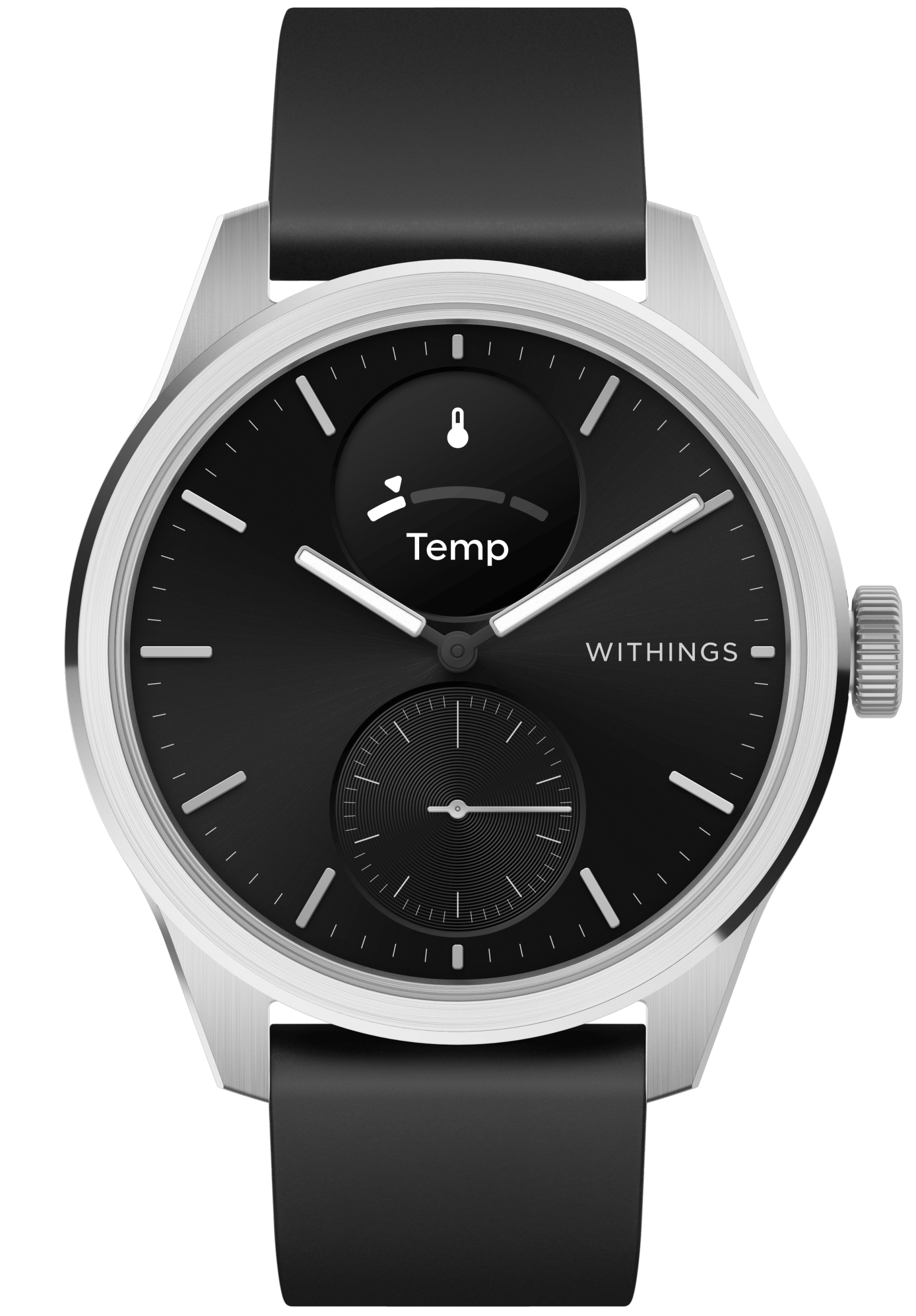
Withings ScanWatch: FDA Cleared ECG and SpO2 in a Classic Watch Design
An FDA cleared electrocardiogram and pulse oximeter built into a watch that actually looks like a watch, not a miniature computer strapped to your wrist.
Presented By Our Partners



Product status update, August 2026. This model has been superseded by the Withings ScanWatch 2, priced at $349.95 in both 38mm and 42mm.
In a prospective diagnostic study published in 2023 in JACC: Clinical Electrophysiology, researchers at University Hospital Basel enrolled 201 patients presenting to a cardiology service and simultaneously tested five direct to consumer wearable devices for atrial fibrillation detection. The results revealed something unexpected: the devices differed dramatically in inconclusive tracing rates, ranging from 17% to 26%, and sensitivity scores varied from 58% to 85%. The clinical takeaway was clear. Not all consumer ECG devices perform equally, and the gap between marketing claims and clinical reality remains wide enough to matter.
That study included the Withings ScanWatch, which demonstrated 58% sensitivity and 75% specificity for AFib detection in its automated algorithm. Those numbers tell only part of the story. When clinicians manually reviewed the inconclusive tracings, the rhythm could be determined in 99% of single lead electrocardiograms across all devices. The device captures clinically useful data. The question is whether you, or your physician, know how to interpret it.
This is the tension at the heart of consumer cardiovascular monitoring: the sensor hardware has outpaced the software intelligence and the clinical workflows needed to make the data actionable.
What Is the Withings ScanWatch?
The Withings ScanWatch is a hybrid analog smartwatch that embeds FDA 510(k) cleared medical sensors into a traditional watch form factor. Unlike fully digital smartwatches with bright rectangular screens, the ScanWatch uses physical watch hands over a small OLED subdisplay, giving it the appearance of a conventional timepiece rather than a health monitoring device.
Inside that analog exterior sits a single lead electrocardiogram sensor, a medical grade photoplethysmography (PPG) sensor for continuous heart rate and blood oxygen saturation (SpO2) tracking, and an accelerometer that monitors sleep stages and detects breathing disturbances associated with sleep apnea risk. The device also tracks heart rate variability, daily activity, and elevation gained.
The ScanWatch earned FDA 510(k) clearance for its ECG, SpO2, and atrial fibrillation detection capabilities, placing it among a small group of consumer wearables with genuine regulatory validation. It pairs with the Withings Health Mate app, which stores historical data, generates health reports sharable with physicians, and provides trend analysis over time. Battery life stretches to approximately 30 days, a significant advantage over fully digital smartwatches that require daily or weekly charging. There is no mandatory subscription; the core health features work without an ongoing fee, though Withings offers optional Health+ programs for additional coaching content.
The Science Behind Consumer ECG and Blood Pressure Monitoring
To understand why a device like the ScanWatch matters, you need to understand what it measures and why those measurements have clinical significance.
Atrial fibrillation affects an estimated 37.6 million people worldwide and is a leading risk factor for stroke. The condition is often asymptomatic and intermittent, which means it frequently goes undetected during routine clinical visits. A 2020 study published in PLoS One by Lown et al. demonstrated that machine learning algorithms applied to wearable heart rate monitor data could detect atrial fibrillation with 100% sensitivity and 97.6% specificity in a validation cohort, establishing the technical foundation for consumer device screening.
The BASEL Wearable Study, published in 2023 in JACC: Clinical Electrophysiology by Mannhart et al., took this further by testing five commercially available smart devices head to head in a real world clinical cohort of 201 patients. The study confirmed that consumer wearables can capture clinically useful single lead ECG tracings, but also exposed the gap between device algorithms and clinical interpretation. Across all five devices, approximately 18% to 26% of tracings were flagged as inconclusive by automated algorithms, yet manual physician review could determine the rhythm in 99% of those cases.
Blood pressure variability adds another dimension. A 2022 review published in Nature Reviews Cardiology by Schutte et al. examined the evolution of blood pressure measurement techniques and found that BP variability itself is independently associated with cardiovascular outcomes, beyond average BP levels. The review highlighted that novel cuffless wearable technologies could provide continuous 24 hour BP profiling, but noted that accuracy and clinical utility remain uncertain for most current devices.
A systematic review and meta analysis published in European Heart Journal: Digital Health by Islam et al. in 2022 evaluated 15 cuffless blood pressure monitoring devices across 16 validation studies. The pooled analysis found no statistically significant difference between wearable and reference devices for systolic blood pressure (mean difference 3.42 mmHg) or diastolic blood pressure (mean difference 1.16 mmHg), but the authors cautioned that variation in validation protocols limited cross study comparisons.
This is the broader scientific context. Consumer wearables can detect clinically significant cardiovascular events, but the gap between detection capability and clinical action remains the central challenge. The Withings ScanWatch sits squarely in this space: it captures real, FDA cleared data, but making that data clinically useful requires engagement from both the user and their healthcare provider.
What the Withings ScanWatch Does Well
The ScanWatch’s primary strength is its form factor. It is the only FDA cleared ECG and SpO2 wearable that genuinely looks like a traditional watch. For users who want continuous health monitoring without broadcasting that fact to everyone in the room, this matters. The device is available in 38mm and 42mm case sizes with interchangeable bands, and its analog hands move over a recessed OLED display that shows notifications and real time health data only when prompted.
Battery life is a legitimate differentiator. At up to 30 days between charges, the ScanWatch eliminates the compliance problem that plagues many smartwatches: you cannot collect data from a device sitting on a nightstand because its battery died. This extended battery life is especially important for sleep monitoring and continuous heart rate tracking, where overnight data collection is essential.
Featured Partner
Invest in the Infrastructure Behind Modern Medicine
As healthcare expands beyond hospital walls, the buildings and campuses supporting that shift are generating compelling returns for investors who move early. The Healthcare Real Estate Fund offers qualified investors direct access to a curated portfolio of medical office, outpatient, and specialty care facilities.
Learn More →
The breathing disturbance detection feature is clinically interesting. The ScanWatch uses its SpO2 sensor during sleep to estimate the frequency of oxygen desaturation events, providing a screening proxy for obstructive sleep apnea risk. While this does not replace a formal polysomnography study, it can flag users who should pursue clinical evaluation.
Withings’ Health Mate app generates PDF health reports that can be shared directly with physicians, creating a practical bridge between consumer data collection and clinical decision making. The app’s trend tracking spans months and years, making it useful for monitoring chronic conditions over time rather than just providing daily snapshots.
Pricing, Access, and Practical Realities
The Withings ScanWatch retails between $279 and $349 depending on case size and band selection. There is no required subscription, making the total first year cost identical to the purchase price. This represents a significant cost advantage over subscription dependent wearables where annual costs can exceed $300 for the device plus $70 to $100 for required software access.
HSA and FSA eligibility for the ScanWatch is not officially confirmed by Withings, though some users have reported success submitting claims given its FDA cleared medical device status. Prospective buyers should verify eligibility with their specific plan administrator before assuming coverage.
The device carries FDA 510(k) clearance for ECG recording, SpO2 measurement, and atrial fibrillation detection. This is a meaningful regulatory distinction. FDA clearance means the device has been reviewed and found to be substantially equivalent to legally marketed predicate devices for these specific functions. It does not mean the device can diagnose, treat, or cure any condition, and Withings appropriately positions it as a screening and monitoring tool rather than a diagnostic instrument.
Replacement bands and charging accessories are available through Withings directly, and the device uses a proprietary magnetic charging cradle. The watch is water resistant to 50 meters, supporting swim tracking and shower use without removal.
Who the Withings ScanWatch Is Best For
The ScanWatch is ideal for users who prioritize aesthetics alongside health monitoring. Professionals who cannot or prefer not to wear a conspicuous smartwatch in business settings will find the analog design compelling. It also suits users who have been prescribed home ECG monitoring by their cardiologist and want a passive, always available recording option rather than a dedicated portable ECG device.
Users with a family history of atrial fibrillation or those managing known cardiovascular risk factors will benefit from continuous heart rate and rhythm monitoring. The sleep apnea screening feature makes it relevant for users with suspected sleep disordered breathing who have not yet undergone formal evaluation.
The 30 day battery life makes the ScanWatch particularly attractive for travelers and users who find daily or weekly charging routines inconvenient or who simply want to maximize data continuity.
Users who want a full featured digital smartwatch with app ecosystems, cellular connectivity, or advanced workout analytics may want to skip the ScanWatch. It is deliberately limited in smart features to preserve battery life and the analog watch experience. Users seeking the most clinically validated AFib detection algorithm may prefer the Apple Watch, which demonstrated 85% sensitivity in the BASEL study compared to the ScanWatch’s 58%.
How the Withings ScanWatch Compares
Against the Apple Watch Series 9, the ScanWatch trades smart features for battery life and form factor. The Apple Watch offers a brighter display, a richer app ecosystem, cellular connectivity, and a more sensitive AFib detection algorithm (85% vs 58% in the BASEL study). However, the Apple Watch requires charging every 18 to 36 hours and is unmistakably a smartwatch. For users who want medical grade monitoring in a discreet, traditional watch design, the ScanWatch wins that comparison.
Against the Samsung Galaxy Watch 7, the dynamics are similar. Samsung offers a more feature rich digital experience with superior fitness tracking, but requires more frequent charging and lacks the ScanWatch’s analog aesthetic. Samsung matched the Apple Watch’s 85% sensitivity for AFib detection in the BASEL study.
Against the Oura Ring Gen 3, which occupies another “discreet wearable” niche, the ScanWatch offers FDA cleared ECG capability that the Oura lacks entirely. The Oura provides HRV and sleep tracking in a ring form factor, but cannot record an electrocardiogram or measure SpO2 with regulatory clearance. For users whose primary concern is cardiovascular screening rather than sleep optimization, the ScanWatch provides clinically stronger data.
Limitations and Open Questions
The 58% sensitivity for AFib detection in the BASEL Wearable Study is the ScanWatch’s most significant limitation. While specificity was reasonable at 75%, the lower sensitivity means the device misses a substantial proportion of true atrial fibrillation episodes compared to competing devices. Withings has stated that algorithm updates may improve this over time, but published validation data currently places it behind Apple Watch and Samsung Galaxy Watch in this specific metric.
The ScanWatch does not measure blood pressure, despite Withings’ broader ambitions in this space (the BPM Connect and BPM Core are dedicated BP devices in their ecosystem). Users seeking cuffless blood pressure monitoring will need to look elsewhere.
Data export is limited to the Withings Health Mate ecosystem. While the app supports Apple Health and some third party integrations, users deeply embedded in other health platforms (Google Fit, Samsung Health) may find data portability constraining. The small OLED subdisplay, while elegant, provides limited real time information compared to full screen smartwatches.
Long term clinical outcome data specifically tied to Withings ScanWatch usage does not currently exist. The device captures validated measurements, but no published study has demonstrated that consumer use of this specific device improves cardiovascular outcomes or reduces hospitalization rates.
What This Means for Your Health
Cardiovascular disease remains one of the Four Villains, the primary chronic disease threats to human longevity alongside cancer, neurodegenerative disease, and metabolic dysfunction. The Withings ScanWatch addresses this threat through continuous, passive monitoring of heart rhythm, oxygen saturation, and heart rate variability, three biomarkers with established clinical significance for cardiovascular risk stratification.
Within Healthcare Discovery‘s Five Pillars framework, the ScanWatch most directly serves the Sleep and Movement pillars. Its 30 day battery enables uninterrupted overnight sleep monitoring, including breathing disturbance detection that screens for sleep apnea, a condition strongly linked to cardiovascular disease, hypertension, and metabolic dysfunction. Its activity tracking supports daily movement accountability without requiring the complexity of a full fitness platform.
The broader principle here is that the most useful health data is the data that actually gets collected. A device with a 30 day battery and a design you are willing to wear every day produces more clinically meaningful longitudinal data than a more powerful device that sits uncharged in a drawer. The ScanWatch makes a deliberate trade: fewer features, longer battery, better adherence. For users who value consistency over complexity, that trade pays dividends.
If you are considering cardiovascular monitoring, start with the fundamentals: know your resting heart rate, understand your heart rate variability trends, and monitor your blood oxygen levels during sleep. The ScanWatch captures all three, with FDA clearance backing the measurements. Pair it with annual clinical checkups and open conversations with your physician about what the data shows, and you have a practical bridge between daily self monitoring and clinical care.

Explore the full wearable guide
See how the Withings ScanWatch compares with smart rings, watches, ECG devices, and other connected health hardware across the full Healthcare Discovery wearables guide.
Frequently Asked Questions
Is the Withings ScanWatch FDA cleared?
Yes. The Withings ScanWatch holds FDA 510(k) clearance for its single lead ECG recording, blood oxygen saturation (SpO2) measurement, and atrial fibrillation detection capabilities. This clearance means the FDA reviewed the device and found it substantially equivalent to legally marketed predicate devices for these specific functions. The clearance does not extend to diagnosis or treatment of any medical condition; it is classified as a screening and monitoring tool.
How accurate is the ScanWatch for detecting atrial fibrillation?
In the 2023 BASEL Wearable Study published in JACC: Clinical Electrophysiology, the Withings ScanWatch demonstrated 58% sensitivity and 75% specificity for automated AFib detection in a cohort of 201 patients. When clinicians manually reviewed inconclusive tracings, the rhythm could be determined in 99% of cases. The device captures clinically useful ECG data, but its automated algorithm currently trails the Apple Watch (85% sensitivity) and Samsung Galaxy Watch (85% sensitivity) in the same study.
Does the Withings ScanWatch require a subscription?
No. All core health monitoring features, including ECG recording, SpO2 measurement, heart rate tracking, sleep analysis, and breathing disturbance detection, work without any subscription. Withings offers optional Health+ programs for additional coaching and wellness content, but these are not required for full device functionality. Total first year cost is the purchase price only: $279 to $349 depending on model.
How long does the Withings ScanWatch battery last?
The ScanWatch achieves up to 30 days of battery life with typical use, including continuous heart rate monitoring, sleep tracking, and SpO2 measurements. This is significantly longer than fully digital smartwatches like the Apple Watch (18 to 36 hours) or Samsung Galaxy Watch (approximately 40 hours). The extended battery life is achieved through the analog watch design with a small OLED subdisplay rather than a full color touchscreen.
Can the Withings ScanWatch detect sleep apnea?
The ScanWatch monitors blood oxygen levels during sleep and detects breathing disturbances, providing a screening estimate of oxygen desaturation events that may indicate obstructive sleep apnea risk. It does not diagnose sleep apnea; a formal polysomnography study is required for clinical diagnosis. However, the screening data can help users and their physicians decide whether to pursue further evaluation. The feature runs automatically during sleep and does not require any setup.
Is the Withings ScanWatch HSA or FSA eligible?
HSA and FSA eligibility is not officially confirmed by Withings for the ScanWatch. Some users have reported successfully submitting reimbursement claims based on the device’s FDA cleared medical device status, but approval depends on individual plan administrators. Users should contact their HSA or FSA provider directly before assuming coverage. Withings does confirm HSA/FSA eligibility for its dedicated blood pressure monitors (BPM Connect, BPM Core).
Withings ScanWatch at a glance
- Hardware price
- $279 to $349
- First year total
- $279
- Form factor
- Hybrid smartwatch (wrist)
- FDA status
- Has FDA clearance
- HSA/FSA
- Not confirmed
Measures Activity, Breathing disturbances, ECG, HR, HRV, Sleep stages, SpO2
Pricing verified August 5, 2026. Maintained in the Healthcare Discovery device database and updated automatically.


Similar Posts

The Daily Rounds: Longevity & Health Care Brief | April 16, 2026
🔬 Senolytics Reduce Epigenetic Age: Lab data show senolytic compounds measurably lower biological age markers, with human pilot trials now exploring effects on mobility and cognition. 🧠 FTL1 Protein Drives Memory Decline: Scientists identified a specific protein that weakens brain cell connections with age, opening a new therapeutic target for cognitive preservation. 🤖 Novo Nordisk + OpenAI Partnership: The pharma giant is applying frontier AI to compress drug discovery timelines and accelerate patient access to novel medicines. 🦠 CAG-170 Bacteria Linked to Gut Health: A globally validated analysis found this rare bacterial group is a marker of health, producing B12 and stabilizing the gut ecosystem. 😴 Solar Jet Lag and Liver Cancer: A new federally backed study will probe whether circadian misalignment is an upstream cause of the most common form of liver cancer.

Closed-Loop Referrals: The AI Delivery Layer Healthcare Keeps Missing
A referral is not care. Closed-loop referrals show whether healthcare AI can turn a clinical recommendation into a completed visit, returned result, and next action.
The Daily Rounds: Longevity & Health Care Brief | May 16, 2026
🧬 Arginine Targets Alzheimer’s Amyloid — An inexpensive, already-safe amino acid supplement reduces toxic amyloid protein buildup in the brain, positioning it as a compelling candidate for early-stage Alzheimer’s prevention…

Plunge Cold Plunge Tub Review: Electric Cold Water Immersion for Recovery, Inflammation, and Mental Resilience
The Plunge delivers consistent, temperature controlled cold water immersion without the ice runs, bringing clinical grade cold exposure to the home recovery protocol. Presented By Our Partners Cold water immersion…
The Daily Rounds: Longevity & Health Care Brief | April 2, 2026
🧬 - Epigenetic reprogramming has entered human clinical trials for the first time, with Life Biosciences receiving FDA clearance to test partial reprogramming in retinal degeneration patients, a landmark moment for the entire longevity field. 🤖 - An AI-designed drug for pulmonary fibrosis showed a 160 mL treatment differential in forced vital capacity versus placebo in Phase IIa, suggesting the drug may stop or reverse disease progression rather than merely slowing it. 🦠 - Gut bacteria use molecular syringe-like structures to inject proteins directly into human cells, and this bacterial protein transfer is now linked to elevated Crohn's disease risk, redefining how the microbiome communicates with the immune system. ❤️ - A new cardiovascular drug class reduces heart attack and stroke risk in older adults by nearly 20 percent by simultaneously targeting cholesterol, inflammation, and blood sugar, pointing toward a potential revision of current standard-of-care protocols. ⏰ - Circadian biology is entering the clinic, with evidence that vaccine timing, sleep medication evaluation, and cardiovascular risk management all benefit from treating the biological clock as a measurable and modifiable variable rather than background noise.
Tempo Studio: 3D Motion Capture and Real Weights for AI-Coached Strength Training
The only smart home gym that combines real weight plates with 3D body scanning and AI form correction. Does adding a depth sensor to a barbell change the equation for…
