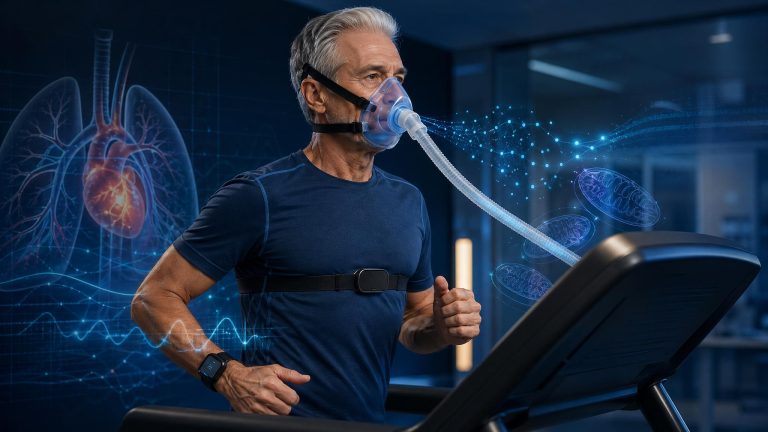
VO2 max testing and oxygen metabolism illustrating cardiorespiratory fitness as a longevity biomarker | Healthcare Discovery
| | |

Your VO2 Max May Be the Single Best Predictor of How Long You Will Live: What 3.8 Million People and 58 Clinical Trials Reveal About Cardiorespiratory Fitness and the Science of Living Longer

A meta-analysis of 3.8 million people shows that each one-MET increase in cardiorespiratory fitness reduces all-cause mortality by 14 percent. A 2026 Cochrane review of 58 clinical trials confirms HIIT…

Healthcare Discovery 10 fundamentals metabolic health ancient wisdom modern science showing nutrition breath recovery movement and wearable data
| |

The 10 Fundamentals Your Body Already Knows: What Modern Metabolic Science Is Finally Confirming

Modern metabolic science, continuous glucose monitors, and wearable technology are confirming what ancient healers understood for millennia: optimal health comes down to mastering the fundamentals of nutrition, breath, recovery, and…

Immune cells clearing damaged mitochondria through mitophagy as urolithin A supports immune rejuvenation
| | |

Your Immune System Is Aging Because Your Mitochondria Are Failing: How Mitophagy Activation Is Reversing Immune Decline in Clinical Trials

A landmark clinical trial published in Nature Aging shows that urolithin A, a natural mitophagy activator, rejuvenated immune cell populations in middle-aged adults in just 28 days. The MitoImmune trial…

Scientist conducting AI drug discovery and biological aging research in a modern laboratory
| |

The Longevity Toolkit Takes Shape: AI Drug Discovery, Biological Age Clocks, and Microbiome Science Converge

A generative AI-designed drug has delivered clinical proof in a Phase IIa trial, while new biological age clocks and microbiome science are completing the precision longevity toolkit. Here is what…

Healthcare Discovery slow breathing vagal tone HRV clinical research 2025 showing five-minute exhale practice rewiring autonomic balance
| | |

Five Minutes of Slow Breathing Rewires Your Nervous System: What a New Wave of Clinical Research Reveals About Vagal Tone, Heart Rate Variability, and the Most Underused Tool in Medicine

A 2025 scoping review confirms that slow breathing at six cycles per minute significantly improves vagal tone, heart rate variability, and autonomic flexibility. Combined with the Stanford cyclic sighing trial…

Blood sample vials in a clinical laboratory setting, representing the p-tau217 blood test revolution in Alzheimer's disease diagnosis
| | |

A Simple Blood Test Can Now Detect Alzheimer’s Years Before Symptoms: How the P-Tau217 Revolution Is Rewriting Diagnosis

A wave of FDA-cleared blood tests measuring phosphorylated tau 217 is transforming Alzheimer’s diagnosis from expensive brain scans and spinal taps into a routine blood draw at your doctor’s office….

Scientist examining samples in a modern research laboratory representing longevity and epigenetic reprogramming breakthroughs
| |

Epigenetic Reprogramming Goes Human: Three Breakthroughs Signal a Turning Point for Longevity Science

The first human trial of partial epigenetic reprogramming has launched, an AI platform published in Cell is accelerating longevity drug discovery, and a landmark NEJM trial proves cardiovascular primary prevention…

Strength training signals flowing into deep sleep waves and recovery biology
| | |

Strength Training Is the Most Underrated Sleep Aid in Medicine: What 86 Clinical Trials and 7,276 Participants Reveal About Lifting Weights and Deep Sleep

A 2025 network meta-analysis of 86 clinical trials and 7,276 participants reveals that resistance training significantly improves sleep quality, increases deep slow-wave sleep, reduces anxiety and inflammatory markers, and triggers…

Healthcare Discovery polygenic risk scores heart attack prediction cardiovascular prevention 2026 showing genomic heart risk
| | |

Your DNA Can Now Predict a Heart Attack Decades Before It Happens: How Polygenic Risk Scores Are Rewriting Cardiovascular Prevention

The 2026 ACC/AHA guidelines formally recognize polygenic risk scores as a cardiovascular risk-enhancing factor for the first time. With a multi-ancestry PRS validated across 190,000 participants and the eMERGE Network…