
The First Human Reprogramming Trial Is an Eye Study—Not Proof of Age Reversal
Updated August 11, 2026. Partial epigenetic reprogramming has entered a human clinical trial. Human age reversal has not.
Presented By Our Partners



One participant. One eye. One viral vector carrying instructions for three transcription factors. Then, for 56 days, an antibiotic acts as the switch.
That is the real experiment now underway in a small Phase 1 study of ER-100. It is audacious enough without the extra mythology. Researchers are testing whether damaged retinal neurons can tolerate a controlled attempt to restore more youthful patterns of gene activity—and whether vision-related measurements move in the right direction. They are not testing whether a healthy person can become biologically young, live for centuries, or achieve “longevity escape velocity.”
The distinction matters because this is both a legitimate translational milestone and an ideal machine for generating misleading headlines.
What happened—and what did not
Life Biosciences announced on June 9, 2026, that the first participant had been dosed in its Phase 1 trial of ER-100. The official study record, NCT07290244, describes a non-randomized, open-label, sequential study planning to enroll up to 18 people: 12 with open-angle glaucoma and six with non-arteritic anterior ischemic optic neuropathy, or NAION.
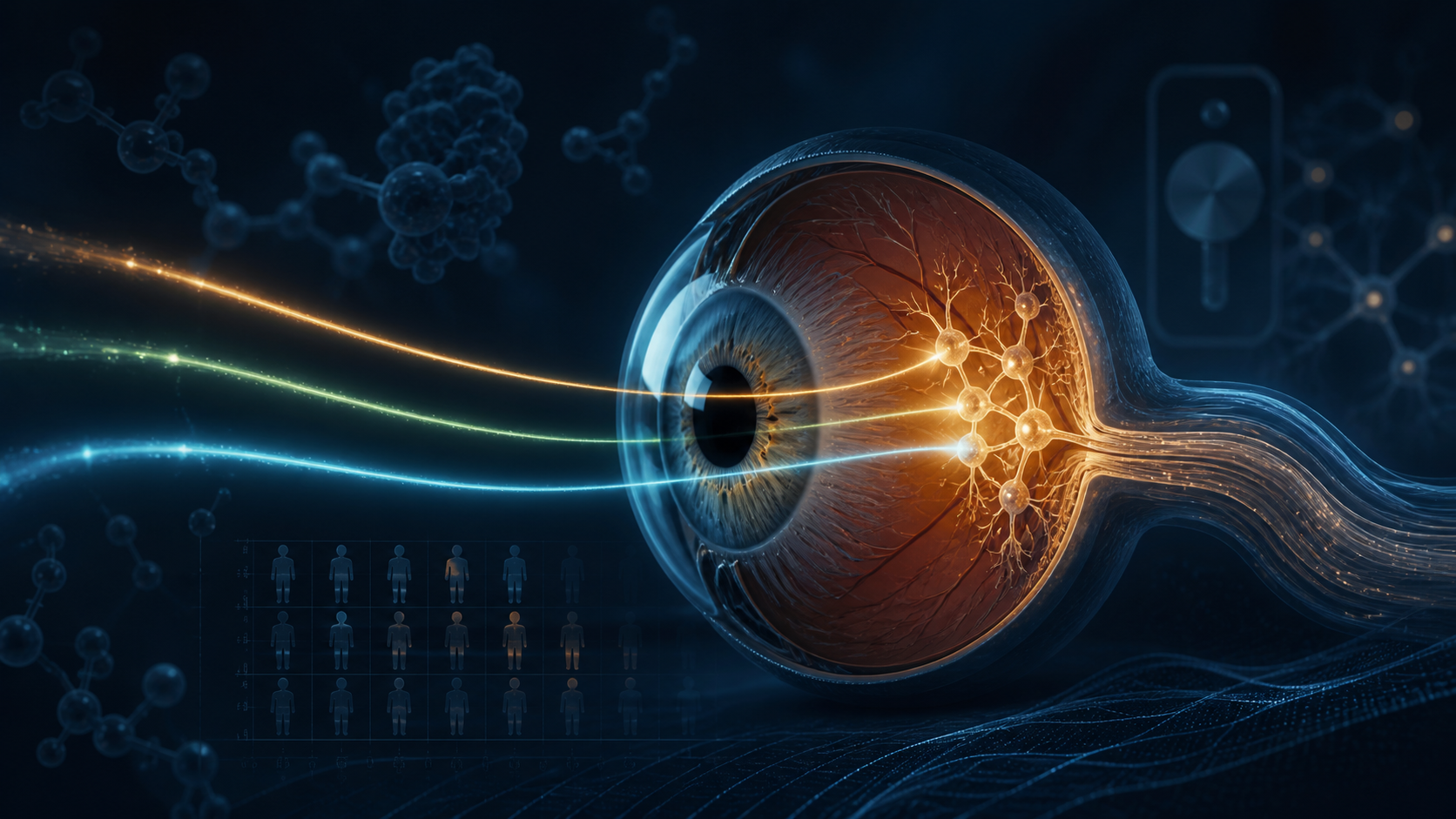
The treatment is administered to one study eye. ER-100 uses an adeno-associated viral vector to deliver OCT4, SOX2 and KLF4—collectively OSK—to retinal ganglion cells. Systemic doxycycline is then used to activate expression for 56 days. The trial escalates dose cautiously and includes review by a data and safety monitoring board before enrollment proceeds.
The primary purpose is safety and tolerability. Investigators will also track immune responses, retinal structure and multiple measures of visual function for preliminary evidence of biological activity. The registry estimates primary completion in May 2027 and overall completion in March 2032, reflecting five years of follow-up.
What has not happened: no human efficacy result has been reported. No participant has been shown to regain vision because of ER-100. No evidence shows that the treatment reverses whole-body aging or extends human lifespan.
Evidence level: registered first-in-human Phase 1 trial. This is stronger than animal evidence because people are now being treated under a clinical protocol—but it remains below a human safety signal, a human efficacy result, or any evidence of longer life.
Why three factors can change a cell’s identity—or its age
In 2006, Shinya Yamanaka and Kazutoshi Takahashi showed that four transcription factors—OCT4, SOX2, KLF4 and c-MYC, abbreviated OSKM—could return mature mouse cells to an embryonic-like state. The work helped establish induced pluripotent stem cells and led to the 2012 Nobel Prize in Physiology or Medicine for Yamanaka and John Gurdon.
For regenerative medicine, the discovery opened a door and exposed a cliff. Full reprogramming can erase a cell’s accumulated age-associated state. It can also erase what the cell is. In living animals, uncontrolled reprogramming has produced dysplasia and teratomas. A neuron that forgets it is a neuron is not rejuvenated in any medically useful sense.
Featured Partner
Invest in the Infrastructure Behind Modern Medicine
As healthcare expands beyond hospital walls, the buildings and campuses supporting that shift are generating compelling returns for investors who move early. The Healthcare Real Estate Fund offers qualified investors direct access to a curated portfolio of medical office, outpatient, and specialty care facilities.
Learn More →
Partial reprogramming is the attempt to stop before that point: change enough of the epigenetic program to recover function, but not enough to cause dedifferentiation. ER-100 omits c-MYC, the factor most plainly associated with oncogenic risk, and uses a doxycycline-responsive system intended to control when OSK is expressed.
Those are rational safety choices. They are not proof of safety. Removing c-MYC does not eliminate every route to abnormal growth, altered cell identity, inflammation, immune reaction, vector toxicity or unintended gene-expression changes. The trial exists because mouse and nonhuman-primate studies cannot settle those questions for humans.
The mouse experiment that made the trial plausible
The scientific spine of ER-100 is a 2020 Nature study led by Yuancheng Lu. Researchers delivered OSK to retinal ganglion cells in mice. In optic-nerve injury and glaucoma models, the treatment promoted axon regeneration and improved measures of visual function. In older mice, it also restored vision-associated function alongside younger-looking DNA-methylation and gene-expression patterns.
A later mouse study followed the effect for longer. In a glaucoma model, two months of inducible OSK expression restored impaired vision in the reported experiments; benefit persisted after expression was switched off, although it gradually diminished. The investigators reported no adverse change in retinal structure or body weight during prolonged expression in mice.
These are striking results. They are also mouse results produced in experimental disease models. “Restored vision in a mouse” does not mean “reversed aging in a person.” Even within the mouse work, improved function, younger molecular signatures and longer life are separate outcomes.
Life Biosciences has also reported visual-function recovery and tolerability in a nonhuman-primate NAION model. Those data helped support clinical development, but the accessible evidence is largely found in company releases and conference presentations rather than a complete peer-reviewed human evidence package. It should therefore be described as company-reported preclinical evidence, not as proof that ER-100 works.
Why begin in the eye?
The eye gives researchers an unusually useful first test bed. Treatment can be localized to one organ and compared with extensive structural and functional measurements. Retinal imaging, visual-field testing, contrast sensitivity and other ophthalmic assessments can detect changes that would be difficult to measure in many internal organs.
The diseases also provide a serious unmet need. Open-angle glaucoma progressively damages retinal ganglion cells and their axons; lowering intraocular pressure can slow risk and progression, but it does not reliably restore lost neural function. NAION causes sudden, usually painless vision loss after injury to the optic nerve’s blood supply, and there is no FDA-approved treatment that reverses the damage.
Starting in the eye therefore does two things at once: it constrains the experiment and asks a clinically meaningful question. Can a local, controllable reprogramming therapy be tolerated in human neural tissue—and might it preserve or recover measurable function?
What it cannot do is automatically answer whether the same method would be safe in the brain, heart, liver or across the whole body. Different tissues divide at different rates, respond differently to reprogramming factors and carry different consequences if cell identity slips.
What would count as success?
The word “rejuvenation” bundles together outcomes that should remain separate.
- Acceptable safety: no dose-limiting toxicity, damaging inflammation, serious immune response, tumor formation or harmful ocular change.
- Target engagement: evidence that the OSK program was activated in the intended tissue and altered relevant molecular pathways.
- A younger molecular signature: changes in DNA methylation or gene expression associated with younger cells.
- Functional benefit: credible improvement or preservation in visual function.
- Disease modification: evidence, in a larger controlled trial, that the treatment changes the course of glaucoma or NAION.
- Systemic rejuvenation or longer life: outcomes this eye trial is not designed to test.
A methylation clock moving backward would be scientifically interesting. It would not, by itself, prove that a participant sees better. Better vision would matter clinically, but it would not establish that the participant’s body is younger or that life has been extended.
The danger of turning a trial into a prophecy
Some coverage has paired ER-100 with a 2026 mathematical model estimating how long humans might survive if conventional aging disappeared. The paper reported a median of 1,759 years under one hypothetical non-aging baseline and 156 years when somatic-mutation damage remained. Those numbers are model outputs built from assumptions, not forecasts, treatment targets or claims about ER-100.
The distance between the model and the trial is enormous. ER-100 is a local intervention in diseased eyes. The lifespan model asks what mortality might look like after removing broad classes of age-related failure. Combining them creates a compelling story, but not a continuous chain of evidence.
The promotional context also deserves disclosure. In the Moonshots video that helped drive renewed attention to this story, Peter Diamandis states that Life Biosciences is a portfolio company. That does not invalidate the trial or the underlying research. It does mean the discussion is not independent analysis, and readers should evaluate its predictions accordingly.
The sober reason this still matters
The most revolutionary outcome from this trial may initially look mundane: an acceptable safety profile, evidence that the molecular switch behaves as intended, and perhaps a signal in retinal structure or vision strong enough to justify a controlled Phase 2 study.
That would not be human age reversal. It would be something medicine can actually build on.
If ER-100 proves tolerable, the field gains its first human safety experience with this particular partial-reprogramming strategy. If it shows a credible functional signal, researchers gain a reason to test the therapy more rigorously in optic neuropathy. If it fails, the result will help define where the boundary lies between an elegant animal experiment and a viable human treatment.
Revolutions in medicine rarely enter through the front door carrying proof of immortality. They arrive as small trials, narrow indications, safety tables and measurements that may or may not move. ER-100 has crossed that threshold. Now the evidence—not the headline—gets to decide what it means.
Direct sources
- ClinicalTrials.gov: NCT07290244, ER-100 Phase 1 trial
- Life Biosciences: first participant dosed, June 9, 2026 (company source)
- Life Biosciences: FDA IND clearance announcement, January 28, 2026 (company source)
- Lu et al., “Reprogramming to recover youthful epigenetic information and restore vision,” Nature (2020)
- Karg et al., “Sustained Vision Recovery by OSK Gene Therapy in a Mouse Model of Glaucoma” (2023)
- Life Biosciences: nonhuman-primate conference results (company-reported)
- Efimov et al., “Somatic mutations impose an entropic upper bound on human lifespan,” npj Aging (2026)
- Cagan et al., “Somatic mutation rates scale with lifespan across mammals,” Nature (2022)
This article is educational and does not provide medical advice. ER-100 is investigational and is not FDA-approved for treatment. People with glaucoma, sudden vision loss or other optic-nerve symptoms should seek care from a qualified eye-care professional.


Similar Posts

Samsung Galaxy Watch 7 Sleep: FDA-Cleared Sleep Apnea Detection and AI Sleep Coaching
The first smartwatch to receive FDA authorization for sleep apnea detection, using blood oxygen patterns during sleep to screen for a condition that affects nearly a billion people worldwide and…

Longevity Science Is Having a Reckoning: Why the Next Breakthrough May Not Be a Drug
Scientists at the 2nd World Congress on Targeting Longevity in Berlin delivered an uncomfortable verdict in April 2026: despite decades of discoveries, longevity science has stalled on clinical translation. The…

Why Muscle Is the Organ of Longevity: New Research Reveals the Exercise Prescription That Actually Extends Your Life
New research from the UK Biobank, a landmark Cochrane review, and a breakthrough randomized controlled trial reveal why skeletal muscle is the most important organ for longevity, and why the…

The Daily Rounds: Longevity & Health Care Brief | April 24, 2026
🧬 SuperAgers Grow Twice as Many New Neurons — Adults over 80 with 50-year-old-level memory generate up to 2.5 times more new neurons than peers, redefining what is biologically possible for the aging brain. 🤖 AI Drug Discovery Reaches Scale — Novo Nordisk joins OpenAI while NVIDIA commits $1 billion alongside Lilly, as 173-plus AI-discovered drug programs advance through clinical trials simultaneously. ⌚ Wearables Achieve Clinical-Grade Metabolic Prediction — The WEAR-ME study confirms consumer wearables predict insulin resistance with 80% accuracy, enabling population-scale metabolic screening without lab visits. 🌙 Circadian-Aligned Eating Extends Lifespan by 35% — A Science study shows that timing meals within the optimal circadian window delivers lifespan gains far beyond caloric restriction alone. 💪 Muscle Mass Is Metabolic Medicine — Every 10% gain in muscle mass reduces insulin resistance by 11%, with men who skip strength training 2.4 times more likely to develop metabolic disease.

Biobeat BB-613: FDA-Cleared Cuffless Blood Pressure Monitoring for Clinical Care
The first FDA-cleared cuffless blood pressure monitor designed for hospital and remote patient monitoring brings continuous hemodynamic surveillance to patients who need it most. Presented By Our Partners Blood pressure…

AI-Designed Drugs Are Entering Human Trials: Inside the Quiet Pharmaceutical Revolution of 2026
For the first time in pharmaceutical history, molecules designed almost entirely by artificial intelligence are surviving Phase 2 trials in real patients. From Insilico’s rentosertib to Isomorphic Labs’ multi-billion dollar…
