
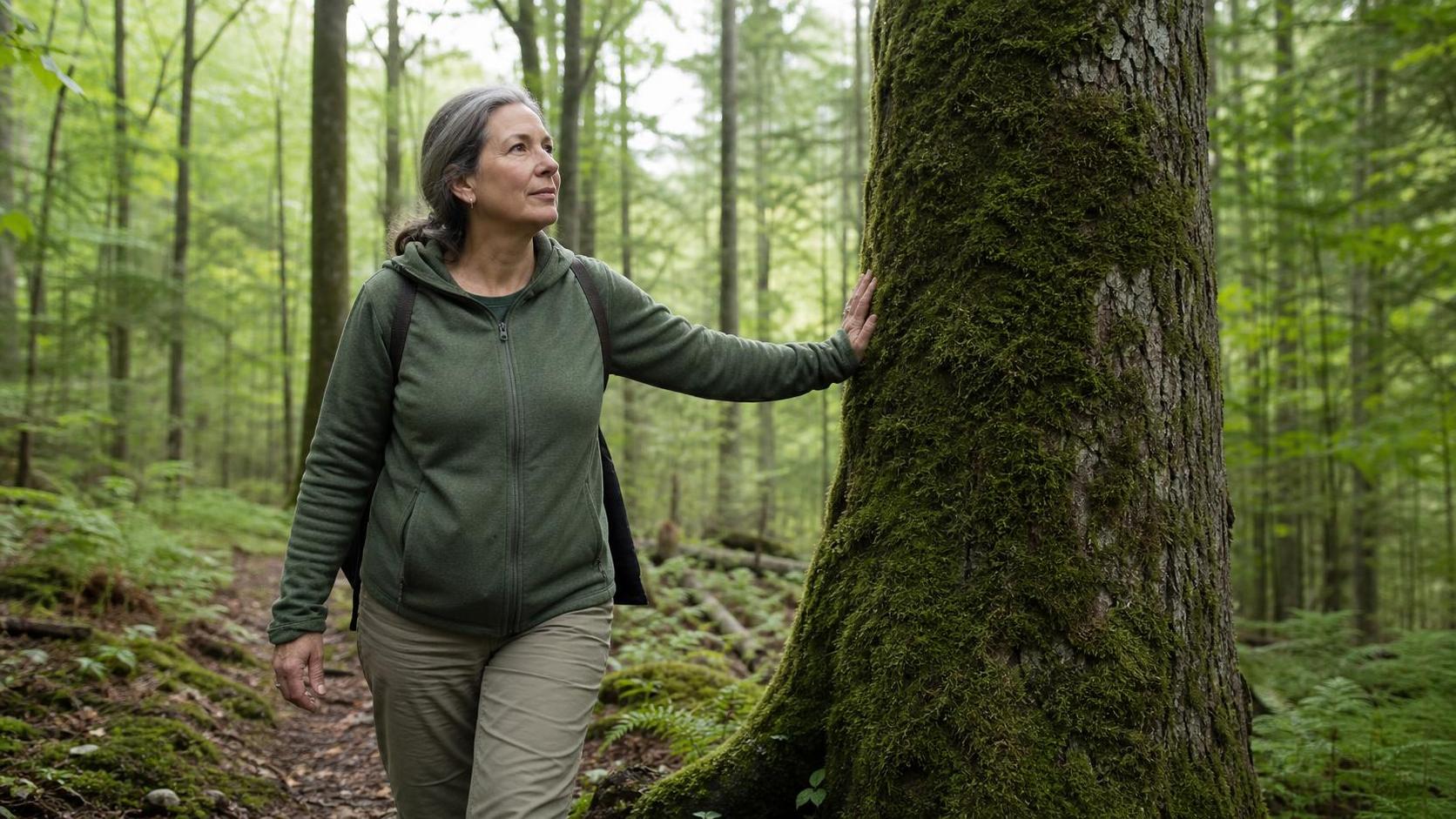
The Forest Is Not a Wellness Trend. It Is a Biological Environment.
There is a quiet kind of medicine that does not arrive in a capsule, a wearable, or a lab panel. It arrives through the feet, the lungs, the eyes, and the nervous system.
Presented By Our Partners



A person walks into a forest. The air is cooler. The light is softer. The soundscape changes. The shoulders drop before the mind has finished explaining why. Breathing slows. Attention widens. The body, which may have spent the week braced against notifications, deadlines, traffic, fluorescent light, and indoor air, begins to receive a different set of instructions.
For most of medical history, this would have sounded obvious. Human beings were not designed in sealed rooms. We evolved in landscapes filled with trees, soil, sunlight, shade, wind, water, microbial life, seasonal variation, and long horizons. The modern surprise is not that nature affects biology. The modern surprise is how much of that effect can now be measured.
One of the clearest examples comes from shinrin-yoku, the Japanese practice often translated as forest bathing. It does not mean exercise in the athletic sense. It does not require hiking, performance, or intensity. It means taking in the forest atmosphere slowly, through the senses.
Over the past two decades, Japanese physician and immunologist Dr. Qing Li and colleagues have helped turn that simple practice into a serious field of inquiry. Their work suggests that time in forests can shift immune activity, lower stress hormones, support cardiovascular regulation, and produce effects that last beyond the walk itself.
Forest bathing does not replace medicine. It reminds medicine that environment is part of physiology.
The indoor body
The Environmental Protection Agency notes that people spend about 90 percent of their time indoors. The deeper scientific source behind that often quoted figure is the National Human Activity Pattern Survey, which found that Americans spent about 87 percent of their time in enclosed buildings and another 6 percent in enclosed vehicles.
That means modern life is not simply an indoor lifestyle. It is an enclosed lifestyle.
This matters because the body is always reading its surroundings. Indoor environments can be safe and useful, but they also tend to narrow the biological inputs humans evolved with. Light becomes artificial. Air becomes recirculated. Movement becomes optional. Vision collapses toward near-field screens. Sound becomes mechanical. Stress becomes chronic but physically unresolved.
The question is not whether this affects health. The question is how often we remember to count it.
Preventive health is usually described through food, exercise, sleep, medication, screening, and risk factors. Those matter enormously. But environment belongs in the same conversation. The body does not regulate itself in abstraction. It regulates itself in context.
A forest is one of the oldest contexts the human nervous system knows.
What the forest releases
Trees are not passive scenery. They are chemically active organisms.
Many trees release volatile organic compounds called phytoncides. These compounds help plants defend themselves against bacteria, fungi, and insects. Conifers, including cypress, pine, cedar, spruce, and fir, release aromatic compounds such as alpha-pinene and beta-pinene. These are part of what gives forest air its distinct smell.
Li’s research has explored whether inhaling these compounds contributes to measurable immune changes. In one study, phytoncides from wood essential oils were associated with increased natural killer cell activity. In another line of work, forest trips were linked with increases in natural killer cells and immune proteins involved in cellular defense.
Natural killer cells are part of the innate immune system. They help identify and destroy virus-infected cells and abnormal cells, including tumor cells. They are not the whole immune system, and they should not be reduced to a single “boost immunity” slogan. But they are a meaningful marker of immune surveillance.
In Li’s 2009 review of forest bathing trips and human immune function, participants took three-day, two-night trips into forest environments. Blood and urine samples were collected before, during, and after the trips. Researchers measured natural killer cell activity, the number of NK cells, and levels of granulysin, perforin, and granzymes A/B — proteins involved in the destructive machinery NK cells use against target cells.
The results were striking. Forest bathing trips increased NK-cell activity, increased the number of NK cells, and increased the expression of several anti-cancer proteins. Some of these effects lasted more than seven days. In some measures, including NK-cell activity and NK-cell number, the effects were still detectable 30 days later.
A matched urban trip did not produce the same immune effect.
That contrast is important. If a forest trip merely worked because people were away from the office, walking more, or sleeping differently, a city trip with similar movement and schedule might be expected to produce similar results. It did not. The forest environment appeared to matter.
Featured Partner
Invest in the Infrastructure Behind Modern Medicine
As healthcare expands beyond hospital walls, the buildings and campuses supporting that shift are generating compelling returns for investors who move early. The Healthcare Real Estate Fund offers qualified investors direct access to a curated portfolio of medical office, outpatient, and specialty care facilities.
Learn More →
This is where the popular “80 percent” claim enters the discussion. Some summaries of Li’s work describe NK-cell activity rising by roughly 80 percent after a multi-day forest trip. That figure is directionally consistent with the dramatic immune changes reported in the forest-bathing literature, but it should be used carefully. The strongest version is not “nature increases disease-fighting cells by 80 percent” as a universal claim. The more accurate version is that in small Japanese studies, multi-day forest exposure produced large increases in NK-cell activity, with effects that could persist for weeks.
That is still remarkable. It is simply more honest.
The stress pathway may be just as important
The immune findings are compelling, but the forest’s effect on stress physiology may be even more foundational.
Stress is not only a feeling. It is a chemical state. Chronic sympathetic activation changes heart rate, blood pressure, glucose regulation, sleep architecture, inflammatory tone, attention, cravings, and immune function. A body that lives in constant fight-or-flight is not simply “busy.” It is metabolically and immunologically expensive.
Forest environments appear to shift that state.
Li and others have reported reductions in urinary adrenaline and noradrenaline after forest bathing. Other studies of shinrin-yoku have found lower cortisol, lower heart rate, lower blood pressure, and improved mood compared with urban or indoor control conditions. A 2021 systematic review focused on forest therapy and immune function found that most studies measuring NK-cell activity reported increases after forest interventions, while the broader literature also points toward improvements in stress-related physiology.
This may be one reason nature exposure feels restorative before anyone explains the mechanism. The body is not waiting for a TED Talk. It is reading light, air, sound, smell, texture, distance, and safety cues in real time.
A forest tells the nervous system something different than a phone.
That difference may matter because stress hormones and immune function are not separate systems. Psychological strain can suppress aspects of immune defense. Recovery states can permit repair. If forest exposure reduces sympathetic load while also exposing the body to biologically active plant compounds, the result may be a combined effect: chemistry plus calm.
The time-in-nature dose
The most practical question is not whether a three-day forest retreat is good for the body. It almost certainly is. The better question is what ordinary people can do in ordinary weeks.
Here the “nature dose” research becomes useful.
In 2019, researchers writing in Scientific Reports analyzed data from nearly 20,000 people in England and found that spending at least 120 minutes per week in nature was associated with significantly higher odds of reporting good health and high wellbeing. The pattern held whether those two hours came all at once or were spread across multiple visits.
The number is not a prescription in the pharmaceutical sense. It does not prove that exactly 119 minutes is useless and 120 minutes is magic. But it gives public health a starting point.
Two hours a week in nature is not extravagant. It is less than 20 minutes a day. It is one long walk, two park visits, a Saturday trail, or several short outdoor resets stitched into the week.
That matters because many health recommendations fail at the level of daily life. They sound correct but collapse under schedule pressure. The nature-dose idea is different. It is simple, measurable, and forgiving.
A person does not need to become an outdoorsman. A person needs repeated contact with living environments.
The inner pharmacy of the forest
The body has its own pharmacy. It makes dopamine, serotonin, endorphins, endocannabinoids, ketones, nitric oxide, melatonin, cortisol, adrenaline, inflammatory signals, repair signals, and immune messengers. Health is partly the art of influencing that pharmacy without constantly outsourcing the job.
Time in nature belongs in that category.
A forest walk may support dopamine not through the hard spike of novelty addiction, but through gentle motivation, curiosity, and reward without compulsion. It may support serotonin through light exposure, movement, and mood regulation. It may support endorphins through rhythmic walking and easeful exertion. It may support metabolic health indirectly when outdoor time displaces sedentary screen time, improves sleep pressure, and makes movement feel less like punishment.
None of this requires turning nature into a supplement. That would miss the point. Nature is not a pill. It is a regulating environment.
This is the deeper lesson for healthcare discovery: the most advanced future of health will not be only more technology. It will be better discernment about when technology is needed and when biology is asking for fundamentals.
The forest is a fundamentals-first intervention. It asks almost nothing from the user except presence, time, and enough humility to accept that the body may know something the calendar forgot.
What this does not prove
The evidence is promising, but it deserves adult supervision.
Many forest-bathing immune studies are small. Several were conducted in Japan or East Asia, often with specific forest types, guided protocols, and short follow-up periods. Some outcomes are biomarkers rather than hard clinical endpoints. Increased NK-cell activity is biologically meaningful, but it does not automatically prove fewer infections, fewer cancers, or longer life.
The best conclusion is not that forest bathing is a cure. It is that forest exposure is a low-cost, low-risk, biologically plausible health practice with measurable effects on stress physiology, immune markers, cardiovascular regulation, and wellbeing.
That is enough to take it seriously.
Modern health culture often makes two opposite mistakes. One side dismisses anything simple because it is not technological enough. The other side overclaims anything natural because it wants nature to be magic. Forest bathing requires neither error.
The forest is not magic. It is measurable.
How to use it
The most useful protocol is simple.
Start with 120 minutes per week in nature. More may be better, but consistency matters more than drama. Walk slowly enough that breathing changes. Leave the phone in a pocket. Let the eyes look far away. Choose trees when possible, water when available, and quiet when you can find it.
For deeper resets, a half day or full day in a forest may create a stronger effect. Li’s work suggests that multi-day forest immersion can produce immune changes that last well beyond the trip itself. But the weekly habit is the foundation.
A good target is not “go outside more” in the abstract. A good target is this:
Two hours a week in living environments. Once a month, a longer forest session. Whenever stress rises, remember that the body may need a different environment before it needs another stimulant.
Health is not built only in clinics. It is built in meals, sleep, breath, movement, relationships, light, attention, and place.
The forest belongs on that list.
Sources
- Li Q. Effects of forest environment (Shinrin-yoku/Forest bathing) on health promotion and disease prevention: the establishment of forest medicine. Environmental Health and Preventive Medicine. 2022.
- Li Q. Effect of forest bathing trips on human immune function. Environmental Health and Preventive Medicine. 2009.
- Li Q, Nakadai A, Matsushima H, et al. Phytoncides (wood essential oils) induce human natural killer cell activity. Immunopharmacology and Immunotoxicology. 2006.
- Chae Y, Lee S, Jo Y, Kang S, Park S, Kang H. The effects of forest therapy on immune function. International Journal of Environmental Research and Public Health. 2021.
- White MP, Alcock I, Grellier J, et al. Spending at least 120 minutes a week in nature is associated with good health and wellbeing. Scientific Reports. 2019.
- Klepeis NE, Nelson WC, Ott WR, et al. The National Human Activity Pattern Survey: a resource for assessing exposure to environmental pollutants. Journal of Exposure Analysis and Environmental Epidemiology. 2001.
- U.S. Environmental Protection Agency. Improving Your Indoor Environment.


Similar Posts

The 12-Hour Calm: What the 2025 Cold Water Immersion Evidence Really Says About Stress, Sleep, and Recovery
A 2025 PLOS One meta-analysis shows cold water immersion can cut stress for about 12 hours and aid sleep and recovery. Here is what the science says and how to…

Time-Restricted Eating in 2026: What Circadian Science Reveals About When You Eat
A new wave of circadian biology research from Satchin Panda, Courtney Peterson, and the NIH is reshaping how scientists think about meal timing. Time-restricted eating influences glucose, blood pressure, autophagy,…

Beyond Inheritance by Roxanne Khamsi: A Review
An inaugural entry in HD Reads. Roxanne Khamsi’s Beyond Inheritance is the most important popular biology book of 2026 to date, and the foundation text for a way of seeing…

Slow Breathing Rewires Your Nervous System: What the Vagus Nerve Research Actually Shows
Breathing at six breaths per minute activates the vagus nerve, raises heart rate variability, and shifts the autonomic nervous system toward recovery. A growing body of peer-reviewed research shows that…
The Sauna Prescription: What 30 Years of Finnish Research Reveal About Heat Exposure, Cardiovascular Mortality, and the Recovery Science That Rewrites Hormesis
Three decades of Finnish cohort research, anchored by the Kuopio Ischemic Heart Disease cohort and a 2015 JAMA Internal Medicine paper, have transformed sauna bathing from a cultural ritual into…

The Ten Second Test: Why Balance Predicts How Long You Live, and Why Walking Alone Will Not Save It
A ten second one legged stance predicts survival. Cochrane rates balance training high certainty for cutting falls by 24 percent. Walking programs remain unproven, and in some trials they increase…
