
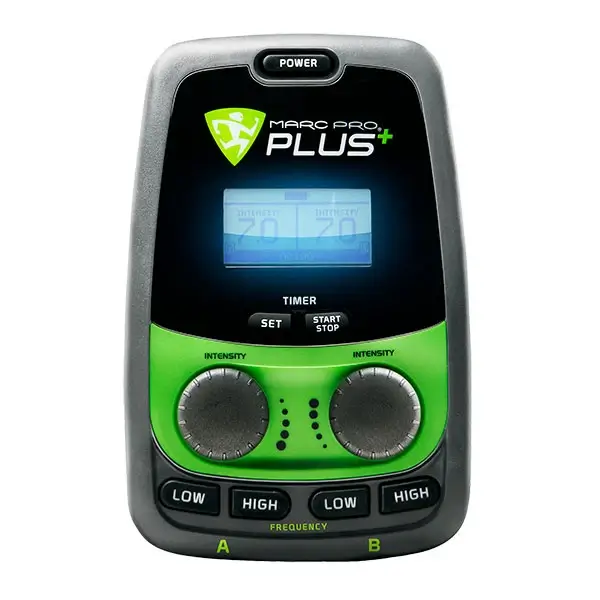
Marc Pro Plus Review: Does EMS Speed Recovery, and Is It Worth It?
The Marc Pro Plus promises recovery while you sit still. Athletes say they feel the difference, but controlled studies of electrical muscle stimulation mostly find little that can be measured.
Presented By Our Partners



In 2008, sport scientists in Rome gave ten young elite futsal players four ways to recover after a match: sitting, light exercise on land, exercise in water, or lying down under electrical muscle stimulation. On sprints, jumps, stress hormones and muscle pain, the four methods tied. The players disagreed. They scored stimulation 7.8 out of 10 for perceived benefit and seated rest 5.2 (Journal of Strength and Conditioning Research, 2008).
That gap, between how a recovery tool feels and what it measurably does, is the story of the Marc Pro Plus, the electrical muscle stimulator made by Marc Pro Inc. and still listed on the company’s online store as of October 2026.
The Marc Pro Plus is an electrical muscle stimulation (EMS) device that sends pulses through skin electrodes to make a muscle contract and relax in rhythm, with the goal of faster recovery and less pain. The company’s core claim is that its contractions are non-fatiguing: strong enough to push blood and fluid through tired muscle, gentle enough to add no new damage. The Plus adds a higher-frequency setting for pain relief and tight muscles. The idea makes physiological sense. Whether it beats lying on the couch is a harder question.
The short answer: The Marc Pro Plus is a well-built electrical muscle stimulator. It reliably makes muscles contract, and its Plus mode adds a pain-relief setting. Faster recovery is unproven: our PubMed searches found no published trial of the device itself, and reviews of recovery-style stimulation in general find small, mostly subjective benefits. Buy it for comfort and pain relief, not for a guaranteed edge.
- Best for: hard-training athletes who want a passive recovery routine they will actually use, and active adults who find electrical stimulation soothes exercise soreness.
- Not for: anyone expecting measurable performance gains, buyers who want strength-training EMS programs, or people with implanted cardiac devices who have not cleared it with their cardiologist.
- Price (October 2026): $1,399, or 12 monthly payments of $121.58, on Marc Pro’s official product page as of October 2026.
- Regulatory status: marketed by Marc Pro as an FDA-cleared muscle stimulator; we could not independently confirm the 510(k) number or cleared indications for the Plus model.
- Evidence: Limited; no published trial of this device turned up, and studies of similar stimulation show mixed, mostly perceptual effects on recovery.
What Is the Marc Pro Plus?
The Marc Pro Plus is a portable electrical muscle stimulator from Marc Pro Inc. that is sold for muscle recovery and pain relief. It has a control unit, lead wires, and adhesive electrode pads that go on the skin over the target muscle. It is sold directly online and through sports retailers. It records nothing and gives no score. Its only job is to make muscles move.
The product line has two tiers. The base Marc Pro delivers the company’s recovery stimulation, a slow rhythm of contractions meant to work a muscle without tiring it. The Plus adds a higher-frequency setting, which Marc Pro’s own guides describe as a way to relieve pain and help tight muscles release. The company’s comparison page sets the two side by side, with the Plus as the step up for people who also want pain management.
The marketing aims squarely at athletes. Marc Pro runs pages for golf and other sports, and the baseball development organization Perfect Game sells the device in its own online shop. Trade coverage in medical device press has featured the company under the banner of technologies Olympians love. None of that is evidence the device works. It does tell you who the device is built for: people who train hard enough that recovery feels like the thing holding them back.
How Does the Marc Pro Plus Work?
The Marc Pro Plus sends electrical pulses through the skin that fire the motor nerves feeding a muscle, so the muscle contracts without any effort from you. Repeated gentle contractions squeeze nearby veins and lymph vessels and push fluid back toward the heart. The pain setting uses faster pulses meant to change how pain signals are processed.
Start with the problem the device is trying to solve. Your calf is a second heart, of a sort. The veins deep in your lower leg have one-way valves, and every step squeezes the calf muscles around them, wringing blood upward against gravity. Physiologists call this the musculovenous pump. When you stop moving, the pump stops. After a hard session, the muscles you just damaged sit in a pool of slowly moving blood and fluid just when repair crews (white blood cells, nutrients, oxygen) need to reach them and debris needs to be cleared.
Electrical stimulation can start that pump without a step. A pulse from the electrode depolarizes the motor nerve, the nerve fires, and the muscle fibers it controls contract. Pulse after pulse, the calf squeezes and relaxes. In 2012, engineers at the National University of Ireland, Galway, measured this with Doppler ultrasound in healthy adults. Stimulating the soleus muscle alone pushed out 58.3 percent of the venous blood a full voluntary calf contraction expelled. Stimulating the soleus and tibialis posterior together pushed out 76.5 percent (IEEE Transactions on Neural Systems and Rehabilitation Engineering, 2012). Electrically driven contractions really do move blood, though less of it than your own muscles do.
Moving fluid has visible effects. In a 2003 crossover study at King’s College London, 20 healthy people stood still for 30 minutes, once with no help and once with electrical stimulation of the lower leg. Foot and ankle volume rose by an average of 51 mL without stimulation and 12 mL with it (Medicine and Science in Sports and Exercise, 2003). The stimulation largely prevented the swelling that standing still causes. That is the best-supported part of the Marc Pro story: stimulation can stand in for movement when you are not moving.
The Plus mode works on nerves rather than plumbing. Faster stimulation of the sensory nerves under the skin can dampen pain signals on their way to the spinal cord. This is the principle behind transcutaneous electrical nerve stimulation (TENS), the familiar pain unit sold in pharmacies. The evidence for TENS as a category is reasonably good. In a 2022 BMJ Open meta-analysis of 381 randomized trials with 24,532 participants, pain intensity during or right after TENS was lower than with placebo stimulation, with a standardized mean difference of minus 0.96 across 91 placebo-controlled trials (moderate-certainty evidence). That result covers TENS devices in general, not the Marc Pro Plus, and it measures relief during and right after use, not lasting healing.
Look closely at the logic, because this is where the marketing outruns the data. Every link in the chain is plausible: stimulation causes contraction, contraction moves blood, blood carries repair materials. What the chain does not prove is the last step, that better circulation in the hours after training makes you measurably readier for the next session. That has to be tested directly. It mostly has been, with generic stimulators, and the results are more modest than the logic suggests.
What Does the Research Show About EMS for Muscle Recovery?
Studies of electrical stimulation for recovery are small and mixed. People consistently say they feel better, but performance, muscle damage markers, and soreness usually match passive rest or light exercise. Our PubMed searches found no published trial of the Marc Pro device itself, so everything below comes from similar stimulation protocols, not this product.
The systematic reviews. In 2014, researchers in Liverpool and Dublin pooled every study they could find that used low-intensity, motor-threshold stimulation for recovery, the same category the Marc Pro belongs to. They found 13 studies, 11 of them randomized crossover trials. Three found a benefit for subjective muscle pain, three for blood lactate clearance, one for creatine kinase (a marker of muscle damage), and only one for a performance measure. Their meta-analysis found no advantage over active recovery for clearing lactate, and mixed results against passive rest. The authors concluded that although there may be some subjective benefits, the evidence is not convincing that stimulation improves later performance (Journal of Strength and Conditioning Research, 2014).
A larger 2018 meta-analysis from the University of Poitiers looked at 99 studies of post-exercise recovery methods, with electrostimulation among the search terms. Active recovery, massage, compression garments, water immersion, contrast water therapy, and cryotherapy all reduced delayed onset muscle soreness to some degree. Electrostimulation, one of the methods searched, was not on that list. Massage came out as the strongest single method for soreness and perceived fatigue (Frontiers in Physiology, 2018).
The newest review points the same way. A 2025 meta-analysis of 19 randomized trials with 672 healthy participants compared stimulation, pneumatic compression, and light therapy for recovery after muscle-damaging exercise. It found low-certainty evidence that stimulation did not reduce soreness right after treatment: the average difference was 4.6 points on the soreness scale, with a confidence interval running from a 20-point reduction to an 11-point increase (Journal of Bodywork and Movement Therapies, 2025). Put plainly, the effect could be helpful, harmful, or nothing, and the data cannot tell which.
The most encouraging trial. The strongest positive result comes from professional sport. In a randomized, counterbalanced study, 28 professional rugby and football academy players ran a session of repeated maximal sprints, then either wore a stimulation device for eight hours or went about their day. At 24 hours, jump height in the stimulation condition was 3.2 percent below baseline, compared with 7.2 percent in the control condition. Creatine kinase and perceived soreness were also lower. Blood lactate, testosterone, and cortisol did not differ (Journal of Science and Medicine in Sport, 2014). This is a real signal. There was no sham device, though, so the players knew when they were being stimulated, and nothing in the published abstract identifies the device as a Marc Pro.
Featured Partner
Invest in the Infrastructure Behind Modern Medicine
As healthcare expands beyond hospital walls, the buildings and campuses supporting that shift are generating compelling returns for investors who move early. The Healthcare Real Estate Fund offers qualified investors direct access to a curated portfolio of medical office, outpatient, and specialty care facilities.
Learn More →
The head-to-head trials. Other small, well-designed studies find stimulation roughly equal to its rivals. In a 2022 crossover trial of 15 recreational CrossFit athletes, 15 minutes of stimulation after a high-intensity session did no better than easy pedaling or total rest on lactate, muscle oxygen, soreness, or jump height. The only hint of an advantage was lower perceived exertion right afterward, a trend that did not reach statistical significance (Frontiers in Physiology, 2022). In a 2020 trial of nine endurance athletes doing two 5 km cycling time trials 45 minutes apart, the drop-off in the second trial was nearly identical whether athletes recovered with stimulation (5.4 seconds slower), active recovery (7.9 seconds), or ischemic preconditioning (6.1 seconds). Muscle blood volume rose by a similar 13 to 15 percent with all three (Journal of Sports Science and Medicine, 2020).
The perception effect. The futsal study in the opening was not an outlier. In a 2010 study of eight trained men, recovery methods made no difference to oxygen use, lactate, or afternoon performance after a morning run, yet 40 percent of participants picked electrostimulation as the most effective option (International Journal of Sports Medicine, 2010). Feeling recovered is not trivial. Mood, motivation, and willingness to train again all matter. But it is a different claim from faster tissue repair, and it is the claim the evidence actually supports.
Timing may matter. A 2021 meta-analysis that measured fatigue with electromyography rather than questionnaires found a trend toward benefit when stimulation was applied during exercise, but not after it (Frontiers in Bioengineering and Biotechnology, 2021). Marc Pro is built for use after exercise, which is the condition with the weaker data.
If you want a framework for weighing claims like these, our explainer on what “clinically validated” actually means covers why mechanism, marketing, and outcome trials are three different levels of proof.
What the Marc Pro Plus Gets Right
The Marc Pro Plus gets the physiology right in principle. It is designed for low-intensity, long-duration use rather than punishing strength contractions, it bundles a pain setting supported by the broader TENS literature, and it turns recovery into a habit you can do while reading or watching television.
It matches the stimulation to the goal. Much consumer EMS is built around strength programs: hard, tetanic contractions that tire a muscle on purpose. That is the opposite of what a muscle needs the day after a race. Marc Pro designed its stimulation around gentle, rhythmic work, the electrical version of an easy walk, which fits what the circulation studies show stimulation can actually do.
It can stand in for movement. The clearest benefit of stimulation in the literature is fluid management: preventing pooling and swelling when muscles are idle. For an athlete stuck on a long flight or bus ride, or a worker on their feet all day, that is a real use case, supported by measurements like the 2003 ankle volume study.
The pain setting has a good evidence base behind it. TENS-style stimulation is one of the better-studied drug-free pain tools, with a 381-trial meta-analysis showing short-term relief over placebo. Having that and recovery stimulation in one device means one purchase instead of two.
People like using it. Across the trials above, the one consistent finding is that athletes feel better after stimulation and rate it highly. A recovery tool you enjoy is one you will use, and a routine that brings you calmly back to the next session has value even if your blood markers look the same.
It stands alone. Unlike app-locked trackers and memberships, it is a self-contained stimulator, and the main recurring purchase is electrode pads.
Where the Marc Pro Plus Falls Short
The Marc Pro Plus is expensive for a category whose recovery benefits are mostly subjective, there is no published trial of the device itself, and its regulatory details are harder to verify than they should be. It also measures nothing, so you cannot check whether it is working for you.
No device-specific evidence. Marc Pro’s central claim is that its particular stimulation pattern is different from, and better than, generic EMS. That is testable. It would take a randomized trial comparing Marc Pro against a sham or a cheaper stimulator on outcomes like next-day performance. Our PubMed searches turned up no such trial. Until one exists, the claim of a unique waveform advantage rests on the company’s word and on athletes’ impressions.
The blinding problem. You can feel electrical stimulation, which makes true placebo control hard. Nearly every positive recovery study, including the professional rugby and football trial, compared stimulation with nothing rather than with a convincing fake. Given how strongly athletes rate stimulation in study after study, expectation is a serious alternative explanation for subjective improvements.
Regulatory fog. FDA regulates powered muscle stimulators through the 510(k) clearance pathway, under which a device is shown to be substantially equivalent to one already on the market. Clearance is about safety and equivalence, not proof of faster recovery. Marc Pro markets the device as FDA cleared, and public databases list FDA filings under the Marc Pro company name. We could not confirm the specific 510(k) number or cleared indications for the Plus model in this review. Ask the company for its K number and look it up in FDA’s database before you buy.
The price-to-evidence ratio. At $1,399 on Marc Pro’s official product page as of October 2026, the Marc Pro Plus costs several times more than generic stimulators that can also produce gentle contractions. The case for paying more rests on build quality, support, and the specific stimulation pattern, and the last of those is the part no trial has tested.
It measures nothing. The device has no sensors. It cannot tell you whether a session changed your heart rate variability, your soreness, or your readiness. If you want to test it on yourself, you need a separate tracker such as the WHOOP 5.0 and the patience to log a few weeks with and without the device.
Pads and wires. The electrodes are consumables that lose their stickiness with use, and the wired setup takes longer than slipping on compression boots. Each muscle group needs its own placement, so treating both legs and your back means repositioning pads.
Safety limits apply. Like all electrical stimulators, it should not be used over the front of the neck, across the chest, on broken skin, or by anyone with a pacemaker or implanted defibrillator without their cardiologist’s approval. If pain persists, worsens, or followed an injury, have a clinician assess it before you treat it yourself. The Healthcare Discovery doctor directory lists sports medicine and physical medicine specialists by state.
Marc Pro Plus vs Compex Sport Elite vs PowerDot 2.0 Duo vs Normatec 3 Legs
The Compex Sport Elite and PowerDot 2.0 Duo are general-purpose stimulators that cover strength, recovery, and pain. The Normatec 3 Legs uses air compression instead of electricity. The Marc Pro Plus is the most specialized of the four: built around low-intensity recovery stimulation, with a pain setting added.
| Feature | Marc Pro Plus | Compex Sport Elite 3.0 | PowerDot 2.0 Duo (Therabody) | Normatec 3 Legs (Hyperice) |
|---|---|---|---|---|
| How it works | Electrical muscle stimulation, wired pads | Electrical muscle stimulation, wired pads | Electrical stimulation from two smart pods (four channels) | Pneumatic compression boots that inflate in sequence |
| Main design goal | Gentle, non-fatiguing recovery contractions | Training and recovery programs | Smart recovery and strength programs | Flushing fluid from the legs after training |
| Pain relief mode | Yes, higher-frequency Plus setting | Yes, sold with a TENS kit | Yes, TENS and NMES | No |
| Strength training programs | No | Yes | Yes | No |
| Category evidence for faster recovery | Limited and mixed for recovery stimulation | Limited and mixed for recovery stimulation | Limited and mixed for recovery stimulation | Mixed; better circulation, little effect on soreness in pooled trials |
| Device-specific trial found | No | No | No | No |
If you want electrical stimulation for performance training as well as recovery, a multi-program stimulator such as the Compex Sport Elite or the app-driven PowerDot 2.0 Duo covers more ground, and both include pain-relief stimulation. If you mainly want the post-workout flush, the Normatec 3 Legs does it with air instead of current. Compression has its own mixed record: a 2025 randomized trial of 48 combat sport athletes found pneumatic compression improved tissue blood flow and muscle elasticity compared with passive rest (Scientific Reports, 2025), while the 2025 meta-analysis above found moderate-certainty evidence that it did not reduce soreness at 24 hours. Manual massage, the strongest method in the 2018 meta-analysis, is another option, and a percussive device like the Theragun PRO Gen 6 is the gadget version, though percussion and massage are not the same thing. You can compare more options in our recovery and readiness device reviews.
How Much Does the Marc Pro Plus Cost, and Is It HSA or FSA Eligible?
As of October 2026, Marc Pro’s official product page lists the Marc Pro Plus at $1,399, or 12 monthly payments of $121.58. Check Marc Pro’s store for promotions such as free shipping, which change often. Paid at once or in installments, the device is a one-time purchase, but electrode pads wear out and have to be replaced, and that cost adds up for daily users.
Insurance generally does not pay for consumer recovery devices bought for athletic use. HSA and FSA eligibility for electrical stimulators depends on your plan and on whether the device treats a medical condition. Some plan administrators ask for a letter of medical necessity from a clinician. We could not confirm Marc Pro’s HSA or FSA status as of October 2026, so ask your plan administrator before counting on pre-tax dollars. Keep the receipt and any clinician note together.
For value, the comparison is not just other stimulators. The recovery methods with the most consistent evidence in the 2018 meta-analysis (massage, compression garments, water immersion, and active recovery such as an easy spin) range from free to inexpensive. Spending $1,399 makes most sense if you have already handled those basics, train hard enough that recovery truly limits you, and value the ritual and pain relief for their own sake.
Who Should Use the Marc Pro Plus, and Who Should Skip It?
The Marc Pro Plus suits committed athletes and hard-training adults who want an easy, passive recovery routine and who also deal with exercise-related aches. Skip it if you want measurable performance gains, if your budget is better spent on sleep and coaching, or if your pain needs a diagnosis first.
Reasonable candidates:
- Athletes in heavy training blocks or crowded competition schedules who will use it consistently and value how it feels.
- Active adults with recurring exercise soreness who want a drug-free option and like electrical stimulation.
- People who sit or stand still for long stretches after training, such as travelers, and want help preventing leg swelling.
- Anyone who has already covered sleep, nutrition, and training load and is looking for a marginal, comfort-focused addition.
Better served by something else:
- Casual exercisers who already recover well between sessions: rest and an easy walk do much of the same work for free.
- Buyers who want strength-building EMS programs: a multi-program stimulator fits better.
- Anyone with new, sharp, or worsening pain, swelling after an injury, or numbness: see a clinician first.
- People with pacemakers, implanted defibrillators, or other implanted electronics, unless their cardiologist approves.
- Pregnant users, who should check with their obstetric clinician before using any electrical stimulator.
What This Means for You
Recovery is where training turns into fitness. Muscle fibers repair, capillaries multiply, mitochondria adapt, and over years that accumulated adaptation is one of the strongest defenses against the Silent Assassin, cardiovascular disease, and the Energy Arsonist, metabolic dysfunction. That is why recovery tools sell so well and why they deserve close scrutiny. We explain how training fits the wider fight against chronic disease in the Four Villains of Health and Longevity.
Seen through the Five Pillars, the Marc Pro Plus is an add-on to Movement, not a replacement for any pillar. Sleep does more for recovery than any device on this page, because it is when much of the repair the device hopes to speed up actually happens. Nutrition supplies the protein and energy that rebuild tissue. Breath and Mindset shape how stressed your body is between sessions. A $1,399 stimulator layered on top of short sleep and erratic eating is a fancy bandage on a structural problem.
The honest takeaway is simple. Electrical stimulation can move blood, prevent swelling, and dull pain, and athletes reliably feel better after it. What controlled trials have not shown is that it gets your muscles ready for the next hard session faster than easy movement or rest. Buy the Marc Pro Plus if you want that feeling and that relief, and if the price does not crowd out the basics. Do not buy it expecting a shortcut. In the Rome study, the players were right that the stimulation felt good. They were just measuring a different thing than the stopwatch was.
Frequently Asked Questions
Is the Marc Pro Plus Worth It?
It depends on what you want from it. The Marc Pro Plus is a well-made electrical muscle stimulator that athletes consistently rate highly, and its pain setting draws on a well-studied stimulation approach. But we found no published trial of the device itself, and studies of similar recovery stimulation show mostly subjective benefits. It is worth it for committed athletes who value comfort and pain relief, and less so for anyone expecting measurably faster recovery.
Does the Marc Pro Actually Speed up Muscle Recovery?
The evidence is weak. A 2014 systematic review of 13 studies of low-intensity recovery stimulation found occasional benefits for soreness and lactate but little effect on later performance. A 2025 meta-analysis found low-certainty evidence that stimulation did not reduce soreness. One trial in 28 professional players found better jump recovery at 24 hours, but it had no sham control, and none of these studies tested the Marc Pro itself.
Is the Marc Pro Plus FDA Cleared?
Marc Pro markets the device as FDA cleared, and FDA filings under the Marc Pro company name appear in public databases. We could not independently confirm the specific 510(k) number or cleared indications for the Plus model. FDA clearance of a muscle stimulator means it was found substantially equivalent to a device already on the market. It does not mean the FDA confirmed faster recovery. Ask the company for its K number to check.
Marc Pro vs a TENS Unit: What Is the Difference?
A TENS unit stimulates sensory nerves to reduce pain and usually does not make muscles contract strongly. The Marc Pro is a muscle stimulator designed to produce gentle, repeated contractions that act like a pump for blood and fluid. The Marc Pro Plus adds a higher-frequency setting for pain relief, so it covers both jobs. A basic TENS unit costs far less if pain relief is all you need.
Is the Marc Pro Plus HSA or FSA Eligible?
Possibly, depending on your plan. Eligibility for electrical stimulators often depends on whether the device treats a medical condition, and some plan administrators require a letter of medical necessity from a clinician. We could not confirm Marc Pro’s HSA or FSA status as of October 2026. Check with your plan administrator before buying, and keep the receipt and any clinician documentation together in case of review.
Marc Pro vs Normatec: Which Is Better for Recovery?
Neither has strong evidence for faster recovery. Normatec boots use air compression to squeeze fluid out of the legs. Marc Pro uses electrical stimulation to make muscles contract and do the squeezing. Pooled trials found neither reduced soreness much compared with rest, though compression improved tissue blood flow in some studies. Choose Normatec for an easy full-leg session and Marc Pro if you want targeted muscle work and a pain-relief mode.
Sources
- Tessitore A, et al. Effectiveness of active versus passive recovery strategies after futsal games. Journal of Strength and Conditioning Research, 2008. DOI
- Cortis C, et al. Effects of post-exercise recovery interventions on physiological, psychological, and performance parameters. International Journal of Sports Medicine, 2010. DOI
- Breen PP, et al. Comparison of single- and two-channel neuromuscular electrical stimulation sites for enhancing venous return. IEEE Transactions on Neural Systems and Rehabilitation Engineering, 2012. DOI
- Man IOW, et al. Effect of neuromuscular electrical stimulation on foot/ankle volume during standing. Medicine and Science in Sports and Exercise, 2003. DOI
- Johnson MI, et al. Efficacy and safety of transcutaneous electrical nerve stimulation (TENS) for acute and chronic pain in adults: a systematic review and meta-analysis of 381 studies. BMJ Open, 2022. DOI
- Malone JK, Blake C, Caulfield BM. Neuromuscular electrical stimulation during recovery from exercise: a systematic review. Journal of Strength and Conditioning Research, 2014. DOI
- Dupuy O, et al. An evidence-based approach for choosing post-exercise recovery techniques to reduce markers of muscle damage, soreness, fatigue, and inflammation: a systematic review with meta-analysis. Frontiers in Physiology, 2018. DOI
- Canez MS, et al. Effects of photobiomodulation, intermittent pneumatic compression and neuromuscular electrical stimulation on muscle recovery: systematic review with meta-analysis. Journal of Bodywork and Movement Therapies, 2025. DOI
- Taylor T, et al. The impact of neuromuscular electrical stimulation on recovery after intensive, muscle damaging, maximal speed training in professional team sports players. Journal of Science and Medicine in Sport, 2014. DOI
- Martínez-Gómez R, et al. Comparison of different recovery strategies after high-intensity functional training: a crossover randomized controlled trial. Frontiers in Physiology, 2022. DOI
- Paradis-Deschênes P, et al. Similar recovery of maximal cycling performance after ischemic preconditioning, neuromuscular electrical stimulation or active recovery in endurance athletes. Journal of Sports Science and Medicine, 2020. PubMed
- Hou X, et al. Effects of various physical interventions on reducing neuromuscular fatigue assessed by electromyography: a systematic review and meta-analysis. Frontiers in Bioengineering and Biotechnology, 2021. DOI
- Trybulski R, et al. Effect of pneumatic and cold compression on muscle performance and recovery in combat sports athletes. Scientific Reports, 2025. DOI
- U.S. Food and Drug Administration. Guidance document for powered muscle stimulator 510(k)s. FDA
- Marc Pro. Marc Pro Plus product page. marcpro.com
- Marc Pro. Compare Marc Pro. marcpro.com
- Marc Pro. How to use the Marc Pro Plus to effectively release muscles. marcpro.com
Marc Pro Plus at a glance
- Hardware price
- $1,399
- Subscription
- None required
- First year total
- $1,399
- Form factor
- EMS muscle recovery device
- FDA status
- Has FDA clearance
- HSA/FSA
- Possibly, with a letter of medical necessity
Measures Blood flow enhancement, Electrical muscle stimulation, Muscle recovery, Pain relief
Pricing verified October 20, 2026. Maintained in the Healthcare Discovery device database and updated automatically.


Similar Posts
GLP-1 Red Flags: When an Online Weight-Loss Offer Should Stop You
Six hard-stop safety signals and six serious caution flags to check before trusting an online GLP-1 medication offer.

The Glymphatic System: How Sleep Cleanses the Aging Brain and What 12 Years of Neuroscience Reveal About Dementia Prevention
In 2013, Maiken Nedergaard’s lab at the University of Rochester discovered that the brain runs a sleep-gated waste clearance network called the glymphatic system. Twelve years of follow up research,…

Whil Mindfulness: Enterprise-Grade Meditation and Resilience Training for the Workplace
How a purpose-built enterprise mindfulness platform differs from consumer meditation apps, and what the workplace wellness research actually supports Presented By Our Partners A 2025 analysis published by Carnegie Mellon…

Curcumin for Joint Pain: What 15 Trials Show (2026 Evidence Grade)
The best-supported curcumin claim, with a 16-week ceiling on what the trials can say. Presented By Our Partners Across 15 randomized trials enrolling 1,621 people with osteoarthritis, curcumin or Curcuma…
Garmin Epix Pro Gen 2: AMOLED Endurance Watch With FDA Cleared ECG and Advanced Navigation
Garmin’s premium AMOLED multisport watch pairs FDA cleared atrial fibrillation screening with deep training analytics, multi band GPS, and expedition grade durability in a display that finally matches the data…
AI-Designed Drugs Are Entering Human Trials: Inside the Quiet Pharmaceutical Revolution of 2026
For the first time in pharmaceutical history, molecules designed almost entirely by artificial intelligence are surviving Phase 2 trials in real patients. From Insilico’s rentosertib to Isomorphic Labs’ multi-billion dollar…
