
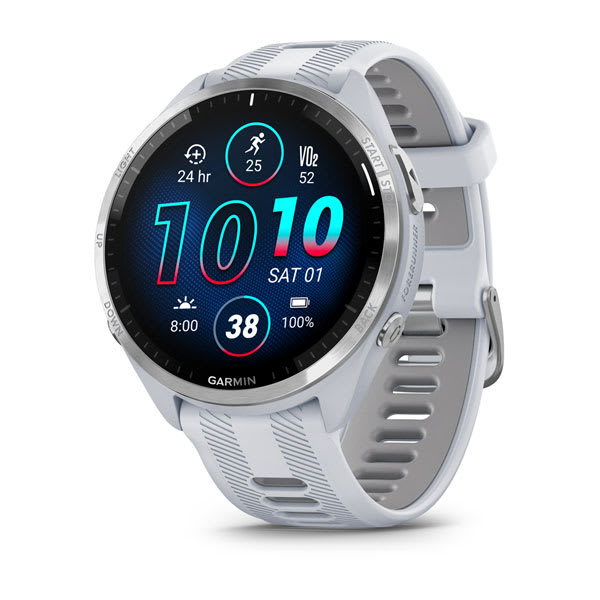
Garmin Forerunner 965 Review: The Most Accurate Wrist Based VO2 Max Estimate for Serious Endurance Athletes
Garmin’s flagship running watch pairs Firstbeat analytics with an AMOLED display to deliver the most comprehensive wrist based cardiorespiratory fitness tracking available.
Presented By Our Partners


Product status update, August 2026. This model has been superseded by the Garmin Forerunner 970 at $749.99, which has since been discounted to around $649.99.
VO2 max is the single most powerful predictor of all cause mortality ever identified. That is not an overstatement. A 2018 study published in JAMA Network Open by Mandsager et al. examined 122,007 patients who underwent treadmill stress testing at the Cleveland Clinic between 1991 and 2014 and found that cardiorespiratory fitness, measured as estimated VO2 max, was inversely associated with all cause mortality across every subgroup analyzed. The most striking finding: individuals in the lowest fitness quintile had a five fold higher mortality risk compared to the elite fitness group. Moving from “below average” to “above average” fitness reduced mortality risk by approximately 60 percent, an effect size that exceeds the benefit of virtually every pharmaceutical intervention in preventive medicine. A separate 2022 meta analysis published in the British Journal of Sports Medicine by Imboden et al. analyzed data from 199,265 participants and confirmed that each one MET increase in cardiorespiratory fitness was associated with a 7 to 17 percent reduction in all cause mortality.
If VO2 max is the metric that matters most, then the tool that tracks it most accurately has outsized importance. The Garmin Forerunner 965 is widely regarded as delivering the most reliable wrist based VO2 max estimate available in a consumer wearable.
What Is the Garmin Forerunner 965?
The Forerunner 965 is Garmin’s flagship multisport GPS watch, designed primarily for serious runners and triathletes but capable of tracking over 30 sport profiles. At its core is Garmin’s integration of Firstbeat Analytics, a Finnish sports science company acquired by Garmin in 2020 that has published over 200 peer reviewed studies validating its physiological algorithms. The watch estimates VO2 max using a combination of wrist based heart rate monitoring, GPS pace data, and Firstbeat’s proprietary algorithms that account for running economy, environmental conditions, and training history.
Beyond VO2 max, the Forerunner 965 tracks training load across three dimensions (aerobic, anaerobic, and low aerobic), estimates lactate threshold from heart rate and pace data, calculates running power from wrist dynamics, provides recovery time recommendations, and offers a Training Status metric that synthesizes all of these inputs into a single assessment of whether you are peaking, maintaining, overreaching, or detraining.
The hardware features a 1.4 inch AMOLED touchscreen display, multi band GPS for improved positioning accuracy, 32 GB of internal storage for maps and music, and a battery life of approximately 23 days in smartwatch mode or 31 hours in GPS mode. The watch retails at $599.99 with no subscription requirement. All analytics, training plans, and data features are included at the purchase price.
The Science Behind VO2 Max and Cardiorespiratory Fitness
VO2 max measures the maximum volume of oxygen the body can utilize during intense exercise, expressed in milliliters of oxygen per kilogram of body weight per minute (mL/kg/min). It reflects the integrated capacity of the cardiovascular system (cardiac output), respiratory system (oxygen exchange), and muscular system (oxygen extraction and utilization). Higher VO2 max values indicate a more efficient cardiovascular system, greater mitochondrial density in muscle tissue, and superior metabolic capacity.
The Mandsager et al. 2018 study in JAMA Network Open established the mortality gradient with exceptional clarity. Among 122,007 patients, the hazard ratio for all cause mortality was 5.04 for the lowest fitness quintile compared to the elite group, after adjusting for age, sex, BMI, diabetes, hypertension, smoking, coronary artery disease, and end stage renal disease. Notably, there was no upper limit of fitness above which benefit plateaued. Even “elite” fitness (above the 97.7th percentile) was associated with lower mortality than merely “high” fitness. This challenges the common assumption that extreme fitness carries diminishing returns.
Cardiorespiratory fitness connects directly to all four of The Four Villains in Healthcare Discovery‘s longevity framework. Cardiovascular disease: higher VO2 max reflects superior cardiac function, lower resting heart rate, improved endothelial function, and reduced arterial stiffness. Cancer: higher fitness is associated with reduced cancer incidence and improved cancer survival, likely through improved immune surveillance and reduced systemic inflammation. Neurodegenerative disease: cardiorespiratory fitness is strongly associated with greater hippocampal volume and reduced dementia risk, as demonstrated by a 2014 study in Annals of Internal Medicine. Metabolic dysfunction: VO2 max is inversely correlated with insulin resistance, visceral fat, and metabolic syndrome prevalence.
Wrist based VO2 max estimation has been validated against laboratory gold standard measurements (mask based metabolic analyzers). A 2022 validation study by Passler et al. published in the International Journal of Environmental Research and Public Health found that Garmin’s Firstbeat derived VO2 max estimates correlated with laboratory measurements at r = 0.87 to 0.93, with a mean absolute error of approximately 2.5 to 3.5 mL/kg/min. This makes wrist based estimation suitable for tracking trends over time, though it should not be treated as equivalent to a clinical measurement for diagnostic purposes.
What the Forerunner 965 Does Well
The Forerunner 965’s primary advantage is the depth and sophistication of its physiological analytics. This is not a step counter that also estimates VO2 max. The Firstbeat engine processes heart rate variability, pace dynamics, and environmental data through algorithms refined across two decades of sports science research. The Training Status metric, which synthesizes VO2 max trends, training load balance, recovery status, and sleep quality into a single actionable assessment, represents the most integrated view of athletic readiness available in any consumer wearable.
The three dimensional training load model (aerobic high, aerobic low, and anaerobic) provides nuanced guidance that prevents the common error of training too hard on easy days and too easy on hard days. This polarized training approach is increasingly supported by the exercise science literature as optimal for endurance performance development.
Lactate threshold estimation from heart rate and pace data provides a meaningful training intensity benchmark without requiring laboratory testing. While less precise than a blood lactate test, the wrist based estimate is accurate enough to set training zones and track threshold improvement over time.
Multi band GPS significantly improves position accuracy in challenging environments (urban canyons, dense tree cover, mountainous terrain), which in turn improves pace accuracy and, by extension, the reliability of the VO2 max estimation algorithm.
Featured Partner
Invest in the Infrastructure Behind Modern Medicine
As healthcare expands beyond hospital walls, the buildings and campuses supporting that shift are generating compelling returns for investors who move early. The Healthcare Real Estate Fund offers qualified investors direct access to a curated portfolio of medical office, outpatient, and specialty care facilities.
Learn More →
The AMOLED display is the best screen in any Garmin watch, providing vibrant data visualization in all lighting conditions. At 32 GB of storage, the watch holds full topographic maps, turn by turn course navigation, and several thousand songs for phone free running.
Pricing, Access, and Practical Realities
The Forerunner 965 retails at $599.99 with no subscription fee. All training analytics, VO2 max estimation, training load tracking, and recovery metrics are included at purchase. Garmin Connect, the companion app and web platform, is free. This subscription free model is a significant advantage over competitors that gate advanced metrics behind monthly fees.
The device is classified as a general wellness product. Its VO2 max estimate is not FDA cleared for clinical use and should not be used for medical diagnosis. The VO2 max estimation is most accurate for running and cycling; it is less validated for other activities. Users should understand that the estimate represents an approximation suitable for trend tracking, not a clinical measurement.
HSA and FSA eligibility has been confirmed by some users for fitness wearables with a letter of medical necessity, though this varies by plan administrator.
Battery life is excellent for a full featured AMOLED smartwatch: approximately 23 days in smartwatch mode, 31 hours with GPS, and up to 10 days with always on display. For ultramarathon and multi day events, a UltraTrac power saving mode extends GPS recording significantly at the cost of reduced sampling frequency.
The watch pairs with Garmin’s ecosystem of chest strap heart rate monitors, running dynamics pods, power meters, and environmental sensors. The wrist based heart rate sensor is adequate for most training, but a chest strap improves accuracy during high intensity intervals and is recommended for users who want the most precise VO2 max and threshold estimates.
Who the Forerunner 965 Is Best For
The Forerunner 965 is best suited for serious endurance athletes who train with structure and want data driven guidance on training load, recovery, and fitness progression. Runners training for marathons, ultramarathons, or sub qualifying times will find the training load, threshold, and VO2 max metrics directly actionable. Triathletes benefit from the multisport profiles and the ability to track VO2 max trends across running and cycling. Coaches who use Training Peaks, Strava, or Garmin Connect for athlete management will find the Forerunner 965’s data export comprehensive and well integrated.
Health conscious individuals who view cardiorespiratory fitness as a longevity metric (as the Mandsager et al. research strongly supports) will find the VO2 max trend tracking motivating and informative, even if they are not competitive athletes.
Those who may want to look elsewhere include casual fitness users who do not need the depth of training analytics (the Garmin Venu series or Apple Watch provides sufficient fitness tracking at lower cost). Tech enthusiasts who prioritize smartphone integration, app ecosystem, and smart home features may prefer the Apple Watch, which offers a broader lifestyle feature set at the expense of training depth. Budget conscious buyers should consider the Garmin Forerunner 265, which shares most core training features at approximately $450.
How the Forerunner 965 Compares
Against the Apple Watch Series 9 ($399 to $499), the Forerunner 965 delivers significantly more sophisticated training analytics: three dimensional training load, lactate threshold estimation, Training Status, running power, and race predictions. Apple Watch offers a basic VO2 max estimate (Cardio Fitness) that is less frequently updated and less nuanced. Apple Watch excels in general smartwatch features (notifications, apps, cellular connectivity, health monitoring breadth) while the Forerunner 965 excels in sport science depth. For runners and endurance athletes, the Forerunner 965 is clearly superior. For general health consumers who also run occasionally, Apple Watch may be the better all around choice.
Against the Polar Vantage V2 ($499.95), the Forerunner 965 offers a superior display (AMOLED versus MIP), more internal storage, and a wider range of daily smartwatch features. Polar’s training analytics are comparable in depth, with strong recovery metrics and a Training Load Pro system that rivals Garmin’s. Polar’s Precision Prime optical heart rate sensor is well regarded. The choice often comes down to ecosystem preference and display quality, where Garmin has the advantage.
Against the COROS PACE 3 ($299), the Forerunner 965 costs twice as much but delivers more advanced analytics, a better display, and more storage. COROS offers exceptional battery life and increasingly competitive training features at a price point that challenges the need for a $600 watch for many athletes.
Limitations and Open Questions
Wrist based VO2 max estimation, even from Garmin’s best algorithm, is not a clinical measurement. The 2.5 to 3.5 mL/kg/min mean absolute error means that your displayed VO2 max could be several points above or below your true value. This is acceptable for tracking trends over months and years but should not be used for precise comparisons with laboratory tested values or with other athletes using different wearable brands.
The optical heart rate sensor, while improved in the Forerunner 965, is still subject to the limitations of wrist based photoplethysmography: reduced accuracy during high intensity intervals, cold conditions, and activities with significant wrist movement. A chest strap heart rate monitor remains more accurate for interval training, threshold testing, and any activity where heart rate precision matters for the analytics.
At $599.99, the Forerunner 965 represents a premium investment. Many of its core training features (VO2 max estimation, training load, recovery) are available in the $300 to $450 Garmin range (Forerunner 265, Forerunner 955). The 965’s premium buys the AMOLED display, additional storage, and incremental analytics refinements that may not justify the price difference for all users.
The device generates enormous amounts of data, which can lead to analysis paralysis for less experienced athletes. The abundance of metrics (Training Status, Body Battery, HRV Status, Training Readiness, Sleep Score, VO2 max, Training Load) can be overwhelming without the knowledge to interpret and prioritize them.
What This Means for Your Health
If there is one metric that every adult should track, the evidence points to cardiorespiratory fitness. The Mandsager et al. data from 122,007 patients is unambiguous: moving from low fitness to moderate fitness produces a mortality risk reduction that exceeds virtually every pharmaceutical intervention studied. And unlike blood biomarkers or genetic tests, cardiorespiratory fitness is modifiable through training. VO2 max can be improved at any age through consistent cardiovascular exercise, with the most significant improvements occurring in the least fit individuals.
Within HealthcareDiscovery.ai’s Five Pillars, the Forerunner 965 is fundamentally a Movement pillar tool. It quantifies the dimension of movement that matters most for longevity (cardiorespiratory capacity), tracks progress over time, and provides training guidance designed to improve it. The recovery and sleep metrics support the Sleep pillar by quantifying rest quality and advising on training readiness. HRV tracking supports the Breathwork pillar by providing a window into autonomic nervous system balance that can be influenced through deliberate breathing practices.
The Four Villains (cardiovascular disease, cancer, neurodegenerative disease, metabolic dysfunction) are all modifiable through cardiorespiratory fitness improvement. A wearable that accurately tracks VO2 max and provides the training guidance to improve it is, by the evidence, one of the most health relevant technologies available at any price. The Garmin Forerunner 965 does this better than any other wrist based device currently on the market.
The most important feature of the Forerunner 965 is not the AMOLED screen or the multi band GPS. It is the VO2 max trend line on your Garmin Connect dashboard, and whether that line is going up.

Explore the full wearable guide
Garmin Forerunner 965 is one piece of a much larger wearable health landscape. For a broader comparison of smartwatches, rings, glucose monitors, sleep trackers, recovery tools, and clinical-grade devices, see the full HealthcareDiscovery.ai guide to wearable health technology.
Frequently Asked Questions
How accurate is the Garmin Forerunner 965 VO2 max estimate?
A 2022 validation study by Passler et al. published in the International Journal of Environmental Research and Public Health found that Garmin’s Firstbeat derived VO2 max estimates correlated with laboratory measurements at r = 0.87 to 0.93, with a mean absolute error of approximately 2.5 to 3.5 mL/kg/min. This means the watch’s estimate may be a few points above or below your true VO2 max, but it is reliable for tracking trends over time. For the most accurate readings, use a chest strap heart rate monitor and run on flat terrain in consistent conditions.
Does the Garmin Forerunner 965 require a subscription?
No. All training analytics, VO2 max estimation, training load tracking, recovery metrics, maps, and data features are included with the $599.99 purchase price. Garmin Connect (the companion app and web platform) is free with no premium tier. This is a significant advantage over competitors like Fitbit (which gates some health metrics behind Fitbit Premium at $9.99/month) and WHOOP (which operates on a subscription only model). The Forerunner 965 has no recurring costs beyond the initial purchase.
What is a good VO2 max score?
VO2 max varies by age and sex. For men aged 30 to 39, average is approximately 38 to 42 mL/kg/min, “good” is 43 to 48, and “excellent” is above 48. For women of the same age, average is approximately 30 to 34, “good” is 35 to 40, and “excellent” is above 40. Elite endurance athletes often exceed 60 to 70 mL/kg/min. The Mandsager et al. 2018 study of 122,007 patients found that individuals in the lowest fitness quintile had a five fold higher mortality risk compared to the elite group, making VO2 max improvement one of the most impactful health interventions available regardless of starting point.
How does the Forerunner 965 compare to the Forerunner 265?
The Forerunner 265 ($449.99) shares most of the 965’s core training features including VO2 max estimation, Training Status, training load, and Morning Report. The 965 adds a larger 1.4 inch AMOLED display (versus 1.3 inch on the 265), 32 GB of storage (versus 8 GB), full map navigation with TopoActive maps, multi band GPS for superior position accuracy, and a titanium bezel option. For runners who primarily want training analytics and do not need maps or extensive music storage, the Forerunner 265 delivers approximately 90 percent of the 965’s capability at 75 percent of the price.
Can I improve my VO2 max at any age?
Yes. While VO2 max naturally declines with age (approximately 1 percent per year after age 25 in sedentary individuals), it is highly trainable at any age. Studies have shown that previously sedentary adults in their 60s and 70s can improve VO2 max by 15 to 25 percent with consistent aerobic training. The greatest improvements occur in the least fit individuals. High intensity interval training (HIIT) has been shown to produce larger VO2 max improvements than moderate continuous training across all age groups. The Garmin Forerunner 965 tracks your VO2 max trend over time, providing objective feedback on whether your training is producing the desired improvement.


Similar Posts

Everlywell Women’s Health Test: Accessible Hormone Panels for Metabolic and Reproductive Insight
The most common endocrine disorders affecting women, thyroid dysfunction and hormonal imbalance, are also among the most treatable when caught early enough to intervene. Presented By Our Partners Subclinical hypothyroidism…
Alice 6 LDx PSG System: The Definitive Polysomnography Platform for Sleep Laboratories
Every night, roughly 70 million Americans struggle with a sleep disorder, yet the diagnostic gold standard for unraveling what happens in their brains after lights out has remained fundamentally the…

The Race to Replace Lost Neurons: How Stem Cell Therapies, Genetic Targeting, and a New Class of Oral Drugs Are Rewriting the Parkinson’s Playbook
For the first time in Parkinson’s disease history, three distinct therapeutic frontiers are advancing simultaneously through late-stage clinical trials. Stem cell grafts are surviving in human brains and restoring dopamine…

The $2,500 MRI Question: Why Healthcare Prices Still Hide in Plain Sight
Why the same MRI can be a medical miracle, a billing maze, and a test case for whether healthcare price transparency can actually help patients before they book care.
Klotho’s First Human Trial: Inside the 2026 Cognitive Aging Bet
Almost three decades after Makoto Kuro-o named the protein after the Greek Fate of life, UCSF’s Dena Dubal has launched the first human trial of klotho. Inside the cell biology,…
Plunge Cold Plunge Tub Review: Electric Cold Water Immersion for Recovery, Inflammation, and Mental Resilience
The Plunge delivers consistent, temperature controlled cold water immersion without the ice runs, bringing clinical grade cold exposure to the home recovery protocol. Presented By Our Partners Cold water immersion…
