
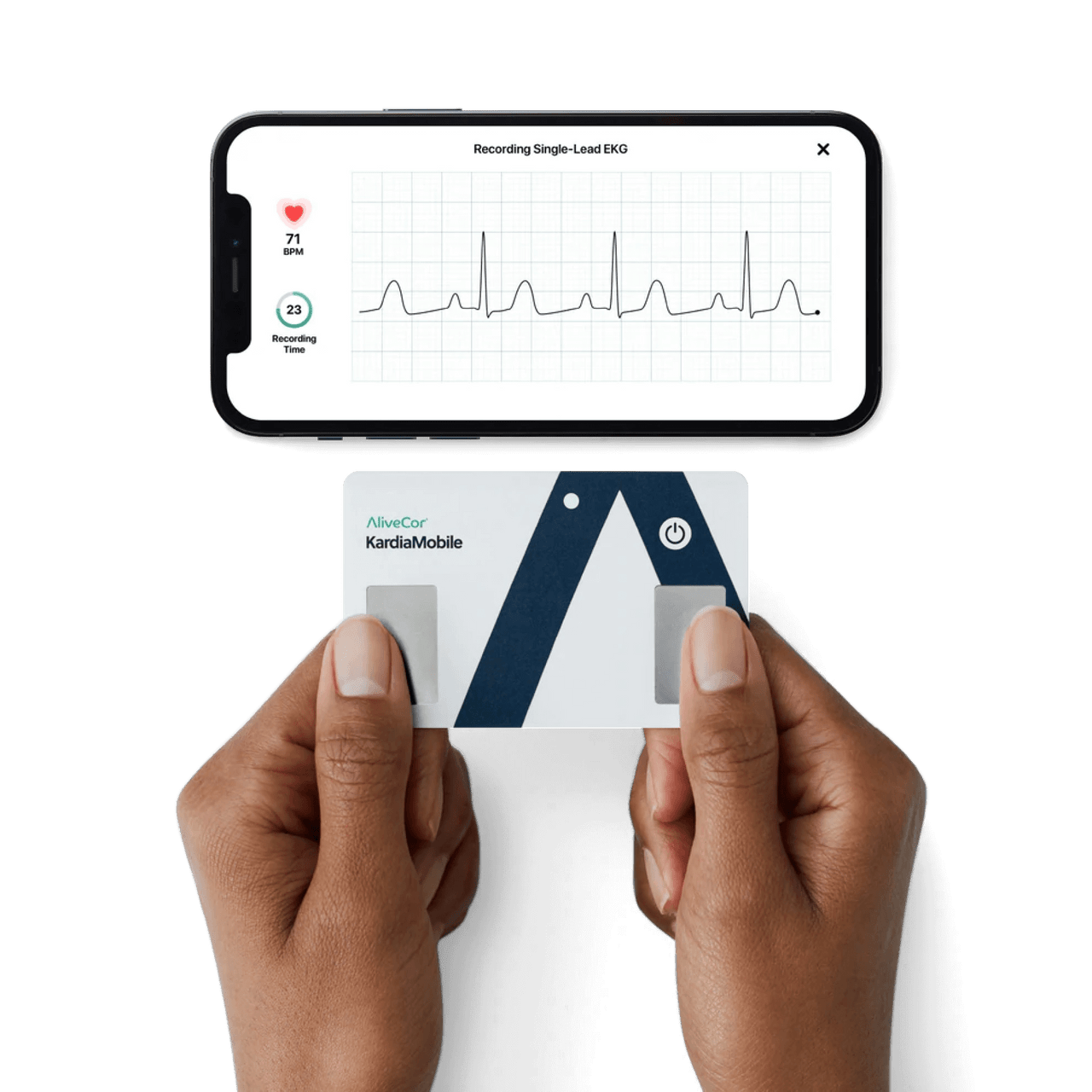
AliveCor KardiaMobile Card: The Credit Card ECG That Fits in Your Wallet
An FDA cleared single lead ECG the size and thickness of a credit card, designed for people who need cardiac monitoring but refuse to carry one more gadget.
Presented By Our Partners



The most powerful medical device in the world is useless if it stays in a drawer. This is the fundamental problem with every health monitoring tool that requires deliberate effort to carry, charge, and deploy. Consumer ECG devices have made remarkable progress in clinical capability, but adoption still depends on one question: will this person actually have it with them when symptoms strike?
Atrial fibrillation episodes are unpredictable. Palpitations can hit during a business dinner, on a morning walk, at 3 AM, or during a flight. The clinical value of a personal ECG depends entirely on proximity: the device must be within arm’s reach at the moment a cardiac event occurs. AliveCor’s original KardiaMobile solved the portability problem for pocket carriers. The KardiaMobile Card takes it further, engineering the same FDA cleared ECG technology into a form factor that slides into a credit card slot in your wallet.
The logic is simple. Your wallet is the one thing, aside from your phone, that you carry everywhere, every day, without exception. A medical grade ECG that lives in your wallet is a medical grade ECG that is always available.
What Is the AliveCor KardiaMobile Card?
The AliveCor KardiaMobile Card is an FDA cleared single lead ECG device engineered into a form factor measuring 84mm x 54mm x 5mm, approximately the dimensions of two stacked credit cards. It weighs 25 grams. The device features two metal electrode pads on its surface; the user places thumbs from each hand on the electrodes, and the Card records a 30 second single lead electrocardiogram transmitted via Bluetooth to the Kardia app on a paired smartphone.
The Card detects atrial fibrillation, bradycardia, tachycardia, and normal sinus rhythm, providing the same algorithmic classifications as the standard KardiaMobile. It uses a rechargeable battery rather than a coin cell, lasting approximately one week per charge (roughly 50 recordings), and charges via a magnetic USB cable included with the device.
The Kardia app provides immediate rhythm analysis, stores all recordings with timestamps, and enables PDF sharing with healthcare providers. The optional KardiaCare subscription ($9.99 per month or $99 per year) adds enhanced reporting and unlimited storage. Core ECG recording and arrhythmia detection work without any subscription. The Card retails at $149 and is confirmed HSA and FSA eligible.
The Science Behind Always Available ECG Monitoring
The clinical utility of personal ECG devices depends on two variables: diagnostic accuracy and usage frequency. The BASEL Wearable Study published in 2023 in JACC: Clinical Electrophysiology demonstrated that the AliveCor platform achieves 79% sensitivity and 69% specificity for automated AFib detection, with physician review resolving 99% of inconclusive tracings. That diagnostic capability is constant across AliveCor’s product line; the standard KardiaMobile, 6L, and Card all use the same core detection algorithms for single lead analysis.
Usage frequency, however, varies dramatically based on form factor. A device that requires remembering to carry it, finding space for it, and consciously bringing it along will inevitably be absent during some fraction of symptomatic episodes. Research on medication adherence and device compliance consistently demonstrates that reducing friction, even small amounts, produces meaningful improvements in consistent use.
The KardiaMobile Card’s design philosophy applies this compliance principle to ECG monitoring. By eliminating the need for a separate carrying decision (the wallet is already coming with you), the Card maximizes the probability that the device is available during a symptomatic event. For patients with paroxysmal AFib, where episodes may occur weeks or months apart and without warning, this constant availability can be the difference between capturing and missing a diagnostic recording.
A 2022 review in Nature Reviews Cardiology by Schutte et al. noted that novel wearable monitoring technologies offer advantages for both researchers and patients by enabling assessment of cardiovascular parameters during daily activities and over extended periods. The Card embodies this principle at its most practical: monitoring capability that integrates into existing daily habits rather than requiring new ones.
What the AliveCor KardiaMobile Card Does Well
The Card’s defining strength is its form factor. No other FDA cleared medical device fits in a credit card slot. This is not a marketing gimmick; it is a genuine engineering achievement that solves the compliance problem for users who refuse to carry additional devices. The 25 gram weight and 5mm thickness mean it adds essentially no bulk to a standard wallet.
Bluetooth connectivity is an improvement over the standard KardiaMobile’s ultrasonic communication. Bluetooth is more reliable across diverse environments and eliminates the ambient noise sensitivity that can interfere with ultrasonic transmission in loud settings. Pairing is straightforward and persistent once established.
The rechargeable battery eliminates the need for coin cell replacement, though it introduces a weekly charging requirement. For users who charge devices daily as part of their routine, the weekly charge cycle is unobtrusive. The magnetic charging cable provides a secure connection without requiring precise alignment.
Featured Partner
Invest in the Infrastructure Behind Modern Medicine
As healthcare expands beyond hospital walls, the buildings and campuses supporting that shift are generating compelling returns for investors who move early. The Healthcare Real Estate Fund offers qualified investors direct access to a curated portfolio of medical office, outpatient, and specialty care facilities.
Learn More →
The Card shares the same Kardia app ecosystem as all AliveCor products, meaning recordings are stored alongside any data from a standard KardiaMobile or 6L. Users who own multiple AliveCor devices can use whichever is most convenient in the moment, with all recordings unified in a single timeline. PDF sharing and physician reporting work identically across the product line.
Pricing, Access, and Practical Realities
The AliveCor KardiaMobile Card retails at $149, the same price as the KardiaMobile 6L. This pricing creates an interesting decision for prospective buyers: the same investment buys either the most diagnostically capable consumer ECG (6L, with six leads) or the most portable consumer ECG (Card, wallet sized). The choice depends on whether the user prioritizes diagnostic depth or constant availability.
No subscription is required for core ECG recording and arrhythmia detection. The optional KardiaCare subscription ($9.99 per month or $99 per year) adds medication tracking, monthly reports, and unlimited storage. First year total cost ranges from $149 to $249.
The Card is confirmed HSA and FSA eligible with a Letter of Medical Necessity. FDA 510(k) clearance covers the same arrhythmia determinations as the standard KardiaMobile: atrial fibrillation, bradycardia, tachycardia, and normal sinus rhythm. The Card does not detect PVCs or SVE, which are available only on the 6L model.
The rechargeable battery lasts approximately one week per charge with typical use (about 50 recordings). The magnetic USB charging cable is proprietary. Users should keep the cable in a consistent location to avoid the common problem of misplacing proprietary chargers.
Who the AliveCor KardiaMobile Card Is Best For
The Card is ideal for users who need an ECG device that is truly always with them. Frequent travelers, professionals who cannot carry additional medical devices during business engagements, and anyone who has purchased a personal ECG device in the past but found themselves not carrying it consistently will benefit from the wallet form factor.
Patients with infrequent, unpredictable paroxysmal AFib episodes represent the core clinical use case. When episodes occur weeks apart and without pattern, the probability of having a recording device available is directly proportional to how seamlessly it integrates into daily carry. The Card maximizes this probability.
Users who value diagnostic depth over portability should choose the KardiaMobile 6L instead. The Card provides a single lead recording; the 6L provides six leads with PVC detection at the same price point. For users who will consistently carry either device, the 6L provides more clinical information per recording. The Card’s advantage manifests specifically when the alternative is not carrying any ECG device at all.
Users who want passive, continuous rhythm monitoring should consider a smartwatch with ECG capability. The Card, like all AliveCor products, requires intentional recording sessions and cannot detect events between recordings.
How the AliveCor KardiaMobile Card Compares
Against the standard AliveCor KardiaMobile ($99), the Card offers a thinner, wallet friendly form factor and Bluetooth connectivity at a $50 premium. Both provide single lead ECG with identical detection capabilities. The standard model uses a coin cell battery lasting 12 months; the Card uses a rechargeable battery lasting one week. For users who prioritize the lowest price and longest battery life, the standard model wins. For users who prioritize ultimate portability, the Card wins.
Against the AliveCor KardiaMobile 6L ($149), the comparison is form factor versus function. Both cost $149. The 6L captures six leads with PVC detection; the Card captures one lead in a wallet sized package. These are fundamentally different products serving different priorities. Users who can carry either device reliably should choose the 6L for superior clinical data. Users who realistically will only carry a wallet sized device should choose the Card.
Against the Apple Watch ECG, the Card provides on demand ECG recording in a device that never needs to be worn. It complements rather than competes with smartwatch ECGs: the Apple Watch provides continuous passive monitoring, while the Card provides a backup recording option that lives in the wallet rather than on the wrist.
Limitations and Open Questions
The Card provides a single lead ECG only, which means it captures less diagnostic information than the 6L at the same price point. For the same $149 investment, users who consistently carry devices in their pocket gain more clinical value from the 6L. The Card’s advantage is purely a form factor play, and that advantage matters only for users whose compliance depends on wallet integration.
The rechargeable battery introduces a weekly charging requirement that the standard KardiaMobile’s coin cell does not. Users who are inconsistent with charging routines may find the Card dead at the moment they need it. There is some irony in solving the “device not available” problem with a form factor that introduces a “device not charged” problem.
At 5mm thick, the Card adds noticeable thickness to a wallet’s credit card stack. Users with already stuffed wallets or slim wallet designs may find the fit impractical. The device also cannot be placed in automated card readers, ticket machines, or anywhere it might be confused with an actual credit card, which is a minor practical consideration.
Like all on demand ECG devices, the Card cannot detect arrhythmias between recording sessions. It does not provide continuous monitoring, event triggered recording, or any passive screening capability.
What This Means for Your Health
Cardiovascular disease is one of the Four Villains, and the AliveCor KardiaMobile Card represents perhaps the most elegant solution to a simple but critical problem: having a medical grade ECG device available at the exact moment you need it. The science is clear that early detection of atrial fibrillation reduces stroke risk by enabling timely anticoagulation therapy. The engineering challenge is not building a better ECG; it is building one you will actually have with you.
Within Healthcare Discovery‘s Five Pillars framework, the Card supports the Mindset pillar most directly. The peace of mind that comes from knowing you can capture an ECG within seconds, anywhere, is a meaningful reduction in health related anxiety for patients living with cardiac risk factors. When palpitations strike, reaching for your wallet is an instinctive response that produces diagnostic data instead of diagnostic uncertainty.
The practical advice is straightforward: if you own any AliveCor device and find yourself not carrying it consistently, the Card may solve that problem. If you do not currently own a personal ECG device and your cardiologist has recommended one, consider whether the Card’s constant availability outweighs the 6L’s diagnostic depth for your specific situation. For many patients, the best ECG device is not the most clinically advanced one; it is the one that is actually in your hand when you need it.

Explore the full wearable guide
See how the AliveCor KardiaMobile Card compares with smart rings, watches, ECG devices, and other connected health hardware across the full Healthcare Discovery wearables guide.
Frequently Asked Questions
How thin is the AliveCor KardiaMobile Card?
The KardiaMobile Card measures 84mm x 54mm x 5mm and weighs 25 grams. It is approximately the thickness of two stacked credit cards and fits into a standard credit card slot in most wallets. It is the thinnest FDA cleared ECG device currently available.
Is the AliveCor KardiaMobile Card FDA cleared?
Yes. The KardiaMobile Card holds FDA 510(k) clearance for detecting atrial fibrillation, bradycardia, tachycardia, and normal sinus rhythm. It uses AliveCor’s proven single lead ECG technology, the same platform that has been validated in multiple clinical studies including the BASEL Wearable Study.
How does the KardiaMobile Card compare to the 6L?
Both devices cost $149. The 6L captures six ECG leads and detects PVCs and SVE in addition to AFib, bradycardia, and tachycardia. The Card captures one lead and detects AFib, bradycardia, tachycardia, and normal sinus rhythm in a credit card form factor. The 6L provides more diagnostic information; the Card provides greater portability. Your choice depends on whether you prioritize clinical depth or constant availability.
How long does the KardiaMobile Card battery last?
The Card uses a rechargeable battery that lasts approximately one week per charge, which translates to roughly 50 ECG recordings. It charges via a proprietary magnetic USB cable. Unlike the standard KardiaMobile (which uses a 12 month coin cell battery), the Card requires weekly charging to remain functional.
Does the KardiaMobile Card work without a smartphone?
No. The KardiaMobile Card requires a paired smartphone with the Kardia app installed for all functionality, including ECG recording, rhythm analysis, data storage, and physician reporting. The device connects via Bluetooth and has no built in display or standalone recording capability.
AliveCor KardiaMobile Card at a glance
- Hardware price
- $149
- Subscription
- $119.88 per year
- First year total
- $268.88
- Form factor
- Credit card-sized ECG
- FDA status
- Has FDA clearance
- HSA/FSA
- Possibly, with a letter of medical necessity
Measures AFib, Bradycardia, ECG, Normal sinus rhythm, Tachycardia
Maintained in the Healthcare Discovery device database and updated automatically.


Similar Posts

BodySpec Mobile DEXA: Gold Standard Body Composition and Bone Density Scanning
When clinical precision matters more than convenience, DEXA remains the measurement against which every consumer device is judged. BodySpec brings that standard directly to you. Presented By Our Partners In…
GlycanAge: Measuring Biological Age Through Your Immune System’s Sugar Coating
While most biological age tests measure DNA methylation, GlycanAge uses a fundamentally different biomarker: the sugar molecules coating your antibodies. This glycan-based approach reveals immune system aging in a way…

The Daily Rounds: Longevity & Health Care Brief | April 9, 2026
🧬 Aging Reframed as Coordination Failure: Scientists at the World Longevity Congress are shifting from single-target anti-aging interventions toward restoring coordination across the body's biological systems. ❤️ Long COVID and the Heart: A 1.2-million-person Swedish study confirms long COVID significantly raises cardiovascular disease risk, including in younger non-hospitalized adults, with women facing more than double the risk. 🤖 AI Hits a Clinical Milestone: With 173 AI-discovered drugs now in clinical trials and Insilico's AI-designed pulmonary fibrosis drug showing Phase IIa efficacy, generative AI in medicine has arrived at clinical scale. 🦠 Fasting for Gut Health: Just five days per month of low-calorie plant-based eating reduced gut inflammation and achieved clinical response in nearly 70% of Crohn's disease patients in a Nature Medicine randomized trial. 😴 Circadian Health and Cancer: New ACS-funded research at Fred Hutch will investigate whether night-shift-driven solar jet lag is a driver of liver cancer, reinforcing circadian alignment as a cancer prevention frontier.
Moxy Monitor: Real-Time Muscle Oxygen Saturation for Training Zone Precision
Heart rate tells you how hard your cardiovascular system is working. Muscle oxygen tells you how hard your muscles are actually working, and more importantly, when they are about to…

Slow Breathing Rewires Your Nervous System: What the Vagus Nerve Research Actually Shows
Breathing at six breaths per minute activates the vagus nerve, raises heart rate variability, and shifts the autonomic nervous system toward recovery. A growing body of peer-reviewed research shows that…
Clearlight Sanctuary Y Sauna Review: Low EMF Infrared Therapy for Longevity and Cardiovascular Health
Clearlight’s flagship personal sauna combines True Wave far infrared heaters with full spectrum capability and industry leading EMF shielding. Presented By Our Partners Heat stress is not new to human…
