
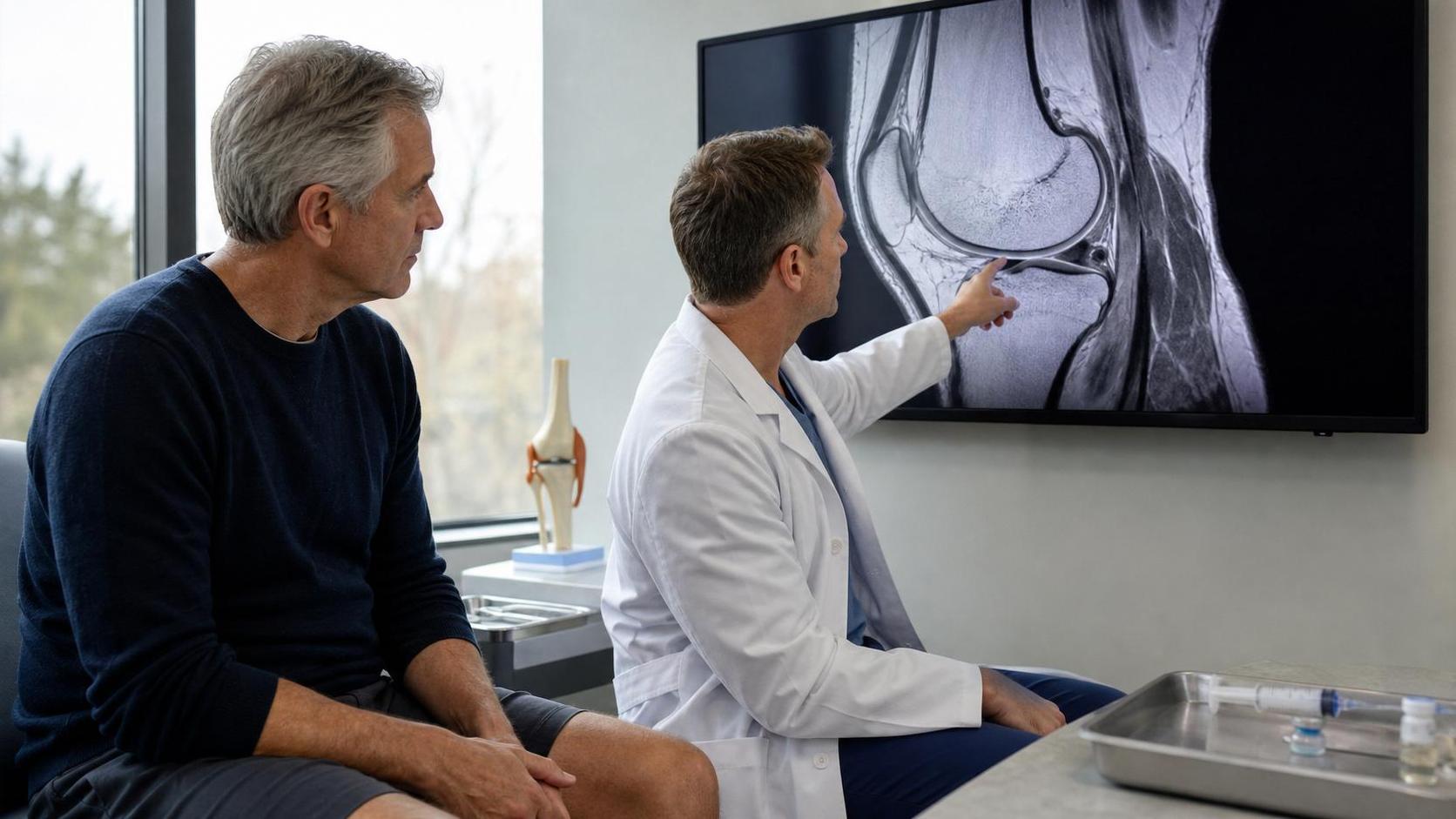
The Shot That Regrows Knee Cartilage: Inside the 15-PGDH Breakthrough
Stanford researchers switched off a single age-related enzyme and watched worn knee cartilage grow back. It happened in old mice, in injured mice, and in human tissue removed during knee replacement surgery. Here is what the science actually shows, how it got here, and how close it really is to your knees.
Presented By Our Partners



For as long as medicine has treated arthritic knees, one assumption has held firm: articular cartilage, the smooth and glassy tissue that caps the ends of bones, does not grow back. Once it thins, you manage the pain, and eventually you replace the joint. A study published in the journal Science in late 2025 challenges that assumption at its root. By blocking one enzyme that accumulates as the body ages, a team at Stanford Medicine prompted thinned and damaged knee cartilage to regenerate into functional, load-bearing tissue. The result did not rely on stem cells, surgery, or implanted scaffolds. It relied on the cartilage cells already living in the joint, persuaded to behave as if they were young again.
The lead authors, Mamta Singla and Yu Xin Wang, working in the laboratories of Helen Blau and Nidhi Bhutani, described the regeneration as beyond anything reported for other drugs or interventions. To understand why longevity researchers are paying such close attention, it helps to start with the enzyme at the center of the story.
The aging enzyme that quietly wears joints down
The enzyme is 15-hydroxyprostaglandin dehydrogenase, mercifully shortened to 15-PGDH. Its job is to break down a signaling molecule called prostaglandin E2, usually written as PGE2. PGE2 carries a reputation as an inflammatory messenger, yet at ordinary biological levels it does something more constructive: it tells tissue to repair and regenerate. Blau’s group has spent years showing that PGE2 is essential for the function of muscle stem cells and for healing across muscle, nerve, bone, and blood.
Here is the problem with age. As tissues grow older, they accumulate more 15-PGDH. More of the enzyme means more PGE2 gets degraded, which means less of the regenerative signal reaches the cells that depend on it. The researchers measured roughly a two-fold rise in 15-PGDH in the knee cartilage of old mice compared with young ones. Because this kind of enzyme climbs with age and actively drives the loss of tissue function, the team gave it a memorable name: a gerozyme, an enzyme of aging.
There is a genuine irony buried in the mechanism. Many people with sore joints reach for nonsteroidal anti-inflammatory drugs, and those drugs work by suppressing prostaglandin production. Blau’s earlier work in muscle suggested that blunting PGE2 too aggressively can also blunt repair. That does not mean anyone should stop a medication their clinician prescribed; it is an open scientific question, not a treatment instruction. But it reframes PGE2 from a molecule to be suppressed into a signal that, at the right level, tells tissue to rebuild.
What the Stanford study actually found
The team tested a small-molecule drug that inhibits 15-PGDH. In aged mice, they first delivered it systemically, through an injection into the abdomen, and later directly into the knee joint. In both cases the cartilage, which had grown markedly thinner and weaker with age, thickened again across the surface of the joint. Follow-up analysis confirmed the new tissue was hyaline cartilage, the smooth low-friction type that lines healthy joints, rather than the inferior fibrocartilage that scar-like repair usually produces. “The effect was remarkable,” Bhutani said.
The biggest surprise was how the regeneration happened. In muscle, nerve, and bone, blocking 15-PGDH works by waking up tissue-specific stem cells. In cartilage, the researchers went looking for those stem cells and could not find them at work. Instead, the chondrocytes, the mature cells already embedded in the cartilage, rewrote their own gene expression and shifted back toward a youthful state. Single-cell analysis captured the change in detail. A population of cells producing 15-PGDH and cartilage-degrading genes shrank from about 8 percent to 3 percent. A fibrocartilage-producing population fell from roughly 16 percent to 8 percent. And the healthy population, the cells that build hyaline cartilage and maintain its supporting matrix, nearly doubled, climbing from about 22 percent to 42 percent. The joint did not import new cells. It re-educated the ones it already had.
The team then modeled injury rather than aging. They gave young mice a tear resembling a torn anterior cruciate ligament, the ACL injury common in sports that involve sudden stops and pivots. Roughly half of people who tear an ACL develop osteoarthritis in that joint within about fifteen years, even after surgical repair. Mice that received the gerozyme inhibitor twice a week for four weeks after injury were far less likely to develop arthritis. They also moved more normally and put more weight on the affected leg, signs that they were in less pain. Untreated animals, by contrast, showed 15-PGDH levels twice as high as uninjured peers and developed osteoarthritis within four weeks.
Featured Partner
Invest in the Infrastructure Behind Modern Medicine
As healthcare expands beyond hospital walls, the buildings and campuses supporting that shift are generating compelling returns for investors who move early. The Healthcare Real Estate Fund offers qualified investors direct access to a curated portfolio of medical office, outpatient, and specialty care facilities.
Learn More →
The most translationally important experiment used human tissue. The researchers took cartilage removed from patients undergoing total knee replacement for osteoarthritis and treated it in the laboratory. After one week, the human tissue showed fewer 15-PGDH-producing cells, lower activity in cartilage-degrading and fibrocartilage genes, and early signs of new articular cartilage forming. The same mechanism that rejuvenated a mouse knee began to move in diseased human cartilage.
Why this is unlike any knee injection on the market
It is worth being precise about how different this is from what a clinic can offer today. The injections currently used for knee osteoarthritis fall into a few buckets. Corticosteroids calm inflammation and can relieve pain for a few weeks before the effect fades. Hyaluronic acid, marketed as viscosupplementation, aims to lubricate and cushion the joint. Platelet-rich plasma and other orthobiologics deliver a concentrate of growth factors drawn from the patient’s own blood.
All of these share one limitation: they manage symptoms, they do not rebuild the joint. A 2025 network meta-analysis pooling more than forty high-quality trials found that no common intra-articular injection produced a clinically meaningful improvement in pain or function over placebo at three to six months. Major guideline panels no longer recommend hyaluronic acid for routine use. Most pointedly, there is still no approved drug of any kind that slows, stops, or reverses osteoarthritis. The disease remains, in the plain language of the review literature, incurable. Stem cell injections that some clinics market as regenerative have not delivered convincing cartilage regrowth, which is exactly what makes the Stanford result striking: it regenerated cartilage without recruiting stem cells at all.
How the science got here
Breakthroughs rarely arrive from nowhere, and this one sits at the end of a decade-long thread. In 2015, a team led by cancer biologist Sanford Markowitz reported in Science that inhibiting 15-PGDH could potentiate the regeneration of multiple tissues, and identified a usable small-molecule inhibitor. In 2017, Blau’s lab showed that PGE2 is essential for skeletal muscle stem cells to do their job. In 2020, her team demonstrated in Science that blocking 15-PGDH in old mice restored muscle mass, strength, and endurance, and framed the enzyme as a direct molecular driver of aging. In 2023, the group extended the idea to the nervous system, using the same gerozyme inhibition to regenerate neuromuscular connections. The 2025 cartilage paper is the fourth major tissue in that sequence, and the first where the mechanism ran through cellular reprogramming rather than stem cells.
Who is actually giving these injections, and when you might get one
This is the question that matters most to anyone with aching knees, so it deserves a direct answer. As of now, no one is injecting a 15-PGDH inhibitor into human knees to regrow cartilage. That work remains preclinical: mice and laboratory tissue, not living patients.
What does exist in humans is the oral cousin of the treatment. A San Diego biotechnology company, Epirium Bio, is developing a first-in-class oral 15-PGDH inhibitor called MF-300. The drug reversibly binds the same PGE2 site on the enzyme, and it has already completed a Phase 1 trial, the first stage of human testing, aimed at sarcopenia, the age-related loss of muscle. In that trial MF-300 met its primary safety goal, was generally well tolerated across younger and older adults, and produced the biological signal the researchers were looking for. Epirium has said it intends to advance the drug into a Phase 2 efficacy study in sarcopenia during 2026. A clean Phase 1 safety record in muscle is genuinely useful for cartilage, because it establishes that inhibiting this enzyme in people appears tolerable.
It does not, however, mean a knee therapy is around the corner. A cartilage-specific human trial still has to be designed and launched, and even in an optimistic scenario it would then have to move through Phase 2 and Phase 3 testing before any regulator could approve it. Realistically, that is a horizon measured in years, not months, most plausibly the late 2020s at the earliest, and only if the human data hold up. Blau has said she hopes a trial testing the effect on cartilage will launch soon. Hope and a launched trial are not the same thing, and honest expectation setting matters here.
One point of transparency belongs in any serious account of this research. Blau is a co-founder of Epirium and holds equity in the company, and the underlying patents on 15-PGDH inhibition are licensed to it. That arrangement is common in translational science and does not diminish the biology, but readers deserve to know the commercial thread running alongside the discovery.
What this means for you
If you are living with knee pain today, the most important takeaway is also the least glamorous: this is not yet a treatment you can get, and you should be skeptical of any clinic that implies otherwise, especially one selling stem cell injections as cartilage regeneration. The genuine breakthrough here is scientific, and its clinical payoff is still ahead.
The productive response is to protect the cartilage you already have while the science matures. That is squarely a Movement question. Resistance training builds the muscle that stabilizes and offloads the joint. Regular low-impact movement keeps cartilage nourished, since it has no blood supply and depends on loading to exchange nutrients. And maintaining a healthy metabolic weight reduces the mechanical and inflammatory burden on the knee. None of this regrows cartilage, but it preserves function and buys time.
Buying time is the whole point of a longevity mindset. The goal is healthspan, the years lived in good working order, not merely lifespan. If therapies like this one reach the clinic in the coming decade, the people positioned to benefit most will be the ones who kept their joints functional in the meantime. Staying mobile is not a consolation prize while we wait; it is the bridge to what comes next, and it sits alongside the broader work of holding off the chronic threats to a long healthspan.
And if your knees hurt now, that is a reason to see a qualified clinician rather than to wait for a headline to turn into a prescription. You can find orthopedic and musculoskeletal specialists through our provider directory. This article is educational and is not medical advice.
The bottom line
A single enzyme, rising quietly with age, helps explain why joints wear out and why they have proven so stubborn to repair. Turn that enzyme down, and the cartilage cells already sitting in the joint appear willing to rebuild what was lost. That idea has now been shown in aged mice, in injured mice, and in human tissue, and it rests on a decade of converging work across muscle, nerve, and bone. It is not a therapy yet, and anyone promising you a cartilage-regrowing shot today is running ahead of the evidence. But for the first time, the long-held rule that knee cartilage cannot come back looks less like a law of biology and more like a problem with a solution in sight.
Sources and further reading
Singla M, Wang YX, and colleagues. Inhibition of 15-hydroxy prostaglandin dehydrogenase promotes cartilage regeneration. Science, 2025. DOI: 10.1126/science.adx6649.
Palla AR and colleagues. Inhibition of prostaglandin-degrading enzyme 15-PGDH rejuvenates aged muscle mass and strength. Science, 2021.
Epirium Bio. Phase 1 clinical trial results for MF-300 in sarcopenia, 2025 to 2026.
Pereira TV and colleagues. Comparative effectiveness of intra-articular injections for knee and hip osteoarthritis, network meta-analysis, 2025.


Similar Posts

WHOOP 5.0: Recovery Coaching, Strain Tracking, and the Science of Readiness
The difference between training hard and training smart comes down to one question: is your body ready for what you are about to ask of it? Presented By Our Partners…

The Grip Strength Signal: What 30 Years of Research Reveals About the Most Underrated Longevity Biomarker and How to Build It
A two dollar handheld dynamometer can predict mortality better than blood pressure in millions of people across 17 countries. Inside the Leong PURE cohort, the Saeidifard and Stamatakis meta-analyses, the…

The Nobel Ensemble: Inside the Lab Trying to End Disease
Five Nobel laureates are quietly orbiting Isomorphic Labs, the Alphabet-backed company trying to use artificial intelligence to end the world’s deadliest diseases. What they are building would have been science…

Masimo W1: Clinical-Grade SpO2 Monitoring in a Wrist Wearable
The company that wrote the book on pulse oximetry accuracy brings hospital-grade oxygen monitoring to a wrist-worn form factor for the first time. Presented By Our Partners In the early…

How David Sinclair Helped Turn Aging Into a Serious Scientific Frontier
David Sinclair helped move aging research from the scientific margins into mainstream conversation. Through his Harvard lab, his work on sirtuins, NAD+ biology, epigenetic reprogramming, and his public role as…

Ultra-Processed Food Is Rewiring Your Brain: What 385,000 People Reveal About Diet, Depression, and the Gut-Brain Axis
A meta-analysis of 385,541 people finds that high ultra-processed food consumption raises depression risk by 44 percent and anxiety risk by 48 percent. New research on the gut-brain axis, neuroinflammation,…
