The Race to Build a Virtual Cell: Can AI Simulate Biology Before It Makes Medicine?
Scientists have spent centuries learning about cells by disturbing them and watching what happens. Add a compound. Disable a gene. Expose the cell to a virus. Change its environment. Then measure the response and try to understand why it occurred.
Presented By Our Partners



The process works, but living systems are astonishingly complicated. A cell contains interacting networks of genes, proteins, metabolites, membranes, organelles, and signaling pathways. Its behavior changes with its type, developmental state, surroundings, and history. Even a narrowly defined experiment may capture only a small piece of that machinery.
Now a coalition spanning philanthropy, government, and some of the world’s largest artificial-intelligence laboratories is trying to build a computational alternative: models that can predict how cells behave before every possibility has to be tested at a laboratory bench.
Biohub, the nonprofit research organization founded and supported by Priscilla Chan and Mark Zuckerberg, calls the destination a virtual cell. In October 2026, Biohub announced a $1.8 billion coordinated commitment with the U.S. Department of Energy, the National Institutes of Health, Google DeepMind, Isomorphic Labs, Meta, and other partners. The resources include funding, federal datasets, supercomputing, biological measurement systems, and new experimental technologies.
The phrase sounds almost cinematic: a living cell recreated inside a computer, ready to reveal what a drug will do before a researcher touches a pipette. The real undertaking is both less magical and more consequential. It is an attempt to give biology something that engineering has long depended on: useful simulations that can narrow the universe of experiments worth performing in the physical world.
If it works, the virtual cell will not eliminate the laboratory. It will change which questions reach it.
What a virtual cell actually is
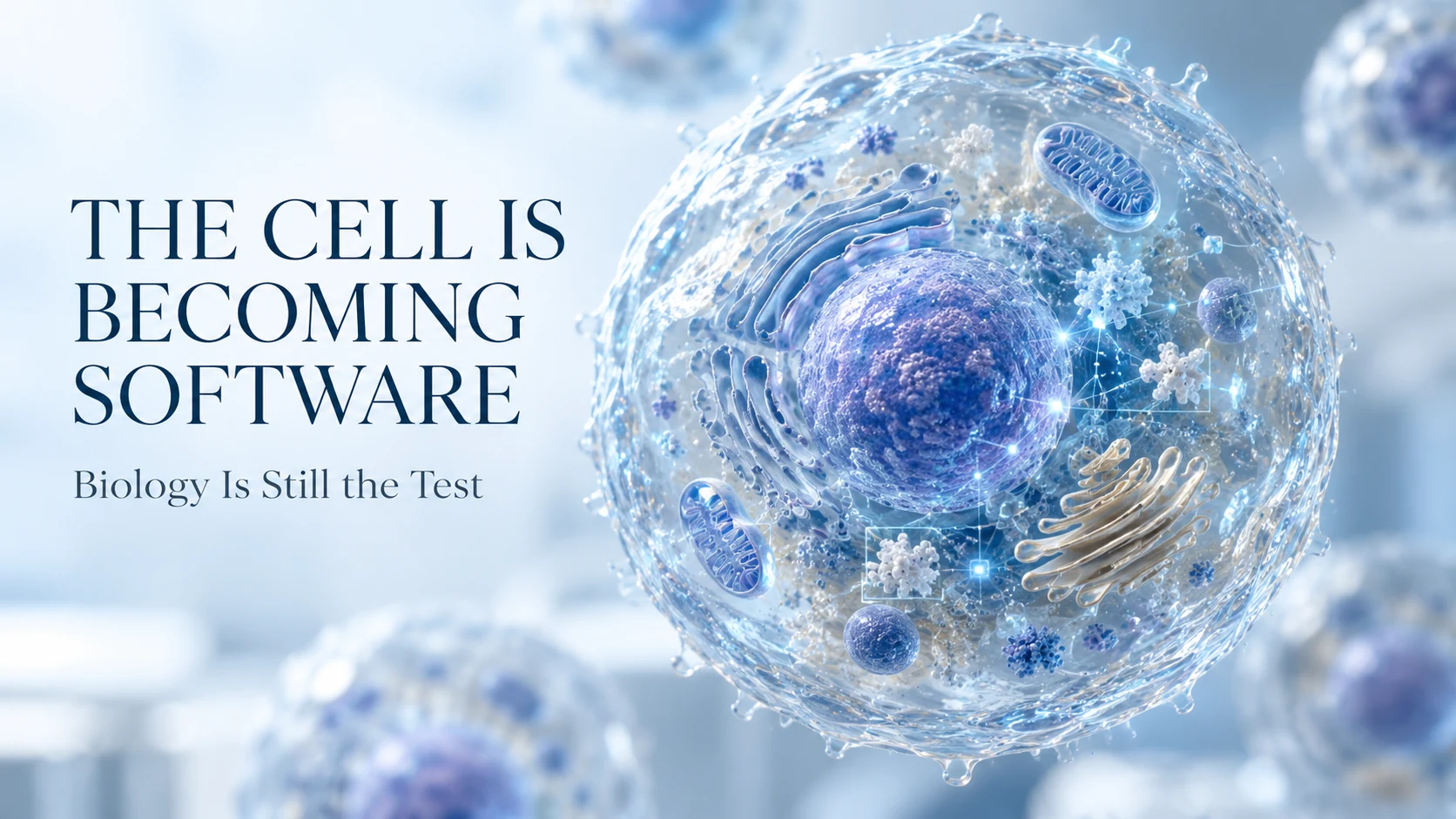
A virtual cell is not a tiny animated replica with every atom faithfully represented. At least not yet. It is a family of machine-learning models trained on measurements of real cells. Those measurements may include gene activity, protein abundance, molecular structure, cell images, spatial organization, and responses to genetic or chemical interventions.
The model’s job is to learn enough of the relationships within those data to answer questions it has not seen before. What happens if a particular gene is switched off? How might one cell type respond to a drug compared with another? Which intervention is most likely to push a diseased cellular state toward a healthier one?
In 2024, researchers writing in Cell described the virtual-cell ambition as the construction of AI systems that can represent biological processes across scales and predict cellular behavior under new conditions. Their review, “How to Build the Virtual Cell with Artificial Intelligence,” also made clear how far the field has to go. Biology does not offer clean, universal rules in the way a physics simulation might. Data are collected with different instruments, protocols, cell populations, and experimental assumptions. Many observations are sparse. Negative results are rarely assembled into standardized public resources.
Today’s most advanced cell models can classify cell types, organize large single-cell datasets, infer relationships between genes, and predict selected responses to perturbations. Biohub’s own AI Cell Models platform presents multiple models because no single system yet captures the whole cell or performs every task reliably.
The “universal” virtual cell is therefore a direction, not a finished object.
Why $1.8 billion is going into data
The most revealing part of Biohub’s announcement is not the size of the commitment. It is what the participants believe they need to buy.
The $1.8 billion is not simply a cash round handed to one organization. Biohub says its founding commitment totals $500 million, including $400 million for technologies such as advanced microscopy, cryo-electron tomography, and tools for engineering and perturbing biological systems. The Department of Energy plans to contribute more than $500 million over five years in measurement, modeling, computation, and national-laboratory capabilities. NIH will coordinate resources created through more than $500 million in earlier federal investment. Google DeepMind, Isomorphic Labs, and Meta are collectively contributing $300 million.
The coalition is assembling an industrial-scale data engine.
Featured Partner
Invest in the Infrastructure Behind Modern Medicine
As healthcare expands beyond hospital walls, the buildings and campuses supporting that shift are generating compelling returns for investors who move early. The Healthcare Real Estate Fund offers qualified investors direct access to a curated portfolio of medical office, outpatient, and specialty care facilities.
Learn More →
That is necessary because biological AI faces a problem familiar from language models, but far harder to solve. The internet already contained trillions of words written by humans. There is no biological equivalent containing the measured response of every important cell type to every meaningful intervention. Those data have to be generated in laboratories, under conditions rigorous enough for a model to learn the difference between a biological signal and an experimental artifact.
The Department of Energy and NIH announcements both emphasize this measurement gap. Training better models requires observations across more cell types, diseases, interventions, and conditions than science has systematically captured.
The expensive part of virtual biology may not be the artificial intelligence. It may be teaching the machines enough biology to keep them honest.
From prediction to a discovery loop
A virtual cell becomes most valuable when it participates in a cycle rather than producing a single prediction.
The model proposes what may happen. A physical experiment tests the proposal. The result returns to the model. The model updates its understanding and chooses the next experiment. Each turn makes the system more informed about both the biology and the boundaries of its own predictions.
Biohub describes a similar predictive immunology loop: generate data, build models, make predictions, and use those predictions to decide what new data to generate. Lila Sciences is building what it calls AI Science Factories, which combine reasoning models, scientific instruments, laboratory automation, and verification in a tightly integrated cycle. Its systems are intended to generate hypotheses, design experiments, run them, interpret the results, and repeat.
Jeff Dean’s newly formed company, Discovery Loop, takes the idea beyond biology. The company says it plans to automate experimental loops that propose, run, evaluate, and refine experiments, initially in machine-learning research and eventually across science and engineering.
These efforts point toward a change in the role of AI. Most scientific models answer a question posed by a person. A closed discovery loop helps decide which question should be tested next.
That is a much higher bar. It requires reasoning, experimental design, reliable instruments, error detection, and a definition of success that a machine can evaluate. In biology, the feedback is often noisy, delayed, and incomplete. An experiment can fail because the hypothesis was wrong, because the sample was poor, because the instrument drifted, or because an unmeasured variable mattered.
Automation does not make those distinctions disappear. It makes detecting them part of the system.
The difference between designing a molecule and making a medicine
AI has already compressed important parts of early drug discovery. AlphaFold transformed protein-structure prediction. Chai Discovery reports that its models can generate experimentally testable antibody designs in roughly a day of computation. Isomorphic Labs is building an AI drug-design engine across small molecules, antibodies, peptides, and other modalities. Enveda uses machine learning and metabolomics to search nature’s largely unexplored chemistry for potential medicines.
These are substantial advances, but they operate at different points in the process. Predicting a structure is not the same as designing a molecule. Designing a molecule is not the same as proving it binds its intended target. Binding is not the same as changing disease biology. A promising preclinical candidate is not a safe and effective medicine.
Drug development remains a long sequence of increasingly demanding tests: laboratory validation, manufacturability, toxicology, animal studies where appropriate, regulatory submissions, human safety trials, efficacy trials, and review. Many candidates fail after performing well at an earlier stage.
This is why reports that Isomorphic Labs is seeking financing at a valuation of at least $40 billion are both economically striking and scientifically incomplete. A valuation reflects expectations. The more meaningful milestones are whether AI-designed candidates advance into human testing, whether they succeed at rates better than comparable programs, and whether the platform learns from failures rather than merely producing more candidates.
The virtual cell could improve the odds by eliminating weak ideas earlier and selecting more informative experiments. It cannot declare a treatment safe or effective for a person.
What would count as success?
The field needs a proof standard that rises with the claims.
A computational prediction is the beginning. A retrospective benchmark asks whether a model can reproduce known results. Prospective validation asks it to predict an experiment whose answer is not yet known. Replication tests whether the finding survives in another laboratory or biological context. Preclinical development establishes whether the result can become a credible therapeutic candidate. Human trials determine safety and efficacy. Regulatory approval confirms that the evidence meets a legal standard for a particular use. Patient outcomes reveal whether the innovation ultimately matters in care.
These stages should not be collapsed into the phrase “AI discovered a drug.”
The most informative virtual-cell results will be prospective. A model should identify a response that was not used to train it, guide an experiment, and survive contact with living biology. Better still, the system should reveal when it is uncertain and choose an experiment that reduces that uncertainty.
Success will also require breadth. A model that performs well on a familiar cancer cell line may fail in primary human tissue, across ancestry groups, or inside the changing environment of an actual tumor. Cells behave differently in isolation than they do within tissues, immune systems, and whole organisms. Moving from a cell to a person is not a matter of adding more computing power.
A new instrument for healthcare discovery
The microscope changed biology by making a hidden world visible. Sequencing changed it by turning inherited information into data. A credible virtual cell would add another kind of instrument: a system for exploring biological possibilities before committing scarce laboratory time to them.
Its first impact may be mundane rather than miraculous. Researchers could prioritize experiments more intelligently. Failed hypotheses could become useful training data. Rare diseases with limited samples might benefit from knowledge transferred across related cell states. Drug programs could identify toxicity or weak mechanisms earlier. Laboratories could spend less time searching blindly and more time testing the predictions that would teach them the most.
The larger ambition is a scientific system that improves through use. Models guide measurements. Measurements correct models. Automated laboratories increase the number of cycles. Human scientists choose meaningful problems, challenge assumptions, and interpret results that do not fit the machine’s frame.
That relationship matters because biology is not software. A cell does not have to obey a model, no matter how elegant the model appears. Living systems remain the final judge.
The race to build a virtual cell is therefore not a race to replace experiments. It is a race to create a better conversation between prediction and reality. If that conversation becomes reliable, the most important result may not be one simulated cell. It may be a new way of doing science.
Sources
- Biohub: AI-ready biological data, $1.8 billion global commitment
- U.S. Department of Energy: DOE, NIH, and Biohub partnership
- National Institutes of Health: Predictive models of human biology
- Cell: How to build the virtual cell with artificial intelligence
- Biohub: AI Cell Models platform
- Biohub: Predictive immunology loop
- Discovery Loop: Automating the experimental loop
- Lila Sciences: AI Science Factories
- Isomorphic Labs: AI drug design engine
- Enveda: AI and natural-product drug discovery


Similar Posts
FDA AI in Radiology: Why Medical Imaging Became AI’s First Beachhead
Radiology dominates the FDA AI-enabled medical device list because medical imaging already turns the body into structured data, making it the first large proving ground for regulated medical AI.
The Literature Is a Debate, Not a Record
Healthcare AI claims often arrive as facts. The safer way to read them is as arguments shaped by evidence, incentives, peer review, and the missing data still outside the published…
Zombie Cells Meet Their Match: How Natural Fatty Acids Could Become Longevity’s Most Promising New Weapon
Researchers at the University of Minnesota have identified naturally occurring fatty acids, specifically alpha-eleostearic acid and its methyl ester derivative, that selectively kill senescent zombie cells through ferroptosis. Published in…

The Scan Found a Lung Nodule. Then the Hospital Had to Find the Patient.
A new emergency-department study shows where healthcare AI can matter: not simply spotting a signal, but helping a care team contact the patient and complete the next step.
The AI Second Reader That Changed the Chart
A large liver-cancer study shows what happened after an AI system found overlooked lesions: reports changed, cases escalated, and care pathways moved—without yet proving better patient outcomes.

The First Longevity Board: How Insilico Medicine Is Using AI to Target the Biology of Aging Itself
Insilico Medicine has formed the industry’s first Longevity Board, chaired by Eli Lilly’s Group VP of Molecular Discovery and featuring Nobel laureate Michael Levitt. Inside the AI strategy, dual-purpose targets,…