
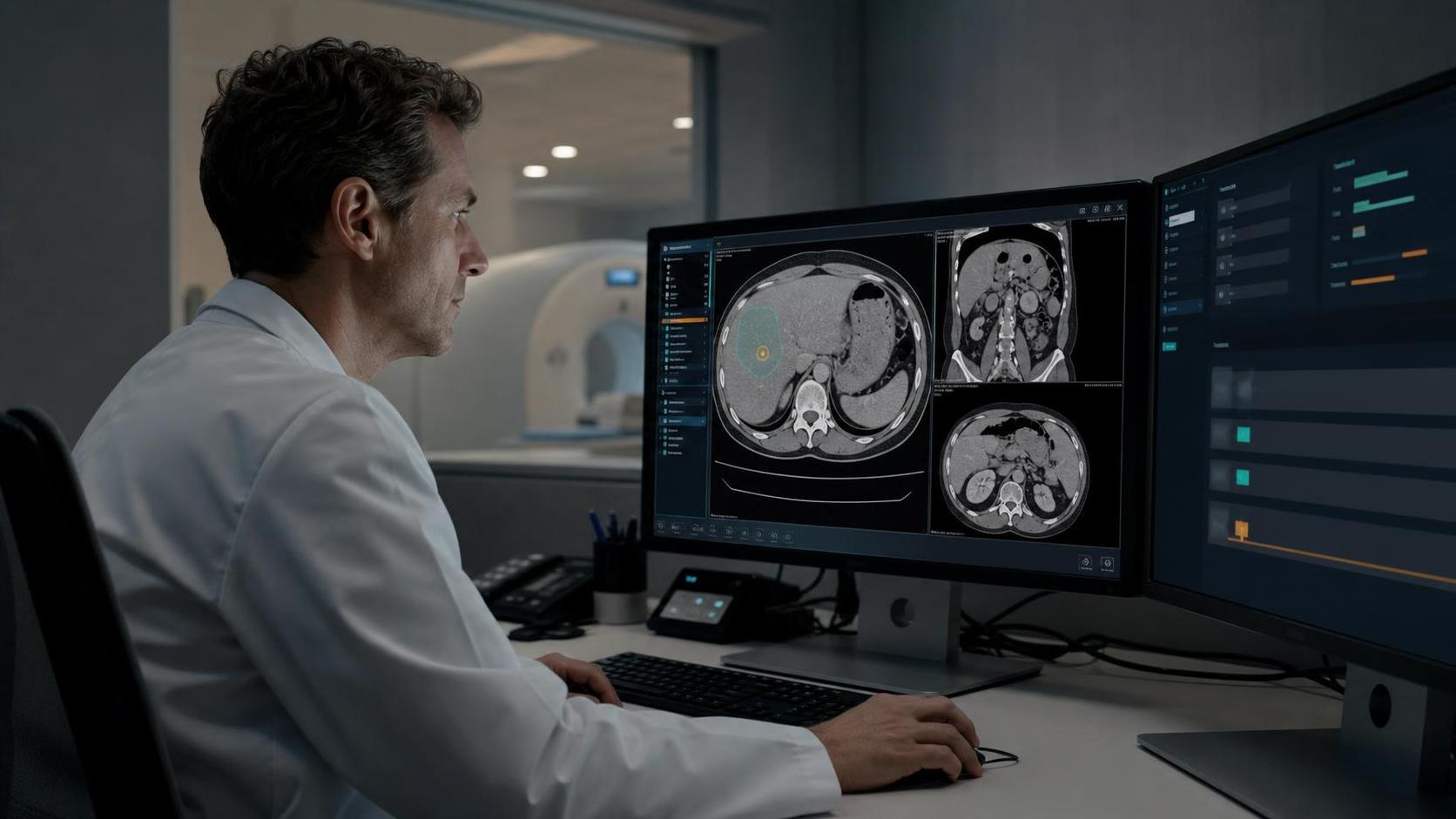
The AI Second Reader That Changed the Chart
A large liver-cancer study offers a rare look at what happens after an algorithm spots something a clinical workflow missed. The answer is more useful—and less miraculous—than the usual AI headline.
Presented By Our Partners



The most consequential moment in a medical AI system’s life is not when it produces a probability. It is when somebody changes the chart.
That distinction is easy to lose. Healthcare AI stories tend to end at performance: a model achieves an impressive score, beats a benchmark, or finds a disease earlier than expected. But a prediction can be both technically excellent and clinically inert. If nobody owns the alert, revisits the scan, speaks to the patient, or changes the next step, the software has discovered a fact without delivering care.
A study published August 19 in Nature Medicine gets unusually close to that missing middle. Researchers developed the Liver DiagnOsis Network, or LiON, to help interpret contrast-enhanced CT scans for liver malignancy. After training the system on 6,443 patients and retrospectively validating it across 22,251 more, they placed it into routine clinical practice as an additional reader in a single-arm trial involving 10,333 patients.
The headline number was strong: LiON achieved an area under the receiver operating characteristic curve of 0.952 in the clinical trial. But the more revealing numbers came after the score.
AI-human collaboration identified 51 previously overlooked lesions, 15 of them malignant. Clinicians amended 37 radiology reports. Twenty-two cases were escalated to multidisciplinary teams. The study reports clinical-management changes in a subset of patients.
Those are not survival data. They are not proof that the system prevented a death, found every important cancer, or improved care across different health systems. They are something more modest and more concrete: evidence that an AI signal crossed the boundary into accountable clinical action.
The signed report is a handoff, not an endpoint
Radiology is often described as image interpretation, but its real product is a chain of decisions. A scan becomes a report; a report becomes a recommendation; a recommendation may lead to another test, a specialist review, surveillance, biopsy, surgery, or no action at all. Every transition creates another place for information to stall.
LiON was designed for that chain. It could process different combinations of contrast phases and incorporate clinical data, which matters because real-world imaging is not a perfectly standardized research dataset. In the trial, it operated inside the existing workflow as another reader rather than as a separate demonstration tool.
Featured Partner
Invest in the Infrastructure Behind Modern Medicine
As healthcare expands beyond hospital walls, the buildings and campuses supporting that shift are generating compelling returns for investors who move early. The Healthcare Real Estate Fund offers qualified investors direct access to a curated portfolio of medical office, outpatient, and specialty care facilities.
Learn More →
That design choice may be the study’s most important contribution. An AI model does not need to replace the radiologist to matter. It can function as a diagnostic safety net: a second look that causes a human reader to reopen the case, reconcile a discrepancy, and document the result.
The amended reports are therefore more meaningful than they first appear. A signed report is an accountable clinical artifact. Changing it means the model’s output was reviewed, accepted, and translated into a record another clinician could act on. Escalation to a multidisciplinary team goes one step further by assigning the case to a visible decision process.
This is the difference between an alert and a pathway.
What the trial did—and did not—show
The scale of the study is notable. LiON’s retrospective validation included multicenter and real-world cohorts, and performance remained high in groups that can complicate liver imaging, including patients with hepatic steatosis and cirrhosis. The clinical deployment then tested the system across more than 10,000 patients in ordinary practice.
Yet the trial was single-arm. Without a concurrent comparison group, it cannot tell us how many overlooked lesions, report amendments, or management changes would have occurred under an alternative workflow. Nor does it establish the effect on cancer stage, time to treatment, treatment completion, complications, quality of life, or survival.
Generalizability also remains open. The institutions were in China, and the authors themselves call for prospective comparative studies across diverse healthcare systems. Local imaging protocols, specialist availability, reporting culture, disease prevalence, and escalation capacity can all alter what happens after a model raises its hand.
The conflict-of-interest disclosures deserve attention too. Alibaba researchers helped develop the system; company employees reported stock ownership, and Alibaba has filed patent protection related to the work. That does not invalidate the findings, but it strengthens the case for independent replication and comparative evaluation.
The responsible interpretation is not that AI has solved missed liver cancer. It is that a workflow-compatible second reader produced measurable changes in clinical work—and now the field must determine whether those changes improve patient outcomes.
The next evidence bar is what happened to the patient
Healthcare systems evaluating diagnostic AI should ask for more than sensitivity, specificity, or AUC. They should ask for a handoff ledger.
How many alerts were generated? How many were reviewed? How many reports changed? How many patients were contacted? How many reached specialist review? How many completed the recommended test or treatment? How long did each step take? Which patients were lost between steps, and did performance differ by geography, insurance, language, sex, age, disability, or disease severity?
Those questions are not administrative garnish. They determine whether a model reduces missed care or merely creates a better-documented queue.
They also expose a practical constraint hidden inside many AI demonstrations: escalation capacity. Finding more suspicious lesions helps only if radiologists, tumor boards, specialists, schedulers, and patients can absorb the additional work. A system that improves detection while overwhelming the pathway may move the bottleneck rather than remove it.
LiON’s trial matters because it lets us see several rungs of the ladder: model signal, human review, report amendment, multidisciplinary escalation, and some management change. Most studies stop at the first rung. This one did not.
But completed care is still farther ahead. The next trial should compare workflows and follow patients through diagnosis, intervention, and outcome. It should report not just what the AI noticed, but whether the health system finished what the notice began.
That is the real promise of the second reader. Not artificial omniscience. A better chance that an overlooked signal becomes somebody’s responsibility—and then becomes care.
Sources
- Zhang X, Li C, Han X, et al. “Large-scale AI-guided liver malignancy diagnosis: multicenter study and a single-arm trial.” Nature Medicine. Published online August 19, 2026. DOI: 10.1038/s41591-026-04589-y. PMID: 42618635.
- ClinicalTrials.gov. LiON clinical study registration: NCT07153783.
This article is for general information and does not provide medical advice. The system described remains subject to further comparative and external validation.


Similar Posts
How Scientists Are Learning to Reverse Cardiovascular Aging: From Centenarian Genes to Rapamycin
New research reveals that cardiovascular aging can be slowed and even reversed. A centenarian gene rewinds heart age by ten years, rapamycin improves diastolic function in elderly men within weeks,…

Moxy Monitor: Real-Time Muscle Oxygen Saturation for Training Zone Precision
Heart rate tells you how hard your cardiovascular system is working. Muscle oxygen tells you how hard your muscles are actually working, and more importantly, when they are about to…

AI in Healthcare Venture Capital: Where the Durable Moats Are Forming
Healthcare AI models are becoming cheaper and more accessible. The durable venture moats are forming around workflow ownership, proprietary learning data, evidence, regulation, distribution, measurable economics, and platform expansion.

Akkermansia Muciniphila and the New Science of Metabolic Health: What 2026 Research Reveals About the Gut Bacterium Redefining Insulin Sensitivity
Two decades after a Dutch researcher isolated a strange mucus eating bacterium from a healthy human gut, Akkermansia muciniphila has become one of the most studied targets in metabolic medicine….

Polar Vantage V2 Review: Multisport VO2 Max and Training Load Analysis Without a Subscription
Polar’s flagship multisport watch combines decades of heart rate science with running power from the wrist and comprehensive training load management, all without a recurring fee. Presented By Our Partners…

The Longevity Toolkit Takes Shape: AI Drug Discovery, Biological Age Clocks, and Microbiome Science Converge
A generative AI-designed drug has delivered clinical proof in a Phase IIa trial, while new biological age clocks and microbiome science are completing the precision longevity toolkit. Here is what…
