
AI Found the Trial Patient. That Was the Easy Part.
AI Found the Trial Patient. That Was the Easy Part.
A new health-system deployment shows how quickly artificial intelligence can widen clinical-trial screening. It also reveals the measurement healthcare still avoids: whether a patient actually makes it into the study.
Presented By Our Partners



The most consequential moment in clinical research may happen long before anyone signs a consent form. It happens when a patient who could qualify for a study is never noticed.
The omission is usually mundane. Eligibility rules run for pages. Important facts are scattered across notes, laboratory results, scans, medications, and dates. A research coordinator has a finite morning. A patient’s condition changes while the spreadsheet built to remember them goes stale.
This is an unusually plausible job for artificial intelligence: read more records, compare them with trial criteria, and keep watching as a patient’s circumstances change.
Ochsner Health says that approach is expanding the number of patients its research operation can consider. In an October 6 interview with Healthcare IT News, the Louisiana-based system reported that an AI-assisted platform increased screening capacity by 41 percent, cut manual screening work by about 75 percent, and increased by 3.6 times the number of patients being followed for possible future eligibility. The platform operates across Ochsner’s 47 hospitals and 370 health centers, according to an August announcement from Ochsner and the vendor, Paradigm Health.
Those numbers describe a real operational advance. They do not yet describe the thing a patient cares about most.
Ochsner’s public results tell us how many more people could be reviewed and how much coordinator work was reduced. They do not report how many flagged patients were confirmed eligible, contacted, offered a study, consented, enrolled, started the intervention, or remained in the trial. The distinction is not pedantic. It is the difference between finding a door and helping someone through it.
The patient who might qualify later
Traditional recruitment often treats eligibility as a snapshot. A coordinator reviews a chart, the patient does not qualify, and the file returns to the pile. But eligibility is frequently a moving target. A line of treatment ends. A laboratory value changes. A new pathology report arrives. A study that was irrelevant in May becomes an option in October.
Ochsner’s deployment is interesting because it treats matching as a continuing process. The system can keep potential candidates in view and reassess them as new clinical information appears. It also cross-references appointments so research staff can validate a match and coordinate outreach around an existing visit.
That is closer to a care pathway than a search engine. The software does not merely retrieve a name. It tries to put the name in front of the right human at a moment when a conversation can happen.
Featured Partner
Invest in the Infrastructure Behind Modern Medicine
As healthcare expands beyond hospital walls, the buildings and campuses supporting that shift are generating compelling returns for investors who move early. The Healthcare Real Estate Fund offers qualified investors direct access to a curated portfolio of medical office, outpatient, and specialty care facilities.
Learn More →
The human remains essential. Ochsner says coordinators review the most likely candidates, while recruitment personnel help with triage and follow-up. The model narrows the field; people confirm eligibility and handle the ethically sensitive work of approaching a patient about research.
What stronger evidence already shows
The broader evidence supports cautious optimism. A 2026 scoping review and meta-analysis in the Journal of Clinical and Translational Science found that AI tools have been studied across eligibility parsing, cohort identification, patient screening, matching, and retention. The literature is broad enough to show that this is no longer a novelty, but heterogeneous enough that one accuracy number cannot describe the field.
More persuasive evidence comes from a randomized clinical trial published in JAMA in 2025. Mass General Brigham investigators randomized 4,476 patients within a heart-failure trial to manual or large-language-model-assisted prescreening. The AI-assisted process identified eligibility faster. It produced 35 enrollments, compared with 19 under manual screening. More than 99 percent of patients in the AI arm were processed within 15 days; manual screening stretched to roughly 50 days.
That study crossed an important evidentiary line. It did not stop at model accuracy or charts reviewed. It measured enrollment.
It also had limits. It was conducted in one health system and one disease context. The final enrollment numbers were small. An analysis found no significant differences in race, ethnicity, or gender between the two arms, but a single-center study cannot settle whether automated matching will broaden access across rural communities, safety-net settings, languages, or insurance barriers.
The Ochsner deployment is larger in geographic reach and operational scale, especially across the Gulf South. The randomized trial is stronger on causal evidence. Read together, they suggest both the opportunity and the unfinished work.
Screening is not access
Clinical-trial access can fail at every step after a match.
A patient may live three hours from the trial site. The study may require visits that an hourly worker cannot absorb. Transportation, lodging, caregiving, broadband, language, mistrust, and out-of-pocket costs can turn a technically valid match into a practical impossibility. A clinician may not have time to discuss the option. A coordinator may call once and never connect. The study may fill before testing is complete.
AI can make some of these failures less likely. It can surface candidates earlier, remind teams to revisit them, and reduce the clerical burden that consumes research staff. But it can also industrialize the narrowest version of access: counting everyone the system found while ignoring everyone the pathway lost.
The next generation of reporting should therefore use a funnel, not a headline percentage. Health systems deploying AI for trial recruitment should disclose:
- patients screened, flagged, and confirmed eligible;
- patients successfully contacted and offered the trial;
- consent, enrollment, treatment initiation, and retention;
- reasons for nonparticipation or abandonment;
- time from first match to each subsequent step;
- performance and completion rates by geography, race, ethnicity, sex, age, language, disability, and insurance status;
- false negatives found through audit, not only the precision of positive matches.
These measures would separate three different claims that are too often blended together: the AI found more people; the research team worked faster; and more patients actually received an opportunity to participate. All three matter. They are not interchangeable.
The better bargain
There is a humane bargain available here. Let machines do the relentless remembering. Let them revisit thousands of records when a test result changes or a new study opens. Give coordinators fewer irrelevant charts and more time for the work only people can do: explain uncertainty, answer questions, earn trust, and help a patient navigate the logistics of saying yes.
But the bargain works only if success follows the patient.
Ochsner’s results are encouraging because they show that continuous screening can function across a large health system without simply adding more manual review. They are preliminary because the public evidence comes from the health system and its technology partner, and because the reported outcomes stop before enrollment and completed participation.
The next milestone is not another record screened. It is a patient who would otherwise have been missed, who was offered a legitimate choice, and who was able to complete the journey from match to medicine.
Sources
- Ochsner Health and Paradigm Health. Ochsner Health and Paradigm Health expand access to clinical trials across the Gulf South. August 12, 2026.
- Siwicki B. Ochsner uses AI to widen clinical trial screening. Healthcare IT News. October 6, 2026.
- Unlu O, et al. Manual vs AI-Assisted Prescreening for Trial Eligibility Using Large Language Models: A Randomized Clinical Trial. JAMA. 2025;333(12):1084–1087. doi:10.1001/jama.2024.28047.
- Yin Z, et al. Artificial intelligence in clinical trial participant recruitment and retention: A scoping review and meta-analysis. Journal of Clinical and Translational Science. 2026;10(1):e98. doi:10.1017/cts.2026.10743.
This article is for informational purposes and does not provide medical advice. Clinical-trial eligibility and participation decisions should be discussed with a qualified care team and research staff.


Similar Posts
The Daily Rounds: Longevity & Health Care Brief | April 23, 2026
🔥 Inflammation at the Core of Heart Disease: Scientific American's May 2026 cover spotlights chronic inflammation as a central cardiovascular driver, with inexpensive drugs like colchicine entering the prevention playbook. 🧠 Lifelong Learning Delays Alzheimer's by Years: Cognitive enrichment throughout life cuts Alzheimer's risk by 38% and delays onset by approximately five years compared to low-engagement peers. 🤖 GPT-Rosalind Enters Drug Discovery: OpenAI's new life sciences model is live at Amgen, Moderna, and the Allen Institute, built to compress the earliest and slowest stages of drug development. ⚡ Gut Bacteria Drive ALS and Frontotemporal Dementia: Scientists identify a gut-brain mechanism in which microbial sugars trigger immune-mediated brain cell death, with promising targets for intervention now identified. 🌙 Circadian Fragmentation Accelerates Brain Shrinkage: Johns Hopkins confirms that weak, irregular rest-activity rhythms are directly linked to faster volumetric loss in memory-related brain regions over time.
Garmin Index S2: WiFi Smart Scale Built for the Garmin Fitness Ecosystem
Your watch tracks every mile, every rep, every heartbeat. Without a scale that speaks the same language, half the story stays untold. Presented By Our Partners Fitness wearables have created…

AliveCor KardiaMobile Card: The Credit Card ECG That Fits in Your Wallet
An FDA cleared single lead ECG the size and thickness of a credit card, designed for people who need cardiac monitoring but refuse to carry one more gadget. Presented By…

The Daily Rounds: Longevity & Health Care Brief | June 15, 2026
💊 Glucosamine Warning for People With Early Cognitive Decline - A 65,000-patient Nature Metabolism analysis links glucosamine use to a 25% higher likelihood of Alzheimer's progression in those with mild cognitive impairment, a finding with immediate clinical relevance for one of the most widely used supplements in older adults. 💪 Retatrutide Sets a New Ceiling for What Metabolic Drugs Can Achieve - Lilly's triple agonist delivered an average 71-pound weight loss in Phase 3 while also reducing arthritis pain, establishing the drug as a potential platform therapy across metabolic and musculoskeletal aging simultaneously. 🥗 Oral GLP-1 Drugs Enter Their Most Competitive Phase Yet - Orforglipron beat oral semaglutide in a Lancet head-to-head trial and AstraZeneca's elecoglipron advanced to Phase 3 on 10.5% weight loss data, creating a three-way race for the oral metabolic drug market. 🤖 SLAMF6 Could Unlock Immunotherapy for Patients Who Have Run Out of Options - A Nature study identifies a self-activating T cell brake that suppresses immunity independently of tumors, opening a new class of cancer treatment targets for patients most likely to fail existing checkpoint inhibitors. ❤️ Sleep Apnea Cardiovascular Risk Now Has a Gut Target - The bile acid receptor FXR, operating through gut microbiome signaling, is now identified as a mediator of arterial plaque buildup during sleep apnea, a finding that may eventually lead to gut-directed prevention strategies for cardiovascular disease in this high-risk population.
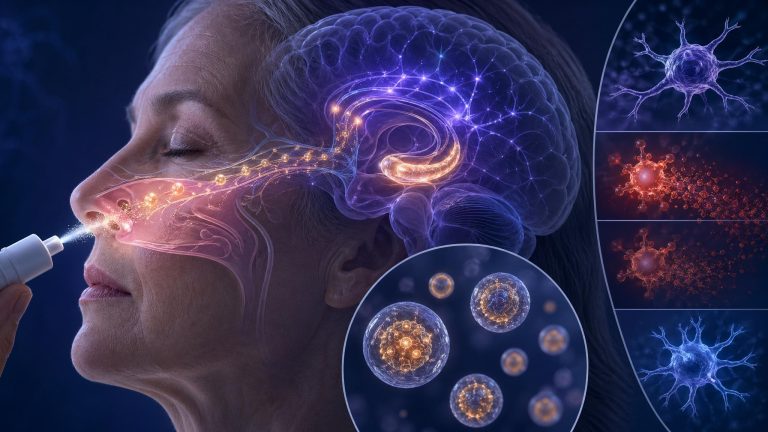
A Nasal Spray That Reverses Brain Aging: The Texas A&M Breakthrough Reshaping Alzheimer’s Research
A two-dose nasal spray built from human neural stem cell-derived particles silenced the inflammation signals that drive cognitive decline, restored memory in aged mice, and is now being positioned for…
The Gut Molecule That Sabotages Your Metabolism: Inside Imidazole Propionate and the 2025 Atherosclerosis Breakthrough
A gut bacterial metabolite called imidazole propionate has gone from obscure molecule to validated driver of insulin resistance, type 2 diabetes, heart failure, and atherosclerosis. Inside the University of Gothenburg…