
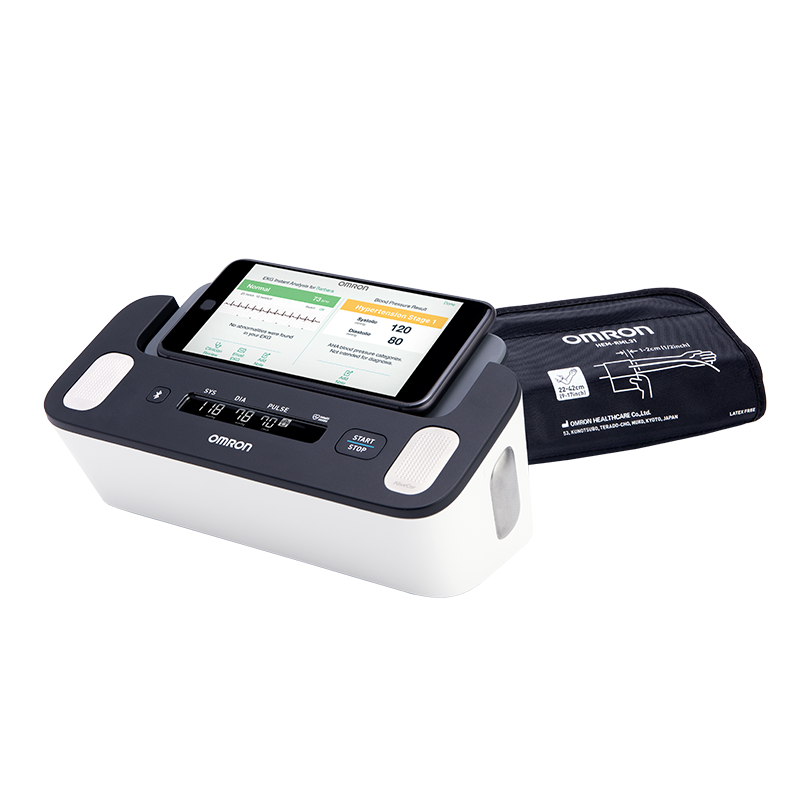
Omron Complete: FDA Cleared Blood Pressure Monitor With Built In ECG for AFib Detection
The most affordable FDA cleared device that combines upper arm blood pressure measurement with a single lead ECG for atrial fibrillation screening, built on AliveCor’s proven detection technology.
Presented By Our Partners



Hypertension and atrial fibrillation are deeply intertwined conditions. Elevated blood pressure is one of the strongest independent risk factors for developing atrial fibrillation, and atrial fibrillation in turn increases stroke risk by approximately fivefold. Among patients with both conditions, the compounding cardiovascular risk is substantially higher than either condition alone. Yet in standard clinical practice, these two conditions are typically monitored with separate devices, separate workflows, and often separate clinical specialists.
A 2023 study published in JACC: Clinical Electrophysiology by Mannhart et al. (the BASEL Wearable Study) validated five consumer ECG devices for atrial fibrillation detection in 201 patients and found that the AliveCor KardiaMobile achieved 79% sensitivity and 69% specificity for AFib detection. The study confirmed that consumer grade single lead ECGs can capture clinically interpretable cardiac rhythm data, but also highlighted that approximately 26% of KardiaMobile tracings were flagged as inconclusive by the automated algorithm. Manual physician review resolved 99% of those ambiguous recordings.
The Omron Complete brings AliveCor’s proven ECG technology into Omron’s blood pressure monitoring platform, creating a single device that screens for both hypertension and atrial fibrillation in one measurement session.
What Is the Omron Complete?
The Omron Complete is an FDA cleared upper arm blood pressure monitor with an integrated single lead ECG. It combines Omron’s validated oscillometric blood pressure measurement technology with AliveCor’s ECG detection algorithms in a single arm cuff device. During a measurement session, the device first captures blood pressure and pulse, then prompts the user to place their fingers on the integrated ECG electrodes to record a 30 second single lead electrocardiogram analyzed for atrial fibrillation, bradycardia, tachycardia, and normal sinus rhythm.
Both the blood pressure and ECG functions hold FDA 510(k) clearance, making the Omron Complete one of the few consumer devices with dual FDA cleared cardiac monitoring capabilities. The device syncs via Bluetooth to the Omron Connect app, which stores readings, provides trend analysis, and enables data sharing with healthcare providers. It supports multi user profiles for household sharing.
At $99.99 with no subscription requirement, the Omron Complete is the most affordable combined blood pressure and ECG device on the market. It is confirmed HSA and FSA eligible with a Letter of Medical Necessity.
The Science Behind Combined Blood Pressure and ECG Monitoring
The clinical rationale for combining blood pressure and ECG monitoring in a single device rests on the epidemiological relationship between hypertension and atrial fibrillation. Hypertension is present in approximately 60% to 80% of patients diagnosed with atrial fibrillation, making it the most common comorbidity in this population. The mechanisms linking the two conditions include left atrial enlargement driven by chronic pressure overload, myocardial fibrosis, and neurohormonal activation.
Importantly, many patients with atrial fibrillation are asymptomatic during episodes, which means the arrhythmia can persist undetected for months or years. During that time, the elevated stroke risk remains active regardless of whether the patient feels any symptoms. This is why screening is clinically valuable: detecting AFib early enables initiation of anticoagulation therapy, which reduces stroke risk by approximately two thirds.
The BASEL Wearable Study provided direct evidence that consumer ECG devices can function as screening tools in real world clinical populations. The AliveCor KardiaMobile technology used in the Omron Complete achieved 79% sensitivity and 69% specificity in that study. While these numbers are lower than the Apple Watch (85% sensitivity, 75% specificity), the AliveCor platform has the longest track record of clinical use among consumer ECG devices and has been the subject of numerous published validation studies.
A 2020 study by Lown et al. published in PLoS One demonstrated that machine learning algorithms applied to consumer wearable data could achieve 100% sensitivity and 97.6% specificity for AFib detection, suggesting that the ceiling for consumer device accuracy is considerably higher than current commercially deployed algorithms achieve. This gap between what is technically achievable and what current devices deliver represents an ongoing area of development.
The practical value of combining both measurements in one session is adherence. A patient who sits down for a blood pressure reading and simultaneously receives an ECG screening is far more likely to accumulate longitudinal rhythm data than a patient who must use a separate ECG device in a separate workflow. For patients managing hypertension who are also at elevated risk for atrial fibrillation, this consolidation eliminates the compliance barrier of a second monitoring task.
What the Omron Complete Does Well
The Omron Complete’s primary strength is its value proposition. At $99.99, it delivers FDA cleared blood pressure monitoring and FDA cleared ECG screening in a single device for roughly the same price as a standalone connected blood pressure monitor. Adding a separate AliveCor KardiaMobile ($99) to a standalone blood pressure cuff would cost approximately twice as much for equivalent functionality.
The AliveCor ECG technology integrated into the Omron Complete is the most extensively validated consumer ECG platform on the market. AliveCor has published more clinical validation data than any other consumer ECG manufacturer, and its algorithms have been refined over multiple product generations. This is not a first generation technology; it is an established platform with a substantial evidence base.
Featured Partner
Invest in the Infrastructure Behind Modern Medicine
As healthcare expands beyond hospital walls, the buildings and campuses supporting that shift are generating compelling returns for investors who move early. The Healthcare Real Estate Fund offers qualified investors direct access to a curated portfolio of medical office, outpatient, and specialty care facilities.
Learn More →
The blood pressure measurement uses Omron’s validated oscillometric technology in the upper arm position, which remains the guideline recommended measurement site for home blood pressure monitoring. Unlike wrist monitors, upper arm measurement minimizes positional variability and provides readings most comparable to clinical measurements.
The Omron Connect app provides clear trend visualization for both blood pressure and ECG data, with color coded readings that indicate whether values fall within normal, elevated, or high ranges. The app supports multiple user profiles, enabling household sharing. Data can be exported and shared with healthcare providers, closing the loop between home monitoring and clinical decision making.
Pricing, Access, and Practical Realities
The Omron Complete retails at $99.99 with no subscription requirement. Total first year cost is the purchase price alone. This makes it the most affordable dual modality (blood pressure plus ECG) cardiac monitoring device available, significantly less expensive than the Withings BPM Core ($249.95), which offers similar combined capabilities plus a digital stethoscope.
The device is confirmed HSA and FSA eligible with a Letter of Medical Necessity. For patients prescribed home blood pressure and cardiac rhythm monitoring, reimbursement through pre tax healthcare accounts makes the Omron Complete exceptionally accessible from a cost perspective.
Both the blood pressure and ECG functions hold FDA 510(k) clearance. The blood pressure clearance follows Omron’s long established regulatory pathway for oscillometric monitors. The ECG clearance derives from AliveCor’s technology, which has been FDA cleared for six arrhythmia determinations: atrial fibrillation, bradycardia, tachycardia, normal sinus rhythm, premature ventricular contractions, and sinus rhythm with supraventricular ectopy (the latter two detections are available on the 6L model; the Complete uses the single lead algorithm).
The device uses standard AA batteries rather than a rechargeable battery, which eliminates charging infrastructure requirements but introduces an ongoing (minimal) consumable cost. The cuff fits arm circumferences of 22 to 42 cm.
Who the Omron Complete Is Best For
The Omron Complete is ideal for patients managing hypertension who are also at elevated risk for atrial fibrillation due to age, family history, or comorbid conditions. It is particularly well suited for adults over 65, where the prevalence of both hypertension and AFib increases substantially. Patients already using a home blood pressure monitor who want to add ECG screening without purchasing a second device will find the Complete a natural upgrade.
Primary care physicians and cardiologists who prescribe home monitoring may find the dual capability useful for increasing screening coverage among patients who might not independently seek out a dedicated ECG device. The $99.99 price point and HSA/FSA eligibility reduce the financial barrier to prescribing combined monitoring.
Users who want continuous, passive cardiac rhythm monitoring throughout the day should consider a wrist worn ECG device like the Apple Watch or Withings ScanWatch instead. The Omron Complete requires an intentional measurement session; it does not provide background rhythm monitoring. Users seeking the most advanced consumer ECG for arrhythmia detection should consider the AliveCor KardiaMobile 6L, which provides a 6 lead recording with broader arrhythmia detection capabilities. Users who need only blood pressure monitoring without ECG can save money with the Omron Platinum or Withings BPM Connect.
How the Omron Complete Compares
Against the Withings BPM Core ($249.95), the Omron Complete is $150 less expensive and holds FDA clearance for both its blood pressure and ECG functions in the US market (the BPM Core’s ECG carries CE marking but not FDA clearance for the US). The BPM Core adds a digital stethoscope for valvular heart disease screening, which the Omron Complete lacks. For US consumers who prioritize regulatory clearance and value, the Omron Complete offers a stronger proposition. For users who want the broadest cardiac screening, the BPM Core’s stethoscope adds a unique dimension.
Against a standalone AliveCor KardiaMobile ($99) plus a separate Omron blood pressure monitor ($50 to $80), the Complete consolidates both functions at a lower total cost and with a simpler workflow. The standalone KardiaMobile offers the same ECG detection algorithm, so there is no clinical disadvantage to the integrated approach.
Against the Apple Watch Series 9, which offers a single lead ECG and continuous heart rate monitoring, the Omron Complete provides validated blood pressure measurement that the Apple Watch cannot. However, the Apple Watch offers 24/7 passive rhythm monitoring, a feature the Omron Complete’s session based approach cannot replicate. Users with both hypertension and AFib risk factors may find that these devices complement each other rather than compete.
Limitations and Open Questions
The Omron Complete requires an intentional measurement session for each reading, typically taking 60 to 90 seconds for the combined blood pressure and ECG measurement. It does not provide continuous monitoring, overnight tracking, or event triggered recording. Paroxysmal atrial fibrillation episodes that occur between measurement sessions will be missed.
The single lead ECG provides less diagnostic information than multi lead configurations. While it is FDA cleared for atrial fibrillation detection, its ability to characterize more complex arrhythmias is limited compared to the 6 lead recordings produced by the AliveCor KardiaMobile 6L or the Withings Body Scan.
The device uses Bluetooth only (no Wi-Fi), which means the phone must be in proximity for data to sync to the Omron Connect app. This is a practical limitation compared to Wi-Fi enabled devices like the Withings BPM Connect, which sync readings automatically even when the phone is absent.
Battery powered rather than rechargeable design means periodic battery replacement, though AA batteries typically last several months with regular use. The Omron Connect app, while functional, is generally considered less polished than the Withings Health Mate platform in terms of data visualization and reporting.
What This Means for Your Health
Cardiovascular disease, one of the Four Villains, typically does not announce itself with dramatic symptoms. Hypertension and atrial fibrillation develop quietly over years, compounding cardiovascular risk with each unmonitored day. The Omron Complete addresses both conditions in a single device that costs less than a typical dinner for two, requires no subscription, and produces FDA cleared data that your physician can act on.
Within Healthcare Discovery‘s Five Pillars framework, the Omron Complete supports comprehensive cardiovascular health monitoring that connects to every pillar. Nutrition changes show up in blood pressure trends. Movement and exercise produce measurable hemodynamic effects. Sleep quality correlates with morning blood pressure patterns and rhythm stability. Breathwork and stress management translate into observable cardiovascular responses. And the Mindset pillar is served by the empowerment that comes from understanding your own cardiovascular data rather than relying solely on intermittent clinical snapshots.
If you are over 50, manage hypertension, or have risk factors for atrial fibrillation, the Omron Complete represents an exceptionally practical entry point into dual modality cardiac monitoring. At $99.99 with no subscription, the financial barrier is negligible relative to the potential clinical value of early AFib detection. Take readings consistently, share the data with your physician, and use the trends to inform conversations about medication management, lifestyle modifications, and when further clinical evaluation is warranted.

Explore the full wearable guide
See how the Omron Complete compares with smart rings, watches, ECG devices, and other connected health hardware across the full Healthcare Discovery wearables guide.
Frequently Asked Questions
Is the Omron Complete FDA cleared for both blood pressure and ECG?
Yes. The Omron Complete holds FDA 510(k) clearance for both its oscillometric blood pressure monitoring and its single lead ECG functions. The ECG technology is provided by AliveCor, the most extensively validated consumer ECG platform available. The device can detect atrial fibrillation, bradycardia, tachycardia, and normal sinus rhythm.
How much does the Omron Complete cost?
The Omron Complete retails at $99.99 with no subscription requirement. Total cost of ownership is the purchase price plus periodic AA battery replacement (typically every few months). It is confirmed HSA and FSA eligible with a Letter of Medical Necessity, allowing eligible purchasers to use pre tax healthcare dollars.
How does the Omron Complete ECG compare to AliveCor KardiaMobile?
The Omron Complete uses AliveCor’s single lead ECG technology, providing the same atrial fibrillation detection algorithm as the standalone KardiaMobile. The main difference is integration: the Complete combines ECG with blood pressure monitoring in a single measurement session. Users who want a 6 lead ECG with broader arrhythmia detection capabilities should consider the AliveCor KardiaMobile 6L ($149) as a standalone device.
Can the Omron Complete detect all types of arrhythmias?
No. The Omron Complete’s single lead ECG is FDA cleared to detect atrial fibrillation, bradycardia (slow heart rate), tachycardia (fast heart rate), and normal sinus rhythm. It cannot detect more complex arrhythmias such as premature ventricular contractions or atrial flutter with the same specificity as multi lead ECG devices. Any abnormal reading should prompt follow up with a healthcare provider for comprehensive evaluation.
Does the Omron Complete work without a smartphone?
The device displays blood pressure readings directly on its built in screen, so you can take and view blood pressure measurements without a smartphone. However, ECG analysis, data storage, trend tracking, and physician reporting require the Omron Connect app on a smartphone. The app connects via Bluetooth and must be in proximity during measurement for data sync.
Omron Complete at a glance
- Hardware price
- $99.99
- Subscription
- None required
- First year total
- $99.99
- Form factor
- Upper arm BP monitor + ECG
- FDA status
- Has FDA clearance
- HSA/FSA
- Possibly, with a letter of medical necessity
Measures AFib detection), Blood pressure, ECG (single-lead, HR
Maintained in the Healthcare Discovery device database and updated automatically.


Similar Posts

Ultra-Processed Food Is Rewiring Your Brain: What 385,000 People Reveal About Diet, Depression, and the Gut-Brain Axis
A meta-analysis of 385,541 people finds that high ultra-processed food consumption raises depression risk by 44 percent and anxiety risk by 48 percent. New research on the gut-brain axis, neuroinflammation,…

Vivoo Urine Wellness Test: AI-Powered Daily Metabolic Tracking
How daily urine biomarkers reveal the invisible accelerators of aging—oxidative stress, metabolic drift, and nutritional gaps—that blood tests miss. Presented By Our Partners The Silent Accelerator: Why Oxidative Stress Matters…

The Daily Rounds: Longevity & Health Care Brief | April 3, 2026
🧬 - Epigenetic reprogramming enters human trials for the first time, with Life Biosciences' ER-100 receiving FDA clearance for a phase 1 study in optic nerve degeneration, marking the dawn of cellular rejuvenation medicine. 🫁 - An AI-designed molecule for idiopathic pulmonary fibrosis shows clinical promise in a phase 2a trial, proving that algorithmically discovered drugs can survive contact with human biology. 🦠 - Gut bacteria can inject proteins directly into human cells, a newly described mechanism now linked to Crohn's disease inflammation and poised to reshape microbiome therapeutics. 🧠 - Disrupted circadian rhythms are associated with 2.5 times the risk of dementia, reinforcing that sleep timing and biological clock integrity are modifiable targets for brain aging. 💊 - With more than 173 AI-discovered drug programs now in clinical trials and Eli Lilly committing $2.75 billion to AI drug development, the algorithmic era of medicine is no longer theoretical.

How Adrian Woolfson Is Helping Medicine Move From Reading DNA to Writing It
Adrian Woolfson trained under a Nobel laureate at Cambridge, ran global oncology programs at the world’s largest pharmaceutical companies, and led research and development at Sangamo Therapeutics during the first…
The Daily Rounds: Longevity & Health Care Brief | May 10, 2026
🫀 Thymus as Longevity Organ: AI analysis of CT scans across 25,000 adults finds that healthy thymus tissue predicts a 50% lower risk of all-cause death and 63% lower cardiovascular death risk, reframing this overlooked organ as a modifiable longevity target. 🧠 Cognitive Disability Rising Fast in Young Adults: Self-reported cognitive disability in US adults under 40 has nearly doubled since 2013, making younger adults the primary driver of overall cognitive impairment for the first time on record. 🖨️ Adhesive-Free Wearable Tracks Metabolism Continuously: A 3D-printed University of Arizona device, published in Nature Communications on May 10, monitors dehydration, metabolic shifts, and stress through skin gas emissions with no adhesive and no skin irritation. 💊 Eli Lilly Goes All-In on AI Drug Discovery: A $2.75 billion deal with Insilico Medicine signals that Big Pharma has moved from piloting AI to fully integrating AI-first companies as primary R&D partners. ⏱️ Fasting Windows Alone Do Not Boost Metabolism: A controlled study finds that intermittent fasting without calorie reduction produces no measurable metabolic or cardiovascular benefit, confirming that caloric balance, not timing alone, is the key driver.

The New Race in Healthcare AI Is Not to Detect More. It Is to Finish the Job.
Healthcare AI is getting better at finding signals. The harder test is whether those signals turn into accountable action, completed care, and measured outcomes.
