
The Zone 2 Revolution: How Mitochondrial Science Is Rewriting Endurance Training for Longevity
A decade ago, the phrase “zone 2 training” lived almost entirely inside elite endurance camps in Boulder, Davos, and the Tour de France peloton. Today it is a standard talking point in longevity clinics, on Peter Attia’s podcast, and in the broader conversation around mitochondrial health. The shift did not happen by accident. It traces back to a quiet body of research from a Colorado exercise physiologist named Iñigo San Millán and a growing scientific consensus that the slow, easy aerobic work most people skip may be the single most metabolically valuable form of exercise in the human catalog.
Presented By Our Partners



The story has a counterintuitive shape. The same kind of effort you might dismiss as too easy to count turns out to be the precise stimulus your mitochondria need to grow, multiply, and burn fat efficiently. The same intensity that feels conversational and forgettable is the one that builds the engine your body will draw on for the next four decades.
This is the science of zone 2, what it actually does inside your cells, why a generation of longevity researchers consider it foundational, and what the most recent data say about how to use it.
## What Zone 2 Actually Is
Zone 2 is not a heart rate number. It is a metabolic state. It is the intensity at which your body produces most of its energy from fat oxidation, before lactate begins to accumulate in the bloodstream in any meaningful way. In sports science it sits below the first lactate threshold, often called LT1, where blood lactate hovers between 1.5 and 2.0 millimoles per liter.
Researchers identify zone 2 in different ways. In a laboratory it is defined by lactate measurement. In the field it is approximated by heart rate, perceived exertion, or the simplest test of all, the talk test. Zone 2 is the highest intensity at which you can hold a full sentence conversation without breath disruption. The moment speech becomes choppy, you have left zone 2.
For most adults, zone 2 corresponds to roughly 60 to 70 percent of maximum heart rate, but individual variation is large. A trained cyclist may sit at 75 percent. A deconditioned adult may need only a brisk walk to find it. The intensity is personal. The physiology is universal.
## The Iñigo San Millán Body of Work
The scientist most associated with the modern zone 2 conversation is Iñigo San Millán, an assistant professor at the University of Colorado School of Medicine and the longtime exercise physiologist for the UAE Team Emirates cycling squad, the team behind Tadej Pogačar’s Tour de France wins.
San Millán’s published work, including a 2020 paper in the International Journal of Environmental Research and Public Health and a 2018 review in the Annals of Translational Medicine, focuses on the relationship between mitochondrial function and metabolic flexibility. His central claim, repeated across his laboratory and clinical work, is that lactate clearance capacity at sub threshold intensities is one of the best functional readouts of mitochondrial health available to non invasive testing.
In other words, zone 2 is not just a training zone. It is a diagnostic window. The intensity at which your lactate begins to rise tells you how well your mitochondria are functioning, and the training itself, performed at that exact intensity, is the most efficient stimulus for improving the underlying machinery.
## The Mitochondrial Story
Mitochondria are the energy organelles inside every cell, with the highest concentrations in tissues that demand sustained ATP production. Skeletal muscle, heart, brain, and liver lead the list. They produce energy through the oxidation of substrates, primarily fatty acids and glucose, in a cascade that ends with the electron transport chain.
Two adaptations matter most for zone 2 training.
The first is mitochondrial biogenesis. Sustained low to moderate intensity work activates a transcriptional coactivator called PGC-1α, often described as the master regulator of mitochondrial biogenesis. Research from the labs of Bruce Spiegelman at Harvard and David Bishop in Australia has traced PGC-1α signaling through dozens of downstream targets that drive new mitochondrial protein synthesis. The result is more mitochondria per cell, each more efficient at producing ATP.
The second is the up regulation of fatty acid oxidation enzymes. Carnitine palmitoyltransferase 1, known as CPT-1, shuttles long chain fatty acids across the mitochondrial membrane. The beta oxidation enzymes inside the mitochondria break those fatty acids down for energy. Consistent zone 2 work increases the activity of all of them. The cell becomes metabolically flexible. It can burn fat efficiently at rest and at low intensities, sparing precious glycogen for moments that actually demand it.
There is also the lactate shuttle, characterized in detail by George Brooks at the University of California, Berkeley over more than three decades. Brooks demonstrated that lactate is not a metabolic waste product but a key intercellular fuel. Healthy mitochondria, equipped with the monocarboxylate transporter MCT1, can take up lactate from the blood and oxidize it inside the cell. Zone 2 training improves this clearance capacity, which is why lactate stays low at progressively higher workloads in a trained subject. The training does not just shift the threshold curve to the right. It rebuilds the system that creates the curve.
## Why the Longevity Community Moved In
For most of the last century, exercise science divided itself between performance physiology and rehabilitation medicine. The longevity field, when it spoke about exercise at all, focused on cardiovascular mortality reduction and the all cause mortality curves associated with VO2 max.
Then a synthesis happened. Peter Attia, a physician and longevity advocate, began talking about zone 2 on his podcast with San Millán in a 2021 conversation that has since been viewed by an audience well into the millions. Attia framed zone 2 alongside VO2 max work as the two pillars of cardiovascular longevity, with zone 2 building the mitochondrial base and high intensity intervals extending the ceiling.
Featured Partner
Invest in the Infrastructure Behind Modern Medicine
As healthcare expands beyond hospital walls, the buildings and campuses supporting that shift are generating compelling returns for investors who move early. The Healthcare Real Estate Fund offers qualified investors direct access to a curated portfolio of medical office, outpatient, and specialty care facilities.
Learn More →
The framing landed for two reasons. First, the biology held up to scrutiny. The PGC-1α pathway, the lactate shuttle, the fatty acid oxidation enzyme up regulation, all of it was already in standard exercise physiology textbooks. The new contribution was the synthesis and the bridge to clinical longevity practice. Second, the practical message was unusually clear. Most adults overtrain in the murky middle zone, an effort hard enough to feel like work but not hard enough to drive adaptation in either direction. Zone 2 corrected for that.
## The 80/20 Rule and Polarized Training
A second body of research arrived in parallel from Norwegian sport scientists Stephen Seiler and Espen Tønnessen, who studied the training distributions of elite endurance athletes across cross country skiing, rowing, cycling, and running.
Seiler’s central finding, published across multiple papers from 2010 forward in journals including the International Journal of Sports Physiology and Performance and Sports Medicine, is that the world’s most successful endurance athletes spend roughly 80 percent of their training time at very low intensities, below the first lactate threshold, and 15 to 20 percent at high intensities above the second threshold. The murky middle, the moderate intensity that feels like work, is largely avoided.
This polarized training distribution maps almost perfectly onto the zone 2 plus VO2 max longevity framework. The reason is mechanical. Easy work builds the engine. Hard work sharpens the top end. Moderate work fatigues the athlete without driving specific adaptation in either direction.
The cross country skier or marathoner who trains polarized produces durable improvements in lactate threshold, VO2 max, and economy. The recreational athlete who lives in the moderate zone tends to plateau, accumulate fatigue, and stall.
## The Metabolic Flexibility Connection
Outside the athletic literature, zone 2 training intersects with the most consequential conversation in metabolic medicine. Insulin resistance, type 2 diabetes, fatty liver disease, and the loss of metabolic flexibility that defines aging are all connected to the same underlying problem. Mitochondria struggle to oxidize fatty acids and switch fuel sources on demand.
Metabolic flexibility, a term coined by David Kelley and colleagues in the early 2000s, refers to the ability to switch between fuel sources, fat at rest and during low intensity work, carbohydrate during high intensity work, based on availability and demand. Insulin resistant individuals lose this flexibility. They burn glucose poorly at high intensities and fat poorly at rest, a state that drives weight gain and chronic disease.
Zone 2 training, by improving mitochondrial fatty acid oxidation specifically, restores some of this flexibility. A 2017 paper from Mary Ellen Harper at the University of Ottawa, and follow up work from Jørgen Wojtaszewski in Copenhagen, demonstrated that low intensity endurance training improves insulin sensitivity through mechanisms that high intensity intervals do not fully replicate.
The implication is large. The same training that helps a Tour de France cyclist clear lactate at 400 watts may help a sedentary 55 year old reverse the early signs of type 2 diabetes. The biology does not distinguish between performance and prevention. It just responds to the right stimulus.
## What Is New in 2025 and 2026
The last 18 months have produced several updates worth noting.
A 2024 paper in Cell Metabolism from the Mark Tarnopolsky lab at McMaster University traced single fiber mitochondrial adaptations to different training intensities and found that low intensity continuous training produced uniquely robust increases in mitochondrial network complexity in slow twitch fibers, while high intensity intervals produced different adaptations in fast twitch fibers. The conclusion: the two modalities are complementary, not redundant. Doing only one leaves a meaningful portion of the muscle adaptation map untouched.
A 2025 review in the Journal of Applied Physiology, led by Robert Hickner and colleagues, synthesized the metabolic flexibility literature and argued that fat oxidation rate during sub maximal exercise is among the strongest available predictors of long term cardiometabolic health, more predictive than fasting insulin alone in several cohorts. Maximal fat oxidation, often abbreviated MFO, sits squarely in the zone 2 intensity range.
And a 2026 paper in Aging Cell from the Mayo Clinic linked sustained zone 2 training to improved mitochondrial quality control through enhanced autophagy and mitophagy signaling, the cellular processes that remove damaged mitochondria and replace them with new ones. Mitophagy is now considered one of the central longevity mechanisms, downstream of nutrient sensing pathways like AMPK and mTOR. The finding that low intensity endurance work can activate it strengthens the bridge from exercise physiology to the molecular biology of aging.
## How to Find Zone 2 in Your Own Body
The challenge with zone 2 is that it does not feel like training. It feels like a slightly purposeful walk, a slow jog, a comfortable bike ride, or a relaxed swim. The intensity is low enough that most people, without coaching, drift above it within minutes.
Three tools help.
The talk test is the simplest and the most useful. Zone 2 is the highest intensity at which you can speak a full sentence comfortably. If you cannot, you are too high. If you can sing, you are too low.
Heart rate offers a second anchor. For most adults, zone 2 sits at 60 to 70 percent of maximum heart rate. The Karvonen formula, which uses heart rate reserve calculated as the difference between resting and maximum heart rate, is more individualized than crude percentages of maximum. Many smartwatches now estimate zone 2 directly, though the accuracy depends on whether your maximum heart rate is measured rather than estimated from age.
A lactate meter offers the most precision. For the precision minded, a handheld lactate meter, costing under 300 dollars, can identify the workload at which blood lactate begins to rise, the most accurate way to define zone 2. A few finger sticks during a 30 minute ramp test will reveal a personal LT1 within a single afternoon.
The recommended dose, in nearly every protocol the modern longevity community endorses, is 150 to 240 minutes per week of zone 2 work, distributed across three to four sessions of 45 to 60 minutes. This sits inside what most major guidelines describe as the minimum effective dose for cardiometabolic health, framed through a different vocabulary.
## What This Means For Your Practice
The research is clear. The translation is what gets hard.
If you are starting from scratch, three changes will deliver most of the benefit.
First, track your conversational threshold. Before you worry about heart rate zones, simply choose a sustainable pace at which you can talk in full sentences. Walk briskly, jog easily, or cycle gently. The moment your breathing fractures your speech, you have crossed the line. Slow down five percent and hold there.
Second, aim for 180 minutes per week of zone 2 work, spread across three to four sessions of 45 to 60 minutes. If your current baseline is zero, start with 90 minutes and build by 10 percent per week. The volume matters more than the intensity once you are in the zone.
Third, pair it with one true high intensity session per week. The Norwegian polarized model is built on volume of easy work plus a small dose of hard work. One VO2 max interval session per week, such as a 4 by 4 protocol at 90 percent of max heart rate, complements zone 2 work without overlapping with it.
If you are already active, audit your distribution. Most recreational endurance athletes spend 60 to 70 percent of training in the moderate zone that drives the least adaptation. Pushing the easy work easier and the hard work harder almost always produces measurable gains within a training block of 8 to 12 weeks. Resist the gravitational pull of comfortably hard. That intensity is where progress goes to die.
If you have metabolic concerns, including pre diabetes, insulin resistance, fatty liver, or rising HbA1c, treat zone 2 work as a clinical intervention. The published evidence on mitochondrial fatty acid oxidation, insulin sensitivity, and metabolic flexibility is consistent and robust. Most cardiologists and endocrinologists who pay close attention to the metabolic literature now prescribe zone 2 walking or cycling as a foundational lifestyle intervention, often alongside protein and fiber adjustments to support glycemic control.
If you are over 60, consider zone 2 work the cornerstone of your weekly movement plan. The mitochondrial decline that drives sarcopenia, frailty, and metabolic dysfunction is precisely the kind of damage zone 2 training is suited to reverse. The Mayo Clinic mitophagy data from 2026 make this especially compelling. Pair the aerobic work with resistance training two times per week and you have hit the two highest yield exercise interventions in the longevity literature.
The hardest part of zone 2 is psychological. The intensity feels too easy to feel like progress. The research says otherwise. The slow, steady, conversational pace is the one that builds the mitochondrial machinery your body will rely on for the next 30 years.
The zone 2 conversation is not a fitness trend. It is a return to physiological first principles, the easy aerobic base that every endurance tradition, from the 1960s Kenyan distance runners to the modern Tour de France peloton, has used to build the engine that makes everything else possible.
What is new is the convergence with longevity science. The mitochondrial adaptations that build a champion’s cardiovascular system are the same ones that protect an aging adult’s metabolic health. The intensity at which lactate stays low in a cyclist is the same intensity at which an insulin resistant adult begins to recover fat oxidation. The biology does not distinguish between performance and prevention. It just responds to the right stimulus.
That stimulus is slow, easy, sustained, and conversational. Most people skip it. The data say they should not.


Similar Posts

Moxy Monitor: Real-Time Muscle Oxygen Saturation for Training Zone Precision
Heart rate tells you how hard your cardiovascular system is working. Muscle oxygen tells you how hard your muscles are actually working, and more importantly, when they are about to…

The Senolytic Revolution: New Science Shows Zombie Cells Hold the Key to Reversing Aging at Its Source
Two landmark studies published this month are rewriting the cellular biology of aging, revealing that the very cells once viewed as purely destructive may hold the most precise key yet…
LetsGetChecked Hormone Tests: At-Home Panels With Nurse-Supported Results
Knowing your hormone levels is only half the equation. Understanding what those numbers mean for your specific situation requires a conversation that most at-home testing platforms leave to the user….
Supersapiens: Real-Time Glucose Monitoring System Built for Athletic Performance
The first continuous glucose monitoring system designed specifically for athletes, powered by Abbott’s Libre Sense biosensor, providing real-time fueling data during training and racing with integration into Garmin, Wahoo, TrainingPeaks,…
VO2 Master Analyzer Review: Wireless Mask Based VO2 Max Testing for Field and Laboratory Use
The VO2 Master eliminates the cart, the hoses, and the tether, delivering real time metabolic analysis through a wireless mask that goes wherever the athlete trains. Presented By Our Partners…
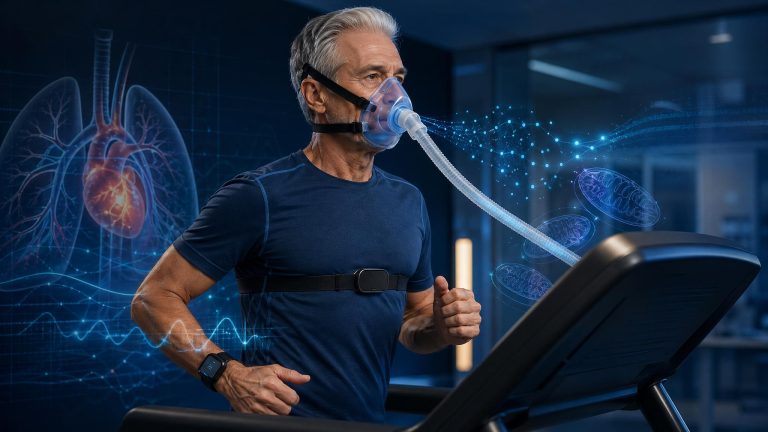
Your VO2 Max May Be the Single Best Predictor of How Long You Will Live: What 3.8 Million People and 58 Clinical Trials Reveal About Cardiorespiratory Fitness and the Science of Living Longer
A meta-analysis of 3.8 million people shows that each one-MET increase in cardiorespiratory fitness reduces all-cause mortality by 14 percent. A 2026 Cochrane review of 58 clinical trials confirms HIIT…
