
Closed-Loop Referrals: The AI Delivery Layer Healthcare Keeps Missing
A referral sounds simple until you watch one fail.
Presented By Our Partners



A primary care doctor notices a suspicious rash and sends a patient to dermatology. A cardiologist recommends electrophysiology follow-up. A hospital discharge team refers an older adult to home health. A cancer screening program finds an abnormal image and tells the patient to get further evaluation. On paper, the next step exists. In the medical record, the box may even be checked.
But the patient has not been seen.
The specialist office may not receive the right documentation. The referral may arrive by fax, half-legible and incomplete. The patient may not know whom to call. The office may call once, leave a voicemail, and move on. Insurance may not match. The specialist may not have availability for months. The referring clinician may never learn whether the visit happened. The patient may assume someone else is handling it. The system may assume the patient is handling it.
That is how healthcare loses people in plain sight.
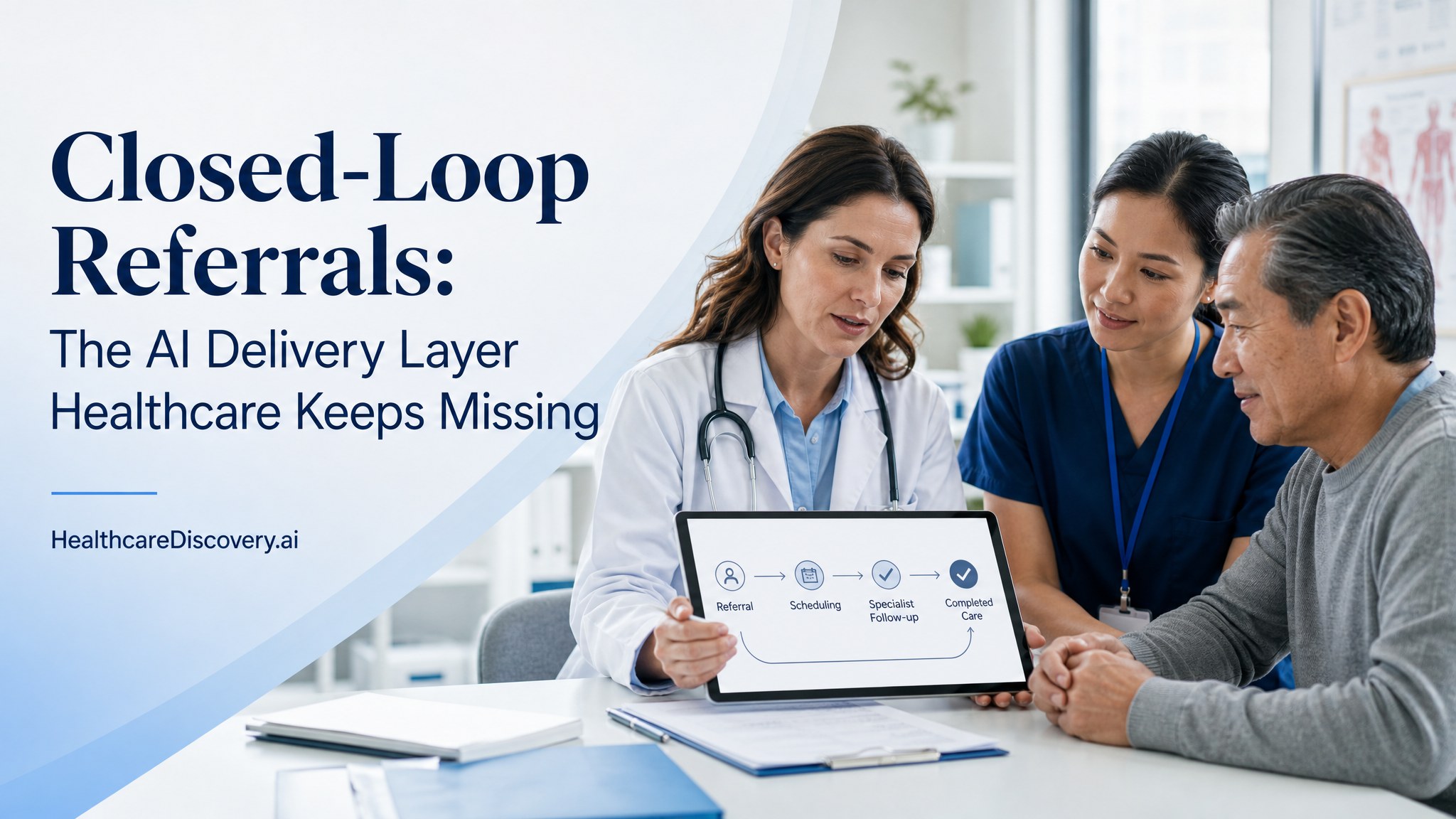
Closed-loop referrals are the attempt to fix that failure. The phrase sounds technical, almost bureaucratic. It is not. It means the system does not treat a referral as complete when it is ordered. The loop is not closed until the patient is routed to the right care, scheduled, seen, documented, and the result returns to the clinician or team responsible for the next step.
In a healthcare system increasingly filled with artificial intelligence, closed-loop referrals may become one of the most practical tests of whether AI can help medicine deliver care instead of merely identifying need.
Because a prediction is not care. A risk score is not care. A diagnosis is not always care. A referral is not care.
Care happens when the next action is completed.
The referral is where medicine hands off responsibility
A referral sits at a fragile moment in healthcare. It is the point where one person or system recognizes a need but cannot complete the response alone.
A primary care physician may need a specialist. An emergency department may need follow-up care. A hospital may need post-acute placement. A screening program may need diagnostic confirmation. A health plan may need a patient connected to a covered provider. A social worker may need a community organization to provide food, transportation, housing support, or community-based services.
Every referral contains an implicit promise: someone will pick this up.
The problem is that healthcare often lacks a reliable operating system for that promise. It has electronic medical records, portals, faxes, call centers, scheduling rules, insurance checks, prior authorization workflows, specialist queues, provider directories, care managers, community resource lists, and patient messaging systems. What it often lacks is a single accountable loop.
A closed-loop referral asks five plain questions:
- Was the referral received?
- Was it complete enough to act on?
- Was the patient matched to the right destination?
- Was the care actually completed?
- Did the result return to the person responsible for the next decision?
If the answer to any of those questions is no, the loop is open.
That open loop is not just an administrative nuisance. It is a clinical risk.
A systems-engineering analysis of diagnostic referral processes described referral loop closure as a persistent patient-safety problem. The authors cited studies reporting failure rates of roughly 65% to 73% for completing diagnostic referrals. In the mapped workflows they examined, only about 21% of activities were estimated to be value-add. The rest was coordination tax: reminders, workarounds, manual checking, rework, inspection, variation, and follow-up labor.
That is the hidden machinery behind the familiar patient experience: waiting, calling, repeating information, wondering whether anyone has the records, and not knowing who owns the next step.
Why referrals fail
Referral failure rarely has one villain. It is usually a chain of small weaknesses.
The first is intake. A referral often arrives as unstructured information: a fax, scanned note, PDF, EHR message, outside record, prior authorization form, discharge packet, imaging report, or handwritten order. It may be missing demographics, insurance details, clinical reason, urgency, diagnostic codes, prior test results, medications, images, or contact information. A human being has to read it, interpret it, enter it, route it, and decide whether it is ready.
The second is matching. The patient does not just need “a specialist.” The patient needs the right specialist for the clinical question, insurance network, geography, language, availability, acuity, site of care, and sometimes equipment or procedural capability. Provider directories are famously messy. Availability is dynamic. Referral rules vary by specialty and payer. A referral can fail simply because the system points the patient to the wrong door.
The third is scheduling. Even when the destination is correct, the patient still has to be reached. Phone calls miss. Voicemails disappear. Patients work, travel, care for family, change numbers, avoid unknown callers, or cannot navigate portals. Appointment slots open and close. Waitlists are not always automated. If a patient cancels, the loop may quietly die.
The fourth is authorization and financial fit. Insurance eligibility, benefits, referral requirements, prior authorization, network rules, and out-of-pocket exposure can all derail completion. A patient may be told to see someone, only to discover the appointment is not covered or the paperwork is incomplete.
The fifth is feedback. Even if the visit happens, the loop is not truly closed unless the result returns. The referring clinician needs the specialist note, diagnostic conclusion, care plan, medication changes, imaging interpretation, or follow-up recommendation. Without that return signal, the system may not know whether the problem was resolved, escalated, or abandoned.
The sixth is ownership. This may be the most important failure mode. When a referral crosses organizational boundaries, responsibility can blur. The referring office assumes the receiving office will call. The receiving office assumes the patient will call. The patient assumes the doctor’s office will call. The health system assumes the EHR has the answer. The payer assumes the provider network is sufficient. Everyone has a fragment. No one owns the loop.
This is why closed-loop referrals are such a useful lens for healthcare discovery. The issue is not whether medicine knows something should happen. The issue is whether the healthcare system can make it happen reliably.
Why AI belongs in the referral loop
AI is not needed because referrals are intellectually mysterious. It is needed because referrals are operationally messy.
Referral work is full of tasks that are difficult for overburdened humans to perform consistently at scale but increasingly suitable for intelligent automation: reading unstructured documents, extracting key fields, detecting missing information, comparing clinical need against specialty rules, matching patients to providers, checking benefits, prioritizing urgency, generating summaries, contacting patients, translating messages, filling cancellations, monitoring status, and flagging stalled cases.
That does not mean AI should own clinical judgment. It means AI can help build a more reliable delivery layer around clinical judgment.
The referral loop is especially well suited to AI because it contains structured goals but unstructured inputs. The goal is clear: get the patient to the right next step and return the result. The inputs are chaotic: notes, faxes, scans, calls, eligibility rules, provider schedules, clinical context, patient preferences, payer requirements, and organizational boundaries.
The right AI system does not simply “automate referrals.” It turns a referral from a static order into an active workflow.
That workflow has several layers.
Layer one: referral intake and triage
The first task is making the referral usable.
A large share of referral work begins with information cleanup. Somebody has to open the referral, identify the patient, understand the reason for referral, determine the specialty, check whether the required data is present, and decide whether the referral is ready to schedule or needs more information.
AI referral intake tools aim to compress this front-end chaos. They can read faxes, PDFs, EHR messages, and forms; extract patient demographics, diagnoses, test results, insurance information, referring provider details, and clinical reason; flag missing fields; create referral summaries; and route the referral to the right work queue.
This is where companies such as Innovaccer, ReferralMD, Healos, Insight Health, Calvient, Relency, Docufindr, and Proficient Health fit into the landscape. Some are referral-forward platforms. Others are broader healthcare workflow companies with referral-specific use cases. Their common target is the same: turn messy incoming referral information into an actionable digital object.
Innovaccer’s referral management positioning, for example, includes referral intake, a referral copilot, patient outreach agents, scheduling support, and analytics. ReferralMD emphasizes patient intake, referrals, AI fax, and scheduling. Healos and Insight Health describe AI-assisted referral processing, document extraction, missing-information detection, and specialty-specific classification. Calvient frames referral management as an agentic workflow from intake to scheduling, including status updates and intelligent document processing. Docufindr is more focused on the documentation-heavy referral and order workflow in areas such as durable medical equipment.
The business case is obvious: fewer staff hours spent reading documents, fewer referrals stuck because of missing information, faster handoffs, cleaner worklists, and less revenue leakage.
The clinical case is stronger: fewer patients disappear before the first appointment is even attempted.
Layer two: matching the patient to the right destination
Once a referral is usable, it still has to go somewhere.
This is harder than it sounds. A patient may need a dermatologist, but not every dermatologist handles the same conditions, accepts the same insurance, has the same availability, speaks the same languages, practices at the same sites, or sees the same age groups. A cardiology referral might need general cardiology, electrophysiology, imaging, interventional cardiology, heart failure, or vascular medicine. A behavioral health referral may depend on diagnosis, acuity, modality, geography, age, and coverage.
Bad matching causes delay. It also creates waste. Patients wait for the wrong appointment, show up with incomplete records, get redirected, or abandon the process entirely.
Featured Partner
Invest in the Infrastructure Behind Modern Medicine
As healthcare expands beyond hospital walls, the buildings and campuses supporting that shift are generating compelling returns for investors who move early. The Healthcare Real Estate Fund offers qualified investors direct access to a curated portfolio of medical office, outpatient, and specialty care facilities.
Learn More →
Provider-matching and care-access platforms try to solve this part of the loop. Kyruus Health is one of the more visible companies in this category, built around provider data management, patient access, scheduling, and matching patients to appropriate care. Ribbon Health operates in the provider data layer, helping organizations maintain the accuracy needed for navigation, directories, and network decisions. DexCare focuses more broadly on access optimization and routing demand to the right care setting. Oracle Health, Optum, and other large incumbents approach the problem from within broader clinical, payer, or enterprise platforms.
This segment is not only about referral software. It is about the data layer beneath referrals. If provider data is wrong, AI can route faster and still route badly. If availability is stale, the patient is sent toward a dead end. If insurance fit is inaccurate, scheduling creates a future denial. If clinical matching is too crude, specialty capacity is wasted.
AI can help with matching, but only if the underlying directory, rules, and scheduling data are reliable. Otherwise the system simply accelerates confusion.
Layer three: patient outreach and scheduling completion
The referral loop often fails in the gap between “we know what needs to happen” and “the patient is on the calendar.”
This is where patient engagement platforms become part of referral infrastructure, even when they do not look like referral companies at first glance.
Luma Health, Artera, NextGen’s patient access tools powered by Luma, Phreesia, Notable, and similar platforms operate in the practical world of patient communication, scheduling, intake, reminders, waitlists, call deflection, chat, translation, payments, and access-center workflow. These tools may not all be referral-native, but they matter because a referral cannot close if the patient is not reached.
Luma’s platform is a useful example of the broader category. It spans access, engagement, intake, and payments, with referral-relevant functions such as order orchestration, inbound and outbound faxes, waitlists, conversational AI, two-way messaging, translation, eligibility, prior authorization, and EHR integration. Artera’s referral capabilities sit inside a larger patient communication platform, aimed at improving referral conversion and reducing leakage. NextGen’s access tools include self-scheduling, automated reminders, smart waitlists, rebooking, IVR, call deflection, and chatbots.
This layer matters because healthcare often treats communication as secondary. It is not secondary. Communication is the delivery mechanism.
A referral can fail because a patient does not understand the urgency. It can fail because the patient cannot answer a phone call during work. It can fail because the message is in the wrong language. It can fail because rescheduling requires a 20-minute hold. It can fail because a cancellation creates an open slot that no one fills. It can fail because the patient does not know whether insurance is accepted.
AI can help by turning outreach into a persistent, adaptive process rather than a one-time phone call. It can retry through multiple channels, explain next steps, collect missing information, offer available times, translate instructions, escalate to staff when needed, and monitor whether the appointment was completed.
The goal is not to replace human care teams. The goal is to stop wasting human care teams on avoidable friction while patients wait.
Layer four: eConsults and referral avoidance
A closed-loop referral does not always mean a completed face-to-face specialist visit.
Sometimes the best referral is the one that becomes an eConsult. A primary care physician may need a specialist’s guidance, but the patient may not need a separate appointment. The specialist can review the case asynchronously, recommend additional workup, adjust treatment, reassure the primary care team, or identify when an in-person visit is truly necessary.
This matters because specialist capacity is scarce. If every uncertainty becomes a full referral, queues grow, patients wait, and higher-acuity cases compete with lower-need appointments.
AristaMD, RubiconMD, ConferMED, and related eConsult models sit in this part of the landscape. AristaMD combines electronic specialist consultation with clinical workup checklists and referral-management capabilities; its acquisition of Preferral was aimed at pairing eConsults with better face-to-face referral management. RubiconMD built around same-day specialist insights and virtual specialty networks. ConferMED has worked in the specialty access and eConsult space, particularly for underserved populations and safety-net settings.
This layer reframes closed-loop referrals. The loop closes not when every patient sees a specialist, but when the clinical question is answered and the patient receives the right level of care.
AI could strengthen this model by helping assemble case summaries, ensure the right pre-consult workup is complete, route questions to the right specialty, identify when escalation is needed, and track whether recommendations are followed.
The danger is using eConsults as a denial mechanism rather than an access mechanism. The verification question should be simple: did the patient get the right answer faster, or was care merely diverted?
Layer five: post-acute and discharge referrals
Referral failure does not end at the clinic. It becomes especially consequential after hospitalization.
A patient leaving the hospital may need skilled nursing, home health, rehabilitation, hospice, durable medical equipment, behavioral health follow-up, transportation, medication management, or community support. Delays here can keep patients in hospital beds longer than medically necessary, increase readmission risk, burden families, and create unsafe transitions.
Post-acute referral management has its own software ecosystem. Aidin focuses on care transitions and post-acute placement, helping case managers send referrals, manage provider responses, track placement, and reduce delays. WellSky and CarePort operate in the broader post-acute and care-transition network, connecting hospitals, home health, hospice, skilled nursing, and other care settings. ABOUT Healthcare works more in transfer-center and patient-flow coordination. Optum and NaviHealth touch the space through post-acute management and payer-connected care coordination, though those models require careful scrutiny because utilization management and patient access can pull in different directions.
AI can help discharge referrals by predicting likely post-acute needs earlier, assembling discharge packets, matching patients to available and appropriate providers, tracking acceptance, identifying barriers, and alerting care teams when placement stalls.
But again, the test is not whether a referral was sent. The test is whether the patient safely landed.
A hospital can electronically send a post-acute referral to multiple providers and still fail the patient if no one accepts, the family does not understand the options, transportation is unresolved, home equipment is delayed, or medication instructions are unclear.
Closed loop means handoff plus arrival.
Layer six: social care referrals
Some of the most important referral loops do not end inside a hospital or specialist office.
They end with food, housing, transportation, behavioral health support, utility assistance, legal aid, caregiver support, or community-based services. These social needs shape whether medical care can work. A diabetes plan fails if the patient cannot afford food. A cardiology appointment fails if transportation is impossible. A post-discharge plan fails if the patient returns to an unsafe home.
Social care referral platforms such as Unite Us and Findhelp are built around this wider loop. Unite Us powers closed-loop social care networks connecting healthcare, government, and community organizations. In Arizona, CommunityCares brings together AHCCCS, Contexture, and Unite Us as a statewide closed-loop referral system for social determinants of health needs.
This part of the market is adjacent to clinical referral management but philosophically central. It expands the definition of delivery. Healthcare delivery is not just the movement from doctor to specialist. It is the movement from identified need to completed support.
AI may help social care referrals through needs screening, resource matching, eligibility support, status tracking, outreach, and network analytics. But the risk is significant: social needs are personal, sensitive, and often shaped by poverty, disability, immigration status, language, trauma, and trust. Automation must be careful not to turn a human need into a ticket number.
The best version of AI in social care referrals would reduce clerical burden while preserving dignity and human connection.
Layer seven: analytics and leakage management
Closed-loop referrals also create a management problem: health systems need to see where referrals go.
Referral leakage is often described in financial terms. A patient is referred outside the network, and the health system loses downstream revenue. That matters to hospitals and specialty groups, but the patient-centered version is broader. Leakage can mean clinical leakage: the patient leaks out of the intended care path. The referral stalls. The abnormal result is never worked up. The discharge plan breaks. The specialist note never returns. The next action is not completed.
Analytics platforms can help identify these gaps. They can show referral volume by source, specialty, payer, site, and provider. They can track conversion rates, time to appointment, completion rates, no-show rates, out-of-network leakage, missing documentation, and bottlenecks. They can reveal whether one specialty has a capacity problem, whether one clinic’s referrals frequently lack required information, or whether a patient population is disproportionately failing to complete follow-up.
Innovaccer, Kyruus, Optum, Oracle, Salesforce Health Cloud, Arcadia, Lightbeam, and broader population-health or CRM platforms may all touch this layer in different ways. Some focus on referral analytics directly. Others provide the data infrastructure, care management, CRM, or population health layer around it.
The most important analytic is not revenue retained. It is loop closure.
How many referrals were ordered? How many were accepted? How many were scheduled? How many were completed? How many produced a returned note or result? How many led to the next action? How many failed, and why?
That is where referral management becomes healthcare intelligence.
The vendor map is really a workflow map
It is tempting to list closed-loop referral companies as though they all compete in one neat category. They do not.
Some companies are referral-native. ReferralMD, Aidin, AristaMD, Healos, Relency, Insight Health, Calvient, and similar companies speak directly to referral intake, routing, tracking, or completion.
Some are broader care-access platforms with referral modules. Luma Health, Artera, Kyruus, NextGen, Innovaccer, Oracle Health, Optum, Phreesia, Notable, and DexCare may address referrals as part of a larger operating system for access, communication, scheduling, engagement, or data.
Some are adjacent but essential. Unite Us and Findhelp extend closed-loop logic into social care. eHealth Technologies helps with medical record retrieval and complex specialty access, especially where the right records determine speed to diagnosis. WellSky, CarePort, Aidin, and ABOUT Healthcare address care transitions and post-acute placement. Salesforce Health Cloud and other CRM tools may support referral pipelines even when they are not healthcare-referral companies by origin.
This matters because healthcare organizations do not buy “closed-loop referrals” in the abstract. They buy solutions to specific workflow pain:
- Too many faxed referrals are incomplete.
- Specialists are reviewing poor-quality intake packets.
- Patients are not scheduling.
- Provider directories are inaccurate.
- Call centers are overwhelmed.
- Prior authorization slows the path.
- Discharge referrals delay hospital throughput.
- Community referrals vanish without status updates.
- Referral leakage is invisible until revenue or outcomes suffer.
- Referring clinicians do not receive results.
The right vendor depends on which loop is broken.
What improves for doctors
For clinicians, closed-loop referrals can remove a quiet source of moral injury.
Doctors are trained to diagnose, decide, explain, and treat. But much of modern care requires them to operate inside systems they do not control. They can tell a patient to see a specialist and still have little visibility into whether the patient was contacted, scheduled, seen, or returned to care. They can order diagnostic follow-up and still worry that the patient disappeared somewhere in the machinery.
A better referral loop gives clinicians three kinds of relief.
First, it reduces clerical burden. Staff spend less time chasing faxed forms, correcting missing fields, entering duplicate data, calling patients repeatedly, manually checking statuses, and reconciling specialist notes.
Second, it improves clinical confidence. The referring clinician can see whether the patient moved forward. The specialist receives cleaner information. The care team can identify when a case is stalled. Results come back into the record or work queue.
Third, it protects capacity. Specialist time is not wasted on poorly matched referrals. eConsults can resolve questions that do not require a visit. Better triage can prioritize urgent cases. Waitlists and cancellation-filling can use open capacity more intelligently.
In an overburdened system, that matters. AI does not have to diagnose cancer or design a drug to improve healthcare. Sometimes it has to make sure the dermatology referral actually happens.
What improves for patients
For patients, the referral loop is often where healthcare becomes confusing.
Patients may not know which office is responsible. They may not understand the urgency. They may not have the records. They may not know whether insurance covers the visit. They may wait for a call that never comes. They may be told to create a portal login, call a scheduling line, obtain authorization, find transportation, bring imaging discs, or repeat information they already gave.
A better closed-loop system can make the next step feel less like self-navigation.
The patient gets contacted through channels they actually use. The referral destination is matched to insurance, location, specialty need, and availability. Missing information is collected before the appointment. Reminders are clear. Rescheduling is easier. Language support is better. Waitlist openings can be offered automatically. If a referral stalls, someone knows.
This is especially important for patients with less time, less money, less English fluency, less digital access, less trust in healthcare, or more complex disease. The patients most likely to benefit from completed follow-up are often the patients least able to navigate fragmented systems alone.
Closed-loop referrals are therefore an equity issue. A sophisticated patient with resources can sometimes brute-force a broken referral process. A vulnerable patient may simply disappear from it.
The AI risk: faster fragmentation
AI can improve referrals, but it can also make the system worse.
A poorly designed AI referral tool can route patients based on incomplete data. It can prioritize network retention over patient fit. It can automate outreach that feels impersonal or confusing. It can bury exceptions. It can create false confidence that the loop is closed because the software sent a message. It can optimize revenue while ignoring whether care was appropriate. It can widen inequities if patient communication assumes digital access, English fluency, stable phone numbers, or high health literacy.
The risk is not science fiction. It is ordinary healthcare automation done badly.
The safeguard is to measure the right endpoint. Not referrals processed. Not messages sent. Not worklist items closed. Not revenue captured. Not call volume reduced.
The endpoint is completed care.
Did the patient receive the right next step? Did the responsible clinician get the result? Did the care plan change when needed? Did the patient avoid a preventable delay, duplicate test, missed diagnosis, readmission, or abandoned follow-up?
If AI closes administrative tickets but leaves clinical loops open, it has failed.
The verification question
Every AI referral product should be asked the same verification question:
What evidence shows that more patients complete the intended care pathway?
That question can be broken into practical metrics:
- Referral completion rate
- Time from referral order to scheduled appointment
- Time from referral order to completed visit
- Percent of referrals missing required information
- Percent of specialist notes returned to the referring clinician
- No-show rate
- Rescheduling success rate
- Referral leakage rate
- Patient-reported understanding of next steps
- Avoided unnecessary specialist visits through eConsults
- Post-discharge placement time
- Readmission rates for transition-related referrals
- Equity gaps by language, insurance, geography, age, disability, and digital access
The strongest companies in this space will not only claim automation. They will show loop closure.
That is the difference between AI as workflow decoration and AI as delivery infrastructure.
Why this belongs in the discovery-to-delivery gap
Healthcare often celebrates discovery at the moment of identification. A model detects risk. A test finds disease. A study validates an intervention. A clinician recognizes a problem. A screening program flags an abnormality.
But patients do not benefit from identification alone.
They benefit when identification becomes action.
Closed-loop referrals are where that conversion either happens or fails. They are the connective tissue between clinical recognition and completed care. They determine whether a patient with an abnormal scan reaches the right specialist, whether a discharged patient receives home health, whether a primary care concern gets specialist input, whether a social need receives support, whether a diagnosis is confirmed, and whether a treatment path begins.
That makes referral infrastructure more important than it looks. It is not glamorous. It is not the kind of AI story that gets compared to a miracle cure. But it may be one of the most direct ways AI can improve healthcare in the near term.
The future of healthcare AI will not be judged only by whether machines can discover new drugs, detect disease earlier, or summarize medical records. It will also be judged by whether the system can finish what it starts.
A referral is a promise.
Closed-loop referrals are how healthcare keeps it.


Similar Posts

Oura Ring Gen 3: What HRV, Sleep Staging, and Skin Temperature Actually Tell You About Your Health
A deep look at the science behind the metrics, the clinical validation behind the device, and whether a titanium ring on your finger can actually help you live longer. Presented…
Zio Patch by iRhythm: Gold-Standard 14-Day Continuous Ambulatory ECG Monitor
Atrial fibrillation is the most common cardiac arrhythmia, affecting an estimated 6 million Americans, but its intermittent nature means that traditional 24 to 48 hour Holter monitors miss the majority…
Myokines and the Muscle Brain Axis: What 2026 Research Reveals About Strength Training and Longevity
New 2026 research on myokines, the signaling proteins released by contracting muscle, shows why strength training is a cognitive intervention. Here is what the science reveals about irisin, cathepsin B,…

The Brain Has Its Own Immune System. Rejuvenating It May Be the Next Frontier in Cognitive Aging
A deep dive into neuroinflammageing and the 2025 to 2026 research showing the brain’s resident immune cells, the microglia, drive cognitive aging, and how scientists at Cedars-Sinai, UC Irvine, and…
Compex Sport Elite: Professional Five-Channel EMS for Training and Recovery
Elite athletes do not guess at recovery. They stimulate it, channel by channel, program by program, with the same specificity they bring to every training session. Presented By Our Partners…
