
MIR Smart One Review: What It Measures and Who It Suits
How hard you can blow out a candle turns out to say something about your heart. The MIR Smart One brings that one-second test home, with a short list of measurements and an evidence base thinner than you might expect.
Presented By Our Partners



In a long-running survey of 1,861 American adults aged 40 to 60, researchers measured one number at the start: how much air each person could force out of their lungs in one second. That number is called FEV1. Over follow-up, the people in the lowest fifth for FEV1 had the highest risk of cardiovascular death, a relative risk of 3.36. When the same team pooled 12 large cohort studies covering 83,880 people, reduced FEV1 still carried a 77 percent higher risk of cardiovascular death, independent of age, sex, and smoking (Chest, 2005). One second of breath, it turns out, is also a window on the heart.
For most people that number is measured once in a clinic, if ever. The MIR Smart One is a pocket-sized electronic peak flow and FEV1 meter made by MIR (Medical International Research), built for personal monitoring with a smartphone app. It is listed by medical suppliers as of October 2026 and is designed for people who already have a lung condition and want to track it between appointments.
The appeal is obvious: measure more often, catch trouble sooner. The evidence is more interesting, because a large randomized trial of home lung monitoring found exactly what you would hope, and then something you would not.
The short answer: The MIR Smart One is a small, app-connected meter that measures peak expiratory flow (PEF) and FEV1, two numbers clinicians use to track asthma and COPD. It is listed in FDA 510(k) records. Published evidence for this exact model is limited to one small pilot study, so it suits monitoring a diagnosed condition, not diagnosing one.
- Best for: people with diagnosed asthma or COPD whose clinician wants home PEF and FEV1 trends.
- Not for: diagnosing lung disease, measuring FVC or the FEV1/FVC ratio, or healthy people chasing a fitness number.
- Price (October 2026): we could not confirm a current US retail price; it is sold through medical suppliers.
- Regulatory status: FDA 510(k) listed as Smart One (K181666).
- Evidence: Limited; one 19-patient pilot for this model, with stronger data for MIR’s larger Spirobank Smart and for home spirometry in general.
What is the MIR Smart One?
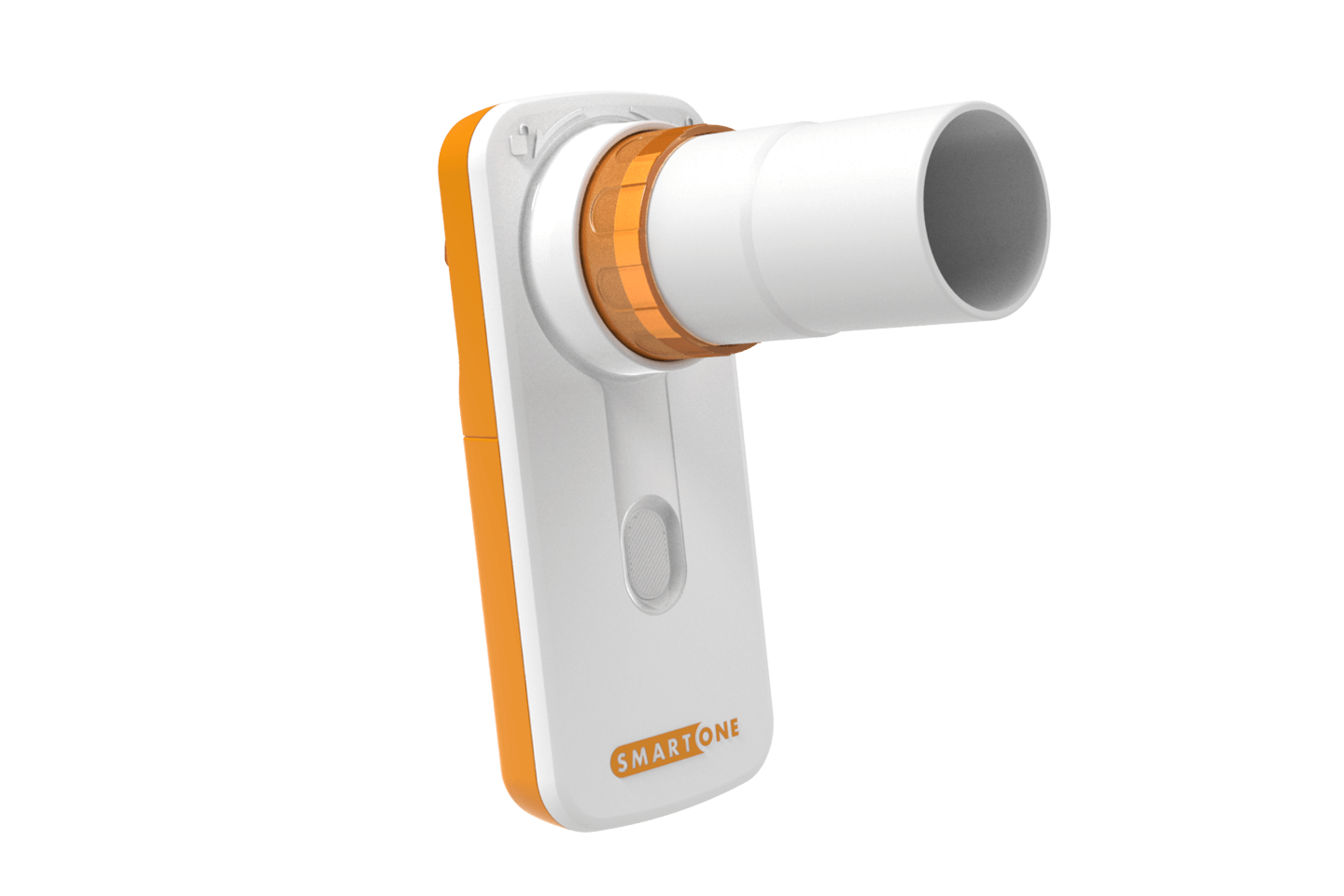
The MIR Smart One is a personal electronic lung function meter made by MIR (Medical International Research) that measures peak expiratory flow and FEV1 when you blow through it. It sends readings to a companion smartphone app that records each test and shows trends. It is a monitoring tool for people with known lung disease, not a full diagnostic spirometer.
MIR’s own US product literature names the device for what it measures: “Smart One Digital PEF FEV1.” Retail listings describe it as a personal pocket spirometer with a reusable turbine, and MIR also lists a Smart One OXI variant. The companion iOS app is described as requiring the Smart One peak flow meter to work. MIR has a US arm, Medical International Research USA, and the same company makes the larger Spirobank Smart, a fuller spirometer that has been studied more extensively.
The distinction matters, and earlier versions of this review blurred it. A full spirometer records the entire forced exhalation and reports FVC, the total volume you can blow out, along with the FEV1/FVC ratio that doctors use to diagnose COPD. MIR’s product naming for the Smart One lists two measurements, PEF and FEV1. If your clinician needs FVC or the ratio, you need a different device or a clinic test.
On regulation, 510(k) database listings of FDA records show a clearance for Smart One under number K181666. In the United Kingdom, the National Institute for Health and Care Excellence (NICE) has published a medtech innovation briefing on Smart One for measuring lung function, number MIB96. Briefings like that summarize the evidence for decision makers; they are not endorsements.
How does the MIR Smart One work?
You take the deepest breath you can, seal your lips around the mouthpiece, and blast the air out as hard and fast as possible. A small turbine inside spins with the rush of air, and its speed is converted to flow. The device reports the fastest flow you reached, peak flow, and the volume you pushed out in the first second, FEV1.
To see why those two numbers matter, picture the airways as an upside-down tree. The windpipe is the trunk. It splits into two main branches, then smaller and smaller ones, ending in tiny air sacs where oxygen crosses into the blood. When you inhale fully, the lungs stretch like a balloon. When you exhale forcefully, that stored elastic recoil, plus the squeeze of your chest and diaphragm, drives air back up through the tree.
How fast it comes out depends on the width of the branches. In asthma, the muscle wrapped around the small airways tightens and their linings swell with inflammation, so the same push moves less air. In COPD, the air sacs lose their spring and the small airways collapse as you blow, trapping air behind them. Either way, the first second of a forced exhale is where narrowing shows up most clearly. In the Rotterdam Study, researchers defined COPD as an FEV1/FVC ratio below 0.7: less than 70 percent of the total breath out in the first second. Narrowed lungs cannot keep up.
Peak flow captures something narrower: the single fastest instant, which happens in the first fraction of a second and reflects mostly the large central airways and how hard you push. The 2019 American Thoracic Society and European Respiratory Society spirometry standard notes that peak flow is correlated with the pressure generated in the chest during the maneuver, which is another way of saying it depends heavily on effort. A half-hearted blow gives a falsely low peak flow. That is why FEV1 is the more trusted number.
The turbine is the measuring heart of the device. Air spins a rotor, and the faster the air moves, the faster it turns; electronics count the rotation and convert it to flow, then add up flow over the first second to get volume. Turbines are compact and reusable. Like every flow sensor, their readings depend on a good seal, a full breath, and a sharp start, which is why technique matters more than the hardware.
How accurate is the MIR Smart One? What the research shows
There is very little published research on the Smart One itself. One 2022 pilot study in 19 older adults with COPD found home readings correlated strongly with office measurements (r of 0.94 for peak flow and 0.96 for FEV1). Larger studies of MIR’s Spirobank Smart and other home spirometers show useful agreement with hospital testing, with limits.
The Smart One study. At Weill Cornell Medical Center, a pilot study tested the Wellinks digital health platform, which bundled a Smart One spirometer with a nebulizer, pulse oximeter, and app, in 19 adults with COPD whose average age was 79.6 years (JMIR Formative Research, 2022). Eleven had severe or very severe disease, and 9 used home oxygen. Over eight weeks, participants used the spirometer an average of 2.5 times a week, and home readings correlated with office readings at r = 0.94 for peak flow and r = 0.96 for FEV1. Two cautions apply. Correlation shows that home and office numbers rise and fall together, not that they match; and one of the two authors worked for Wellinks, the platform’s maker.
A sibling device, tested harder. MIR’s larger Spirobank Smart, which records FVC as well as FEV1, was tested in the REACH-SPIRO randomized trial at Southmead Hospital in Bristol, UK (JMIR Formative Research, 2025). Researchers taught 106 adults to use it face to face, by video call, or with self-directed materials, then compared home readings with hospital spirometry. Home FEV1 differed from hospital values by an average of 0.108 to 0.153 liters across groups, with limits of agreement spanning roughly minus 0.36 to plus 0.66 liters. How patients were taught made no meaningful difference. Those numbers describe a related MIR device, not the Smart One, but they show what home turbine spirometry tends to achieve: the average is close, and any single reading can be off by a few hundred milliliters.
What the standards say. The 2019 ATS/ERS technical standard requires clinic spirometers to meet the ISO 26782 standard with a maximum permissible error of 2.5 percent, verified daily with a 3 liter calibration syringe. The same document states plainly that updated standards are still needed for unattended home monitoring spirometry and for peak flow monitoring. In other words, home devices are being used ahead of a settled rulebook for how to judge them.
Featured Partner
Invest in the Infrastructure Behind Modern Medicine
As healthcare expands beyond hospital walls, the buildings and campuses supporting that shift are generating compelling returns for investors who move early. The Healthcare Real Estate Fund offers qualified investors direct access to a curated portfolio of medical office, outpatient, and specialty care facilities.
Learn More →
Home spirometry over time. In idiopathic pulmonary fibrosis, a scarring lung disease, 50 patients in a London-led study recorded daily home spirometry for a median of 279 days; home values correlated excellently with hospital readings, and the rate of decline over just three months predicted mortality (American Journal of Respiratory and Critical Care Medicine, 2016). But a 2022 review of three later studies, including drug trials, that used daily home spirometry as a main outcome found that while single-day correlations with clinic readings were strong to moderate, longitudinal correlations were weak, with high day-to-day variability and some implausible trends (Respiratory Research, 2022). Several of that review’s authors worked for Roche or Genentech.
Peak flow’s known weakness. In 35 patients admitted to an emergency room with acute asthma, a mechanical peak flow meter gave values averaging 16.1 percent higher than FEV1, as a percent of predicted, with limits of agreement from minus 20 to plus 52 percent, and it classified severity differently (Korean Journal of Internal Medicine, 2002). Peak flow can make a bad day look better than it is. That is one reason a device that also reports FEV1 is more useful than a peak flow meter alone.
Read together, the evidence supports home FEV1 tracking as a trend tool, with the Smart One specifically resting on thin, partly company-linked data. If you want a framework for judging claims like these, our explainer on what “clinically validated” actually means is a useful companion.
What the MIR Smart One gets right
The Smart One gets the core idea right: it measures FEV1, the number that matters most for tracking airway narrowing, in a device small enough to use every day. Its companion app keeps a record of readings, and the device carries an FDA 510(k) listing.
FEV1, not just peak flow. Many home meters stop at peak flow. Adding FEV1 gives a less effort-dependent number that clinicians already use for decisions, and the emergency room asthma data show why that matters.
Frequency. A clinic test captures one day. Daily or twice-weekly readings capture the shape of a decline. In the pulmonary fibrosis study, three months of home data were enough to separate patients by survival.
Older patients can use it. The Wellinks pilot enrolled people up to 95 years old, most with severe COPD, and they used the spirometer about 2.5 times a week for eight weeks. That is not proof of benefit, but it is evidence that the device is usable by the people who most need monitoring.
Remote teaching works. The Spirobank Smart trial found that people taught by video or self-directed materials produced readings as good as those taught in person. For a home device, that is the difference between a pilot program and a scalable one.
Where the MIR Smart One falls short
The Smart One measures only part of what a spirometer does, its own validation record is one small pilot, and home monitoring in general has not yet been shown to slow lung decline. It also depends entirely on technique.
It does not diagnose. Because its product naming lists PEF and FEV1 rather than FVC, it is not positioned to provide the FEV1/FVC ratio that defines COPD. A new diagnosis of asthma, COPD, or any other lung disease needs a clinician and full spirometry.
The model-specific evidence is thin. We found one peer-reviewed study that used the Smart One, with 19 patients, correlation rather than agreement statistics, and a company co-author. The stronger studies are of MIR’s larger device or of home spirometry generally. Earlier versions of this review cited validation studies and telehealth statistics we could not verify; we have removed them.
Catching more is not the same as doing better. The eICE trial randomized 267 people with cystic fibrosis at 14 centers to twice-weekly home spirometry and symptom monitoring or usual care (American Journal of Respiratory and Critical Care Medicine, 2017). Home monitoring detected exacerbations sooner (hazard ratio 1.45), but after 52 weeks, lung function declined at the same rate in both groups. A cost analysis found outpatient visit costs 13 percent higher in the monitoring group, $3,345 versus $2,966, with no significant difference in total healthcare costs (Journal of Cystic Fibrosis, 2021).
Adherence and quality fade. In a Polish study of lung transplant recipients using spirometry telemonitoring, adherence averaged 62.7 percent, and only about 60 percent of FEV1 and FVC measurements were technically acceptable, though the telemonitored group’s hospital admissions were shorter, averaging 5.8 versus 10.0 days, than those of patients on routine care (Life, 2026). The study was retrospective and small.
No standard for home testing yet. The ATS/ERS 2019 standard itself says home monitoring and peak flow monitoring need updated standards. Until they exist, claims that any home device “meets clinical standards” deserve a careful look at what was actually tested.
The blow is hard. A maximal forced exhalation takes effort and coordination. A weak start or a leaky seal lowers both numbers, and a bad week of technique can look like a bad week of lungs.
MIR Smart One vs NuvoAir vs a peak flow meter vs clinic spirometry
The Smart One sits between a basic peak flow meter and a full home spirometer. NuvoAir’s Air Next reports more measurements and has a larger published validation; a mechanical peak flow meter reports only peak flow; and clinic spirometry, done with a trained technician, remains the reference for diagnosis.
| Feature | MIR Smart One | NuvoAir Air Next | Mechanical peak flow meter | Clinic spirometry |
|---|---|---|---|---|
| Main measurements | PEF and FEV1 | FEV1, FVC, FEV1/FVC, and more | PEF only | Full flow-volume loop, FEV1, FVC, ratio |
| Can support a COPD diagnosis | No (no FEV1/FVC ratio listed) | Supports screening and diagnosis per its 2020 validation | No | Yes |
| Regulatory status | FDA 510(k) listed (K181666) | FDA cleared for home use | Varies by model | Spirometers must meet ISO 26782 with a 2.5% maximum error (ATS/ERS 2019) |
| Published validation | One 19-patient pilot (r = 0.96 for FEV1) | 200-person study, correlations above 0.94 | Overstated lung function in acute asthma (2002) | Reference standard |
| Best for | Daily FEV1 and peak flow trends | Home monitoring needing FVC | Simple asthma action plans | Diagnosis and staging |
The NuvoAir figures come from a 2020 study at the University of Ioannina in Greece, which compared the Air Next with a desktop spirometer in 200 people, including 50 each with asthma, COPD, interstitial lung disease, and healthy lungs (Respiratory Research, 2020); news reports have described its FDA clearance for home use. See our NuvoAir home spirometer review. If your goal is to train breathing muscles rather than measure airflow, our reviews of The Breather and the PowerBreathe Plus cover that category. For how lung function feeds into whole-body fitness testing, see our Cosmed K5 review, and browse every device in this space in our respiratory and VO2 max device reviews.
How much does the MIR Smart One cost, and is it covered or HSA/FSA eligible?
As of October 2026, we could not confirm a current US retail price for the Smart One; it is sold through medical suppliers and MIR resellers, and prices vary. Because it is a medical device used to monitor a diagnosed condition, it is generally a qualified HSA and FSA expense; confirm with your plan administrator.
Earlier versions of this review listed a price range and filter costs. We could not verify either, so we have removed them. Insurance coverage for home spirometers varies, and some are supplied through clinician-run remote monitoring programs rather than bought outright, as in the Wellinks pilot, where the spirometer came in a study kit. Ask your pulmonologist or asthma clinic whether they have a program, which device they support, and who reviews the data. A device whose readings nobody looks at is a diary, not a monitor.
Who should use the MIR Smart One, and who should skip it?
The Smart One suits people with diagnosed asthma or COPD whose clinician wants regular FEV1 and peak flow trends. It is the wrong tool for diagnosis, for anyone who needs FVC, and for healthy people looking for a longevity score.
Good fits, with a clinician involved:
- Adults with diagnosed asthma who use an action plan and want FEV1 alongside peak flow.
- People with COPD in a remote monitoring program that supports the device.
- Patients whose specialist wants frequent FEV1 readings between visits.
Better served by something else:
- Anyone without a diagnosis who has a cough, wheeze, or breathlessness: see a clinician and get full spirometry first.
- Patients whose care depends on FVC, such as pulmonary fibrosis: ask about a full home spirometer.
- Sudden severe breathlessness, blue lips, or difficulty speaking: that is an emergency; call 911 rather than taking a reading.
- Healthy people curious about lung capacity: a single clinic spirometry test is more informative than daily home readings.
If you need a pulmonologist to order spirometry or set up home monitoring, the Healthcare Discovery doctor directory lists clinicians by state and specialty.
What this means for you
Lung function is more than a breathing test. In the Rotterdam Study of 3,884 adults aged 45 and older, people whose FEV1 stayed persistently low had 71 percent higher mortality than those with normal spirometry, rapid FEV1 decliners had 48 percent higher mortality, and people with persistently high FEV1 had 18 percent lower mortality (ERJ Open Research, 2024). Another Rotterdam analysis found that a pattern of reduced lung function with a normal ratio, called PRISm, carried 2.8 times the risk of cardiovascular death (European Respiratory Journal, 2020). Those links tie the lungs to the Silent Assassin, cardiovascular disease, and to the larger story in the Four Villains of Health and Longevity.
But a meter does not move those numbers, and the eICE trial is the honest reminder: earlier detection did not by itself slow decline. What helps is what you do with the reading. For someone with asthma or COPD, that means a written action plan, a clinician who reviews the trend, and treatment adjusted before a bad week becomes a hospital stay.
The Breath pillar is where this device lives. Not breathwork as relaxation, but breath as a measurable vital function: how freely air moves in and out. Movement supports it, and not smoking protects it more than any device can. If you have a lung condition, a small meter like the Smart One can turn a vague sense of “tight today” into a number your clinician can act on. If you do not, the best lung test you can take is a single, well-coached spirometry in a clinic, and the best investment is the run, the swim, or the walk that keeps those airways working.
Frequently asked questions
Is the MIR Smart One FDA cleared?
Yes. FDA 510(k) database listings show a clearance for Smart One under number K181666. A 510(k) means the FDA found the device substantially equivalent to existing products; it does not mean the agency tested it for every use. The Smart One is a monitoring device, so a new diagnosis of asthma or COPD still requires full spirometry with a clinician.
What does the MIR Smart One measure?
MIR’s US product literature describes the Smart One as a digital PEF and FEV1 meter. PEF is the fastest speed of air you can blow out, and FEV1 is the volume you exhale in the first second. Its product naming does not list FVC or the FEV1/FVC ratio, which are needed to diagnose COPD, so it is best suited to tracking a diagnosed condition over time.
Is the MIR Smart One accurate?
Evidence for this exact model is limited. In a 2022 pilot of 19 older adults with COPD, home readings correlated strongly with office values, r = 0.94 for peak flow and 0.96 for FEV1. Correlation is not the same as agreement, and one author worked for the platform maker. MIR’s larger Spirobank Smart differed from hospital FEV1 by an average of 0.11 to 0.15 liters in a 106-person trial.
MIR Smart One vs NuvoAir: which is better?
It depends on what you need. The Smart One is marketed as a PEF and FEV1 meter, while NuvoAir’s Air Next reports FEV1, FVC, and the FEV1/FVC ratio and was validated in a 200-person study with correlations above 0.94 against a desktop spirometer. If your clinician needs FVC, the Air Next is the closer fit. If you need simple FEV1 and peak flow trends, the Smart One may be enough.
Can a home spirometer replace clinic spirometry?
No. Home devices are useful for tracking trends between visits, but clinic spirometry with a trained technician remains the standard for diagnosis and staging. The 2019 ATS and ERS spirometry standard says updated standards are still needed for unattended home monitoring. In a cystic fibrosis trial of 267 patients, home monitoring caught exacerbations sooner but did not slow the decline in lung function.
How much does the MIR Smart One cost?
As of October 2026, we could not confirm a current US retail price. The Smart One is sold through medical suppliers and MIR resellers, and prices vary by seller. Some home spirometers are supplied through clinician-run remote monitoring programs, so ask your pulmonologist or asthma clinic before buying. When used for a diagnosed condition, it is generally an eligible HSA or FSA expense.
Sources
- Sin DD, Wu L, Man SFP. The relationship between reduced lung function and cardiovascular mortality: a population-based study and a systematic review of the literature. Chest, 2005. DOI
- Gelbman BD, Reed CR. An integrated, multimodal, digital health solution for chronic obstructive pulmonary disease: prospective observational pilot study. JMIR Formative Research, 2022. DOI
- Morgan C, et al. Comparing approaches to teaching patients how to use an app-based home spirometer: randomized controlled trial. JMIR Formative Research, 2025. DOI
- Graham BL, et al. Standardization of spirometry 2019 update: an official American Thoracic Society and European Respiratory Society technical statement. American Journal of Respiratory and Critical Care Medicine, 2019. DOI
- Russell AM, et al. Daily home spirometry: an effective tool for detecting progression in idiopathic pulmonary fibrosis. American Journal of Respiratory and Critical Care Medicine, 2016. DOI
- Maher TM, et al. A review of the challenges, learnings and future directions of home handheld spirometry in interstitial lung disease. Respiratory Research, 2022. DOI
- Choi IS, Koh YI, Lim H. Peak expiratory flow rate underestimates severity of airflow obstruction in acute asthma. Korean Journal of Internal Medicine, 2002. DOI
- Lechtzin N, et al. Home monitoring of patients with cystic fibrosis to identify and treat acute pulmonary exacerbations: eICE study results. American Journal of Respiratory and Critical Care Medicine, 2017. DOI
- Franz N, et al. Health care costs related to home spirometry in the eICE randomized trial. Journal of Cystic Fibrosis, 2021. DOI
- Basza M, et al. Implementation of spirometry telemonitoring programme in lung transplant recipients: a retrospective, controlled analysis of clinical outcomes. Life, 2026. DOI
- Exarchos KP, et al. Validation of the portable Bluetooth Air Next spirometer in patients with different respiratory diseases. Respiratory Research, 2020. DOI
- Bertels X, et al. Clinical relevance of lung function trajectory clusters in middle-aged and older adults. ERJ Open Research, 2024. DOI
- Wijnant SRA, et al. Trajectory and mortality of preserved ratio impaired spirometry: the Rotterdam Study. European Respiratory Journal, 2020. DOI
- FDA 510(k) database listing K181666, Smart One. 510(k) record
- National Institute for Health and Care Excellence. Smart One for measuring lung function, medtech innovation briefing MIB96. NICE
- MIR Medical International Research USA. Smart One Digital PEF FEV1 product sheet. MIR
MIR Smart One Spirometer at a glance
- Subscription
- None required
- Form factor
- App-connected spirometer
- FDA status
- Has FDA clearance
- HSA/FSA
- Possibly, with a letter of medical necessity
Measures FEV1, FEV1/FVC, FVC, PEF, Spirometry trends
Pricing verified October 20, 2026. Maintained in the Healthcare Discovery device database and updated automatically.


Similar Posts

Mitochondrial Transplantation Enters Human Trials: How Moving Living Powerhouses Between Cells Is Rewriting Longevity Medicine
Mitochondrial transplantation, once a fringe idea, is now being tested in human clinical trials for heart failure, stroke, and age-related cellular decline. A new wave of 2026 research shows that…

How to Shop for an MRI Without Getting Lost in the Price Maze
A practical guide to getting the right MRI at the right place without being blindsided by CPT codes, facility fees, radiologist bills, network rules, cash prices, and deductible math.

Keto-Mojo GK+ Meter: Dual Glucose and Ketone Monitoring for Metabolic Health
Two biomarkers, one fingerstick. Measuring both glucose and ketones simultaneously reveals a metabolic picture that neither number can provide alone. Presented By Our Partners The ketogenic diet has moved from…

OpenAI, Anthropic and Google in Biotech: The 2026 Deal Tracker
Every verified life sciences move by OpenAI, Anthropic and Google in 2026, from Orchestra Bio and Coefficient Bio to Isomorphic Labs, Chai Discovery, Lila Sciences and the AI scientists, with…

The PEARL Trial Is In: What Low-Dose Rapamycin Actually Did to Human Aging Over 48 Weeks
The most anticipated longevity drug trial in a generation has delivered its full one-year results. Here is what rapamycin actually did to lean muscle, pain, biological age, and overall healthspan…

The GLP-1 Trust Test: What an Online Provider Should Be Willing to Show You
Eight source-backed questions for checking an online GLP-1 provider’s clinical accountability, medication category, pharmacy, follow-up, claims, price, and commercial influence.
