
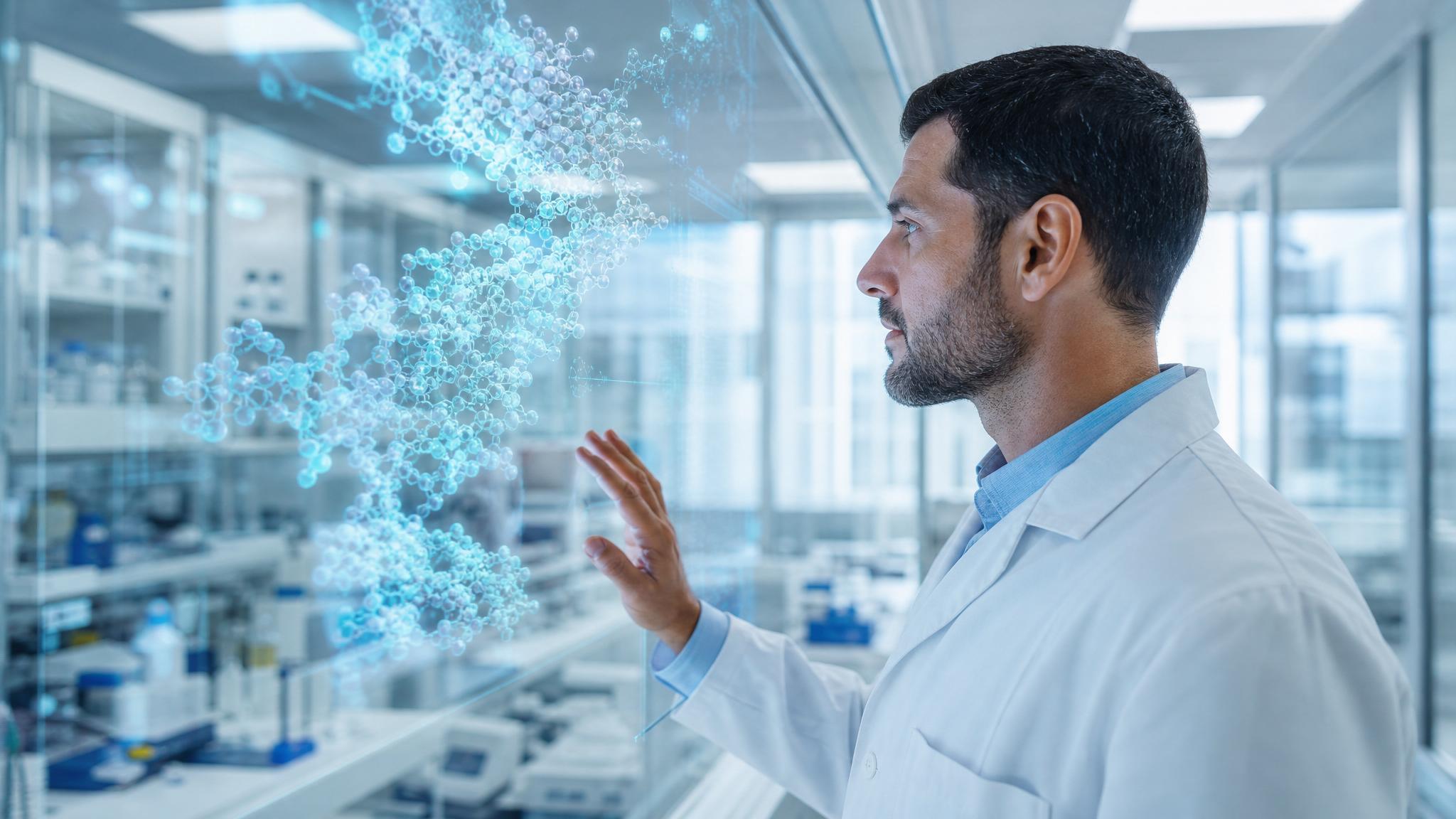
AI Drug Discovery Is Getting Its Market Map
The new market forecast for AI drug discovery reads like the beginning of a gold rush. But the deeper story is not that software is coming for pharmaceuticals. It is that biology has finally become too large, too noisy, and too expensive for the old map.
Presented By Our Partners



In a traditional drug-discovery story, the hero is usually a molecule. A scientist notices a strange biological pathway, a compound binds to a target, a company raises money, and years later—if almost everything goes right—a medicine reaches patients. The plot sounds clean in retrospect. In real time, it is closer to exploring a continent by candlelight.
Every disease is a terrain of genes, proteins, cells, immune signals, environmental inputs, patient histories, clinical measurements, and unlucky randomness. Every promising drug candidate is a hypothesis about that terrain. Most hypotheses fail. They fail because the target was wrong, the molecule was toxic, the biomarker was misleading, the animal model was too flattering, the trial population was too heterogeneous, or the biology changed its mind once the experiment moved from a dish to a human being.
This is why the latest AI for Drug Discovery Market Insights Report 2026–2033, distributed through Yahoo Finance and GlobeNewswire, matters less as a market-size announcement than as a signal flare. The report projects the global AI for drug discovery market growing from $8.8 billion in 2026 to $114.4 billion by 2033, a compound annual growth rate of 44.30%. Those numbers are dramatic. They are also only the surface event. Beneath them is a larger shift: the pharmaceutical industry is trying to replace a flashlight with something closer to radar.
The old map is breaking
Drug discovery has always been a search problem. The search space is brutally large. A small-molecule chemist is not choosing from a neat shelf of options; she is navigating a chemical universe with more possible drug-like compounds than there are stars in the observable sky. A biologist studying disease is not working from a finished blueprint; he is listening to overlapping conversations between cells, proteins, signaling pathways, and feedback loops.
For decades, the industry made this search manageable by narrowing the map. Pick a target. Screen compounds. Optimize hits. Test in cells. Test in animals. Move to humans. Each stage filters the field, but each stage also throws away information. It is like trying to understand a city by looking through one window at a time.
AI promises a different posture. Instead of asking one hypothesis to march slowly through the pipeline, machine-learning systems can scan enormous datasets for patterns: genomic data, protein structures, assay results, electronic health records, imaging, trial data, literature, chemistry libraries, and real-world evidence. The best systems do not merely automate old work. They change the shape of the question.
The question becomes less, “Can we test this one idea?” and more, “Across all the biology and chemistry we can observe, where does the probability mass point?”
That is the promise. It is also the danger. A better map is still not the territory.
The AI drug discovery stack
Part of the confusion around AI drug discovery is that the phrase sounds like one thing. It is not one thing. It is a stack.
At the bottom is biological understanding: using AI to identify disease mechanisms, nominate targets, interpret omics data, and find patterns across human biology that would be hard to detect manually. This is where the field hopes to turn oceans of biological data into sharper hypotheses.
Above that is molecular design: generating, screening, or optimizing compounds that may bind to a target, behave well in the body, avoid toxicity, and remain manufacturable. This is the layer that most resembles the public imagination of AI inventing a drug.
Then comes prediction: estimating whether a candidate will be absorbed, distributed, metabolized, excreted, or toxic; whether it crosses the blood-brain barrier; whether it interacts with the wrong proteins; whether it looks promising only because the data are biased.
There is also clinical-trial intelligence: finding the right patients, selecting endpoints, matching participants to protocols, simulating trial designs, and monitoring safety signals. This is less glamorous than molecule generation, but it may matter just as much. A brilliant drug can still fail inside a poorly designed trial.
Finally, there is drug repurposing: using AI to find new uses for existing drugs or compounds with known safety profiles. This is one of the most practical frontiers because it can shorten the distance between computational insight and patient impact.
The 2026–2033 market report segments the field by offering, technology, application, end user, and geography. That taxonomy is useful, but the deeper strategic split is simpler: AI can help decide what to pursue, what to build, what to abandon, and how to prove it.
The market is betting on compression
The pharmaceutical industry’s central economic problem is time. A drug can take more than a decade to move from early discovery to approval. Many never make it. The failures are not incidental; they are built into the system. Drug development is expensive because biology is hard, clinical proof is slow, and uncertainty compounds at every stage.
AI is attractive because it offers compression. Compress the search for targets. Compress hit identification. Compress lead optimization. Compress trial recruitment. Compress the literature review. Compress the distance between a biological signal and a clinical hypothesis.
The market report’s growth forecast is essentially a bet that enough of this compression will become real. It is also a bet that pharmaceutical companies, biotechnology startups, contract research organizations, academic labs, and cloud-software vendors will keep integrating AI into their workflows. The report highlights machine learning, deep learning, supervised learning, reinforcement learning, and unsupervised learning; it also points toward therapeutic areas including immuno-oncology, neurodegenerative disease, cardiovascular disease, and metabolic disease.
Those categories are not random. They are some of the hardest and most valuable areas in medicine. Cancer evolves. Alzheimer’s hides for years. Cardiovascular disease is systemic. Metabolic disease is tangled with behavior, environment, inflammation, genetics, and time. These are not single-lock, single-key problems. They are weather systems.
AI is useful in weather systems because the human mind is not built to hold thousands of interacting variables at once. But weather forecasts can still be wrong. The same caution applies here.
From beautiful prediction to ugly validation
The next era of AI drug discovery will not be judged by demos. It will be judged by translation.
Featured Partner
Invest in the Infrastructure Behind Modern Medicine
As healthcare expands beyond hospital walls, the buildings and campuses supporting that shift are generating compelling returns for investors who move early. The Healthcare Real Estate Fund offers qualified investors direct access to a curated portfolio of medical office, outpatient, and specialty care facilities.
Learn More →
A model can predict that a molecule should work. A platform can identify a novel target. A company can announce a partnership with a major pharmaceutical firm. A press release can describe a discovery engine in language that sounds almost biological itself: learning, reasoning, designing, optimizing. But the hard question remains: did it produce a better drug?
This is where AI drug discovery collides with a familiar problem in healthcare AI. Retrospective performance is easier than prospective truth. A model that looks strong on historical data may weaken when the patient population changes, the lab conditions shift, the endpoint becomes clinical, or the system meets the messiness of real medicine.
HealthcareDiscovery.ai has been circling this problem from several angles: prospective versus retrospective validation, surrogate endpoints, reproducibility, and the resolution gap between the data we have and the biology we are trying to explain. AI drug discovery sits directly inside that tension.
The model may be new. The burden of proof is not.
The FDA’s Center for Drug Evaluation and Research has already recognized the surge. In its public materials on artificial intelligence for drug development, CDER notes a significant increase in drug application submissions using AI components and says those submissions now span nonclinical, clinical, postmarketing, and manufacturing phases. The agency also points to its 2025 draft guidance on AI use to support regulatory decision-making for drugs and biologics, informed partly by CDER’s experience with more than 500 submissions with AI components from 2016 to 2023.
That matters. AI drug discovery is no longer a slide-deck category floating outside the regulatory system. It is entering the room where evidence has to be inspected.
The companies are not all playing the same game
The market report names a familiar mix of companies: IBM Watson Health, BenevolentAI, Atomwise, Insilico Medicine, Exscientia, Numerate, Berg Health, GNS Healthcare, TwoXAR, Cloud Pharmaceuticals, Recursion Pharmaceuticals, XtalPi, Cyclica, Envisagenics, and BioXcel Therapeutics.
A list like that can create the illusion of a single race. In reality, these companies occupy different parts of the stack. Some are closer to computational chemistry. Some are closer to disease biology. Some build platforms. Some pursue internal pipelines. Some partner with pharma. Some are best understood as data companies; others as biotech companies with software-heavy methods.
The distinction matters because “AI drug discovery company” can hide more than it reveals. A company that uses AI to prioritize targets is not making the same claim as a company that uses AI to generate molecules. A platform that improves trial matching is not making the same claim as a platform that predicts toxicity. A company with an internally owned clinical-stage asset is not in the same evidentiary position as a company selling discovery software.
For investors, partners, and anyone trying to understand the field, the better question is not “Does this company use AI?” It is:
- Where in the drug-development chain does the AI actually operate?
- What decision does it change?
- What evidence shows that changed decision improves outcomes?
- Is the value visible in biology, chemistry, clinical development, economics, or only in narrative?
- Who owns the asset if the model succeeds?
This is where the market needs a stricter vocabulary. Platform claims, pipeline claims, clinical claims, and fundraising claims should not be allowed to blur into one another. The more powerful the model, the more important it becomes to ask what kind of truth it has actually earned.
The analogy: GPS for biology
The simplest analogy is GPS.
Before GPS, getting somewhere unfamiliar required paper maps, memory, landmarks, and wrong turns. GPS did not abolish geography. It did not remove traffic, storms, road closures, bad addresses, or human error. What it did was change navigation from a static act to a dynamic one. The route could update as new information arrived.
AI drug discovery is trying to do something similar for biology. Traditional drug discovery is a map with many blank spaces. AI makes the map more dynamic. It can incorporate new data, reroute around dead ends, surface hidden paths, and estimate which roads are more likely to lead somewhere useful.
But GPS has a famous failure mode: blind obedience. Anyone who has followed a navigation app onto a strange dirt road understands the lesson. The confidence of the interface can exceed the quality of the underlying map.
AI drug discovery has the same risk. A model can make uncertainty look clean. A generated molecule can look inevitable. A ranking can feel like truth because it arrives as a number. The job of the next decade is not merely to build more powerful systems. It is to build systems that know when they are guessing, and companies that tell the difference.
Why 2026 to 2033 is the right window
The 2026–2033 period is important because it is long enough for today’s AI-native discovery claims to meet clinical reality.
Many of the most ambitious claims in AI drug discovery are still upstream. They concern better targets, faster molecules, richer screens, or more efficient discovery cycles. Those are important, but the real scoreboard appears later: investigational new drug filings, clinical trial starts, phase transitions, safety signals, efficacy, approvals, and postmarket performance.
By 2033, the field should have more than partnership announcements. It should have enough evidence to begin separating durable methods from clever demos. Some platforms will look better than expected. Some will discover that biology was more stubborn than the training data implied. Some will become ordinary infrastructure inside pharmaceutical R&D, valuable precisely because they stop sounding magical.
That may be the healthiest outcome. The most important technologies often disappear into workflow. No one says “electricity-enabled surgery” every time the lights turn on in an operating room. If AI succeeds in drug discovery, the phrase may eventually become less interesting. It will simply be how discovery is done.
The public-interest version of the story
There is a narrow version of this market story and a larger one.
The narrow version is about software vendors, pharma budgets, startup valuations, regional growth, and competitive landscape. That version matters. Markets allocate talent and capital.
The larger version is about whether we can make medicine less accidental.
Patients do not experience drug discovery as a market category. They experience it as waiting. Waiting for a therapy that works. Waiting for a trial. Waiting for a diagnosis that makes sense. Waiting for a rare disease to become economically interesting enough for someone to pursue. Waiting for a compound that failed in one context to be reconsidered in another.
This is why AI drug repurposing deserves special attention. If machine learning can identify new uses for existing medicines, especially in neglected diseases, the benefit may arrive faster than the most futuristic parts of the field. Existing compounds bring known safety data. The path is still difficult, but the starting point is less blank.
The same is true for better patient matching and trial design. A therapy that fails in a broad population may work in a biologically distinct subgroup. AI may help find that subgroup earlier. That is not science fiction. It is a more precise version of medicine’s oldest aspiration: give the right treatment to the right person at the right time.
The HealthcareDiscovery.ai market map
The right way to follow AI drug discovery is not as a single boom story. It should be followed as a map with layers.
Layer one: market growth. The capital and adoption curve are real. A forecast moving from $8.8 billion to $114.4 billion by 2033 says that institutions expect AI to become central to pharmaceutical R&D.
Layer two: technical capability. The tools are improving rapidly, especially in machine learning, deep learning, molecular generation, protein modeling, and large-scale biomedical data analysis.
Layer three: workflow adoption. The most near-term value may come from helping scientists make better decisions earlier, not from replacing scientists.
Layer four: clinical validation. The field’s credibility will depend on whether AI-originated or AI-assisted programs improve the odds, speed, cost, or quality of drug development in measurable ways.
Layer five: hype discipline. The companies that matter most will be the ones that can connect model performance to biological and clinical outcomes without laundering uncertainty through beautiful language.
Taken together, those layers point to the central lesson of the field: the machine is not valuable because it sounds intelligent. It is valuable only when it helps discovery become more honest about where the signal is, where the noise is, and where the next experiment should go.
The real discovery is not just the molecule
AI drug discovery is often described as a way to find new molecules. That is true, but incomplete.
The deeper discovery is methodological. Can we discover which biological questions are worth asking? Can we discover which datasets are misleading? Can we discover earlier when a program is likely to fail? Can we discover patient subgroups that old trial designs would blur into statistical noise? Can we discover neglected uses for drugs we already know how to manufacture?
The 2026–2033 market forecast is bullish because the old way is too slow for the burden of disease and too expensive for the economics of modern drug development. But the most useful stance is neither cynicism nor worship. AI will not repeal biology. It may, however, help us see biology with fewer blind spots.
That is the story to watch. Not whether the market becomes large. It almost certainly will. The question is whether the market becomes wise.
If it does, the next decade of drug discovery may be remembered less for the arrival of artificial intelligence than for the moment medicine finally admitted it needed a better map.
Sources include the AI for Drug Discovery Market Insights Report 2026–2033 announcement via Yahoo Finance / GlobeNewswire, ResearchAndMarkets.com, and FDA CDER materials on artificial intelligence for drug development.


Similar Posts
The Patient Does Not Need a Prediction. They Need the Next Step.
A randomized kidney-transplant AI trial shows why healthcare AI cannot stop at predicting risk. The next frontier is closing the loop: referral, navigation, benefits, scheduling, follow-up, and completed care.
AI-Designed Drugs Are Entering Human Trials: Inside the Quiet Pharmaceutical Revolution of 2026
For the first time in pharmaceutical history, molecules designed almost entirely by artificial intelligence are surviving Phase 2 trials in real patients. From Insilico’s rentosertib to Isomorphic Labs’ multi-billion dollar…

Read the Label Before the GLP-1 Link: A Disclosure Decoder
A plain-language guide to affiliate, paid-placement, medication-category, price, and evidence disclosures on GLP-1 pages.

Medicine Has Enough AI Pilots. It Needs a Power Grid.
Healthcare AI has enough pilots, alerts, and dashboards. The harder question is whether any of them close the loop from signal to ownership, action, completed care, and measured result.
Mayo’s AI Stack: From Microsoft’s Frontier Model to the Clinic Floor
Mayo Clinic’s Microsoft partnership is more than a frontier-model announcement. It reveals a broader AI stack connecting clinical data, foundation models, Phoenix campus expansion, Discovery Oasis, and the hard test…

Your Immune System Is Aging Because Your Mitochondria Are Failing: How Mitophagy Activation Is Reversing Immune Decline in Clinical Trials
A landmark clinical trial published in Nature Aging shows that urolithin A, a natural mitophagy activator, rejuvenated immune cell populations in middle-aged adults in just 28 days. The MitoImmune trial…
