
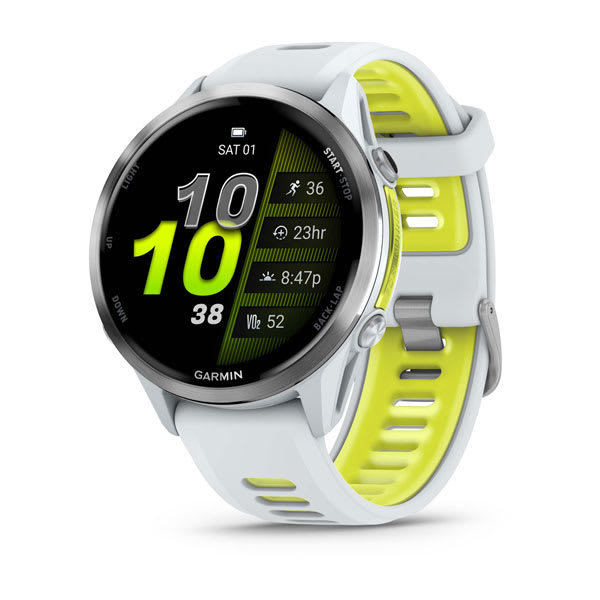
Garmin Forerunner 970 Review: VO2 Max Accuracy and Training Load
Garmin’s flagship running watch estimates your VO2 max with under 10 percent average error in studies of recent models, but the most protective number it records may be the humble length of your longest recent run.
Presented By Our Partners


Over 18 months, 5,205 adult runners let researchers read the files their Garmin watches quietly recorded: 588,071 runs in all, each one logged by distance and date. By the end, 1,820 of them, about 35 percent, had reported an overuse injury. The question the team asked was simple. Which pattern in the data came before the damage?
The answer was not a sophisticated ratio or a readiness score. It was a single run that was too long. When one session stretched more than 10 percent past the longest run of the previous 30 days, injury rates climbed; when it more than doubled it, the hazard rose to 2.28 times baseline. The fashionable acute-to-chronic workload ratio, meanwhile, showed a dose-response relationship running the wrong way (British Journal of Sports Medicine, 2025). The watch had the answer all along. It was hiding in the plainest column of the log.
The Garmin Forerunner 970 is the newest home for those logs. Announced in May 2025 as the replacement for the Forerunner 965, it is Garmin’s flagship running and triathlon watch, and it promises far more than distance: an estimate of your VO2 max, a model of your training load, recovery guidance, an on-demand ECG, and race predictions. This review asks which of those numbers deserve your trust.
The short answer: The Garmin Forerunner 970, Garmin’s 2025 flagship running watch, is worth it for serious runners who want strong training logs and an exercise-based VO2 max estimate. Studies of recent Garmin models put average VO2 max error under 10 percent, close enough for trends but not for individuals near a threshold. Treat recovery and race predictions as guidance, not verdicts.
- Best for: runners and triathletes who train with structure and want long battery life, deep training data, and VO2 max trends.
- Not for: casual exercisers who want a smartwatch first, or anyone who needs a laboratory-grade VO2 max for clinical decisions.
- Price (October 2026): $749.99 at launch; sale prices around $649.99 have appeared since.
- Regulatory status: not FDA regulated for fitness metrics (wellness); Garmin’s ECG App was FDA cleared in 2023 (510(k) K221774).
- Evidence: Moderate for Garmin VO2 max estimates (several independent lab studies of recent models); limited for proprietary readiness and load scores.
What is the Garmin Forerunner 970?
The Garmin Forerunner 970 is a GPS running and triathlon watch made by Garmin, announced in May 2025 as the successor to the Forerunner 965. It estimates VO2 max from your runs, tracks training load and recovery, predicts race times, and adds an on-demand ECG and a built-in LED flashlight. It launched at $749.99.
Garmin introduced the 970 alongside the Forerunner 570 and new HRM 200 and HRM 600 chest straps. Coverage at launch described it as Garmin’s most premium Forerunner, and a later deal report from Notebookcheck summed up its headline features as an LED flashlight, ECG, and 15 days of battery life. As of October 2026, we found no announced successor; references to a “Forerunner 975” have appeared only in rumors and roadmap speculation.
The ECG deserves a precise note. Garmin’s ECG App received FDA clearance in 2023 (510(k) K221774) when it launched on earlier Garmin watches. The 970 carries ECG capability, but regional availability of medical features varies, so check Garmin’s supported-device list for your country. Everything else on the watch, including VO2 max, training load, recovery, and race predictions, is a wellness feature that the FDA does not review.
One more piece of context: Garmin now sells a premium app tier, Garmin Connect+, at $6.99 a month. Garmin has said the free experience is not going away.
How does the Garmin Forerunner 970 estimate VO2 max?
The Forerunner 970 estimates VO2 max by watching how your heart rate responds to your running pace. The faster you can run at a given heart rate, the more oxygen your body must be using, and the higher your estimated aerobic capacity. Because it uses real workouts rather than resting data, it belongs to the more accurate class of watch estimates.
VO2 max is the ceiling on how much oxygen your body can take in, deliver, and burn. Picture a factory with three departments: the lungs that load oxygen into the blood, the heart that ships it, and the muscle mitochondria that burn it as fuel. The laboratory measures the factory’s output directly, with a mask that captures every breath while a treadmill pushes you to exhaustion. The watch cannot see your breath. It infers the factory’s capacity from the delivery trucks.
The logic runs like this. At any steady running speed, your muscles demand a roughly predictable amount of oxygen. Your heart supplies it by beating faster, and a fitter heart moves more blood per beat, so it needs fewer beats for the same pace. By pairing GPS pace with optical heart rate across many runs, the watch estimates where your ceiling lies. It is an inference about the whole factory drawn from one gauge on the loading dock.
That distinction matters, because researchers sort watch estimates into two families. A 2022 meta-analysis of 14 validation studies by the INTERLIVE network found that wearables relying on resting data overestimated VO2 max by an average of 2.17 mL/kg/min, with individual errors stretching from 13.07 below to 17.41 above the true value. Wearables using exercise data had almost no average bias (minus 0.09 mL/kg/min) and narrower individual limits of roughly plus or minus 10 (Sports Medicine, 2022). The Forerunner 970 is in the second family. It still guesses, but it guesses from evidence you generate by running.
Training load works on a similar principle. Every workout is turned into a measure of physiological stress, and Garmin compares your recent (acute) load with your longer-term (chronic) load to judge whether you are building fitness, maintaining it, or overreaching. Recovery guidance on watches like this leans on heart rate variability (HRV), the beat-to-beat wobble that reflects the vagus nerve’s hold on the heart; a 2026 review in Current Atherosclerosis Reports lists Garmin among the consumer devices that now monitor HRV outside the clinic. These are models, not measurements, and their algorithms are proprietary.
How accurate is the Garmin Forerunner 970? What the research shows
No peer-reviewed study has tested the Forerunner 970 itself. Independent studies of recent Garmin watches using the same run-based approach found average VO2 max errors under 10 percent, as low as about 1 percent after repeat runs, and the newest study found consistent overestimates. Race predictions ran fast, and overnight HRV agreed poorly with an ECG.
The closest relative, tested over a training block. At Georgia State University, 20 runners wore a Garmin Forerunner 265 through 12 weeks of half-marathon training. At the start, the watch estimated VO2 max at 43.95 mL/kg/min against 41.10 on a laboratory maximal test; after training, 45.00 against 42.43. Both gaps were statistically significant, but the mean absolute percentage error stayed under 10 percent, the consumer-grade threshold the INTERLIVE network proposed. The watch’s half-marathon predictions averaged 129.97 minutes; the runners’ actual race times averaged 137.55 (Journal of Medical Engineering and Technology, 2026). The authors judged the watch suitable for tracking general fitness trends.
A general population on an outdoor run. A University of Nevada, Las Vegas team compared a Garmin fenix 6 with a laboratory metabolic system in 19 healthy, active and sedentary adults. The watch’s VO2 max estimate met their validation criteria, with a mean absolute percentage error of 7.05 percent and a concordance correlation of 0.73 (Sensors, 2025). The same watch failed badly at blood oxygen measurement, a reminder that accuracy is metric by metric, not brand by brand.
The second run matters. In 24 trained youth soccer players, a Garmin Forerunner 245 estimated VO2 max from a 10-minute warm-up run with a 5.58 percent error after one run. After a second run, the error fell to 1.06 percent and agreement improved (intraclass correlation 0.37, then 0.54) (Journal of Sports Science and Medicine, 2024). The algorithm learns. Your first number is a rough draft.
The older generation was rougher. A 2019 Technical University of Munich study of 24 adults tested five wrist devices and found that only the Garmin Forerunner 920XT estimated VO2 max with an error under 10 percent (7.3 percent), and even it significantly underestimated (International Journal of Environmental Research and Public Health, 2019). The improvement across Garmin generations is real.
Featured Partner
Invest in the Infrastructure Behind Modern Medicine
As healthcare expands beyond hospital walls, the buildings and campuses supporting that shift are generating compelling returns for investors who move early. The Healthcare Real Estate Fund offers qualified investors direct access to a curated portfolio of medical office, outpatient, and specialty care facilities.
Learn More →
Heart rate and HRV. In a 2020 study of 25 people, a Garmin Fenix 5 tracked heart rate with coefficients of variation of 2.9 to 9.2 percent depending on intensity, and the authors advised caution at some intensities (JMIR mHealth and uHealth, 2020). Over 536 nights of sleep in 13 adults, a Garmin Fenix 6 measured overnight HRV with poor agreement against an ECG (concordance 0.87, mean absolute percentage error 10.52 percent), behind Oura rings and WHOOP (Physiological Reports, 2025). HRV underpins recovery features, so that gap matters more than any single heart rate reading.
Training load and injury. The Danish-led study of 5,205 Garmin users is the most useful evidence about what to do with training data. Single runs that exceeded the longest run of the previous 30 days by more than 10 percent and up to 30 percent raised injury rates by 64 percent (hazard rate ratio 1.64); spikes above 100 percent raised them 2.28-fold. The acute-to-chronic workload ratio showed a negative dose-response, and the week-to-week ratio showed no relationship (British Journal of Sports Medicine, 2025). A 2020 critical analysis in the International Journal of Sports Physiology and Performance had already concluded there was no evidence supporting the acute-to-chronic ratio for reducing injury risk, calling it statistically flawed and prone to artifacts.
The broader picture fits. A 2024 living umbrella review covering 249 validation studies found consumer wearables misjudged VO2 max by about 10 percent in exercise-based tests and about 15 percent in resting tests, and that only about 11 percent of devices on the market had been validated for even one metric (Sports Medicine, 2024). Garmin’s run-based estimates sit at the better end of that range.
What the Garmin Forerunner 970 gets right
The Forerunner 970 gets the fundamentals right: an exercise-based VO2 max estimate that recent Garmin studies place under 10 percent average error, a training log rich enough to power injury research, long battery life, and core analytics without a required subscription.
The right kind of estimate. Run-based VO2 max is the approach the meta-analytic evidence favors. In three recent independent studies of Garmin watches, average error stayed inside the 10 percent bar that researchers use for consumer devices, ranging from about 1 percent after two runs to 7 percent where it was reported.
A trend line that moves when you do. In the Georgia State study, the watch’s estimate rose by about 1 mL/kg/min across 12 weeks of training, while laboratory VO2 max rose by about 1.3. Over a training block, the direction was right. For most runners, the direction is the point.
Data that predicts injury, if you read it. The single most actionable rule from the 5,205-runner study needs no proprietary score: keep any single run within about 10 percent of your longest run of the past month. The 970 records exactly what you need to follow it.
Endurance for real training. Up to 15 days of battery life means overnight recovery data and long weekend runs without nightly charging, a practical advantage over smartwatches that need a charger every day.
A real ECG when you need it. An on-demand ECG lets you record a strip during palpitations to share with a clinician, using an app the FDA has cleared. That is a meaningful extra on a training watch.
Where the Garmin Forerunner 970 falls short
The Forerunner 970’s limits are a VO2 max estimate that ran high in the newest study and needs several runs to settle, race predictions that ran about seven minutes fast, recovery scores built on HRV that agreed poorly with an ECG in one study, and no published validation of the 970 itself.
Optimism bias. In the Forerunner 265 study, the watch’s estimate averaged higher than the laboratory value both before and after training, by about 2.5 to 2.9 mL/kg/min. A runner who sees a flattering number may train or race more aggressively than their physiology supports.
Race predictions run fast. In the Georgia State study, predicted half-marathon times were about 7.5 minutes faster than what runners actually ran. Use predictions as a ceiling, and pace your first miles by feel and heart rate.
Recovery scores rest on a shaky input. Overnight HRV from a Garmin fenix 6 showed poor agreement with an ECG in a 2025 study. Any readiness score built on it inherits that noise. Two meta-analyses suggest the payoff from HRV-guided training is real but small: in a 2021 analysis, HRV-guided programs improved vagal HRV (effect size 0.50) but produced only small, non-significant gains in VO2 max and performance compared with fixed plans (International Journal of Environmental Research and Public Health, 2021). A second 2021 meta-analysis of 8 studies with 198 participants found a medium effect on submaximal physiology but only small, non-significant effects on performance and VO2 peak, along with fewer non-responders (Journal of Science and Medicine in Sport, 2021).
The model is a black box. Garmin does not publish the full algorithms behind its training status and recovery features, and the acute-to-chronic logic common across the industry has been criticized as statistically fragile. Treat any load warning as a prompt to look at your log, not a verdict.
New model, inherited evidence. Every study above tested an earlier Garmin. The 970’s hardware and software may perform better or simply differently; until someone tests it, its accuracy is assumed, not demonstrated.
Calories remain guesswork. Wrist-based energy expenditure was unreliable across the devices in the 2020 study, including the Garmin; do not use it to set food intake.
Garmin Forerunner 970 vs Polar Vantage V3 vs COROS PACE 4 vs Apple Watch Series 12
Of these four, the Forerunner 970’s family has the most independent VO2 max evidence we found; Polar’s Vantage V3 leans harder on overnight recovery; COROS PACE 4 is the value pick; and the Apple Watch Series 12 is the better health smartwatch but a weaker training tool.
| Feature | Garmin Forerunner 970 | Polar Vantage V3 | COROS PACE 4 | Apple Watch Series 12 |
|---|---|---|---|---|
| Price (October 2026) | $749.99 at launch; around $649.99 on sale | US price not confirmed | Not verified for this review | From $399 at launch |
| VO2 max estimate | From runs (exercise-based) | Polar’s Fitness Test and Running Performance Test | Method not verified for this review | From outdoor workouts |
| Independent VO2 max evidence | Recent Garmin models: under 10 percent average error | Limited; an older Polar model failed to track change | Not verified for this review | Series 7 and 10: about 13 to 16 percent error |
| ECG | Yes (Garmin ECG App FDA cleared in 2023) | Yes (no FDA clearance found) | Not verified for this review | Apple ECG app (FDA cleared, 2018) |
| Battery | Up to 15 days | Over a week | Not verified for this review | Not verified for this review |
| Best for | Structured runners and triathletes | Recovery-focused multisport athletes | Budget-conscious runners | Health screening first, training second |
If you are upgrading, our Forerunner 965 VO2 max review covers the predecessor the 970 replaced. For a lighter, cheaper alternative, see our COROS PACE 4 review. If you want a measured VO2 max rather than an estimate, our KORR CardioCoach review explains portable metabolic testing. For recovery coaching without a screen, our WHOOP 5.0 recovery review is the counterpoint. Browse every fitness-testing device in our respiratory and VO2 max reviews.
How much does the Garmin Forerunner 970 cost, and is it HSA/FSA eligible?
As of October 2026, the Forerunner 970 launched at $749.99, and retailers including Amazon have offered it for about $649.99, a $100 discount that hit during the 2025 holiday season. Garmin Connect+ is optional at $6.99 a month. Insurance does not cover the watch, and we found no HSA or FSA eligibility.
Connect+ is an optional premium tier, and Garmin has said its free experience is not going away, so the purchase price is the main cost of ownership. Deal coverage of the 970 advised budgeting for a chest strap, which makes sense if you care about precise heart rate during intervals: wrist heart rate error varied with intensity in the studies above.
If what you actually need is a precise VO2 max number, for example to anchor training zones or to track recovery from illness, a single laboratory or clinic test may be the better purchase. A watch is for the weeks between tests.
Who should buy the Garmin Forerunner 970, and who should skip it?
The Forerunner 970 suits runners and triathletes who train with intent, value battery life and detailed logs, and want a VO2 max trend from the best-validated approach. It is overkill for casual exercisers and the wrong tool for anyone who needs a clinical-grade fitness measurement.
Good candidates:
- Runners building toward races who want honest training logs and a VO2 max trend.
- Triathletes who need multisport tracking and long battery life.
- Injury-prone runners who will actually use their logs to cap sudden jumps in run length.
- Endurance athletes who want an on-demand ECG strip for occasional palpitations.
Better served by something else:
- People who mainly want health alerts and a smartwatch: a health-focused watch is a better fit.
- Budget-conscious runners: a cheaper watch logs the same distances and paces.
- Anyone with chest pain, fainting, or breathlessness during exercise: stop and seek medical care. A watch cannot rule out heart disease, and the Healthcare Discovery doctor directory can help you find a sports cardiologist.
What this means for you
Cardio fitness is one of the strongest levers you have against the Silent Assassin, cardiovascular disease, and against early death from any cause. In a Cleveland Clinic study of 122,007 patients who took treadmill tests, the least fit quarter had five times the risk-adjusted mortality of elite performers (hazard ratio 5.04), with no upper limit of benefit (JAMA Network Open, 2018). A 2009 JAMA meta-analysis of 33 studies found each 1-MET gain in fitness, about 1 km/h faster running pace, was associated with 13 percent lower all-cause mortality. Our guide to the Four Villains of Health and Longevity shows how fitness protects against each of them.
The Movement pillar is where the Forerunner 970 earns its price. Use its VO2 max estimate the way a navigator uses dead reckoning: not as a fixed position, but as a heading checked against landmarks. Let the number settle over several runs, watch the trend over months, and anchor it with an occasional laboratory test if your training depends on precise zones. A 2025 Sports Medicine review found that intensity prescribed from ventilatory or lactate thresholds produced more consistent responses and larger VO2 max gains than intensity based on a percentage of peak effort, which is one more reason a real test now and then pays off.
Then read the plainest column in your log. The single rule with the strongest evidence behind it is the simplest: do not let any single run jump more than about 10 percent past your longest run of the last month. Sleep and recovery data can nudge your decisions, but the HRV-guided training meta-analyses suggest they fine-tune training more than they transform it.
The 5,205 runners in that Danish-led study did not need a smarter algorithm. They needed to notice what their watches already knew. The Forerunner 970 will record everything; the protective part is reading it with the same skepticism you would bring to any other number that flatters you.
Frequently asked questions
Is the Garmin Forerunner 970 worth it?
For serious runners and triathletes, yes. It replaced the Forerunner 965 as Garmin’s flagship in 2025, launched at $749.99, and offers up to 15 days of battery, an on-demand ECG, and a run-based VO2 max estimate that recent studies of Garmin watches place under 10 percent average error. Casual exercisers will get most of the same benefit from a cheaper watch, and no study has tested the 970 itself yet.
How accurate is the Garmin VO2 max estimate?
Reasonably accurate on average, though the newest study found it ran high. A 2026 study of the Forerunner 265 found errors under 10 percent but consistent overestimates of about 2.5 to 2.9 mL/kg/min, a 2025 fenix 6 study found 7.05 percent error, and a Forerunner 245 study found error fell from 5.58 to 1.06 percent after a second run. Let the estimate settle over several runs and track the trend.
Are Garmin race time predictions accurate?
They tend to be optimistic. In a 2026 study of 20 runners who trained for 12 weeks with a Garmin Forerunner 265, the watch predicted half-marathon times averaging 129.97 minutes, while actual race times averaged 137.55 minutes, about 7.5 minutes slower. The average error was under 10 percent, so predictions are useful as a rough guide, but plan your pacing conservatively and rely on heart rate and feel early in the race.
Does the Garmin Forerunner 970 have ECG?
Yes. The Forerunner 970 includes an on-demand ECG, and Garmin’s ECG App received FDA clearance in 2023 (510(k) K221774) to record a single-lead ECG and check for signs of atrial fibrillation. Availability of medical features varies by country, so check Garmin’s supported-device list for your region. The ECG is a rhythm check, not a diagnosis; share any abnormal recording with a clinician.
Garmin Forerunner 970 vs Polar Vantage V3: which is better?
For VO2 max accuracy, Garmin has the stronger independent evidence: recent Garmin models averaged under 10 percent error in lab studies, while published Polar VO2 max research is thinner. Polar emphasizes overnight recovery analysis and launched the Vantage V3 in 2023 with new biosensing hardware. Choose the 970 for run-based fitness tracking and long battery life, the Vantage V3 if recovery analytics matter more.
Can a running watch prevent injuries?
Only if you act on the data. In a 2025 study of 5,205 runners using Garmin devices, single runs more than 10 percent longer than the longest run of the previous 30 days raised injury rates by 52 to 128 percent depending on the size of the spike. The popular acute-to-chronic workload ratio did not predict injury in the expected direction, so simple distance limits beat proprietary load scores.
Sources
- Frandsen JSB, et al. How much running is too much? Identifying high-risk running sessions in a 5200-person cohort study. British Journal of Sports Medicine, 2025. DOI
- Impellizzeri FM, et al. Acute:chronic workload ratio: conceptual issues and fundamental pitfalls. International Journal of Sports Physiology and Performance, 2020. DOI
- Howard J, et al. Validity of the Garmin Forerunner 265 to predict VO2max and race performance times. Journal of Medical Engineering and Technology, 2026. DOI
- Carrier B, Marten Chaves S, Navalta JW. Validation of aerobic capacity (VO2max) and pulse oximetry in wearable technology. Sensors, 2025. DOI
- Düking P, et al. Assessment of maximum oxygen uptake in elite youth soccer players: a comparative analysis of smartwatch technology, Yoyo Intermittent Recovery Test 2, and respiratory gas analysis. Journal of Sports Science and Medicine, 2024. DOI
- Passler S, et al. Validity of wrist-worn activity trackers for estimating VO2max and energy expenditure. International Journal of Environmental Research and Public Health, 2019. DOI
- Molina-Garcia P, et al. Validity of estimating the maximal oxygen consumption by consumer wearables: a systematic review with meta-analysis and expert statement of the INTERLIVE network. Sports Medicine, 2022. DOI
- Doherty C, et al. Keeping pace with wearables: a living umbrella review of systematic reviews evaluating the accuracy of consumer wearable technologies in health measurement. Sports Medicine, 2024. DOI
- Düking P, et al. Wrist-worn wearables for monitoring heart rate and energy expenditure while sitting or performing light-to-vigorous physical activity: validation study. JMIR mHealth and uHealth, 2020. DOI
- Dial MB, et al. Validation of nocturnal resting heart rate and heart rate variability in consumer wearables. Physiological Reports, 2025. DOI
- Manresa-Rocamora A, et al. Heart rate variability-guided training for enhancing cardiac-vagal modulation, aerobic fitness, and endurance performance: a methodological systematic review with meta-analysis. International Journal of Environmental Research and Public Health, 2021. DOI
- Düking P, et al. Monitoring and adapting endurance training on the basis of heart rate variability monitored by wearable technologies: a systematic review with meta-analysis. Journal of Science and Medicine in Sport, 2021. DOI
- Mendoza MF, et al. Exercise training and heart rate variability: a guided optimization of cardiorespiratory fitness in cardiometabolic disease. Current Atherosclerosis Reports, 2026. DOI
- Hansen D, et al. Advancing aerobic exercise training intensity prescription in health and disease beyond standard recommendations: a call to action. Sports Medicine, 2025. DOI
- Mandsager K, et al. Association of cardiorespiratory fitness with long-term mortality among adults undergoing exercise treadmill testing. JAMA Network Open, 2018. DOI
- Kodama S, et al. Cardiorespiratory fitness as a quantitative predictor of all-cause mortality and cardiovascular events in healthy men and women: a meta-analysis. JAMA, 2009. DOI
- U.S. Food and Drug Administration. 510(k) premarket notification K221774, Garmin ECG App. FDA database
- Garmin. Garmin unveils the Forerunner 570, Forerunner 970, HRM 200 and HRM 600 (press release), 2025. Garmin
Garmin Forerunner 970 at a glance
- Hardware price
- $749.99
- First year total
- $749.99
- Form factor
- Smartwatch (wrist)
- FDA status
- Has FDA clearance
Pricing verified October 20, 2026. Maintained in the Healthcare Discovery device database and updated automatically.


Similar Posts
Oura Ring Gen 4: Readiness Scoring, HRV Tracking, and Recovery Intelligence
Recovery does not announce itself with a sensation. It reveals itself in data: the subtle shift of autonomic balance that determines whether today is a day to push or a…
HigherDOSE PEMF Mat Review: Pulsed Electromagnetic Field Therapy Combined with Infrared and Crystal Healing
The HigherDOSE PEMF Mat layers pulsed electromagnetic fields over far infrared heat and a bed of amethyst and tourmaline crystals, targeting recovery, pain relief, and relaxation in a single mat….
Emotiv EPOC X: 14 Channel Research Grade EEG for Brain Mapping and Cognitive Science
The most channel dense consumer EEG headset available, offering 14 sensors that approach the spatial resolution of clinical brain monitoring systems at a fraction of the cost and complexity. Presented…
The Daily Rounds: Longevity & Health Care Brief | April 7, 2026
🔬 Aging Redefined as Systems Failure: Researchers in Berlin are shifting the aging conversation toward preserving biological coordination across systems, not fixing a single defect. 🤖 AI Drug Discovery Reaches Scale: Over 173 AI-discovered drug programs are now in clinical trials, and a new free platform targeting global diseases launched this week. 😴 Sleep as a Disease Predictor: Stanford's SleepFM AI model predicts 130+ conditions from one night of sleep data, positioning sleep as a critical longevity biomarker. 🦠 Gut Microbiome Controls Immunity Directly: Common gut microbes inject proteins into immune cells, and a single bacterial metabolite doubled lung cancer immunotherapy response in mice. ❤️ Long-Term Heart-Aging Study Begins: UTMB's decade-long Galveston Heart Study will track thousands of participants to uncover how cardiovascular and brain health intersect with aging.

The Aging Body’s Hidden Brake: Scientists Discover a Glycolytic Metabolite That Suppresses Chronic Inflammation
A landmark 2026 study in Nature Aging reveals that phosphoenolpyruvate (PEP), a glycolytic metabolite, acts as a natural brake on the cGAS-STING inflammatory pathway. As PEP levels decline with age,…
CORE Body Temperature Sensor: Continuous Core Temp Monitoring for Athletes and Heat Safety
A chest-strap sensor that continuously estimates core body temperature during exercise, offering athletes and military personnel a real-time window into thermoregulation that was previously available only through invasive clinical methods….
