
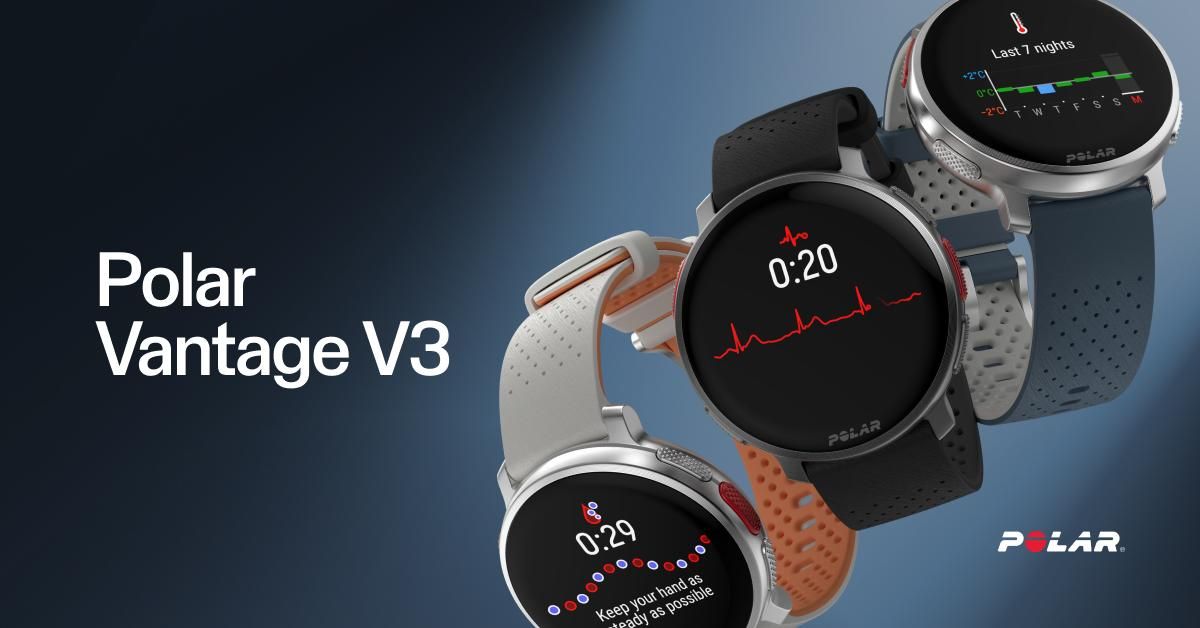
Polar Vantage V3 Review: Recovery, Training Load, and VO2 Max
Polar, whose chest straps researchers use as a reference standard, now asks you to trust what its flagship watch reads from your wrist overnight, and the published evidence is thinner than the marketing suggests.
Presented By Our Partners



Picture two runners finishing the same block of overload training. One wakes to find her overnight heart rate variability has dropped; the other sees no change at all. A wrist-worn recovery tracker would score their nights very differently. A 2025 Finnish study tested what such differences mean: across 24 runners pushed through a two-week overload period, perceived strain and muscle soreness rose, yet the average sleep and nightly recovery metrics showed no consistent change. The group average did not look tired. Individually, though, the overnight numbers differed substantially, and those differences were associated with who got faster.
That study was run partly by scientists at Polar Electro, the Finnish heart rate company whose chest straps researchers still use as a reference standard. Its current flagship, the Polar Vantage V3, launched in October 2023 with an AMOLED screen, dual-frequency GPS, over a week of battery life, and a new sensor platform Polar calls Elixir, whose health metrics include an ECG measurement and skin temperature. Three years on, as of October 2026, a Vantage V4 exists only in previews and speculation. The V3 is still the flagship.
This review asks the question that the overload study raises. When a watch tells you how recovered you are and how fit you are, how much of that is your body, and how much is the model?
The short answer: The Polar Vantage V3, Polar’s flagship multisport watch since October 2023, suits athletes who want overnight recovery analysis and training load guidance with long battery life. Its value is in individual trends, not absolute numbers: independent tests found its sibling watches’ overnight HRV agreed poorly with an ECG, and published validation of Polar’s VO2 max estimates is thin and dated.
- Best for: multisport athletes who want recovery guidance, training load tracking, and long battery life, and who will read trends rather than single scores.
- Not for: anyone who needs validated VO2 max numbers, the most accurate optical heart rate, or medical-grade ECG.
- Price (October 2026): we could not confirm the current US price; check Polar’s US store or authorized retailers.
- Regulatory status: not FDA regulated (wellness); we found no FDA clearance for the V3’s ECG measurement.
- Evidence: Limited; independent studies of Polar watches cover heart rate and energy expenditure, while recovery and VO2 max evidence is thin or Polar-funded.
What is the Polar Vantage V3?
The Polar Vantage V3 is a multisport GPS watch made by Polar Electro of Finland, launched in October 2023 as the successor to the Vantage V2. It tracks training load and overnight recovery, estimates VO2 max through Polar’s fitness tests, and adds an ECG measurement and skin temperature through Polar’s Elixir biosensing platform. It remains Polar’s flagship as of October 2026.
Launch coverage framed the V3 as Polar going “for broke”: an AMOLED display, dual-frequency GPS, over a week of battery life, and the new Elixir sensor platform, with ECG and skin temperature among its health metrics. One reviewer called it an incredible all-round GPS fitness watch, and another a multisport watch with oodles of recovery features. A September 2026 Polar feature update added trend graphs, a custom button, and an 80 percent charge limit to Polar watches, a sign the platform is still actively developed.
Two of Polar’s long-running tools matter most for this review. Nightly Recharge is Polar’s overnight recovery analysis; one of its components, which Polar calls ANS charge, combines heart rate, heart rate variability (HRV), and breathing rate during sleep, according to a 2025 study co-authored by Polar scientists. Training Load Pro tracks how hard your sessions are relative to your recent history. Polar has also published a white paper describing Nightly Recharge. These are Polar’s proprietary models. They are not FDA reviewed, and their internal formulas are not public.
One business change is worth knowing. In 2025, Polar launched a paid Fitness Program subscription, following Garmin’s move to a premium tier. We did not verify which Vantage V3 features, if any, now sit behind it; check before you buy if subscription-free ownership matters to you.
How does the Polar Vantage V3 measure recovery and estimate VO2 max?
The Vantage V3 reads your pulse optically at the wrist. Overnight, Polar combines heart rate, heart rate variability, and breathing rate into a recovery measure called ANS charge. For VO2 max, Polar offers a Fitness Test taken lying still and a Running Performance Test during a run, both of which estimate aerobic capacity from heart rate data rather than measuring oxygen.
Start with recovery, because it is the V3’s signature. During deep, quiet sleep, the vagus nerve, the brake pedal of the heart, presses down. Heart rate falls and the gaps between beats begin to wander with each breath, a rhythm called respiratory sinus arrhythmia. Heart rate variability is the measure of that wandering. After hard training, illness, alcohol, or stress, the brake eases and the rhythm grows more metronomic. Polar’s bet is that reading this overnight, and comparing it with your own baseline, reveals whether your body has absorbed yesterday’s work.
The wrist makes this harder than it sounds. A chest strap reads the heart’s electrical signal directly, each beat a sharp spike. A wrist sensor reads the pulse as it arrives in the capillaries, a softer wave that blurs when your arm moves or your skin is cold. Picture judging the rhythm of a drummer by watching the ripples on a pond he is standing in. You can count the beats. Measuring the tiny differences between them is another matter.
VO2 max takes a different route. Polar’s Fitness Test is taken at rest: you lie still for a few minutes while the watch records your heart, and Polar’s algorithm turns that recording, along with your personal details, into a VO2 max estimate. Polar also offers a Running Performance Test, done during a run, and a support page explaining how the company defines VO2 max. The distinction matters, because a 2022 meta-analysis of 14 validation studies by the INTERLIVE network found that wearables estimating VO2 max from resting data overestimated it by an average of 2.17 mL/kg/min, with individual errors stretching from 13.07 below to 17.41 above the true value, while exercise-based estimates had almost no average bias (Sports Medicine, 2022). Resting estimates are the less accurate family.
Training load uses heart rate during workouts to score how taxing each session was, then compares recent load with your longer-term pattern. Like every brand’s version, it is a model of stress, not a measurement of it.
How accurate is the Polar Vantage V3? What the research shows
No peer-reviewed study has tested the Vantage V3 itself. Studies of earlier Polar watches found good to variable workout heart rate accuracy, poor overnight HRV agreement with an ECG, and a VO2 max estimate from an older Polar model that failed to track training gains. A Polar co-authored study found overnight metrics reflected individual training responses.
Workout heart rate: good, but not best in class. In a 2020 study of 25 people, the Polar Vantage V tracked heart rate with coefficients of variation of 2.2 to 6.7 percent depending on intensity, second only to the Apple Watch Series 4 among four watches; the authors judged it suitable for valid heart rate measurement at the intensities tested (JMIR mHealth and uHealth, 2020). A 2022 study of 60 young adults found the Vantage V’s accuracy ranged from high to poor depending on the activity, with coefficients of variation of 2.44 to 8.80 percent (European Journal of Sport Science, 2022). During stationary cycling in 28 athletes, the Vantage V had a mean absolute error of 4 beats per minute against a chest strap (Scientific Reports, 2025). Newer, cheaper Polar models fared worse in one 2026 study of 10 wearables, where the Polar Ignite 3 and Polar Pacer showed mean absolute errors of 9 to 14 beats per minute (JMIR Formative Research, 2026).
Overnight HRV: the weak link for recovery. Over 536 nights in 13 healthy adults, researchers at Ohio State University compared five wearables with an ECG. A Polar Grit X Pro, another Polar watch, measured overnight resting heart rate with a mean absolute percentage error of 2.71 percent but agreement the authors rated poor (concordance 0.86), and overnight HRV with a mean absolute percentage error of 16.32 percent and poor agreement (concordance 0.82). Oura rings led on both measures (Physiological Reports, 2025). HRV is the foundation of Nightly Recharge, so that error ripples upward into every recovery score built on it.
Do overnight metrics track training response? The Finnish overload study is the most direct evidence. Across 24 runners who completed three weeks of baseline training, two weeks of overload, and one week of recovery, 3,000-meter performance improved by 1.2 percent and then 1.7 percent, perceived strain and soreness rose during overload, and the sleep and nightly recovery metrics showed no consistent group-level change. But a runner’s average ANS charge during overload, and changes in sleep heart rate and HRV, were associated with changes in their 3,000-meter time (Sensors, 2025). Two of the five authors worked for Polar Electro. The finding is plausible and useful, but it is small, company-involved, and not yet replicated.
Featured Partner
Invest in the Infrastructure Behind Modern Medicine
As healthcare expands beyond hospital walls, the buildings and campuses supporting that shift are generating compelling returns for investors who move early. The Healthcare Real Estate Fund offers qualified investors direct access to a curated portfolio of medical office, outpatient, and specialty care facilities.
Learn More →
VO2 max: thin and dated evidence. We found no peer-reviewed validation of the Vantage V3’s VO2 max estimates. The closest independent study is old: in 20 collegiate soccer players, an older Polar FT40 overestimated VO2 max both before (47.3 versus 43.6 mL/kg/min measured) and after an 8-week training program, and the correlation between predicted and actual change was weak (r = 0.18). The authors concluded it was not valid for tracking individual changes (Journal of Sports Sciences, 2014). That device is a decade older than the V3, so it does not settle the question. It does mean Polar’s current estimates carry little independent proof.
Energy expenditure: better than most, still not precise. In a Swiss Federal Institute of Sport study of 30 adults, the Polar Vantage M estimated energy expenditure with a 3.3 percent average bias and a correlation of 0.892 with laboratory measurement, but errors reached 31.4 percent during household chores (JMIR mHealth and uHealth, 2019). A US Navy pilot study of 16 elite military operators found a Polar Grit X Pro had good to excellent agreement with laboratory energy expenditure during treadmill running (Journal of Sports Science and Medicine, 2023). Other studies rated Polar’s calorie estimates poor, so treat them as rough.
Across the field, a 2024 living umbrella review covering 249 validation studies found wearables misjudged VO2 max by about 15 percent in resting tests and about 10 percent in exercise tests, and that only about 11 percent of devices on the market had been validated for even one metric (Sports Medicine, 2024).
What the Polar Vantage V3 gets right
The Vantage V3 gets the philosophy right: it frames recovery as your own trend rather than a universal score, it offers both resting and running fitness tests, and it delivers flagship hardware with long battery life.
Individual responses over group averages. The Finnish overload study’s most useful lesson is that group averages hide individual responses, and that a runner’s own overnight changes tracked their own adaptation. Reading recovery as a personal trend is the right frame for that finding.
A running test, not just a resting guess. The meta-analytic evidence favors exercise-based VO2 max estimates in general. Polar’s Running Performance Test estimates fitness from actual running, so on principle it deserves more weight than the resting Fitness Test, although neither has been independently validated on the V3.
Solid workout heart rate from its predecessor generation. The Vantage V ranked second of four watches for workout heart rate accuracy in one study, behind only the Apple Watch Series 4, and the authors judged it suitable for valid heart rate measurement. If the V3 performs at least as well, that is good enough for steady training.
Flagship hardware that lasts. An AMOLED display, dual-frequency GPS, and over a week of battery life let you wear the V3 through training and sleep without daily charging, which recovery tracking requires.
Active development three years on. Polar’s September 2026 feature update for its watches added trend graphs and charging controls, a sign the platform has not been abandoned; check which features reach the V3.
Where the Polar Vantage V3 falls short
The Vantage V3’s weaknesses are overnight HRV that agreed poorly with an ECG in sibling hardware, recovery metrics with little independent validation, a VO2 max estimate with no modern published proof, and a resting Fitness Test that belongs to the less accurate class of estimates.
Recovery scores inherit noisy HRV. A 16 percent average error in overnight HRV, as one Polar watch showed against an ECG, can easily swamp the night-to-night changes a recovery score is meant to detect. A single low Nightly Recharge result is a question, not an answer.
The group-level null result. In the Polar co-authored overload study, perceived strain rose while the average nightly recovery metrics did not change. Your legs may know something your watch does not.
HRV-guided training helps only a little. Two 2021 meta-analyses found HRV-guided training improved vagal HRV and submaximal physiology but produced only small, non-significant gains in VO2 max and performance compared with fixed plans, though with fewer non-responders (International Journal of Environmental Research and Public Health, 2021; Journal of Science and Medicine in Sport, 2021). Recovery guidance fine-tunes training; it does not transform it.
VO2 max lacks modern validation. The only independent Polar VO2 max study we found tested a 2010s-era model and found it failed to track individual change. Until someone tests the V3, treat its VO2 max as an uncalibrated estimate.
Training load ratios are statistically fragile. A 2020 critical analysis concluded there was no evidence supporting the acute-to-chronic workload ratio for reducing injury risk (International Journal of Sports Physiology and Performance, 2020), and a 2025 study of 5,205 runners found that a simple rule, keeping any single run within about 10 percent of your longest run of the previous 30 days, predicted injury better than load ratios did (British Journal of Sports Medicine, 2025).
The ECG is not a cleared medical feature. We found no FDA clearance for the V3’s ECG measurement. Do not use it to screen for atrial fibrillation; a cleared device or a clinician-ordered test is the right path.
Polar Vantage V3 vs Garmin Forerunner 970 vs COROS PACE 4 vs WHOOP 5.0
The Vantage V3 and Garmin Forerunner 970 are full-featured flagships; Garmin has the stronger independent VO2 max evidence, Polar leans on recovery analysis, COROS is the value option, and WHOOP is a screenless recovery tracker sold through memberships.
| Feature | Polar Vantage V3 | Garmin Forerunner 970 | COROS PACE 4 | WHOOP 5.0 |
|---|---|---|---|---|
| Price (October 2026) | US price not confirmed | $749.99 at launch; around $649.99 on sale | Not verified for this review | Membership tiers; not verified for this review |
| VO2 max approach | Resting Fitness Test and Running Performance Test | From runs (exercise-based) | Not verified for this review | Not verified for this review |
| Independent VO2 max evidence | Older Polar model failed to track change | Recent Garmin models under 10 percent average error | Not verified for this review | Not verified for this review |
| Overnight HRV agreement with ECG | Poor in a sibling Polar watch (16 percent error) | Poor in a Garmin fenix 6 (11 percent error) | Not verified for this review | Moderate for the previous WHOOP 4.0 (8 percent error) |
| Battery | Over a week | Up to 15 days | Not verified for this review | Not verified for this review |
| Best for | Recovery-focused multisport athletes | Structured runners and triathletes | Budget-conscious runners | Recovery coaching without a screen |
If you are upgrading, our Polar Vantage V2 review covers the predecessor. For the closest flagship rival, read our Garmin Forerunner 970 review. For a lighter, cheaper Polar, see our Polar Pacer Pro review, and for screenless recovery tracking, our WHOOP 5.0 recovery review. Browse every recovery device in our respiratory and VO2 max reviews.
How much does the Polar Vantage V3 cost, and is it HSA/FSA eligible?
As of October 2026, we could not confirm the Polar Vantage V3’s current US price from the sources available for this review; check Polar’s US store or an authorized retailer. European retailers have discounted it, including one reported Amazon reduction of 200 euros in Germany. Insurance does not cover it, and we found no HSA or FSA eligibility.
Factor in Polar’s optional Fitness Program subscription, launched in 2025, if any of the features you want sit behind it. A chest strap such as Polar’s own H10, which researchers used as the reference standard in two of the studies cited here, is worth adding if you care about precise heart rate during intervals.
If what you really want is an accurate VO2 max to set training zones, a single laboratory or clinic test will give you a better anchor than any watch estimate. The watch is for tracking direction between tests.
Who should buy the Polar Vantage V3, and who should skip it?
The Vantage V3 suits multisport athletes who like Polar’s recovery-centric approach, want long battery life and a premium display, and will read their data as personal trends. It is the wrong choice for anyone who needs validated fitness numbers, medical-grade ECG, or the most accurate wrist heart rate.
Good candidates:
- Triathletes and multisport athletes who want one watch for training, recovery, and sleep.
- Athletes who value overnight recovery analysis and will compare it with how they feel.
- Existing Polar users with years of data in Polar’s ecosystem.
Better served by something else:
- Runners who want the best-validated VO2 max estimate: Garmin’s run-based estimates have more independent evidence.
- Anyone wanting atrial fibrillation screening: choose a device with an FDA-cleared ECG feature.
- Anyone with chest pain, fainting, or unusual breathlessness during exercise: stop and seek care. A watch cannot rule out heart disease, and the Healthcare Discovery doctor directory can help you find a sports cardiologist.
What this means for you
Fitness is among the most powerful defenses against the Silent Assassin, cardiovascular disease. In a Cleveland Clinic study of 122,007 patients, the least fit quarter had five times the risk-adjusted mortality of elite performers (hazard ratio 5.04), with no upper limit of benefit (JAMA Network Open, 2018), and a 2009 JAMA meta-analysis of 33 studies tied each 1-MET gain in fitness to 13 percent lower all-cause mortality. Our guide to the Four Villains of Health and Longevity explains how fitness guards against each threat.
The Vantage V3 earns its keep at the junction of two Pillars. For Movement, use its training load and running test as a heading, not a destination, and anchor them with an occasional laboratory test if your zones matter. A 2025 Sports Medicine review found that intensity prescribed from ventilatory or lactate thresholds produced larger VO2 max gains than intensity based on a percentage of peak effort.
For Sleep, Nightly Recharge is a reminder that adaptation happens between workouts. Read it the way you would read the sky before a hike: a useful forecast, sometimes wrong, best combined with how you actually feel. If the watch says recovered and your legs say otherwise, the overload study suggests trusting your legs.
Polar built its reputation teaching athletes to listen to their hearts. The Vantage V3 extends that lesson overnight. The honest version of its promise is not that it knows when you are ready. It is that, over weeks, it can help you notice patterns you would otherwise miss.
Frequently asked questions
Is the Polar Vantage V3 worth it?
It is worth it for multisport athletes who want overnight recovery analysis, training load tracking, an AMOLED display, and over a week of battery life in one watch. It is Polar’s flagship as of October 2026. Buy it for trends, not precision: no study has tested the V3 itself, a sibling Polar watch measured overnight HRV poorly against an ECG, and Polar’s VO2 max estimates have little modern independent validation.
How accurate is Polar Nightly Recharge?
Its accuracy is not well established. Nightly Recharge relies on overnight heart rate, HRV, and breathing rate, and in a 2025 study of 536 nights, a Polar Grit X Pro measured overnight HRV with a 16 percent average error and poor agreement with an ECG. A Polar co-authored 2025 study of 24 runners found overnight metrics did not change on average during overload training but did track individual performance changes.
How accurate is the Polar VO2 max estimate?
Unknown for the Vantage V3, because no peer-reviewed study has tested it. An older Polar FT40 overestimated VO2 max in 20 soccer players and failed to track individual training gains. Resting estimates in general are less accurate: a 2022 meta-analysis found resting-based wearable estimates overestimated VO2 max by about 2 mL/kg/min with wide individual error. On principle, give more weight to Polar’s Running Performance Test than the resting Fitness Test.
Does the Polar Vantage V3 have an ECG?
Yes, the Vantage V3 includes an ECG measurement as part of Polar’s Elixir biosensing platform, introduced at the watch’s October 2023 launch. However, we found no FDA clearance for it, so it should not be used to screen for or diagnose atrial fibrillation. If you need rhythm screening, use a device with an FDA-cleared ECG feature or ask a clinician about a monitoring test.
Polar Vantage V3 vs Garmin Forerunner 970: which should I buy?
Choose the Forerunner 970 if VO2 max accuracy matters most: recent Garmin models averaged under 10 percent error in independent lab studies, and it offers up to 15 days of battery. Choose the Vantage V3 if you prefer Polar’s recovery-focused approach. Both measured overnight HRV poorly against an ECG in studies of sibling models, so neither recovery score should be treated as precise.
Sources
- Nuuttila OP, et al. Monitoring sleep and nightly recovery with wrist-worn wearables: links to training load and performance adaptations. Sensors, 2025. DOI
- Dial MB, et al. Validation of nocturnal resting heart rate and heart rate variability in consumer wearables. Physiological Reports, 2025. DOI
- Düking P, et al. Wrist-worn wearables for monitoring heart rate and energy expenditure while sitting or performing light-to-vigorous physical activity: validation study. JMIR mHealth and uHealth, 2020. DOI
- Hajj-Boutros G, et al. Wrist-worn devices for the measurement of heart rate and energy expenditure: a validation study for the Apple Watch 6, Polar Vantage V and Fitbit Sense. European Journal of Sport Science, 2022. DOI
- Yang J, et al. Validity of Hera Leto consumer earbuds for heart rate monitoring during stationary cycling. Scientific Reports, 2025. DOI
- Gielen J, et al. Accuracy of optical heart rate measurements for 10 commercial wearables in different climate conditions and activities: instrument validation study. JMIR Formative Research, 2026. DOI
- Esco MR, Snarr RL, Williford HN. Monitoring changes in VO2max via the Polar FT40 in female collegiate soccer players. Journal of Sports Sciences, 2014. DOI
- Gilgen-Ammann R, Schweizer T, Wyss T. Accuracy of the multisensory wristwatch Polar Vantage’s estimation of energy expenditure in various activities: instrument validation study. JMIR mHealth and uHealth, 2019. DOI
- Kloss EB, et al. Validation of Polar Grit X Pro for estimating energy expenditure during military field training: a pilot study. Journal of Sports Science and Medicine, 2023. DOI
- Molina-Garcia P, et al. Validity of estimating the maximal oxygen consumption by consumer wearables: a systematic review with meta-analysis and expert statement of the INTERLIVE network. Sports Medicine, 2022. DOI
- Doherty C, et al. Keeping pace with wearables: a living umbrella review of systematic reviews evaluating the accuracy of consumer wearable technologies in health measurement. Sports Medicine, 2024. DOI
- Manresa-Rocamora A, et al. Heart rate variability-guided training for enhancing cardiac-vagal modulation, aerobic fitness, and endurance performance: a methodological systematic review with meta-analysis. International Journal of Environmental Research and Public Health, 2021. DOI
- Düking P, et al. Monitoring and adapting endurance training on the basis of heart rate variability monitored by wearable technologies: a systematic review with meta-analysis. Journal of Science and Medicine in Sport, 2021. DOI
- Impellizzeri FM, et al. Acute:chronic workload ratio: conceptual issues and fundamental pitfalls. International Journal of Sports Physiology and Performance, 2020. DOI
- Frandsen JSB, et al. How much running is too much? Identifying high-risk running sessions in a 5200-person cohort study. British Journal of Sports Medicine, 2025. DOI
- Hansen D, et al. Advancing aerobic exercise training intensity prescription in health and disease beyond standard recommendations: a call to action. Sports Medicine, 2025. DOI
- Mandsager K, et al. Association of cardiorespiratory fitness with long-term mortality among adults undergoing exercise treadmill testing. JAMA Network Open, 2018. DOI
- Kodama S, et al. Cardiorespiratory fitness as a quantitative predictor of all-cause mortality and cardiovascular events in healthy men and women: a meta-analysis. JAMA, 2009. DOI
- Polar. Nightly Recharge white paper. Polar
- Polar. Unlocking the mystery of VO2max (support article). Polar Support
Polar Vantage V3 at a glance
- Form factor
- Multisport GPS watch
- FDA status
- Wellness device, no clearance
Pricing verified October 20, 2026. Maintained in the Healthcare Discovery device database and updated automatically.


Similar Posts

January AI: Predicting Glucose Responses from Food Photos Using Artificial Intelligence
What if you could predict how your blood sugar will respond to a meal before you eat it? January AI is building the technology to make that possible. Presented By…

The Machine That Learned to Read the Immune System
Harvard’s COMPASS model uses tumor gene activity to map cancer immunotherapy response, translating thousands of gene-expression signals into interpretable immune concepts.

GLP-1 Intelligence Hub: Verify the Claim Before You Trust It
A source-backed verification hub for decoding GLP-1 claims, checking telehealth transparency, understanding compounded-product risks, and finding accountable care.
Everlywell Heart Health Test: At-Home Cardiovascular Biomarker Screening
Cardiovascular disease kills more people worldwide than any other condition, yet the blood biomarkers that predict it years in advance remain invisible to most people between annual physicals. At-home testing…

AI Can Export Mayo’s Intelligence. Can It Export Mayo’s Care?
A Mayo Clinic model may make elite medical reasoning available far beyond Rochester. But an answer is not the same thing as care—and an API cannot reorganize a hospital by…

Nutrition and Metabolic Health: What the Evidence Actually Shows
The most consistent finding in nutrition science is also the least marketable: variety beats optimization. Presented By Our Partners Researchers running the American Gut Project, one of the largest citizen…
