
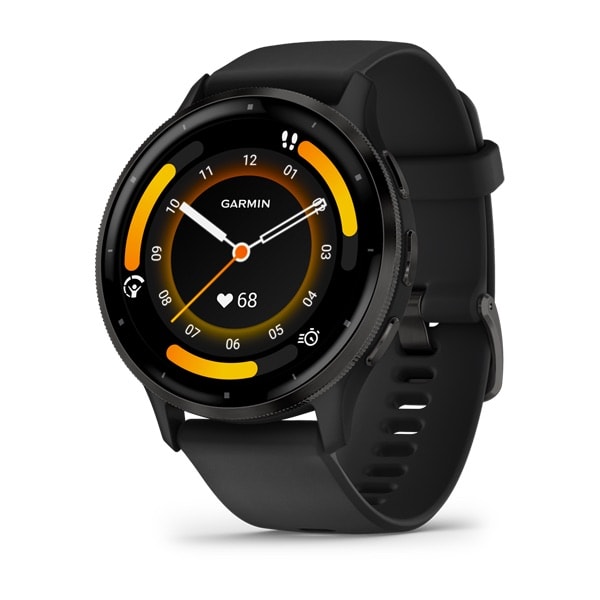
Garmin Venu 3 Review: ECG Accuracy, Battery, and the Venu 4 Question
Garmin’s Venu 3 (2023) pairs an FDA cleared ECG app with up to two weeks of battery and no required subscription; now that the Venu 4 has replaced it, the question is whether the older watch is the smarter heart purchase.
Presented By Our Partners



Your heart does some of its most revealing work while you sleep. Between midnight and dawn, heart rate drifts toward its lowest point of the day, and the tiny beat-to-beat variations in its timing, the signal called heart rate variability, show how firmly the calming branch of the nervous system has taken the controls. A wearable can only read that signal on the nights it is on your wrist. A watch that spends every second or third night on a charger hands you a heart record with holes in it.
That is the quiet argument for the Garmin Venu 3, a GPS smartwatch made by Garmin and announced in August 2023 at $449.99. It promised up to 14 days of battery, and after launch Garmin switched on its FDA cleared ECG App for the watch through a software update, turning the watch into an on-demand rhythm recorder.
As of October 2026, the Venu 3 has a successor, the Venu 4, and has been sold at record-low prices. That makes the buying question sharper, not simpler.
The short answer: The Garmin Venu 3 (2023) is a GPS smartwatch with Garmin’s FDA cleared ECG app, up to 14 days of rated battery, and heart features that need no subscription. Garmin’s Venu 4 has replaced it, but at its record-low sale prices the Venu 3 is still a strong buy for heart-health basics. Its ECG lacks independent validation, and it has no passive AFib alerts.
- Best for: adults who want a full smartwatch with long battery, on-demand ECG, and no monthly fee, bought at a discount.
- Not for: anyone who needs a diagnosis, passive atrial fibrillation alerts, accurate blood oxygen, or the newest Garmin training software.
- Price (October 2026): launched at $449.99; widely discounted, with Android Central, TechRadar, and PhoneArena all reporting record-low deals. Prices change often.
- Regulatory status: Garmin ECG App FDA cleared for single-lead rhythm classification; every other metric is a general wellness feature.
- Evidence: Limited; Garmin’s ECG app has no peer-reviewed independent validation we could find, and Garmin’s heart rate, sleep, and HRV data perform well to modestly in studies of other models.
What is the Garmin Venu 3, and has it been replaced?
The Garmin Venu 3 is a GPS fitness smartwatch made by Garmin, with a touchscreen, an optical heart rate sensor, and an on-demand ECG app. Garmin announced it with the smaller Venu 3S in August 2023 at $449.99. Its successor, the Venu 4, launched in 2025 with an ECG app, a built-in flashlight, and a rated battery of up to 12 days.
Garmin built the Venu line for people who want a smartwatch first and a training computer second. The Venu 3 brought automatic nap detection, a wheelchair mode, and a sleep coach. The ECG did not ship on day one. Garmin’s FDA cleared ECG App debuted in January 2023 on the older Venu 2 Plus, and the company later extended it to the Venu 3 and several flagship watches, including the Fenix 7 Pro and Epix Pro, through a software update.
The Venu 4 arrived as the replacement (our Garmin Venu 4 vs Venu 3 comparison covers the upgrade in detail), with the flashlight that headlined its launch coverage, and Garmin has published its own guide to the differences between the two watches. What makes the Venu 3 interesting in October 2026 is not novelty but price. Android Central, TechRadar, PhoneArena, and Notebookcheck have all reported record-low deals on the Venu 3 or Venu 3S, well below the original $449.99.
One other thing has changed since launch. In March 2025 Garmin introduced Garmin Connect+, a paid tier at $6.99 a month that adds AI features and other premium extras. Garmin said at the time that the free experience “is not going away,” and the Venu 3’s core health data remain in the free app. The headline promise of the original review, that the watch needs no subscription, still holds; it is just no longer the whole story of Garmin’s software.
This review focuses on the Venu 3 as a heart-health instrument: what its ECG can catch, how good its optical sensor is, and what two weeks of battery is actually worth. For how the same watch performs as a sleep tracker, see our companion Garmin Venu 3 sleep tracking review.
How does the Garmin Venu 3 ECG work?
The Venu 3 records a single-lead ECG when you open the ECG app and touch the watch with a fingertip of your other hand. That closes an electrical circuit across your chest, the watch records a short strip of the heart’s voltage, and the app classifies the rhythm, flagging signs of atrial fibrillation.
Every heartbeat begins as a spark in a cluster of pacemaker cells high in the right atrium. The wave spreads across the two upper chambers, which squeeze blood down into the ventricles; pauses for a fraction of a second at the atrioventricular node, the gatekeeper that lets the ventricles fill; then races down specialized wiring and fires the ventricles in one coordinated contraction. Each phase leaves a mark on the tracing: a small P wave for the atria, a tall QRS spike for the ventricles, and a T wave as they reset.
In atrial fibrillation, the upper chambers stop beating in an organized way and quiver instead. The P wave dissolves into a shivering baseline, and because the atrioventricular node lets chaotic impulses through at random, the QRS spikes arrive at uneven intervals, a pattern cardiologists call “irregularly irregular.” A single lead, roughly the arm-to-arm view cardiologists call lead I, is usually enough to see that pattern, which is why one lead can screen for AFib even though it says little about the rest of the heart.
The rest of the Venu 3’s heart data comes from light. LEDs on the back shine into the wrist, and a sensor measures how much bounces back. Each heartbeat sends a pressure pulse into the small vessels under the watch; they swell, absorb more light, then relax. The rhythm of that flicker becomes heart rate, and the tiny variations between pulses become the overnight HRV value Garmin reports. The technique is called photoplethysmography, or PPG.
Here is the distinction that matters most for buyers. The ECG is a camera you have to raise yourself; it captures a short strip only when you choose to look. We found no FDA clearance for a Garmin passive AFib notification of the kind Fitbit and Samsung offer. The Venu 3 can capture a rhythm when you feel something. It will not tap you on the wrist about an arrhythmia you never noticed.
How accurate is the Garmin Venu 3? What the research shows
No peer-reviewed study we could find has independently tested Garmin’s ECG app. Garmin’s optical heart rate is accurate in published tests of related models, with wrist sensors losing ground during vigorous arm movement. Garmin’s sleep staging and overnight HRV perform modestly against laboratory references, and its blood oxygen readings have performed poorly.
The ECG: cleared, but not independently tested. Garmin’s ECG App carries FDA clearance, which means the agency accepted the company’s evidence for a specific rhythm-classification claim. That is a regulatory bar, not a published head-to-head study, and the gap shows. The most-cited independent comparison of consumer ECG devices, the BASEL Wearable Study from University Hospital Basel, tested five devices on 201 cardiology patients (JACC: Clinical Electrophysiology, 2023). The Apple Watch 6 and Samsung Galaxy Watch 3 each reached 85 percent sensitivity for AFib, the Fitbit Sense 66 percent, and the Withings ScanWatch 58 percent, with between 17 and 26 percent of tracings labeled inconclusive. Garmin was not in the study. A 2025 diagnostic meta-analysis in JACC: Advances pooled 26 studies and 17,349 patients; its abstract reports device-level results for Apple, Samsung, and Withings, and none for Garmin.
The honest summary: Garmin’s ECG has passed the FDA’s bar, but no published independent trial we found shows how often it catches AFib or calls a tracing inconclusive in real patients. The BASEL numbers are a reminder that single-lead apps differ, sometimes a lot, and that “FDA cleared” alone does not tell you where in that range a device sits. If you want a framework for reading claims like these, see our guide to what “clinically validated” really means.
Garmin’s optical sensor can see AFib, in research settings. There is a hint of what Garmin’s hardware could do. At Chang Gung Memorial Hospital in Taiwan, 200 patients referred for Holter monitoring wore a Garmin smartwatch for 24 hours while researchers analyzed its raw PPG signal with their own software (American Heart Journal, 2022). Of the 200, 112 had AFib during the recording. The research algorithm detected AFib with 97.3 percent sensitivity and 88.6 percent specificity against the simultaneous Holter. That was a hospital team’s algorithm on a Garmin sensor, not a feature you can turn on, but it shows the optical signal is capable of carrying the information.
Featured Partner
Invest in the Infrastructure Behind Modern Medicine
As healthcare expands beyond hospital walls, the buildings and campuses supporting that shift are generating compelling returns for investors who move early. The Healthcare Real Estate Fund offers qualified investors direct access to a curated portfolio of medical office, outpatient, and specialty care facilities.
Learn More →
Heart rate: strong at rest, weaker when arms swing. No independent study we found tested the Venu 3’s heart rate head-to-head against an ECG during exercise, so the best evidence comes from its predecessor. In a 2024 study in the Scandinavian Journal of Medicine and Science in Sports, 32 participants wore a Garmin Venu 2S and three other optical sensors for 24 hours of laboratory and free-living activity, with a medical-grade ECG as the reference. Across activities, mean absolute percentage error ranged from 2.2 to 4.7 percent for all four sensors, and agreement was high. The Venu 2S underestimated time spent at vigorous intensity by about 16 percent, and the arm-worn sensors outperformed the wrist-worn ones during heavy arm movement. A 2025 Politecnico di Milano study used the Venu 3 alongside an ECG as references for testing smart glasses during six seated and standing tasks; it was not designed to grade the watch itself.
Overnight HRV: Garmin trails the rings. In a 2025 Ohio State University study in Physiological Reports, 13 healthy adults wore an ECG and five wearables across 536 nights. For nocturnal HRV, Oura’s rings came closest to the ECG (concordance 0.97 to 0.99). WHOOP was moderate at 0.94, and the Garmin Fenix 6 showed what the authors called poor agreement, with a concordance of 0.87 and a mean error of about 10.5 percent. Garmin’s resting heart rate was excluded from that analysis because of methodological inconsistencies. The Fenix 6 is an older Garmin, and newer sensors may do better, but no study we found shows the Venu 3 closing that gap.
Sleep: fine for timing, rough for stages. In a 2022 sleep-laboratory study in Sensors, 53 young adults wore six devices alongside polysomnography. A Garmin Forerunner 245 classified sleep versus wake with 89 percent agreement but matched specific sleep stages only 50 percent of the time. In a separate 2022 study of 49 adults with suspected sleep disorders, a Garmin Forerunner 945 significantly overestimated total sleep, with a mean absolute error of about 85 minutes, overestimated light sleep, underestimated deep sleep, and detected none of the daytime sleep that occurred during a nap test. That last finding matters for a watch that sells nap detection, though the Venu 3’s nap feature postdates that study.
Blood oxygen: do not trust it. In a 2023 Duke University study in PLOS Digital Health, 49 adults with and without chronic lung disease wore several consumer smartwatches against a clinical pulse oximeter. The Garmin Venu 2S was farthest from the reference, with a mean absolute error of 5.8 percentage points and a tendency to read high. A 2025 Sensors study of a Garmin Fenix 6 reached the same verdict: accurate VO2 max estimates (mean error about 7 percent) but failed blood oxygen measurement under every condition tested. Treat any Garmin blood oxygen number as a curiosity, not a reading.
What the Garmin Venu 3 gets right
The Venu 3 gets the fundamentals right for an everyday heart-health watch: it stays on your wrist for many nights at a time, its sensor family measures heart rate well in daily life, it gives you an FDA cleared way to capture a rhythm when you feel a flutter, and its core health data live in a free app.
Battery that protects the overnight record. Garmin rates the Venu 3 at up to 14 days of battery. Real-world use with the always-on display and GPS workouts will be shorter, but even a week between charges means the nightly heart rate and HRV record has few gaps. For trend-based metrics, consistency beats precision on any single night.
An ECG in the moment. For people with occasional palpitations, a tracing captured during the event gives a clinician far more to work with than a description of it afterward.
Heart rate that holds up in everyday life. Its predecessor’s sensor showed errors under 5 percent across a full day of activity in independent testing, which supports training zones, resting heart rate trends, and the cardio fitness estimate.
A fitness estimate that tracks the real thing. Garmin’s VO2 max estimate, tested on the Fenix 6 and the Forerunner 265, landed within a 10 percent error in both studies, though the Forerunner 265 overestimated by about 3 ml/kg/min on average. For a metric this strongly linked to longevity, a reasonable trend line is valuable.
Accessibility built in. A dedicated wheelchair mode adapts activity tracking for wheelchair users.
Where the Garmin Venu 3 falls short
The Venu 3’s ECG has no independent validation we could find, it has no passive AFib alerts, its blood oxygen readings are unreliable, and Garmin’s overnight HRV and sleep staging trail the best rings in head-to-head testing. It is also now a previous-generation watch.
An ECG without published proof. FDA clearance tells you the app met a regulatory standard. It does not tell you how it compares with Apple’s or Samsung’s ECG, both of which were tested in the BASEL study of cardiology patients. Until someone publishes that comparison for Garmin, the honest answer to “how accurate is it?” is “unknown, but cleared.”
No watchman in the background. Fitbit’s Irregular Rhythm Notifications and Samsung’s FDA cleared irregular rhythm alerts check for AFib passively. We found no equivalent FDA clearance for Garmin. If your main goal is catching silent AFib, a watch that only checks when you ask is the weaker tool.
One lead, one rhythm question. A single-lead ECG cannot detect a heart attack, judge valves or heart muscle, or replace a 12-lead ECG. Chest pain, pressure, or shortness of breath is an emergency: call 911.
Screening the well is still unproven. In 2022 the US Preventive Services Task Force concluded that the evidence was insufficient to weigh the benefits and harms of screening adults 50 and older without symptoms for AFib (JAMA, 2022). Finding AFib earlier is a plausible route to fewer strokes, but that has not been demonstrated in people who feel fine.
Numbers that look more precise than they are. Garmin’s sleep stages, overnight HRV, Body Battery, and stress scores are estimates built on the optical sensor. Body Battery and stress have no peer-reviewed validation we could find, and Garmin’s sleep stages and nocturnal HRV underperformed in the studies above. Use them for trends, not verdicts.
A watch at the end of its line. The Venu 4 has replaced it, and Garmin’s newest features tend to arrive first on new models and in the paid Connect+ tier. A previous-generation watch will see fewer of them.
Garmin Venu 3 vs Venu 4 vs Fitbit Charge 6 vs KardiaMobile 6L
The Venu 4 is the direct successor, with a flashlight and up to 12 days of rated battery. A Fitbit Charge 6 costs less and adds FDA cleared passive AFib alerts in a band. A KardiaMobile 6L records a six-lead ECG but does nothing else. For the best-studied wrist ECG, Apple’s has the deepest independent evidence.
| Feature | Garmin Venu 3 | Garmin Venu 4 | Fitbit Charge 6 | AliveCor KardiaMobile 6L |
|---|---|---|---|---|
| Form factor | Full smartwatch | Full smartwatch with flashlight | Slim band with screen | Handheld ECG that works with a smartphone |
| ECG | Single lead, FDA cleared Garmin ECG App, added by update | Garmin ECG App | Single lead, FDA cleared Fitbit ECG App | Six lead, FDA cleared |
| FDA cleared passive AFib alerts | Not found | Not found | Yes (Irregular Rhythm Notifications) | No; records only when you take a reading |
| Independent ECG accuracy data | None published that we found | None published that we found | 66% AFib sensitivity (Fitbit’s app, tested on the Fitbit Sense) | Single-lead KardiaMobile: 79% sensitivity in BASEL; 6L not tested there |
| Rated battery | Up to 14 days | Up to 12 days | Up to 7 days | Not applicable |
| Status (October 2026) | Superseded; widely discounted | Current Garmin Venu | Replaced by Fitbit Edge | Standalone ECG device ($150 at launch) |
If you want Garmin’s newest hardware and software, the Venu 4 is the obvious choice. If you want passive AFib alerts and pay far less, our Fitbit Charge 6 review covers the band that has them, along with its replacement, the Fitbit Edge. Apple’s ECG has the deepest independent evidence base: a 2025 JACC: Advances meta-analysis of 11 studies and 4,241 participants pooled its sensitivity at 94.8 percent and specificity at 95 percent; our Apple Watch Series 9 review covers that watch. Samsung’s rugged option is covered in our Galaxy Watch Ultra review, and if you want a dedicated, more detailed ECG, the AliveCor KardiaMobile 6L records six leads. Browse every heart device we cover in our cardiology device reviews.
How much does the Garmin Venu 3 cost, and is it covered or HSA/FSA eligible?
The Venu 3 and Venu 3S launched at $449.99 in 2023. Since then, Android Central, TechRadar, PhoneArena, and Notebookcheck have all reported record-low deals. Garmin’s heart features need no subscription; Garmin Connect+ is an optional $6.99 a month tier. We found no evidence that insurers cover the watch.
Practically, as of October 2026, the Venu 3 is a discount purchase, so check the current deal price before you buy. Well below launch price, it delivers an FDA cleared ECG app, a well-tested heart rate sensor family, built-in GPS, and up to two weeks of rated battery. Near its original $449.99, the case weakens, because the Venu 4 brings newer hardware and a longer runway of software support.
The subscription question has a clean answer. Garmin Connect+ launched in March 2025 at $6.99 a month and adds AI features and other premium extras, while Garmin promised the free experience is not going away. The Venu 3’s core health features, including the ECG app, work without it. We could not verify that the Venu 3 qualifies for HSA or FSA funds; ask your plan administrator before counting on it.
Who should buy the Garmin Venu 3, and who should skip it?
The Venu 3 suits adults who want a real smartwatch with long battery life and an on-demand ECG, without a required subscription, bought at a discount. It is the wrong choice for anyone whose main goal is catching silent AFib, anyone who needs a diagnosis, or anyone who wants the newest Garmin software.
Good candidates:
- People with occasional palpitations who want to capture a tracing in the moment to show a clinician.
- Adults who want nightly heart rate and HRV trends without charging every day.
- Walkers, runners, and gym-goers who want built-in GPS and a cardio fitness estimate in a smartwatch that also handles notifications.
- Wheelchair users who want a dedicated wheelchair mode.
- Anyone who refuses a monthly fee for core health data.
Better served by something else:
- Anyone with chest pain, fainting, or a racing heart with shortness of breath: that is an emergency. Call 911.
- People who want passive AFib alerts: a Fitbit or Samsung watch with FDA cleared irregular rhythm notifications is the better fit.
- Patients with unexplained or recurring symptoms: a clinician-ordered monitor such as the 14-day Zio patch records every beat.
- Anyone who needs reliable blood oxygen readings, for lung disease or altitude: use a medical pulse oximeter.
- Buyers who can only find it near full price: the Venu 4 is the better buy at that point.
If a reading or a symptom sends you looking for a cardiologist or electrophysiologist, the Healthcare Discovery doctor directory lists clinicians by state and specialty.
What this means for you
Cardiovascular disease, the Silent Assassin, earns its name by working without symptoms, and atrial fibrillation is one of its stealthiest tools. In the Framingham Study’s 34-year follow-up of 5,070 people, AFib carried a near fivefold excess risk of stroke (Stroke, 1991). The Venu 3’s ECG gives you a way to catch that rhythm when you feel it. That is the reason it belongs in the larger story we tell in the Four Villains of Health and Longevity.
But the watch’s biggest contribution to heart health may be the least dramatic one: Movement. Cardiorespiratory fitness is one of the strongest predictors of how long people live. In a 2009 JAMA meta-analysis of 33 studies and 102,980 participants, every one-MET increase in fitness, roughly the difference of running one kilometer per hour faster, was associated with a 13 percent lower risk of death from any cause and a 15 percent lower risk of heart disease events. A watch that tracks your cardio fitness, nudges you outside with GPS, and stays on long enough to show the trend over months is working on that number every day.
Sleep is the other pillar the Venu 3 serves, because its battery keeps the overnight record unbroken; our sleep review of the same watch covers what that record can and cannot tell you. And Mindset matters too. Treat the watch’s scores as weather reports, not diagnoses: useful for spotting patterns, never a reason to panic or to ignore a symptom. The quiet hours after midnight are when your heart tells its most honest story. A watch that is there every night is the first step to hearing it.
Frequently asked questions
Is the Garmin Venu 3 still worth buying in 2026?
Yes, at a discount. The Venu 3 launched at $449.99 in 2023, and several outlets, including Android Central, TechRadar, and PhoneArena, have reported record-low deals since. At a deep discount you get Garmin’s FDA cleared ECG app, built-in GPS, up to 14 days of rated battery, and core health features with no required subscription. Near full price, the newer Venu 4 is the better buy.
Does the Garmin Venu 3 have ECG?
Yes. Garmin added its FDA cleared ECG App to the Venu 3 and Venu 3S through a software update after launch; the app first debuted on the Venu 2 Plus in January 2023. You open the app and touch the watch with a fingertip of your other hand, and it records a short single-lead strip that is checked for signs of atrial fibrillation. It does not monitor your rhythm continuously.
How accurate is the Garmin Venu 3 ECG?
It is unknown in published research. Garmin’s ECG App is FDA cleared, but we found no peer-reviewed independent study of how often it detects atrial fibrillation or returns inconclusive results. Garmin was not among the five devices in the BASEL Wearable Study, where sensitivity for AFib ranged from 58 to 85 percent. Any abnormal or inconclusive result should be confirmed by a clinician, usually with a 12-lead ECG.
Does the Garmin Venu 3 need a subscription?
No. The Venu 3’s ECG app and core health tracking work in the free Garmin Connect app. In March 2025 Garmin added Garmin Connect+, an optional $6.99 a month tier with AI features and other premium extras, and said the free experience is not going away. You can take ECGs and track heart rate, sleep, and workouts on the Venu 3 without paying a monthly fee.
Garmin Venu 3 vs Venu 4: which should you buy?
Buy the Venu 4 if the prices are close or you want Garmin’s newest hardware and software, including its built-in flashlight. Buy the Venu 3 if you find it deeply discounted, because it already has the FDA cleared ECG app, built-in GPS, and up to 14 days of rated battery, against up to 12 days for the Venu 4. Both watches support Garmin’s ECG App.
Can the Garmin Venu 3 detect AFib automatically?
Not in the way some rivals can. The Venu 3 checks for atrial fibrillation only when you take an ECG yourself, and we found no FDA clearance for a Garmin passive irregular rhythm notification like those on Fitbit and Samsung watches. If catching silent AFib is your main goal, a watch with that feature, or a clinician-ordered monitor such as a 14-day ECG patch, is the better tool.
Sources
- Mannhart D, et al. Clinical validation of 5 direct-to-consumer wearable smart devices to detect atrial fibrillation: BASEL Wearable Study. JACC: Clinical Electrophysiology, 2023. DOI
- Barrera N, et al. Accuracy of smartwatches in the detection of atrial fibrillation: a systematic review and diagnostic meta-analysis. JACC: Advances, 2025. DOI
- Shahid S, et al. Diagnostic accuracy of Apple Watch electrocardiogram for atrial fibrillation: a systematic review and meta-analysis. JACC: Advances, 2025. DOI
- Chang PC, et al. Atrial fibrillation detection using ambulatory smartwatch photoplethysmography and validation with simultaneous Holter recording. American Heart Journal, 2022. DOI
- Neudorfer M, et al. Validity of four consumer-grade optical heart rate sensors for assessing volume and intensity distribution of physical activity. Scandinavian Journal of Medicine and Science in Sports, 2024. DOI
- Solbiati S, et al. Estimating heart rate from inertial sensors embedded in smart eyewear: a validation study. Sensors, 2025. DOI
- Dial MB, et al. Validation of nocturnal resting heart rate and heart rate variability in consumer wearables. Physiological Reports, 2025. DOI
- Miller DJ, et al. A validation of six wearable devices for estimating sleep, heart rate and heart rate variability in healthy adults. Sensors, 2022. DOI
- Budig M, et al. Validity of two consumer multisport activity trackers and one accelerometer against polysomnography in sleep patients. Sensors, 2022. DOI
- Jiang Y, et al. Investigating the accuracy of blood oxygen saturation measurements in common consumer smartwatches. PLOS Digital Health, 2023. DOI
- Carrier B, et al. Validation of aerobic capacity (VO2max) and pulse oximetry in wearable technology. Sensors, 2025. DOI
- Howard J, et al. Validity of the Garmin Forerunner 265 to predict VO2max and race performance times. Journal of Medical Engineering and Technology, 2026. DOI
- Kodama S, et al. Cardiorespiratory fitness as a quantitative predictor of all-cause mortality and cardiovascular events in healthy men and women: a meta-analysis. JAMA, 2009. DOI
- US Preventive Services Task Force. Screening for atrial fibrillation: recommendation statement. JAMA, 2022. DOI
- Wolf PA, Abbott RD, Kannel WB. Atrial fibrillation as an independent risk factor for stroke: the Framingham Study. Stroke, 1991. DOI
- Garmin. Garmin expands ECG App to additional smartwatches, including its flagship epix Pro and fenix 7 Pro series (press release). Garmin
- Garmin. The difference between Garmin Venu 3 and Venu 4. Garmin
- Garmin. Understand your body better with the new ECG App from Garmin (press release, Venu 2 Plus launch), January 2023. Press release
Garmin Venu 3 at a glance
- Form factor
- Smartwatch (wrist)
- FDA status
- Has FDA clearance
- HSA/FSA
- Possibly, with a letter of medical necessity
Measures Body Battery, ECG, HR, HRV, Nap detection, Sleep stages, SpO2, Stress, VO2max, Wheelchair mode
Pricing verified October 20, 2026. Maintained in the Healthcare Discovery device database and updated automatically.


Similar Posts

Microplastics in the Human Body: What 2026 Cardiovascular and Brain Evidence Reveals About the Synthetic Particles Now Inside Us
A 257 patient New England Journal of Medicine study found microplastics in 58 percent of carotid plaques, with a 4.5 fold higher rate of heart attack, stroke, and death. A…

23andMe Health + Ancestry: Consumer Genetics, BRCA Screening, and What Your DNA Actually Tells You
The most recognizable name in consumer genetics offers FDA-authorized health reports alongside ancestry data. But how much clinical value does a saliva test deliver, and where do its limitations begin?…

The Daily Rounds: Longevity & Health Care Brief | May 31, 2026
🧠 Long COVID Inflammation Theory Overturned — Brain imaging finds no widespread neuroinflammation in long COVID; emotional regulation regions are overactive instead, fundamentally redirecting treatment strategy. ❤️ Inflammation Is Heart Disease's Hidden Engine — Scientific American's May cover story highlights colchicine cutting cardiac events by 31 percent in trials, shifting cardiology toward anti-inflammatory protocols. 🧠 GPNMB Protein Drives Parkinson's Spread — A Neuron study maps a self-reinforcing alpha-synuclein propagation loop and a monoclonal antibody strategy that can interrupt it. 💪 Strength Decline Starts at 35 — A 47-year Swedish study confirms muscle loss begins earlier than guidelines acknowledge, but exercise started later in life still meaningfully extends healthspan. 🔬 Senolytics Reduce Biological Age in Blood — Senolytic compounds produce measurable reductions in epigenetic age estimates, directly linking zombie-cell clearance to molecular rejuvenation signatures.
The Daily Rounds: Longevity & Health Care Brief | May 17, 2026
🧠 Brain Training Cuts Dementia Risk by 25% — Cognitive speed training reduced dementia incidence by 25% over 20 years in a large randomized trial, the first intervention to demonstrate this effect at scale. 🧬 Naked Mole Rat Gene Extends Mouse Healthspan — Transferring a longevity-associated gene across species produced healthier, longer-lived mice, showing that species-specific aging mechanisms can be successfully transposed. ⌚ Wearables Detect Diabetes Without Blood Tests — Sleep and temperature data from consumer wearables detected diabetes with 0.880 AUROC, pointing toward passive, blood-free disease screening at population scale. 🦠 Gut Microbes Predict Heart Disease Years Early — A gut-kidney-heart axis identified by Imperial College scientists enables cardiovascular disease prediction years before symptoms appear using microbiome biomarkers. 💪 Grip Strength Predicts Longevity Independently of Exercise — Simple muscle strength tests predicted 8-year mortality risk even in women who did not meet aerobic exercise guidelines, reinforcing strength as a primary longevity target.

Berberine Review 2026: Evidence Grade, Best Form, Side Effects
Berberine earns its reputation on blood sugar and cholesterol, falls far short of the “natural Ozempic” story, and hides one finding nobody is selling. Presented By Our Partners Across 46…
Flowtime Headband Review: EEG, HRV, and What the Evidence Shows
The Flowtime headband by Entertech pairs EEG with heart rate variability feedback. Its breathing coach is grounded in science; its brainwave scores are unvalidated.
