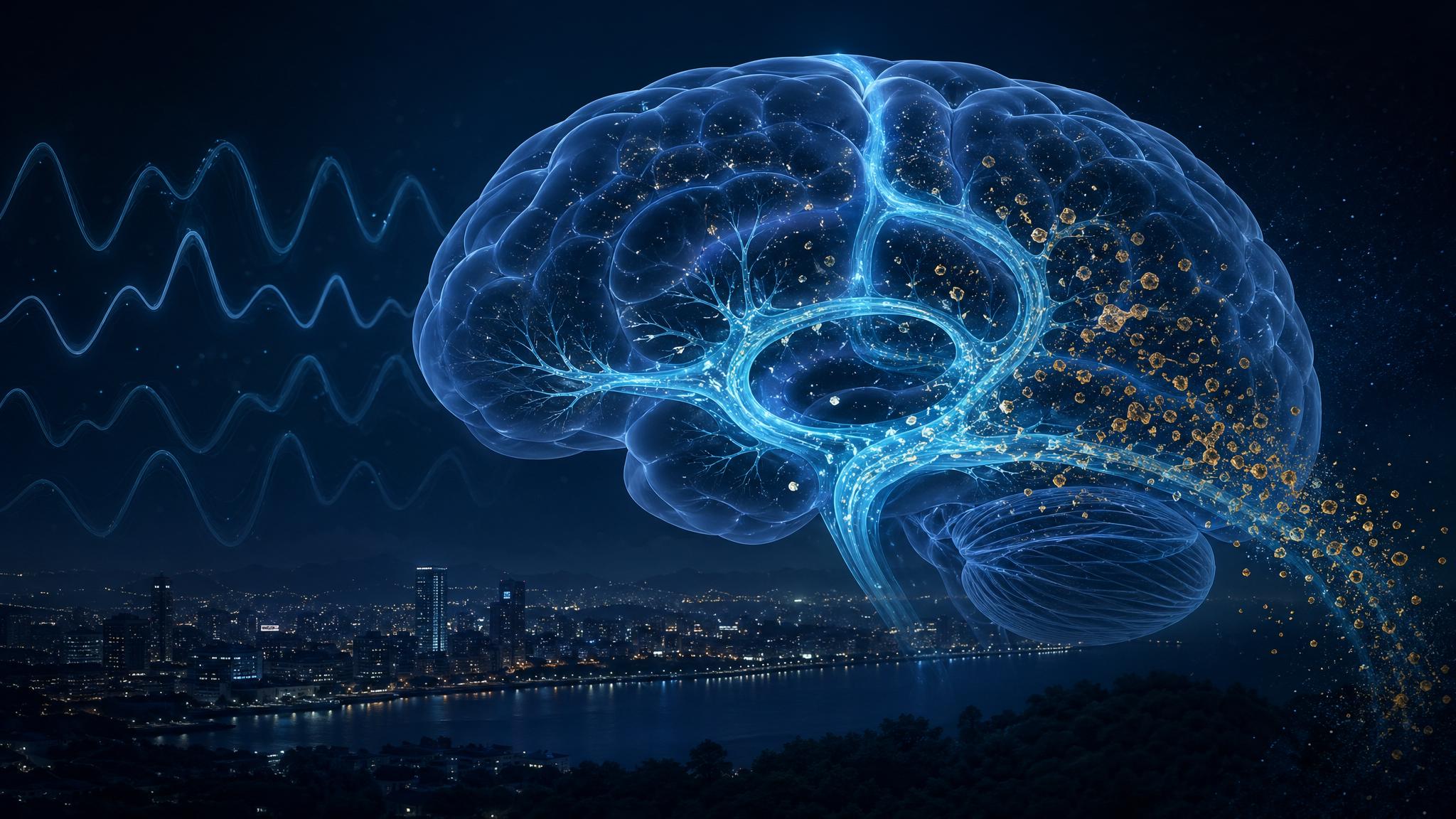
There is a moment each night, about ninety minutes after you fall asleep, when your brain begins to act less like a processing engine and more like a city being hosed down in the quiet hours. Neurons fire in broad, slow waves. Blood flow ebbs. Cerebrospinal fluid pulses into the tissue through channels that are all but closed during waking hours. And by morning, measurable quantities of toxic proteins, including the same amyloid beta and tau species implicated in Alzheimer’s disease, have been washed out.
For most of the twentieth century, sleep was considered a passive state. Something that happened when the brain’s work was done. The research that has emerged over the last decade has collapsed that model. What the 2026 sleep science shows, with growing precision, is that deep non rapid eye movement sleep is a biologically specific cleanup operation. And the machinery behind it, known as the glymphatic system, may be one of the most important variables in long term brain health that almost no patient is actively managing.
Here is what the evidence reveals, and what it means for your nightly routine.
## The Discovery That Changed Sleep Science
The glymphatic system was formally described in 2012 by Maiken Nedergaard and her team at the University of Rochester, writing in Science Translational Medicine. Until that paper, neuroscientists had a problem they rarely discussed. The brain produces metabolic waste at an extraordinary rate, but unlike every other organ in the body, it has no lymphatic drainage that anatomists could clearly see. Where was the garbage going?
Nedergaard’s group showed, using two photon imaging in live mice, that cerebrospinal fluid moves rapidly along the outside of brain arteries, enters the tissue through water channels called aquaporin 4 located on astrocyte endfeet, and flushes out along veins. They named the pathway the glymphatic system, a portmanteau of glia and lymphatic. The flow rate was not trivial. In a follow up 2013 Science paper, the same team reported that the glymphatic space expands by roughly sixty percent during sleep compared to waking, allowing substantially greater clearance of beta amyloid and other neurotoxic metabolites.
The direction of the arrow was startling. Sleep was not incidental to waste clearance. Sleep was the machinery.
## What the Slow Waves Are Actually Doing
The next major advance came in 2019, when Nina Fultz and Laura Lewis at Boston University published a landmark paper in Science demonstrating, for the first time in humans, that slow wave activity during deep sleep directly drives cerebrospinal fluid flow. Using simultaneous functional MRI and electroencephalography, the team recorded subjects sleeping inside the scanner. They found that every large slow wave of neural activity was followed, seconds later, by a corresponding pulse of CSF moving into the fourth ventricle and surrounding tissue. The oscillation was not random. It was a rhythm, a kind of respiratory pulse for the brain.
That paper changed the way researchers talk about sleep quality. It is not enough to sleep for seven or eight hours if the architecture is fragmented. The physiologically meaningful variable is the power and continuity of slow wave activity, which is dominant in stages N2 and N3 of non rapid eye movement sleep and concentrated in the first half of the night. If slow waves are shallow, scattered, or interrupted, CSF flow drops and clearance suffers accordingly.
Subsequent work from Jeffrey Iliff at the University of Washington and Nedergaard’s ongoing program has extended these findings. A 2023 study in Nature Reviews Neurology by Iliff and colleagues summarized the growing human evidence that glymphatic dysfunction correlates with early Alzheimer’s pathology, idiopathic Parkinson’s disease progression, and post concussion cognitive symptoms. In each case, the common denominator is impaired deep sleep.
## One Bad Night Is Measurable
You do not need chronic insomnia to see the effect. A 2018 study in the Proceedings of the National Academy of Sciences by Ehsan Shokri Kojori and Nora Volkow at the National Institute on Alcohol Abuse and Alcoholism used positron emission tomography to measure amyloid beta in the brains of twenty healthy adults. After a single night of sleep deprivation, amyloid beta rose significantly in the right hippocampus and thalamus. These are regions among the earliest to show Alzheimer’s pathology.
A few years earlier, Yo El Ju and colleagues at Washington University in St. Louis had published a companion finding in the journal Brain. Their subjects slept normally, but researchers selectively disrupted slow wave sleep using acoustic cues while preserving total sleep time. The next morning, cerebrospinal fluid amyloid beta was elevated by roughly ten percent in subjects with the most suppressed slow wave activity. The conclusion, put simply, was that fragmented deep sleep and lost deep sleep have similar biochemical consequences.
The tau research followed. A 2020 paper in the Annals of Neurology from Brendan Lucey at Washington University found that subjects with less slow wave activity had higher tau burden in follow up imaging, independent of age and amyloid status. Tau is the protein that forms the neurofibrillary tangles most directly correlated with cognitive decline. More recent work through 2025 has reinforced this pattern across multiple cohorts, including the large observational Mayo Clinic Study of Aging.
## The Dementia Risk Data
The population health signal is now hard to dismiss. In a 2021 paper in Nature Communications, Severine Sabia and colleagues analyzed twenty five years of data from the Whitehall II cohort, nearly eight thousand British civil servants followed from midlife into old age. Participants who consistently slept six hours or less per night at ages fifty, sixty, and seventy showed a thirty percent increased risk of dementia compared to those sleeping seven hours. The effect held after adjusting for cardiovascular risk, mental illness, and socioeconomic status.
Framingham Heart Study data from Pase and colleagues, published in Neurology in 2017, reported similar findings. Short sleepers had nearly double the risk of all cause dementia over a decade of follow up. A 2020 meta analysis in JAMA Neurology pooled results from thirty one studies and more than ninety seven thousand participants and confirmed a U shaped relationship between sleep duration and dementia risk, with both short and excessively long sleep predicting worse outcomes.
None of these studies proves causation in the strict sense. Early dementia can itself disrupt sleep, and the direction of the arrow is not always clean. But the biological plausibility, the mechanistic clarity from the glymphatic work, and the consistency of the epidemiology all point the same way. Slow wave sleep matters for the aging brain in a way we did not appreciate ten years ago.
## Sleep Spindles and the Memory Consolidation Story
Slow wave sleep is not the only phase doing important work. Interleaved within stages N2 and N3 are brief bursts of oscillatory activity called sleep spindles, produced by a thalamocortical feedback loop and lasting about one to two seconds. Matthew Walker’s group at the University of California, Berkeley, has shown across multiple studies that spindles mark the transfer of information from the hippocampus, where short term memories are held, to the neocortex, where they are stored long term.
A 2015 paper in Nature Neuroscience from Walker’s lab demonstrated that older adults with degraded spindles on polysomnography showed correspondingly poorer memory consolidation the next day. The effect tracked linearly with prefrontal cortex atrophy, suggesting that the aging brain loses both the structural capacity to generate spindles and the functional benefit they provide. More recent work through 2024 has connected spindle density to hippocampal volume preservation and to resilience against amyloid accumulation.
Practically, this means that the restorative value of a night of sleep depends on two separate but related architectures. The slow wave machinery flushes metabolic waste. The spindle machinery consolidates what you learned that day. Both decline with age, both are sensitive to lifestyle, and both are invisible to a person checking only whether they got eight hours.
## What Consumer Sleep Trackers Actually See
The rise of wearable sleep tracking has changed what patients know about their own sleep. Oura, Whoop, and Eight Sleep all provide nightly breakdowns of light sleep, deep sleep, and REM, along with derived scores for recovery readiness. Polysomnography, the gold standard, uses electroencephalography to classify stages based on brain waves. Consumer wearables use heart rate, heart rate variability, body temperature, and accelerometer data to infer stages.
A 2024 validation study in Sleep Medicine Reviews compared the Oura Ring Gen 3 to polysomnography in a laboratory cohort and found overall accuracy for wake versus sleep above ninety percent, but staging accuracy for deep sleep in the range of sixty to seventy percent. Whoop’s published internal validations land in similar territory. What this means is that your device gives you a reasonable population level estimate, useful for detecting trends over weeks and months, but any single night of low deep sleep on a wrist or ring should be interpreted with humility.
The signal from trackers is most valuable when it changes. A sustained drop in deep sleep over a month, correlated with alcohol intake, late meals, room temperature, or stress, is meaningful. A single anomalous night is noise. Patients benefit from being coached through this distinction, because the gamification of sleep data can backfire and produce orthosomnia, a pattern in which the anxiety about sleep itself disrupts sleep.
## What Actually Raises Slow Wave Sleep
The interventions that increase deep sleep are, unsurprisingly, the interventions that match the biology. The evidence is strongest for the following.
Vigorous or moderate aerobic exercise in the daytime. A 2021 meta analysis in Sleep Medicine Reviews covering twenty three randomized trials found that regular aerobic exercise increased total slow wave sleep by an average of ten to twenty minutes per night, with effects most pronounced when exercise occurred four or more hours before bedtime. The mechanism involves adenosine accumulation, body temperature dynamics, and growth hormone pulsatility.
A cool ambient temperature in the bedroom. A 2019 paper in Sleep from Eus Van Someren at the Netherlands Institute for Neuroscience demonstrated that bedroom temperatures in the sixty two to sixty eight degree Fahrenheit range, roughly seventeen to twenty Celsius, produced the deepest and most continuous slow wave sleep in healthy adults. Core body temperature needs to drop by about one degree Celsius to initiate and sustain deep sleep, and a cool room makes that easier.
Avoiding alcohol within three hours of bedtime. Alcohol is the single most reliably documented suppressor of slow wave sleep in humans. A 2018 review in Alcoholism: Clinical and Experimental Research analyzed twenty seven studies and concluded that even moderate doses reduce slow wave activity in the first half of the night and cause rebound REM suppression and awakenings in the second half. The net effect on glymphatic clearance is negative even when total sleep time appears normal.
Acoustic stimulation during deep sleep. Research from Giulio Tononi, Chiara Cirelli, and colleagues at the University of Wisconsin has shown that precisely timed auditory pulses can enhance slow wave amplitude in real time. Commercial devices like the Philips SmartSleep headband have operationalized this approach, and early data suggest meaningful memory consolidation benefits in older adults. The 2023 follow up work by Bellesi and colleagues remains the benchmark.
Consistent sleep timing. The 2024 RISE study by Kristen Knutson at Northwestern, published in Sleep Health, found that sleep regularity predicted all cause mortality better than sleep duration in a cohort of eighty eight thousand UK Biobank participants wearing accelerometers. People who went to bed and woke up at consistent times had better glymphatic metrics by proxy and lower mortality, independent of how long they slept.
## The Glymphatic System After Fifty
Age is the single largest risk factor for glymphatic dysfunction. A 2024 paper in Nature Aging from Nedergaard’s group documented a roughly forty percent decline in glymphatic clearance between young adulthood and the seventh decade, driven by changes in aquaporin 4 polarization, reduced arterial pulsatility, and loss of deep sleep. Genetic variants in aquaporin 4 have been linked to Alzheimer’s risk, reinforcing the causal model.
What this means for older patients and those advising them is that the stakes of deep sleep rise as the infrastructure that depends on it decays. A thirty year old whose slow wave sleep is fragmented will generally recover well. A seventy year old with the same fragmentation is losing a clearance pathway that is already running at sixty percent capacity. This is the biological reason that sleep hygiene becomes more, not less, important with age.
## The Mental Health Dimension
Deep sleep is not only about brain clearance. It is also deeply involved in emotional regulation. A 2019 paper in Nature Human Behaviour from Matthew Walker’s group demonstrated that slow wave sleep attenuates amygdala reactivity the following day by as much as sixty percent. Patients with anxiety, post traumatic stress, and depression consistently show reduced slow wave activity on polysomnography, and interventions that restore it tend to improve mood measures in parallel.
This bidirectional relationship between sleep and mood is often underappreciated in primary care. The tendency to treat insomnia as a downstream symptom of depression rather than a parallel and modifiable mechanism misses one of the highest leverage points in behavioral health. The 2021 clinical guidelines from the American Academy of Sleep Medicine now recommend cognitive behavioral therapy for insomnia as first line treatment for chronic insomnia, ahead of any pharmacological approach, based on effect sizes that match or exceed antidepressants for co occurring depression.
## What This Means For Your Practice
For physicians, coaches, and patients who want to translate this science into action, the following protocol is grounded in the evidence above and adjustable to individual circumstances.
Protect the first three hours after sleep onset. This is when slow wave sleep is maximal and glymphatic clearance is highest. Late meals, alcohol, and bedroom temperatures above seventy degrees Fahrenheit all blunt this window. Eating should end at least two hours before bed, alcohol consumption should end three hours before, and the thermostat should be set to sixty five to sixty eight degrees Fahrenheit.
Anchor your sleep schedule. A consistent bedtime within a thirty minute window, seven nights a week, produces better glymphatic function than an extra thirty minutes of sleep on weekends. Regularity beats duration in the population data. Use an alarm not just for waking but for winding down.
Move your body during the day. Any form of sustained aerobic activity for thirty to sixty minutes, ideally in the late morning or early afternoon, reliably increases slow wave sleep that night. For sedentary patients, even brisk walking counts. For athletes, zone two training has particularly strong effects on subsequent sleep architecture.
Treat light as a drug. Bright light in the morning and dim light in the evening sets the circadian rhythm that underlies deep sleep. Fifteen minutes of outdoor light within an hour of waking and a reduction of indoor and screen light to warm low intensity in the two hours before bed is the practical implementation.
Interpret your wearable data as a trend, not a grade. A single night of low deep sleep on your Oura or Whoop is noise. A month of declining deep sleep coinciding with a life change, medication, alcohol habit, or stressor is meaningful. Review your own data like a researcher, not a student.
Consider sleep apnea testing if indicated. Obstructive sleep apnea fragments slow wave activity and is the single most common correctable cause of poor glymphatic function in adults over fifty. A 2024 study in JAMA Neurology found that continuous positive airway pressure treatment in patients with moderate to severe sleep apnea reduced cerebrospinal fluid amyloid levels and slowed cognitive decline over two years. If a bed partner reports snoring, or if daytime sleepiness and hypertension coexist, a home sleep study is almost always the right next step.
Use cognitive behavioral therapy for insomnia rather than hypnotics for chronic sleep complaints. Benzodiazepines and Z drugs suppress slow wave activity as a class and, over time, produce the opposite of glymphatic health. Cognitive behavioral therapy for insomnia preserves architecture and is as effective as medication in most trials.
Track the architecture, not just the duration. If your device separates sleep stages, aim for ninety minutes or more of deep sleep per night as a baseline and monitor whether it rises with the interventions above. This is a coarse marker, not a diagnostic, but it is a practical proxy for a system that is otherwise invisible.
The larger message of the glymphatic research is not that sleep is more complicated than we thought. It is that sleep is more active than we thought. The brain is not resting during deep sleep. It is working, hard, on a problem that cannot be solved any other way. The patients who understand this, who treat the first ninety minutes of the night the way an athlete treats a training session, will be the ones who most benefit from what the science is now telling us.
For more healthcare discovery coverage of sleep, longevity, and the fundamentals of health, visit healthcarediscovery.ai.
Free Daily Briefing
Presented By Our Partners
The Latest Longevity Science. Delivered Every Morning.
Join researchers, physicians, and health professionals getting daily breakthroughs in AI-driven medicine, epigenetics, and longevity research.
Support the research that powers this editorial
No spam. Unsubscribe anytime. We respect your inbox.
Featured Partner
Invest in the Infrastructure Behind Modern Medicine
As healthcare expands beyond hospital walls, the buildings and campuses supporting that shift are generating compelling returns for investors who move early. The Healthcare Real Estate Fund offers qualified investors direct access to a curated portfolio of medical office, outpatient, and specialty care facilities.
A single handheld meter that measures five biomarkers from a fingerstick: blood glucose, blood ketones, uric acid, hemoglobin, and hematocrit, making it the most versatile point-of-care device available to consumers….
Breathing at six breaths per minute activates the vagus nerve, raises heart rate variability, and shifts the autonomic nervous system toward recovery. A growing body of peer-reviewed research shows that…
AI case finding may be one of the most important healthcare delivery use cases of 2026: finding patients who already qualify for proven care but remain invisible to the system.
Revolution Medicines’ daraxonrasib achieved a median overall survival of 13.2 months versus 6.7 months for chemotherapy in previously treated metastatic pancreatic cancer, a 60 percent reduction in the risk of…
Predicting ovulation has been possible at home for decades. Confirming it actually happened is a fundamentally different, and arguably more important, clinical question. Presented By Our Partners Every ovulation predictor…
A 2018 JAMA Network Open study of 122,007 patients found that low cardiorespiratory fitness was a stronger predictor of mortality than smoking, diabetes, or coronary artery disease. Inside the Mandsager,…