
Apple Watch Series 12 Review: Heart, VO2 Max, and Sleep Accuracy
Apple’s newest flagship adds an all-new sensor and a readiness score, but the reasons to buy it rest on heart research that took years to build, and its fitness number carries a margin of error you should understand before you trust it.
Presented By Our Partners


The Apple Watch Series 12, which Apple announced in September 2026 around what it calls an all-new Health Sensing System, descends from one of the largest heart studies ever attempted. In the Apple Heart Study, 419,297 people enrolled over eight months, through nothing more than an iPhone app, to let their watches listen for a hidden rhythm. Most never heard a word. Over a median of 117 days of monitoring, 2,161 participants, about one in 200, were told their pulse looked irregular.
Notified participants were offered a telemedicine visit and mailed an ECG patch. When the analyzable patches came back, atrial fibrillation turned up in about a third of the wearers, and in the moments when patch and watch were recording together, the watch’s warning matched atrial fibrillation 84 percent of the time (New England Journal of Medicine, 2019). Apple paid for the study. It still changed what a wristwatch could be: a sentry that stays silent almost all the time and, when it does speak, is usually right.
Seven years later, the Series 12 asks to be trusted with far more: your rhythm, your fitness, your sleep, and now a warning about blood pressure. This review takes those claims one at a time, because the evidence is wildly uneven. Some features rest on hundreds of patients and a cardiologist’s reference ECG. Others rest on a few dozen volunteers, or on nothing independent at all.
The short answer: The Apple Watch Series 12 is Apple’s September 2026 flagship smartwatch and the newest model in one of the best-studied consumer watch lines for catching atrial fibrillation, now with FDA-cleared hypertension alerts and a readiness score. For iPhone users it is a strong heart screener. Treat VO2 max and sleep stages as trends: earlier models erred by 13 to 16 percent and over 40 minutes of deep sleep.
- Best for: iPhone users, especially those with cardiovascular risk factors, who want passive rhythm and blood pressure screening plus trend tracking for fitness and sleep.
- Not for: Android users, anyone who needs a diagnosis rather than a screen, or athletes who need lab-grade VO2 max numbers.
- Price (October 2026): from $399 at launch; sale prices as low as $349.99 have since appeared.
- Regulatory status: FDA-cleared Apple Watch features include the ECG app and irregular rhythm notifications (2018), sleep apnea notifications (2024), and hypertension notifications (510(k) K250507, 2025, confirmed for the Series 12); VO2 max, sleep stages, and the readiness score are not FDA cleared.
- Evidence: Strong for atrial fibrillation detection; moderate for sleep duration; limited for VO2 max and sleep stages at the individual level; emerging for hypertension alerts and the new readiness score.
What is the Apple Watch Series 12?
The Apple Watch Series 12 is a smartwatch made by Apple, announced in September 2026, that tracks heart rhythm, heart rate variability (HRV), estimated cardio fitness (VO2 max), and sleep. Its headline additions are a redesigned sensor array Apple calls the Health Sensing System and a daily readiness score. It is built for iPhone users.
The Series 12 succeeds the Series 11 as Apple’s flagship; our earlier reviews covered the Series 9. Launch coverage described a new heart rate sensor and reported that the redesigned sensing system is what enables two new capabilities: a readiness score, which tells you how prepared your body is for strain on a given day, and more frequent HRV readings. Apple paired it with a redesigned Health app that uses Apple Intelligence and added ceramic case options.
The more important story sits beneath the new hardware. Over eight years, Apple has stacked a series of FDA-reviewed heart features onto its watches. The ECG app and irregular rhythm notifications arrived together: the FDA cleared them in September 2018, and Apple switched them on that December. Sleep apnea notifications, which rely on the watch’s accelerometer rather than its heart sensors, were cleared by the FDA in 2024, ahead of the Series 10’s release. Hypertension notifications were cleared through a 510(k) premarket notification (K250507) in September 2025 and extended to the Series 9, Series 10, and Ultra 2 as well as newer models.
Hypertension notifications are confirmed for the Series 12: Apple delayed the feature on the Series 12 in India while it awaited local clearances, and the feature reached seven more countries, including Australia and Brazil, in January 2026. The launch coverage we could verify focused on the new sensor and readiness score, so for the ECG app, irregular rhythm notifications, and sleep apnea notifications, which Apple offered on earlier flagships, confirm Series 12 support for your region on Apple’s specification page before you buy. Availability of medical features varies by country.
How does the Apple Watch Series 12 work?
Apple’s watches read your body three ways. Optical sensors on the back shine light into the wrist and track each pulse of blood, which feeds heart rate, irregular rhythm alerts, HRV, and fitness estimates. On models with the ECG app, built-in electrodes record a single-lead ECG on demand. An accelerometer tracks motion, including the movements that reveal sleep and disrupted breathing.
Start with the optical signal, because it does most of the work. Every heartbeat launches a pressure wave down your arteries. At the wrist, each wave swells the smallest vessels with a fresh pulse of blood, and blood absorbs light. A sensor that shines light into the skin and measures what comes back sees the wrist brighten and dim in time with the heart. This technique, photoplethysmography, never touches the heart’s electricity. It reads the heart’s echo in the plumbing.
From that echo, the watch can time the gap between beats. In a healthy heart those gaps vary gently with breathing; that variation is HRV, a window onto the vagus nerve’s grip on the heart. In atrial fibrillation, the upper chambers quiver instead of contracting, and the intervals between beats become chaotic, what cardiologists call “irregularly irregular.” Apple’s irregular rhythm feature looks for exactly that disorder in a series of pulse intervals, which the Apple Heart Study called a tachogram. It is tuned to speak rarely: in that study, only about one in 200 people was ever notified.
The ECG is a different instrument. When you start a reading, the watch’s electrodes and a finger from your other hand complete a circuit across your chest, producing a tracing that researchers compare with lead I of a standard 12-lead ECG, the view from one arm to the other. It is a single camera angle on the heart’s electrical wavefront: enough to see whether the rhythm is regular and whether the small P wave of an organized atrial beat is present, but not enough to diagnose a heart attack or map the heart’s structure.
The fitness and sleep numbers are inferences, not measurements. A laboratory VO2 max test measures the oxygen you actually consume while a treadmill or bike pushes you to exhaustion. The watch estimates it instead, from heart rate and motion data gathered during outdoor workouts such as runs. Sleep stages are similar. A sleep lab defines stages from brain waves, eye movements, and muscle tone; a wristwatch can only infer them from movement and heart rhythm. Picture judging the plot of a play by listening through the wall. You can tell when the actors are moving and when the theater goes quiet, but the dialogue is guesswork.
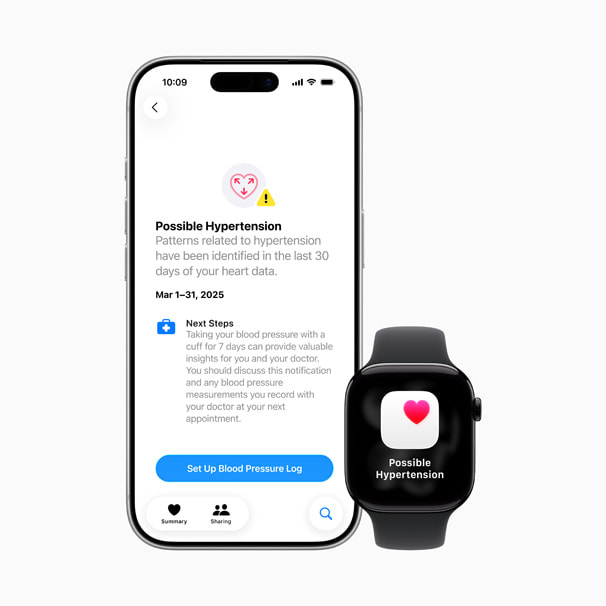
Hypertension notifications work differently from a blood pressure monitor. Rather than producing a number, the feature runs passively in the background over a 30-day window and notifies you if your data suggest possible hypertension. Confirmation still takes a blood pressure cuff.
How accurate is the Apple Watch Series 12? What the research shows
No peer-reviewed study has yet tested the Series 12 itself; it launched only weeks ago. Research on earlier Apple Watch models shows rhythm alerts and ECG readings are highly accurate when a reading is conclusive, sleep duration is close to the lab, and deep sleep and VO2 max carry large individual errors. Hypertension alerts miss many cases.
Rhythm alerts at population scale. The Apple Heart Study remains the anchor. Among 419,297 participants, 0.52 percent received an irregular pulse notification. Of 450 notified participants who returned analyzable ECG patches, applied on average 13 days after the alert, 34 percent had atrial fibrillation on the patch, and 35 percent of those 65 and older. When a later notification arrived while the patch was recording, it was concordant with atrial fibrillation 84 percent of the time. The study was funded by Apple, and several authors were Apple employees. The design also has a built-in blind spot: atrial fibrillation that comes and goes may simply have been absent during the patch’s week of wear, so 34 percent understates how often the watch was right and says nothing about the episodes it missed.
The ECG in the clinic. Independent hospital studies have tested the single-lead tracing against a 12-lead reference. At Amsterdam UMC, 74 patients scheduled for cardioversion recorded Apple Watch ECGs before and after the procedure; the first recording identified atrial fibrillation with 93.5 percent sensitivity and 100 percent specificity, but 27.9 percent of recordings were unclassified until a physician reviewed them (Cardiovascular Digital Health Journal, 2022). In the BASEL Wearable Study of 201 cardiology patients, the Apple Watch 6 had 85 percent sensitivity and 75 percent specificity once inconclusive tracings were counted against it, with 18 percent of tracings inconclusive, a figure comparable to Samsung’s watch and better than the Withings, Fitbit, and AliveCor devices tested (JACC: Clinical Electrophysiology, 2023). A Dutch study of 220 cardioversion patients found that the automated algorithms of all three devices tested had 91 to 99 percent sensitivity and specificity, but 20 to 24 percent of recordings were uninterpretable, and cardiologists reading a six-lead KardiaMobile tracing outperformed both single-lead watches, with 99 percent sensitivity and 97 percent specificity (American Heart Journal, 2022).
Why so many inconclusive readings? In a 2025 Basel study of 256 patients and 1,280 single-lead ECGs, 19 percent were labeled inconclusive by at least one device; a paced rhythm raised the odds more than sixfold (odds ratio 6.35) and a major recording artifact more than tenfold (JACC: Clinical Electrophysiology, 2025). The watch is least conclusive in hearts that already carry a history.
Featured Partner
Invest in the Infrastructure Behind Modern Medicine
As healthcare expands beyond hospital walls, the buildings and campuses supporting that shift are generating compelling returns for investors who move early. The Healthcare Real Estate Fund offers qualified investors direct access to a curated portfolio of medical office, outpatient, and specialty care facilities.
Learn More →
VO2 max: right on average, wrong for many individuals. In a 2024 validation of the Apple Watch Series 7 in 19 adults, laboratory-measured VO2 max averaged 45.88 mL/kg/min while the watch estimated 41.37, a mean absolute percentage error of 15.79 percent and an intraclass correlation of 0.47, which the authors classed as poor reliability; like other watches, it tended to overestimate fitness in unfit people and underestimate it in very fit ones (JMIR Biomedical Engineering, 2024). A 2026 study of the Series 10 in 40 healthy adults was similar: the watch underestimated VO2 max by an average of 6.25 mL/kg/min, with a mean absolute percentage error of 13.2 percent and limits of agreement stretching from 18.23 below to 5.73 above the true value. It placed only 14 percent of participants in their correct fitness percentile band, and another 34 percent one band away (Mayo Clinic Proceedings: Digital Health, 2026). The authors judged individual agreement poor but saw value for population-level research.
The wider literature agrees. A 2022 meta-analysis of 14 validation studies by the INTERLIVE network found that wearables using exercise data to estimate VO2 max had almost no average bias (minus 0.09 mL/kg/min) but individual limits of agreement of roughly plus or minus 10 mL/kg/min (Sports Medicine, 2022). A 2024 living umbrella review covering 249 validation studies found wearables misjudged VO2 max by about 15 percent in resting tests and about 10 percent in exercise tests (Sports Medicine, 2024).
Sleep: duration yes, stages less so. At Brigham and Women’s Hospital, 35 healthy adults wore an Apple Watch Series 8, an Oura Ring Gen3, and a Fitbit Sense 2 during an overnight polysomnography study. All three detected sleep versus wake with at least 95 percent sensitivity and estimated total sleep time close to the lab. But the Apple Watch underestimated deep sleep by 43 minutes and overestimated light sleep by 45 minutes (Sensors, 2024). In an Australian study of 53 adults, an Apple Watch Series 6 agreed with polysomnography 88 percent of the time on sleep versus wake, but only 53 percent of the time when classifying specific stages, and the authors concluded that all six devices tested needed improvement for staging (Sensors, 2022). Our editorial on why the sleep score is not sleep explores what those errors mean in practice.
Sleep apnea and hypertension: cleared, but thinly published. We found no peer-reviewed validation of Apple’s sleep apnea notifications in PubMed; the evidence lives in Apple’s FDA submission. A useful benchmark comes from a rival: in a 2026 Stanford study of 152 adults, a Samsung Galaxy Watch detected moderate to severe obstructive sleep apnea with 94.1 percent sensitivity but 66.7 percent specificity at its default threshold (Journal of Clinical Sleep Medicine, 2026). For hypertension, Apple published a validation paper in September 2025, and the FDA cleared the feature through 510(k) K250507. Independent coverage of those results has focused on one point, summed up in one clinical news headline: smartwatch hypertension alerts “show promise but miss many cases.”
What the Apple Watch Series 12 gets right
The Series 12 gets the hardest thing in screening right: it stays quiet. Its rhythm alerts fire rarely and are usually right, its ECG tracings were rated highest by patients and clinicians in head-to-head comparisons, its heart rate is accurate, and it puts the strongest known predictor of mortality on your wrist as a trend line.
Specificity first. A screening tool that cries wolf trains people to ignore it. A notification rate of about one in 200, with 84 percent concordance when an alert fired during ECG monitoring, is the profile you want from a device worn by millions of healthy people.
An ECG people will actually record. In the BASEL study, the Apple Watch ranked first in patient acceptance among five devices, chosen by 39 percent of participants. When 450 cardiologists, residents, and medical students interpreted 10,865 single-lead tracings from five devices, Apple Watch tracings were rated best for quality by 45 percent and best for readability by 50 percent, although diagnostic accuracy did not differ significantly between devices (Swiss Medical Weekly, 2023). A tracing that a clinician can read quickly is worth more than a perfect one that never gets recorded.
Heart rate you can trust. In a Turkish emergency department study of 721 patients, Apple Watch heart rate differed from a standard ECG by an average of 0.81 beats per minute, with strong agreement in 94 percent of measurements (American Journal of Emergency Medicine, 2024).
Fitness as a trend. Cardio fitness may be the single most consequential number the watch reports. In a Cleveland Clinic study of 122,007 patients who took treadmill tests, the least fit quarter had five times the risk-adjusted mortality of elite performers (hazard ratio 5.04), and being below average versus above average carried a risk (hazard ratio 1.41) comparable to smoking (1.41) or diabetes (1.40), with no upper limit of benefit observed (JAMA Network Open, 2018). A 2009 JAMA meta-analysis of 33 studies found that each 1-MET increase in fitness, about 1 km/h faster running pace, was associated with 13 percent lower all-cause mortality. The watch cannot pin your VO2 max to the decimal. It can tell you, week by week, whether you are moving in the right direction.
Where the Apple Watch Series 12 falls short
The Series 12’s weaknesses are inconclusive ECGs in the hearts that most need clarity, VO2 max and deep-sleep estimates too imprecise for individual decisions, a hypertension alert that can stay silent when blood pressure is high, and new features with no independent evidence yet.
Inconclusive readings. Across the clinical studies, between 18 and 28 percent of single-lead recordings came back inconclusive or unclassified. If you have a pacemaker, a conduction delay, or frequent extra beats, expect more of them.
Your VO2 max is a range, not a number. With limits of agreement spanning more than 20 mL/kg/min in the Series 10 study, a reading of 40 could reflect true fitness well above that, or somewhat below it. Use the trend, never a single reading.
Deep sleep is the weakest stage. An underestimate of 43 minutes of deep sleep in healthy adults is large enough to drive real worry about sleep that may be perfectly normal. Stage breakdowns are best treated as curiosities.
Silence is not a clean bill of health. A hypertension feature that misses many cases cannot be used to rule high blood pressure out. A 2026 scientific statement on cuffless blood pressure technology in the European Journal of Preventive Cardiology concluded that, because accuracy validation remains insufficient, such devices should not yet drive clinical decisions, in line with international guidelines. Measure with a validated cuff at home or at your clinic, whatever your watch says.
New hardware, old evidence. The studies in this review tested earlier models, mostly the Series 5 through Series 10. The Series 12’s redesigned sensing system may perform better, or simply differently; until independent studies test it, its accuracy is assumed, not demonstrated. The same goes for the readiness score and higher-frequency HRV.
Alerts create care. In the Apple Heart Study, 57 percent of notified participants who answered a 90-day survey contacted a health care provider outside the study. That is the point of screening, but it also means visits and tests over findings whose significance is still debated.
Apple Watch Series 12 vs Oura Ring 5 vs WHOOP MG vs KardiaMobile 6L
The Series 12 is the broadest heart-screening package of the four. Oura Ring 5 is the subtler sleep and recovery tracker, WHOOP MG adds on-demand ECG and blood pressure tracking to a training band, and the KardiaMobile 6L records the most detailed on-demand ECG, with no passive monitoring at all.
| Feature | Apple Watch Series 12 | Oura Ring 5 | WHOOP MG | AliveCor KardiaMobile 6L |
|---|---|---|---|---|
| Form | Smartwatch | Smart ring | Wrist band | Six-lead personal ECG recorder |
| On-demand ECG | Apple’s single-lead ECG app (confirm on Apple’s spec page) | None in the launch coverage we found | Yes, on demand | Six leads |
| Passive rhythm alerts | Apple’s FDA-cleared irregular rhythm notifications | Not verified for this review | Not verified for this review | No; records on demand |
| Blood pressure feature | Hypertension notifications (FDA cleared, 2025) | Blood pressure insights (added with Ring 5) | Blood pressure tracking | None |
| Price (October 2026) | From $399 at launch | From $399, plus membership | Three subscription tiers | Not verified for this review |
| Best for | All-round heart screening for iPhone users | Sleep and recovery without a screen | Training and recovery coaching | Detailed ECG strips to share with a cardiologist |
If sleep and recovery matter more than rhythm screening, our Oura Ring 5 review covers the ring’s blood pressure signals and pricing. For strain and recovery coaching with an ECG, read our WHOOP 5.0 and MG review. If you already know you have an arrhythmia and want the clearest possible tracing at home, the six-lead device in our AliveCor KardiaMobile 6L review outperformed single-lead watches in cardiologists’ hands. For every heart device we cover, browse our cardiology device reviews.
How much does the Apple Watch Series 12 cost, and is it covered or HSA/FSA eligible?
As of October 2026, the Apple Watch Series 12 started at $399 at launch, and retailers have since offered it for as little as $349.99. MacRumors reported that the larger 46mm model quietly received a price increase. Insurance does not cover it as far as we found, and HSA or FSA eligibility is not confirmed.
Plan to pay out of pocket, and compare total cost, not sticker price. The Oura Ring 5 also starts at $399 but its membership adds to the real cost, and WHOOP launched its current hardware with three subscription tiers. Check with your HSA or FSA administrator before assuming the watch qualifies; we found no confirmation that it does as a standard purchase.
A watch does not substitute for the tests it can prompt. After an irregular rhythm notification, the usual next step is a clinician-ordered ambulatory monitor such as the Zio patch; after a sleep apnea notification, a sleep study. The watch’s value is in deciding when those tests are worth ordering.
Who should buy the Apple Watch Series 12, and who should skip it?
The Series 12 suits iPhone users who want passive rhythm and blood pressure screening and honest trend lines for fitness and sleep. It is a poor fit for Android users, for anyone who needs a diagnosis rather than a screen, and for most owners of a Series 9 or later who mainly want the hypertension feature.
Good candidates:
- Adults with risk factors for atrial fibrillation, such as high blood pressure, older age, or sleep apnea, who want a silent sentry.
- People who want to track cardio fitness as a long-term trend and train to move it.
- Anyone who wants a quick, shareable ECG strip when palpitations strike (confirm ECG app support for your region).
- Owners of a Series 8 or older, which were not among the models Apple named when it extended hypertension notifications to the Series 9 and later.
Better served by something else:
- Chest pain or pressure, fainting, or a racing heart with shortness of breath: that is an emergency. Call 911; do not wait for a watch.
- Series 9, Series 10, and Ultra 2 owners who mainly want hypertension alerts: Apple extended the feature to those watches.
- People with diagnosed arrhythmias who need detail: a six-lead recorder or a clinician-ordered monitor gives more.
- Anyone who wants a blood pressure number: use a validated cuff.
If a notification sends you looking for a cardiologist, electrophysiologist, or sleep physician, the Healthcare Discovery doctor directory lists clinicians by state and specialty.
What this means for you
The Series 12 is most valuable as an early-warning system for the Silent Assassin, cardiovascular disease, which often does its work without symptoms. Atrial fibrillation lets blood pool in a quivering chamber and can announce itself first as a stroke. High blood pressure stiffens arteries for years before anything hurts. A watch that notices either, even imperfectly, can move a diagnosis years earlier. Sleep apnea, which a 2026 Journal of Clinical Sleep Medicine paper describes as associated with long-term cardiovascular and neurocognitive disease, links the same story to the Mind Thief. The full map lives in our guide to the Four Villains of Health and Longevity.
But the watch is a measuring tape, not a medicine. The most powerful number it shows you, cardio fitness, is also the one you control most directly, through the Movement pillar. Regular aerobic training raises VO2 max, and the Cleveland Clinic data suggest the benefit has no ceiling. Use the watch’s estimate the way a sailor uses a compass rather than a GPS: not for your exact position, but to make sure you are heading the right way.
For the Sleep pillar, trust the watch on when you slept and for how long, and use that to keep a steady schedule; ignore the nightly stage breakdown. For Mindset, a calm ECG strip during a scary flutter can turn hours of worry into a conversation with your doctor.
The Apple Heart Study proved that a watch could stay silent for hundreds of thousands of people and speak up for the few who needed it. The Series 12 extends that bargain to blood pressure, sleep, and fitness, with evidence that ranges from strong to almost nonexistent. Buy it for the rhythm alerts and the trend lines. Keep a blood pressure cuff in the drawer, and keep your expectations calibrated to the studies, not the keynote.
Frequently asked questions
Is the Apple Watch Series 12 worth it for heart health?
For iPhone users who want passive screening, yes. Apple Watch rhythm alerts were concordant with atrial fibrillation 84 percent of the time in the 419,297-person Apple Heart Study, and the Series 12 carries Apple’s FDA-cleared hypertension notifications. Its VO2 max and sleep-stage estimates are less precise, so use them as trends. If you own a Series 9 or later and mainly want hypertension alerts, your current watch already supports them.
How accurate is the Apple Watch VO2 max estimate?
Accurate on average but imprecise for individuals. A 2026 study of the Series 10 found it underestimated VO2 max by about 6 mL/kg/min, with a 13.2 percent average error, and placed only 14 percent of people in their correct fitness percentile band. A Series 7 study found a 15.8 percent error. No study has tested the Series 12 yet. Track the trend over weeks rather than trusting any single reading.
Can the Apple Watch Series 12 measure blood pressure?
No. It offers FDA-cleared hypertension notifications, which work passively in the background over 30 days and alert you to possible hypertension, but it does not give a blood pressure reading. Independent coverage of Apple’s validation data notes the alerts miss many cases, so no alert does not mean normal blood pressure. Confirm with a validated cuff and talk with your clinician about any notification.
Does the Apple Watch detect atrial fibrillation accurately?
Yes, when it gives a clear answer. In hospital studies, Apple Watch ECGs identified atrial fibrillation with 85 to 95 percent sensitivity and 75 to 100 percent specificity against a 12-lead ECG, depending on how inconclusive readings were counted. The catch is that 18 to 28 percent of recordings came back inconclusive, more often in people with pacemakers, conduction delays, or frequent extra beats.
Is Apple Watch sleep tracking accurate?
For sleep timing and duration, it is close to a sleep lab: an Apple Watch Series 8 detected sleep versus wake with at least 95 percent sensitivity against polysomnography. For sleep stages, it is weaker. The same study found it underestimated deep sleep by 43 minutes and overestimated light sleep by 45 minutes, and a Series 6 study found only 53 percent agreement on stages.
Should I upgrade from an Apple Watch Series 9 to the Series 12?
Probably not for heart features alone. Apple extended hypertension notifications to the Series 9, Series 10, and Ultra 2, so a Series 9 already covers the newest FDA-cleared alert. The Series 12 adds a redesigned Health Sensing System, a readiness score, and more frequent HRV readings, none of which has independent validation yet. Upgrade if you want those features or new hardware; not because your heart screening is outdated.
Sources
- Perez MV, et al. Large-scale assessment of a smartwatch to identify atrial fibrillation (Apple Heart Study). New England Journal of Medicine, 2019. DOI
- Pepplinkhuizen S, et al. Accuracy and clinical relevance of the single-lead Apple Watch electrocardiogram to identify atrial fibrillation. Cardiovascular Digital Health Journal, 2022. DOI
- Mannhart D, et al. Clinical validation of 5 direct-to-consumer wearable smart devices to detect atrial fibrillation: BASEL Wearable Study. JACC: Clinical Electrophysiology, 2023. DOI
- Scholten J, et al. Six-lead device superior to single-lead smartwatch ECG in atrial fibrillation detection. American Heart Journal, 2022. DOI
- Isenegger C, et al. Inconclusive single-lead ECGs from smart devices: impact of baseline ECG anomalies. JACC: Clinical Electrophysiology, 2025. DOI
- Weidlich S, et al. Accuracy in detecting atrial fibrillation in single-lead ECGs: an online survey comparing the influence of clinical expertise and smart devices. Swiss Medical Weekly, 2023. DOI
- Paslı S, et al. Diagnostic accuracy of Apple Watch ECG outputs in identifying dysrhythmias: a comparison with 12-lead ECG in emergency department. American Journal of Emergency Medicine, 2024. DOI
- Caserman P, et al. Assessing the accuracy of smartwatch-based estimation of maximum oxygen uptake using the Apple Watch Series 7: validation study. JMIR Biomedical Engineering, 2024. DOI
- Lambe R, et al. Accuracy of VO2max estimates from Apple Watch Series 10. Mayo Clinic Proceedings: Digital Health, 2026. DOI
- Molina-Garcia P, et al. Validity of estimating the maximal oxygen consumption by consumer wearables: a systematic review with meta-analysis and expert statement of the INTERLIVE network. Sports Medicine, 2022. DOI
- Doherty C, et al. Keeping pace with wearables: a living umbrella review of systematic reviews evaluating the accuracy of consumer wearable technologies in health measurement. Sports Medicine, 2024. DOI
- Mandsager K, et al. Association of cardiorespiratory fitness with long-term mortality among adults undergoing exercise treadmill testing. JAMA Network Open, 2018. DOI
- Kodama S, et al. Cardiorespiratory fitness as a quantitative predictor of all-cause mortality and cardiovascular events in healthy men and women: a meta-analysis. JAMA, 2009. DOI
- Robbins R, et al. Accuracy of three commercial wearable devices for sleep tracking in healthy adults. Sensors, 2024. DOI
- Miller DJ, Sargent C, Roach GD. A validation of six wearable devices for estimating sleep, heart rate and heart rate variability in healthy adults. Sensors, 2022. DOI
- Alavi A, et al. Smartwatch-based detection of moderate-to-severe and high-risk obstructive sleep apnea. Journal of Clinical Sleep Medicine, 2026. DOI
- Parati G, et al. Cuffless blood pressure monitoring devices: technical foundations and clinical implications. European Journal of Preventive Cardiology, 2026. DOI
- Apple. Hypertension Notifications validation paper, September 2025. Apple
- U.S. Food and Drug Administration. 510(k) premarket notification K250507, Hypertension Notification Feature. FDA database
- Apple. ECG app and irregular heart rhythm notification available today on Apple Watch (newsroom), December 2018. Apple Newsroom
- Apple. Introducing Apple Watch Series 12, with the all-new Health Sensing System (newsroom), September 2026. Apple Newsroom
- Apple Support. Hypertension notifications on your Apple Watch. Apple Support
- Apple Support. Sleep apnea notifications on your Apple Watch. Apple Support
Apple Watch Series 12 at a glance
- Hardware price
- $399
- First year total
- $399
- Form factor
- Smartwatch (wrist)
- FDA status
- Has FDA clearance
Pricing verified October 20, 2026. Maintained in the Healthcare Discovery device database and updated automatically.


Similar Posts

Your Immune System Is Aging Because Your Mitochondria Are Failing: How Mitophagy Activation Is Reversing Immune Decline in Clinical Trials
A landmark clinical trial published in Nature Aging shows that urolithin A, a natural mitophagy activator, rejuvenated immune cell populations in middle-aged adults in just 28 days. The MitoImmune trial…
What Continuous Glucose Monitors Are Revealing About Metabolic Health in People Without Diabetes
New research from three landmark 2026 studies reveals that continuous glucose monitors can detect hidden metabolic dysfunction, predict cardiovascular risk, and personalize nutrition in people without diabetes. The science is…

The Cash-Pay GLP-1 Trap: What to Check Before the Price Looks Cheap
A source-backed framework for comparing cash-pay GLP-1 offers: medication identity, total cost, clinical accountability, pharmacy verification, dose changes, cancellation, and continuity.

Fit at 18, Protected at 65: A Landmark Circulation Study Rewrites What We Know About Exercise and Heart Risk
A nationwide Swedish cohort tracked 1.1 million men from their teens into their 60s. The message to every runner, cyclist, and gym-goer who worried about their heart: the decades-long scare…

The Omega 3 Index: What 20 Years of Research Reveal About the Blood Marker Modern Medicine Still Underuses
A 2004 Harris and von Schacky proposal in Preventive Medicine turned omega 3 status into a measurable, modifiable blood marker. Two decades of cohort and trial evidence, from VITAL to…

Naked Labs 3D Body Scanner: Full-Body 3D Scanning and Visual Body Composition at Home
A number on a scale cannot show you where your body is changing. A 3D scan can show you exactly where you are gaining muscle and losing fat, down to…
