
The Glymphatic System: How Your Brain Clears Alzheimer’s Proteins During Sleep, and Why 2026 Is a Watershed Year
For most of medical history, the brain looked like a closed system. Every other organ had a lymphatic network to ferry away cellular debris, but the brain was thought to manage its own waste in some elegant, locally contained way. That picture turned out to be wrong.
Presented By Our Partners



In 2012, a team led by Maiken Nedergaard at the University of Rochester discovered an entirely new anatomical system, the glymphatic network, that flushes the brain with cerebrospinal fluid and clears away the proteins, metabolites, and broken machinery that build up during the working day. By 2026, that system has moved from a curiosity in the back pages of neuroscience journals to one of the most consequential frontiers in dementia research. A new Nature Communications study, published this year, has delivered something the field has been waiting more than a decade for: direct human evidence that the glymphatic system clears amyloid beta and tau out of the brain during sleep, with measurable changes in plasma biomarkers the next morning.
This is the story of the brain’s plumbing, why it falters with age, what the latest evidence says about why poor sleep is a dementia risk factor and not just a correlate of one, and what you can actually do about it.
What the Glymphatic System Is
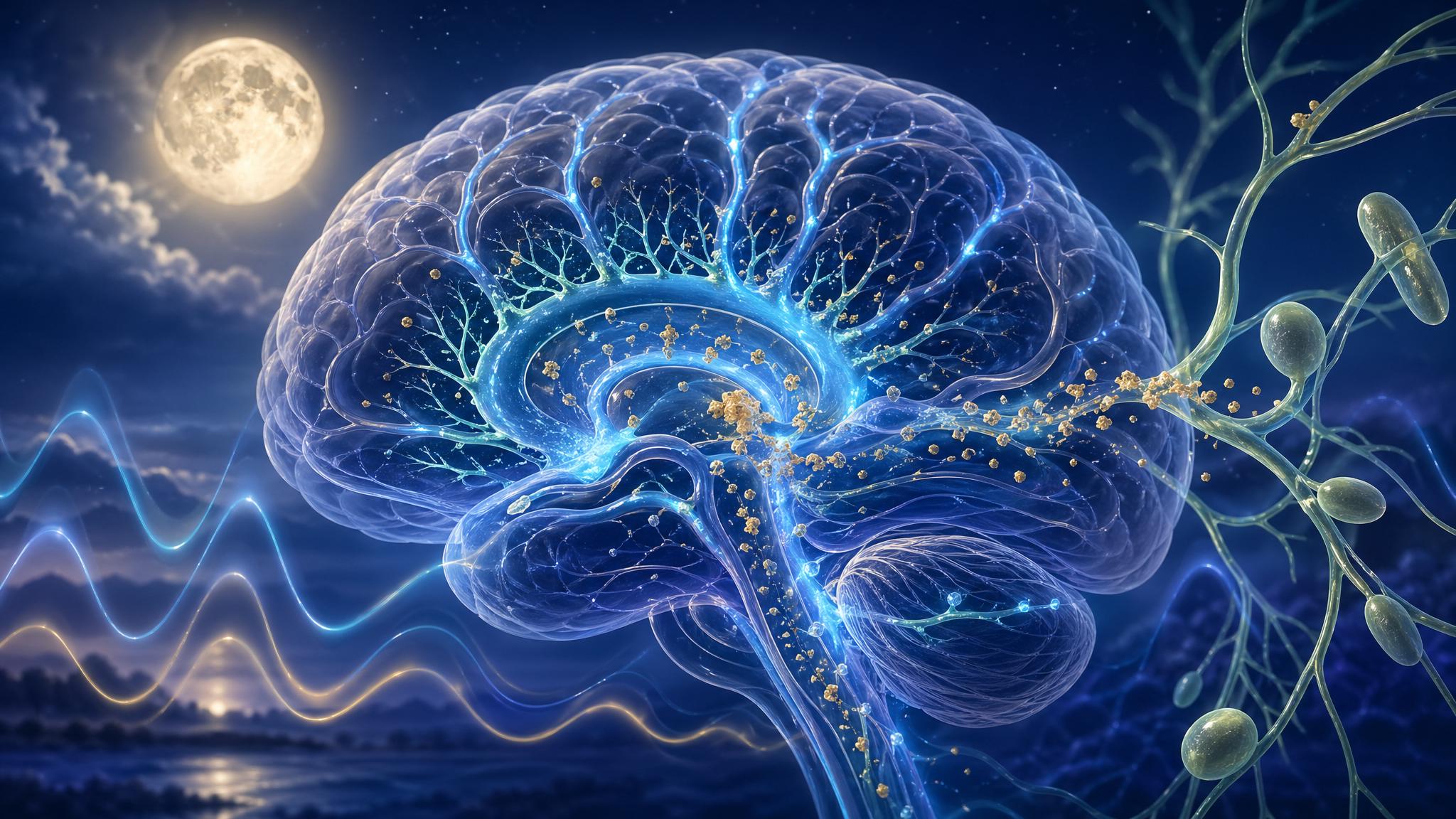
The glymphatic system is a brain-wide fluid transport network. Cerebrospinal fluid enters the brain along the outside of arteries, through perivascular spaces that act like channels around the blood vessels. It then crosses into the interstitial space between neurons through specialized water channels called aquaporin-4, or AQP4, which sit on the endfeet of astrocytes wrapped around the vasculature. Once inside, the fluid mixes with the interstitial fluid bathing every cell, picks up waste products, and exits along perivenous spaces, eventually draining into cervical lymphatic vessels in the neck.
Researchers gave it the name glymphatic to capture two things at once. The system is functionally analogous to the body’s lymphatic system, but it is built almost entirely out of glia, the support cells of the brain. Astrocytes are the engine.
The signature observation, reported by Nedergaard’s group in Science Translational Medicine and elaborated in subsequent work in Cell and other top-tier journals, is that the system is profoundly sleep-dependent. During natural sleep, the interstitial space expands by roughly 60 percent, allowing cerebrospinal fluid to wash through the parenchyma far more efficiently than during waking hours. The brain literally opens up at night to be cleaned.
The 2026 Human Evidence
The strongest skepticism about the glymphatic story has always been the same. Most of the foundational data came from rodents. Mice are convenient, but mouse brains are tiny, mouse vasculature is simpler, and what works in a 25 gram animal does not always scale to a 1.4 kilogram human organ. Until very recently, the human evidence was indirect: imaging studies showing perivascular flow on MRI, post-mortem associations between glymphatic markers and dementia, and a handful of CSF studies showing that a single night of sleep deprivation raised amyloid beta levels.
The 2026 paper in Nature Communications, "The glymphatic system clears amyloid beta and tau from brain to plasma in humans," changes that. Investigators ran a randomized crossover trial in 39 healthy adults comparing one night of normal sleep against one night of total sleep deprivation. They then measured plasma concentrations of amyloid beta 42, amyloid beta 40, and several phosphorylated tau species in the morning. The result was clean. After normal sleep, morning plasma levels of these AD biomarkers were significantly higher than after sleep deprivation, consistent with overnight clearance from brain to bloodstream. The interpretation, supported by mathematical modeling and parallel CSF measurements, is that sleep-active glymphatic clearance is doing exactly what the rodent experiments predicted, in adult humans, on a one-night timescale.
Translation: when you sleep well, your brain is shoving Alzheimer’s proteins out the door. When you do not, those proteins linger.
What Drives the Pump
Understanding why sleep matters so much for clearance has come into sharper focus in the last 18 months. A 2025 paper in Cell from a Copenhagen and Boston collaboration, "Norepinephrine-mediated slow vasomotion drives glymphatic clearance during sleep," resolved one of the central mechanistic puzzles. The team showed that during NREM sleep, norepinephrine release from the locus coeruleus oscillates in slow, synchronized waves. Those waves drive corresponding oscillations in arterial blood volume, which in turn pump cerebrospinal fluid into the brain along perivascular spaces.
Vasomotion, in other words, is the engine of glymphatic flow. Slow wave sleep is when vasomotion is at its most coherent and most powerful. The deeper and more synchronous your slow waves, the better your overnight rinse cycle.
This explains a long-standing observation that has haunted the dementia literature. As people age, slow wave sleep declines steeply. By age 70, the average adult is producing roughly half the slow wave activity of a 25 year old. That decline is associated with rising amyloid burden in PET imaging, faster hippocampal atrophy, and worse memory consolidation. The glymphatic story ties those threads together. Less slow wave activity means less coherent vasomotion, which means less efficient CSF flushing, which means slower clearance of the very proteins that, given enough time, aggregate into the plaques and tangles of Alzheimer’s disease.
A 2017 paper from Yo-El Ju at Washington University remains a touchstone here. Using transcranial acoustic stimulation to selectively disrupt slow waves without changing total sleep time, the team showed that one night of slow wave disruption was enough to raise CSF amyloid beta 40 acutely. Several days of poor sleep raised tau. You do not need to lose sleep entirely to see a glymphatic effect; you can lose its quality and pay a similar price.
Why the Brain’s Plumbing Fails With Age
Three changes appear to drive glymphatic decline.
Featured Partner
Invest in the Infrastructure Behind Modern Medicine
As healthcare expands beyond hospital walls, the buildings and campuses supporting that shift are generating compelling returns for investors who move early. The Healthcare Real Estate Fund offers qualified investors direct access to a curated portfolio of medical office, outpatient, and specialty care facilities.
Learn More →
First, AQP4 polarization breaks down. In healthy young brains, AQP4 channels are tightly clustered on the astrocyte endfeet that face blood vessels. That clustering is essential. It is what allows water to be drawn into the brain along arterial perivascular spaces with directional efficiency. With age and with neurodegenerative disease, AQP4 expression becomes diffuse and disorganized across the astrocyte surface. Studies of AQP4 knockout mice show that without functional AQP4, brain-wide interstitial fluid stagnates. Imaging studies of human Alzheimer’s brains show similar AQP4 mislocalization, and CSF AQP4 levels are elevated in patients with neurodegenerative dementia compared with healthy controls, suggesting an active disturbance of the system rather than a passive decline.
Second, slow wave sleep declines. The clearest single risk factor for glymphatic dysfunction is the loss of deep, consolidated NREM sleep. This is partly a function of normal aging, partly a function of disorders that fragment sleep such as obstructive sleep apnea, and partly a function of behaviors that suppress slow wave activity, including alcohol use and many sedative medications.
Third, the cervical lymphatic outflow path stiffens. Recent imaging work, including a series of studies from the University of Copenhagen and other groups, has shown that the lymphatic vessels draining the brain through the deep cervical chain become less compliant with age. Even if cerebrospinal fluid is mobilized inside the brain, it has nowhere efficient to go. The drain at the bottom of the system clogs up.
Each of these failures reinforces the others. The picture that emerges, captured well by a 2020 Science review titled "Glymphatic failure as a final common pathway to dementia," is that many roads to Alzheimer’s converge on the same underlying breakdown of waste clearance.
What We Are Still Arguing About
It would be misleading to say the science is settled. At the 2025 SLEEP Annual Meeting in Seattle, two of the field’s leaders held a public debate over whether sleep is in fact when most clearance happens. A 2024 paper from researchers at Imperial College London argued, using a different tracer methodology, that clearance is actually higher during wakefulness in mice. Other groups have pushed back, pointing to experimental design choices that may have masked sleep-active flow. Nedergaard’s group has continued to publish data, including the 2025 norepinephrine vasomotion paper, that anchors the sleep-dependent model.
The 2026 Nature Communications human trial, with its randomized crossover design and direct measurement of plasma biomarkers, lands on the side of sleep-active clearance being real and meaningful in humans. But the field is right to keep stress-testing it. What is not in dispute is that glymphatic flow exists, that AQP4 is essential to it, that aging degrades it, and that protecting it appears to matter for the brain.
The Therapeutic Frontier
If glymphatic failure is a final common pathway, restoring it becomes a target. Several lines of work are now in motion.
A 2025 review in International Journal of Molecular Sciences, "The Glymphatic Venous Axis in Brain Clearance Failure," outlined three classes of interventions in development: pharmacologic AQP4 modulators that aim to restore polarized water transport at the astrocyte endfoot, lymphatic-targeted approaches including engineered drainage routes, and noninvasive devices designed to enhance vasomotion or stimulate cerebrospinal fluid flow during sleep. None has reached late-stage clinical trial readout, but a wearable device described in a recent UW Medicine release uses an electrode-embedded head cap to monitor real-time fluid shifts in the brain, the first technology designed to make glymphatic function measurable outside an MRI scanner.
A second area of attention is repurposed cardiovascular and metabolic drugs. SGLT2 inhibitors, which were originally developed for type 2 diabetes, have shown signals of improved cerebral perfusion and reduced cognitive decline in several recent observational studies. Whether part of that benefit runs through better glymphatic flow, given the central role of vasomotion in driving the pump, is an open and increasingly tractable question.
A third frontier is sleep itself. If the principal driver of clearance is slow wave sleep with coherent vasomotion, anything that increases or restores that state is, in effect, a glymphatic therapy. This is why several labs are running trials of acoustic slow wave stimulation, transcranial direct current stimulation timed to NREM, and behavioral sleep optimization programs in adults at elevated dementia risk. The Phase II SoundSleep trial out of Northwestern is one to watch over the next 18 months.
What This Means For You
Most of the actionable advice in this space is unglamorous and sounds like every other piece of sleep guidance you have read. The reason for repetition is that the underlying biology now has a single, coherent explanation. Slow wave sleep drives glymphatic clearance. Anything that protects slow wave sleep protects the brain.
A few specifics, drawn directly from the 2024 to 2026 literature:
Prioritize consistent, sufficient sleep. Aim for seven to nine hours, with a regular bedtime and wake time. The 60,977-person UK Biobank study published this year found that sleep regularity predicted all-cause mortality more powerfully than total duration. Glymphatic clearance is one plausible mechanism among several.
Treat sleep apnea aggressively. Untreated obstructive sleep apnea fragments sleep architecture, suppresses slow wave activity, and is independently associated with elevated CSF amyloid beta. If you snore loudly, gasp at night, or feel unrefreshed in the morning, ask for a sleep study. Continuous positive airway pressure therapy and the newer mandibular advancement devices both restore slow wave content in most patients.
Limit alcohol within four hours of bedtime. Alcohol is one of the most reliable slow wave suppressants available without prescription. Even moderate evening drinking can flatten the first slow wave cycle of the night, the cycle that does the most clearance work.
Be cautious with sleep medications that suppress slow wave activity. Benzodiazepines and the so-called Z drugs (zolpidem and similar) increase total sleep time but tend to flatten slow wave architecture. Newer dual orexin receptor antagonists appear to preserve slow waves better, though long-term data are still emerging. Talk to a sleep-trained physician.
Consider sleep position. A growing literature suggests that lateral sleeping positions, particularly the right side, may be more favorable for glymphatic flow than supine. The signal is preliminary, mostly from rodent imaging, but the cost of trying is essentially zero.
Stay aerobically fit. Cardiovascular fitness drives the cerebral vasomotion that powers the glymphatic pump. The same VO2 max benefits that show up in cardiac mortality data appear to translate, via vasomotion, into better brain clearance.
Watch your blood pressure and your APOE status. Hypertension stiffens cerebral arteries and degrades vasomotion, which in turn degrades glymphatic flow. APOE4 carriers show accelerated glymphatic dysfunction in imaging studies. If either applies to you, the case for sleep optimization is sharper, not softer.
Discuss novel disease-modifying therapies with a neurologist if you are at elevated dementia risk. Lecanemab and donanemab work downstream of clearance, by removing amyloid plaques that have already aggregated. The glymphatic logic suggests a future in which prevention and clearance enhancement work upstream, before plaques form. Some of these tools may arrive within the decade.
The Bigger Picture
The brain spends roughly a third of its life in sleep. For most of medical history, that fact was treated as an evolutionary puzzle, a mystery to be explained away. The glymphatic story reframes it. Sleep is when the brain’s waste removal infrastructure runs at full capacity. The decline of that infrastructure with age is not incidental to the brain’s vulnerability to neurodegeneration; it may be one of the central drivers.
Watching the glymphatic field mature has been a useful corrective. New anatomy turned out to exist in the most studied organ in medicine. Its function turned out to be tied tightly to a state, sleep, that medicine has historically treated as a black box. And its failure turned out to be a common thread running through the diseases that frighten people most. None of this was on the curriculum twenty years ago.
The 2026 Nature Communications paper is not the end of the story. It is something better. It is the moment when the rodent model’s promise survived contact with humans. From here, the work shifts to therapeutics, biomarkers, and behavioral protocols that can be tested at scale. Healthcare Discovery will be tracking it closely.
Sources and Further Reading
The 2026 Nature Communications human trial is the central reference for sleep-active glymphatic clearance in adults. The 2025 Cell paper from the Nedergaard collaboration on norepinephrine-mediated slow vasomotion provides the mechanistic engine. Yo-El Ju’s 2017 work on slow wave disruption and acute amyloid rise grounds the slow-wave-specific argument. The 2020 Science perspective by Nedergaard and Goldman titled "Glymphatic failure as a final common pathway to dementia" remains the best one-paper orientation to the field. The 2025 International Journal of Molecular Sciences review on the glymphatic venous axis is the cleanest available summary of therapeutic development.


Similar Posts

The Heat Prescription: What 20 Years of Finnish Sauna Data Reveal About Your Heart, Brain, and Recovery
Two decades of Finnish KIHD cohort data link frequent sauna bathing to a 50 percent lower risk of cardiovascular death and a 66 percent lower risk of dementia. Inside the…

Clonal Hematopoiesis (CHIP): The Cardiovascular Risk Hidden in Your Blood
By age seventy, somewhere between ten and twenty percent of people carry a population of mutated blood stem cells that quietly double their risk of heart disease. The condition has…

QardioBase 2: Smart Scale with Pregnancy Mode and Cardiovascular Ecosystem Integration
Pregnancy transforms body composition monitoring from a fitness tool into a clinical necessity. Most smart scales were not designed with this reality in mind. Presented By Our Partners Weight monitoring…
Polar Grit X Pro: Military Grade Outdoor Watch With Sapphire Glass and Advanced Navigation for Expedition Athletes
Polar’s toughest watch combines MIL STD 810G durability, sapphire crystal, and ultra long battery life with the same scientifically rigorous training and recovery analytics that have guided elite endurance athletes…

Dreame Haptic AI Smart Ring: World’s First Smart Ring with Fingertip Haptic Feedback
The world’s first smart ring with integrated fingertip haptic feedback, featuring an ultra-slim 2.5mm space-grade ceramic design with continuous heart rate, SpO2, HRV, skin temperature, and touch gesture controls in…
Withings BPM Connect: The Connected Blood Pressure Monitor That Syncs Automatically
An FDA cleared upper arm blood pressure monitor with Wi-Fi and Bluetooth sync that eliminates the compliance gap between home monitoring and clinical follow up. Presented By Our Partners Hypertension…
