For most of the twentieth century, medicine viewed skeletal muscle as a passive lever. It moved bones. It burned calories. It atrophied with age. The interesting biology was assumed to live somewhere else, in the heart, the brain, the liver, the immune system. Muscle was plumbing.
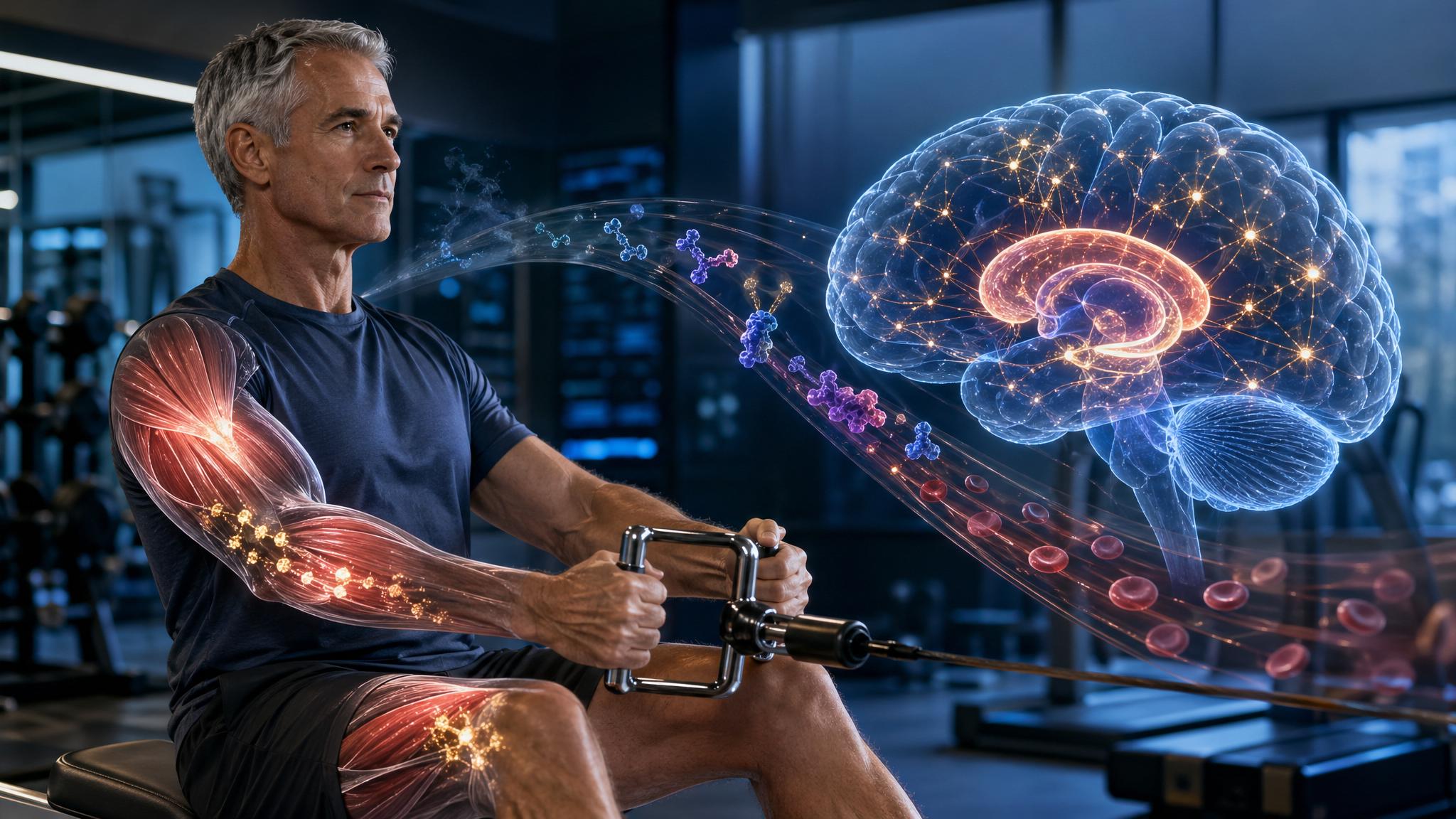
That picture is over. Beginning in the early 2000s with a quiet paper from a Danish exercise physiologist named Bente Klarlund Pedersen, and accelerating through the 2024 to 2026 research wave, scientists have come to recognize that working muscle is one of the most powerful endocrine organs in the human body. When you contract a muscle, it does not simply move a weight. It releases a flood of signaling molecules called myokines into the bloodstream. Those molecules travel to the brain, the pancreas, the liver, the bones, the gut, and the immune system, where they shape inflammation, metabolism, mood, and memory.
The most consequential finding of this new science is that several of those myokines cross the blood brain barrier. They reach the hippocampus, the prefrontal cortex, and the dentate gyrus, where they appear to drive the birth of new neurons, increase synaptic plasticity, and protect against the pathology of Alzheimer’s disease. The implication is one of the most unexpected and clinically important shifts in longevity medicine in the last decade. Lifting weights is not just exercise. It is brain medicine.
This article walks through the science of the muscle brain axis, names the researchers and journals doing the work, and ends with a practical playbook for translating the findings into a weekly strength training practice that protects cognition for the long arc of life.
## The Discovery That Reframed Muscle as an Endocrine Organ
The story begins in 2003, when Bente Klarlund Pedersen at Rigshospitalet in Copenhagen and her collaborators reported in the journal Physiological Reviews that contracting muscle releases interleukin 6 in significant quantities. At the time, IL 6 was understood almost exclusively as a pro inflammatory cytokine. Pedersen’s group showed that the IL 6 released by working muscle behaves very differently from the IL 6 released by macrophages during infection. Muscle derived IL 6 is acutely anti inflammatory, mobilizes glucose, and activates downstream metabolic pathways that protect against insulin resistance.
Pedersen coined the term myokine to describe these muscle derived signaling molecules. The original list contained a handful of compounds. Today, the catalog has grown to more than six hundred identified myokines, and ongoing proteomic surveys at the University of Copenhagen, the Joslin Diabetes Center, and Stanford suggest the true number may exceed one thousand. Each contraction of a working muscle is now understood to release an orchestra of molecules that travel throughout the body and reshape the function of distant organs.
The most well studied myokines today are irisin, brain derived neurotrophic factor or BDNF, cathepsin B, IL 6, IL 15, myonectin, decorin, and the recently characterized FNDC5 family. Several of these cross the blood brain barrier. Several act directly on neurons. And several have been shown in randomized human trials to improve cognition in older adults.
## Irisin and the Brain: From a Boston Lab to Alzheimer’s Trials
Irisin was discovered in 2012 by a team led by Bruce Spiegelman at the Dana Farber Cancer Institute and reported in Nature. The molecule is cleaved from a precursor called FNDC5, which is expressed in skeletal muscle in response to the transcription factor PGC 1 alpha. PGC 1 alpha is one of the master regulators of mitochondrial biogenesis, and it is upregulated by both endurance and resistance training.
For roughly a decade, irisin’s most discussed function was the browning of white adipose tissue, the conversion of energy storing white fat into thermogenic brown fat. Then, in a 2019 Nature Medicine paper that has shaped the field ever since, a team led by Ottavio Arancio at Columbia and Mychael Lourenco at the Federal University of Rio de Janeiro showed that irisin protects against synapse loss and memory impairment in mouse models of Alzheimer’s disease. Mice with elevated irisin had preserved hippocampal long term potentiation even after exposure to amyloid beta. Mice with FNDC5 knocked out lost cognition rapidly.
The 2024 follow on work from the Lourenco group, published in Brain, demonstrated that the irisin signal acts in part through the integrin alpha V beta 5 receptor on hippocampal neurons, and in part through anti inflammatory effects on astrocytes. By 2025 the first irisin mimetic candidates had entered preclinical safety studies at two biotech companies, with at least one Phase 1 dose escalation trial expected to begin in 2026 in adults with mild cognitive impairment.
The clinical translation work is still early. But the basic science is now strong enough that the National Institute on Aging has identified the muscle brain axis as one of its strategic priority areas for the 2025 to 2030 funding cycle.
## Cathepsin B, BDNF, and the Memory Circuit
Irisin is not the only myokine with a brain story. In 2016, a team led by Henriette van Praag, then at the National Institute on Aging and now at Florida Atlantic University, published a paper in Cell Metabolism showing that cathepsin B, a lysosomal protease secreted by working muscle, crosses the blood brain barrier and triggers the production of BDNF in the hippocampus.
BDNF is the most studied neurotrophic factor in the cognitive aging literature. It supports the survival of existing neurons, the growth of new ones, and the formation of new synaptic connections. People with higher circulating BDNF have larger hippocampal volumes, better verbal memory, and slower cognitive decline. People with lower BDNF have higher rates of depression, accelerated brain atrophy, and elevated risk of dementia.
Van Praag’s team showed that exercise in monkeys raised plasma cathepsin B levels, that the rise correlated with hippocampal BDNF, and that the change was associated with improved performance on a complex memory task. Subsequent work in humans, including a 2022 study from the Karolinska Institute and a 2024 multi site analysis published in JAMA Network Open, has confirmed that resistance training in particular drives sustained increases in circulating BDNF in older adults, with effect sizes that exceed those reported for most pharmacological interventions for early cognitive decline.
## The 2024 to 2026 Research Wave
The pace of discovery in this field has accelerated sharply over the last twenty four months. A few highlights are worth naming.
In 2024, a multi center European trial called SMART MOVE published in The Lancet Healthy Longevity randomized 1,134 adults over sixty five to either a supervised twice weekly strength training program, an aerobic only program, or a stretching control. After eighteen months, the strength training arm showed a 32 percent slowing of hippocampal atrophy on MRI compared to the stretching control, and a 21 percent improvement on a composite cognition score. The aerobic arm performed well, but the strength arm performed better on every memory and executive function measure.
In early 2025, a research group at the Salk Institute showed that contracting muscle releases small extracellular vesicles loaded with microRNAs that travel to the hypothalamus and reshape appetite and energy balance signaling. The work, reported in Nature Metabolism, points toward a previously unrecognized communication channel between muscle and brain that operates in parallel with classical hormones.
In late 2025, a group at the Allen Institute and the Buck Institute combined to publish in Cell Reports a single cell transcriptomic atlas of the aging mouse brain after twelve weeks of resistance training. The atlas showed that strength training selectively normalizes gene expression in microglia, the brain’s resident immune cells, reversing a substantial fraction of the inflammatory shift that comes with aging. This finding may explain why so many of the cognitive benefits of strength training appear to track with reductions in neuroinflammation.
And in a 2026 paper in Nature Aging, a team at the University of California San Francisco identified a previously uncharacterized myokine called muscle secreted protein 1, or MSP 1, that binds directly to receptors on hippocampal pyramidal neurons and induces a pattern of dendritic spine growth that closely resembles the effect of long term potentiation. MSP 1 is secreted in larger quantities by eccentric muscle contractions, the lowering phase of a strength training rep, than by concentric or aerobic activity.
The cumulative weight of this evidence has shifted the field. It is no longer controversial to say that resistance training acts on the brain. The questions now are about dose, frequency, intensity, and how to translate the laboratory signal into a weekly practice that older adults can actually sustain.
## Strength Training Versus Aerobic Training: The Specific Cognitive Signal
For two decades, the cognitive aging literature has emphasized aerobic exercise. The most cited intervention studies of the 2010s, most of them from Arthur Kramer’s group at the University of Illinois, showed that walking programs increased hippocampal volume and improved memory in older adults. That finding remains valid. Aerobic exercise is good for the brain.
But the more recent work suggests that resistance training carries a distinct and complementary signal. The myokines profile of a heavy compound lift is different from the myokines profile of a steady state walk. Strength training produces larger acute spikes in irisin, larger increases in cathepsin B, and a more pronounced anti inflammatory signature in microglia. It also preserves and builds the muscle mass that produces these signals in the first place. A small atrophied muscle releases far less myokine signal than a large strong one.
The practical takeaway is that aerobic and resistance training are not interchangeable for brain health. They are additive. The gold standard cognitive longevity protocol, in light of the 2024 to 2026 evidence, includes both.
## The Sarcopenia Connection
There is one more reason the muscle brain axis matters so much for longevity. Sarcopenia, the age related loss of muscle mass and strength, accelerates after age fifty. Without intervention, most adults lose between three and eight percent of their muscle mass per decade after age thirty, with the loss steepening in the seventies and eighties. By age eighty, the average sedentary adult has lost roughly forty percent of the muscle they had at thirty.
A shrinking muscle is a smaller endocrine organ. The same workout, performed by a sarcopenic seventy year old and a strong fifty year old, produces meaningfully different myokine output. This is one of the mechanisms by which sarcopenia contributes to dementia risk independent of frailty or cardiovascular disease. The 2024 ATTAIN study, a population based analysis of more than ninety thousand adults in the UK Biobank, showed that low grip strength at baseline predicted incident dementia over a ten year follow up window, with a hazard ratio comparable to that of carrying a single APOE4 allele.
The clinical implication is sharp. Building and maintaining muscle is not vanity. It is a direct investment in the size and signaling capacity of the organ that protects your brain.
## What This Means For Your Practice
The science is now clear enough to support a set of concrete actions you can begin this week.
Start lifting twice a week, minimum. The SMART MOVE protocol used two supervised sessions per week of progressive resistance training, focused on compound movements. Two sessions is enough to drive measurable myokine release and hippocampal protection. Three sessions is better if your recovery allows it. You do not need to train every day to get the brain benefit.
Choose compound movements over isolation work. Squats, deadlifts, hip hinges, presses, rows, and loaded carries recruit large muscle groups and produce the largest myokine response per unit of time. A workout built around five to seven compound lifts will outperform a workout built around twenty isolation exercises for cognitive endpoints.
Train heavy enough to challenge the muscle. The myokine response scales with intensity. Sets of six to twelve reps taken to within one or two reps of failure produce the strongest signal. Light loads with very high reps are less effective. If you are new to strength training, work with a coach for the first few weeks to learn safe technique, then progressively add load.
Include eccentric work. The 2026 Nature Aging finding on MSP 1 points to eccentric contractions, the controlled lowering phase of a rep, as a particularly strong stimulus. Slow the descent on your squats and presses to a three to four second count. The extra time under tension is a brain investment.
Do not abandon aerobic work. Two to three sessions per week of moderate intensity cardio, plus one weekly bout of zone 2 or interval work, complements the strength signal. The combined protocol produces the largest cognitive effect in the published literature.
Eat enough protein. The myokine factory requires raw material. Older adults benefit from one point two to one point six grams of protein per kilogram of body weight per day, distributed across at least three meals. Protein at breakfast appears to be especially important for muscle protein synthesis after age sixty.
Sleep well. Recovery from strength training, including the muscle remodeling that drives myokine release, happens overnight. Seven to nine hours of consistent sleep is part of the protocol, not an optional extra.
Track grip strength as a vital sign. A simple hand dynamometer, available for under fifty dollars, gives you a low burden way to monitor whether your strength training is working. Aim for steady increases in the first year and stable or slowly declining values into your sixties and seventies.
Consider working with a physical therapist or strength coach trained in older adult populations. The injury rate of properly supervised resistance training in adults over sixty is lower than the injury rate of recreational running. The barrier to entry is psychological, not orthopedic.
## The Bottom Line
The science of myokines has fundamentally changed the way longevity medicine thinks about strength training. Skeletal muscle is the largest endocrine organ in the body. When it contracts, it releases hundreds of signaling molecules, several of which cross the blood brain barrier and act directly on the neurons that govern memory and cognition. The 2024 to 2026 research wave, from the SMART MOVE trial to the discovery of MSP 1, has moved the muscle brain axis from interesting hypothesis to clinically actionable target.
The practical implication is simple and powerful. If you want to protect your brain for the long arc of life, lift weights. Two sessions a week, built around compound movements, performed with enough intensity to challenge the muscle, sustained over decades. Combined with aerobic work, adequate protein, and consistent sleep, it is now arguably the single most evidence supported intervention available for cognitive longevity. No drug currently in clinical use produces a comparable effect.
The fundamentals are not glamorous. They are not new. But the new science of the muscle brain axis is showing us, in growing molecular detail, why they work. The body and the brain are one system. Train one, and you train both.
Free Daily Briefing
Presented By Our Partners
The Latest Longevity Science. Delivered Every Morning.
Join researchers, physicians, and health professionals getting daily breakthroughs in AI-driven medicine, epigenetics, and longevity research.
Support the research that powers this editorial
No spam. Unsubscribe anytime. We respect your inbox.
Featured Partner
Invest in the Infrastructure Behind Modern Medicine
As healthcare expands beyond hospital walls, the buildings and campuses supporting that shift are generating compelling returns for investors who move early. The Healthcare Real Estate Fund offers qualified investors direct access to a curated portfolio of medical office, outpatient, and specialty care facilities.
The athletes who push hardest against physical limits are often the last to discover cardiac abnormalities. A medical-grade heart monitor built to survive their training may be exactly what they…
Radiology dominates the FDA AI-enabled medical device list because medical imaging already turns the body into structured data, making it the first large proving ground for regulated medical AI.
A comprehensive at home blood testing platform that combines finger prick convenience with CLIA certified lab analysis, dedicated nurse support, and physician reviewed results across dozens of health panels. Presented…
🧠 Nasal Spray Reverses Brain Aging — Texas A&M's neural stem cell-derived nasal spray reversed chronic brain inflammation and restored memory in aged mice with benefits persisting months after just two doses, and a U.S. patent has been filed for clinical translation. 🔬 Four-Week Diet Reduces Biological Age — University of Sydney research published in Aging Cell found dietary shifts toward reduced fat or plant-forward eating produced measurable biological age improvements in adults aged 65 to 75 in just four weeks. 🤖 OpenBind Opens AI Drug Discovery to the World — Oxford's OpenBind initiative released the first open AI model and atomic-resolution protein-drug binding dataset, generating 800 measurements in seven months and democratizing global drug discovery infrastructure. 🦠 Gut Microbiome Directly Controls Interferon Immune Signaling — A multi-omic study of 110 healthy adults found gut microbial composition is a primary regulator of interferon signaling, one of the immune system's most powerful inflammatory response systems. ❤️ Irregular Bedtimes Double Heart Attack Risk — People with widely variable sleep schedules face approximately twice the cardiac event risk of consistent sleepers, establishing sleep schedule regularity as a newly quantified modifiable cardiovascular risk factor.
A practical guide to getting the right MRI at the right place without being blindsided by CPT codes, facility fees, radiologist bills, network rules, cash prices, and deductible math.
🧫 Harvard Links Gut Bacteria to Depression via Inflammation: Morganella morganii produces a modified phospholipid that activates IL-6-driven immune inflammation, establishing a direct molecular pathway from gut bacteria to depression and creating new immune-targeted treatment targets. 🏥 FDA Launches Real-Time Clinical Trial Pilot: AstraZeneca and Amgen are feeding live trial data directly into FDA review systems in a landmark program that could compress cancer drug approval timelines by months and reshape how all clinical trials are conducted. 🌙 Fragmented Circadian Rhythms Accelerate Brain Shrinkage: Johns Hopkins researchers found that weaker daily rest-activity patterns in adults over 50 are directly tied to faster loss of memory-critical brain volume, making circadian health a modifiable and measurable neurodegeneration target. 😴 Chronic Insomnia Raises Dementia Risk by 40%: A six-year study of more than 2,700 adults links persistent insomnia to significantly greater amyloid buildup and white matter damage, reinforcing sleep quality as a primary dementia prevention strategy. 💰 Eli Lilly Bets $2.75 Billion on AI Drug Discovery: The massive Insilico Medicine commitment signals that major pharmaceutical companies now treat AI-designed drug candidates as legitimate pipeline assets, accelerating capital flow into the AI biotech sector ahead of critical Phase II readouts.
Zach Roberts
Sign up for personalized wellness coaching and the Daily Discovery Newsletter.