
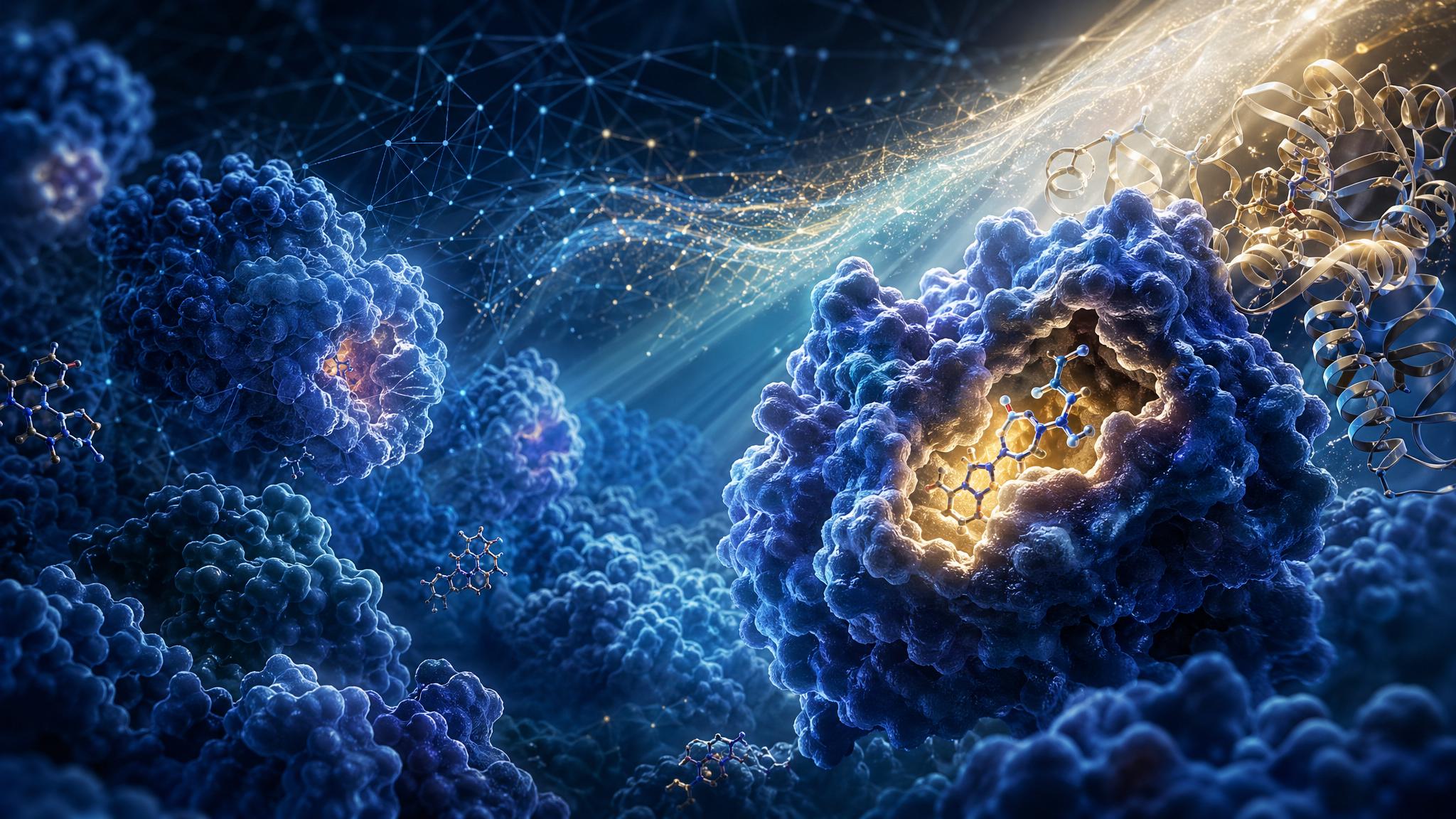
The Undruggable 80 Percent: Why AI Is Cracking the Proteins Medicine Couldn’t Touch
For four decades, the biology of cancer pointed to a single protein that drove roughly a third of all tumors. For four decades, nobody could build a drug against it. Here is why that is finally beginning to change, and why the implications reach far beyond oncology.
Presented By Our Partners



The protein is called KRAS, and for most of the last half century it has been the most frustrating target in cancer research. Biologists knew what it did. They knew where it lived inside the cell. They knew that mutations in the gene that codes for it drove a substantial fraction of human cancers, including the majority of pancreatic tumors, about a third of colon cancers, and a meaningful share of lung cancers. They knew that if you could build a drug to switch it off, you would transform oncology.
They could not build the drug.
For forty years, KRAS was what drug chemists politely called “undruggable.” Its surface was too smooth. Its binding pockets, the small crevices where a drug molecule would need to lodge itself to disrupt function, were too shallow and too polar to hold onto anything useful. Generations of medicinal chemists tried. Generations failed. By the early 2000s, the industry had largely given up. The protein became the canonical example of what modern pharmacology could not do.
Then, in 2021, the FDA approved a drug called sotorasib, the first small molecule ever to successfully target a KRAS mutation in humans. A second drug, adagrasib, followed soon after. Both target a specific mutation called KRAS G12C, which occurs in about 13 percent of lung adenocarcinomas and 3 percent of colorectal cancers. The drugs work because researchers discovered a new kind of binding site, a covalent pocket that only appears when the protein is in a specific conformation, and they learned how to lock a molecule into it.
KRAS is no longer undruggable. Or at least, one version of it is not. And that small victory, two approved drugs out of an ocean of disease, is the tip of something much larger.
The scale of the problem
Depending on who is counting, and how they are counting, somewhere between 80 and 98 percent of the disease-causing proteins inside the human body cannot currently be targeted by traditional drugs. A 2022 Chemical & Engineering News analysis put the figure at 85 percent. A comprehensive 2023 review in the journal Signal Transduction and Targeted Therapy used the same number. An educational analysis in the American Society of Clinical Oncology’s journal estimated that only 1 to 2 percent of disease-modifying proteins are known or predicted to be druggable by conventional methods.
Whichever figure you accept, the implication is the same. The vast majority of molecular levers that cause human disease are currently off-limits. Biology has handed medicine a long list of targets. Medicine has been able to act on a small fraction of the list. The rest have sat, for decades, as known-but-unreachable causes of illness.
The list of undruggable proteins reads like a roster of the most frustrating entries in the medical textbook. KRAS, already discussed, drives roughly a third of human cancers. MYC, a transcription factor stuck in an “always on” state in a wide range of tumors, is considered by many oncologists the single most important undruggable target in cancer. TP53, a tumor suppressor, is mutated in about half of all human cancers; restoring its function has been a medicinal chemist’s dream for thirty years. Tau and amyloid-beta, the aggregation-prone proteins implicated in Alzheimer’s disease, have taken down more Phase 3 trials than almost any targets in the history of neurology. Alpha-synuclein, implicated in Parkinson’s. The huntingtin protein. A long list of intrinsically disordered proteins that flicker between conformations too quickly for conventional small molecules to pin them down.
The reason these proteins resist traditional drug design comes down to a problem of shape. Classical small-molecule drugs work by fitting into a protein’s active site the way a key fits into a lock. That kind of interaction requires a defined pocket, a three-dimensional cavity with the right geometry and the right electrostatic properties for a small molecule to bind with sufficient force. A good druggable pocket is deep, roughly hydrophobic, and usually located near the protein’s functional core.
A good undruggable protein has none of these. Its surface is flat. Its active region may be spread across a large, shallow area rather than concentrated in a pocket. It may be intrinsically disordered, flickering between multiple shapes rather than holding a single stable form. Or, as in the case of transcription factors, its job may be to bind to DNA rather than to perform a chemical reaction, which means it does not present the kind of catalytic pocket that pharmacology has spent a century learning to exploit.
For most of the history of modern drug development, this mismatch between target biology and drug chemistry has been the ceiling on what medicine could reach. Researchers identified new disease-driving proteins faster than chemists could find ways to hit them. The gap widened decade by decade.
Featured Partner
Invest in the Infrastructure Behind Modern Medicine
As healthcare expands beyond hospital walls, the buildings and campuses supporting that shift are generating compelling returns for investors who move early. The Healthcare Real Estate Fund offers qualified investors direct access to a curated portfolio of medical office, outpatient, and specialty care facilities.
Learn More →
What changed
Something quiet has been happening underneath that story over the last five years, and it has to do with what it means to know a protein.
Before 2020, the process of determining the three-dimensional structure of a single protein was both laborious and expensive. A postdoctoral researcher in a structural biology lab could spend years on a single structure, working with X-ray crystallography or, more recently, cryo-electron microscopy. The results were crystalline and beautiful. They were also slow. By 2020, after decades of concerted effort, experimental researchers had resolved the structures of roughly 170,000 proteins. The full human proteome contains more than 20,000. The total number of proteins across all sequenced species exceeds 200 million.
Then AlphaFold arrived. The system, developed by DeepMind, predicted the three-dimensional structure of a protein directly from its sequence of amino acids, with near-experimental accuracy. By 2022, the AlphaFold database contained predicted structures for more than 200 million proteins, nearly every one known to science. The foundational 2021 Nature paper describing AlphaFold has become one of the most cited scientific papers of the decade. Its authors, Demis Hassabis and John Jumper, shared the 2024 Nobel Prize in Chemistry for the achievement.
On 60 Minutes in 2025, Hassabis described the stakes in plain terms. “It takes, you know, ten years and billions of dollars to design just one drug,” he told the program. “We can maybe reduce that down from years to maybe months or maybe even weeks.” The claim sounds implausible until you consider what AlphaFold changed. Structure determines function. Function determines druggability. And for the first time, structure could be obtained at scale, for free, for virtually every target of interest.
AlphaFold 3, released in 2024, went further. It modeled not only the static shape of a protein but the dynamic interactions between proteins, DNA, RNA, and small-molecule drug candidates in a single unified framework. The Nature paper describing AlphaFold 3 detailed how the system can predict the structure of complexes involving all four types of biological molecules in one pass. For the first time, the tool biology needed to actually design a drug existed in a form that any researcher could query.
This is the problem Isomorphic Labs and its peers are attempting to exploit. The company, spun out of DeepMind in 2021 and now backed by partnerships with Eli Lilly and Novartis valued at roughly $3 billion, has declared its intent to apply AI to drug discovery at a scale traditional pharmaceutical development has never achieved. In a 2026 Fortune interview, Hassabis described the target: “A biotech startup might do one or two drugs its entire corporate life. But we’re trying to build a system, a process, and all the technology to do maybe dozens of drugs each year.” The goal, he said, is a process that can “find these needles in a haystack,” applied to disease after disease after disease.
The overlap that matters
The relationship between the list of undruggable targets and the list of diseases that kill the most people is not coincidental.
According to the World Health Organization’s noncommunicable disease data, four categories of chronic illness accounted for the vast majority of global deaths in 2021. Cardiovascular disease led the list, with at least 19 million deaths. Cancer followed at about 10 million. Chronic respiratory diseases accounted for 4 million. Diabetes and its complications contributed more than 2 million. Collectively, these four categories drove roughly 80 percent of premature noncommunicable disease deaths worldwide.
Every one of them has known molecular drivers. Every one of them has had a substantial portion of those drivers classified as undruggable.
Cancer’s undruggable list is the most extensively studied. KRAS and its family members. MYC. TP53. A wide range of transcription factors whose job is to turn genes on and off, and which therefore do not offer the kind of catalytic pocket that small molecules can exploit. Neurodegenerative disease has its own list: tau and amyloid-beta, which misfold and aggregate; alpha-synuclein; huntingtin. Metabolic disease involves dozens of intrinsically disordered proteins that flicker between conformations. Cardiovascular disease, though more addressable because of the LDL receptor and related pockets, still has frustrating entries on its target list.
If AI-driven drug design delivers on even a modest fraction of what its advocates hope, it will not merely expand the number of available drugs. It will redraw the map of which diseases are considered treatable at all.
A necessary clinical reality check
None of this is guaranteed. The history of pharmaceutical development is littered with technologies that worked beautifully in theory, performed elegantly in cell culture, and failed decisively in human beings.
Average drug development still costs approximately $2.6 billion per approved drug, according to the widely cited Tufts Center for the Study of Drug Development analysis published in Nature Reviews Drug Discovery. A 2023 Deloitte report put the figure at $2.3 billion. Median timelines from discovery to approval still exceed a decade. The clinical failure rate for drug candidates entering Phase 1 trials remains around 90 percent. AI has not solved those problems. It has improved one early step in a long chain of steps where failure can occur.
Isomorphic itself has already revised its clinical timeline once. Hassabis originally said the company would have AI-designed drugs in trials by the end of 2025. At the World Economic Forum in Davos in January 2026, he pushed the target to the end of 2026. Industry observers have noted that the hardest part of drug development is not finding promising candidates, which AI accelerates, but shepherding those candidates through the regulatory and biological gauntlet of human trials, which AI does not.
What AI does change is the front end of the funnel. Before AlphaFold, certain targets could not be modeled well enough to begin drug design at all. After AlphaFold, nearly every protein of interest becomes a candidate target. The funnel gets wider. Whether the bottom of the funnel, approved drugs reaching patients, widens in proportion is the open question of the next decade.
What is no longer in doubt is the direction of travel. The number of proteins considered permanently out of reach is shrinking. New technologies, including proteolysis targeting chimeras (PROTACs), covalent inhibitors, and protein-protein interaction modulators, are joining AI-driven structural modeling in expanding the druggable universe. The ceiling is rising.
What this means for you
It is tempting to read a piece like this and conclude that the relevant action is happening in London laboratories and distant clinical trial sites. The drugs, if they work, will reach pharmacies sometime in the late 2020s or the 2030s. The protein structures being solved today will become therapies sometime after that. None of this feels like news you can act on tonight.
The point of following these stories carefully is not the urgency of any single breakthrough. It is the slope of the curve. The categories of disease being re-opened by AI-driven drug design are the same categories that determine whether you live into your eighties and nineties in reasonable health or whether you do not. Cardiovascular disease, cancer, neurodegenerative disease, and metabolic dysfunction together account for most of the premature deaths in the developed world. They are also, not coincidentally, the categories most responsive to foundational wellness practices in the decades before they become clinical.
The five foundational pillars of health, nutrition, sleep, movement, breathwork, and mindset, are not in competition with what Isomorphic Labs and its peers are building. They are the mechanism by which you remain healthy enough, long enough, to benefit from what is being built. A drug that cures a disease you have not yet developed is worth immeasurably more to you than one that treats a disease you have been living with for years. Prevention and breakthrough therapeutics operate on the same targets from different sides.
The undruggable 80 percent is becoming druggable. It is doing so slowly, unevenly, and with false starts, but the direction of travel is unambiguous. The question for readers is not whether to wait for the drugs. The question is whether to arrive at the moment of their availability in good enough condition to use them.
This is the second piece in our ongoing series on AI drug discovery. Read The Nobel Ensemble: Inside the Lab Trying to End Disease for the profile of the scientific advisory board behind Isomorphic Labs. For more on chronic disease, longevity science, and the foundational practices that support healthy aging, explore the HealthcareDiscovery.ai library.


Similar Posts

The Sauna Prescription: What 30 Years of Finnish Research Reveals About Heat, Cardiovascular Health, and Longevity
A 20.7 year prospective study of 2,315 Finnish men found that frequent sauna bathing was associated with a 63 percent lower risk of sudden cardiac death and a 66 percent…

Why Muscle Is the Organ of Longevity: New Research Reveals the Exercise Prescription That Actually Extends Your Life
New research from the UK Biobank, a landmark Cochrane review, and a breakthrough randomized controlled trial reveal why skeletal muscle is the most important organ for longevity, and why the…

Withings Body Cardio: FDA-Cleared Smart Scale with Pulse Wave Velocity for Arterial Health
Your arteries age faster than you do. A bathroom scale that measures how fast is the first step toward slowing them down. Presented By Our Partners Arterial stiffness is one…
The New Longevity Gold Rush: Can Science Really Reverse Aging, or Are We Getting Ahead of the Evidence?
A closer look at Yamanaka factors, partial reprogramming, David Sinclair, Altos Labs, and the widening gap between real age-reversal science and the hype surrounding it.

Every Baby a Genome: How Newborn Sequencing Is Reinventing Precision Medicine
GUARDIAN, BEACONS, BabySeq2, BeginNGS, and the NHS Generation Study are running in parallel in 2026. Inside the 12-fold detection signal from Columbia, the $14.4 million NIH multi-state pilot, and what…

Garmin CIRQA Smart Band: Pricing, Features, and Accuracy
Garmin CIRQA is a $199.99 screen-free health and fitness band with no required subscription. Here is what it tracks, what it omits, and how its pricing compares.
