Continuous Blood Monitors Are Coming: The Race to Build a CGM for Everything
Glucose was the first molecule we learned to watch in real time. Hormones, inflammation and drug levels are next, and a crowded field of startups is racing to put a lab on your arm. Here is the science, the players, the money and the honest limits.
Presented By Our Partners



Picture a Tuesday. You slept five hours because a flight landed late. At 7 a.m. you crush a hard interval workout because the calendar says so. At 10 you walk into a board meeting that goes sideways. By 4 p.m. you are on your third coffee and your second argument.
Inside your bloodstream, that Tuesday is a thriller. Cortisol spikes, crashes and spikes again. Testosterone sags. Inflammatory signals flicker. Glucose swings with every decision. And if you happened to get your annual blood panel that afternoon, your doctor would read the chemistry of one random frame and call it you.
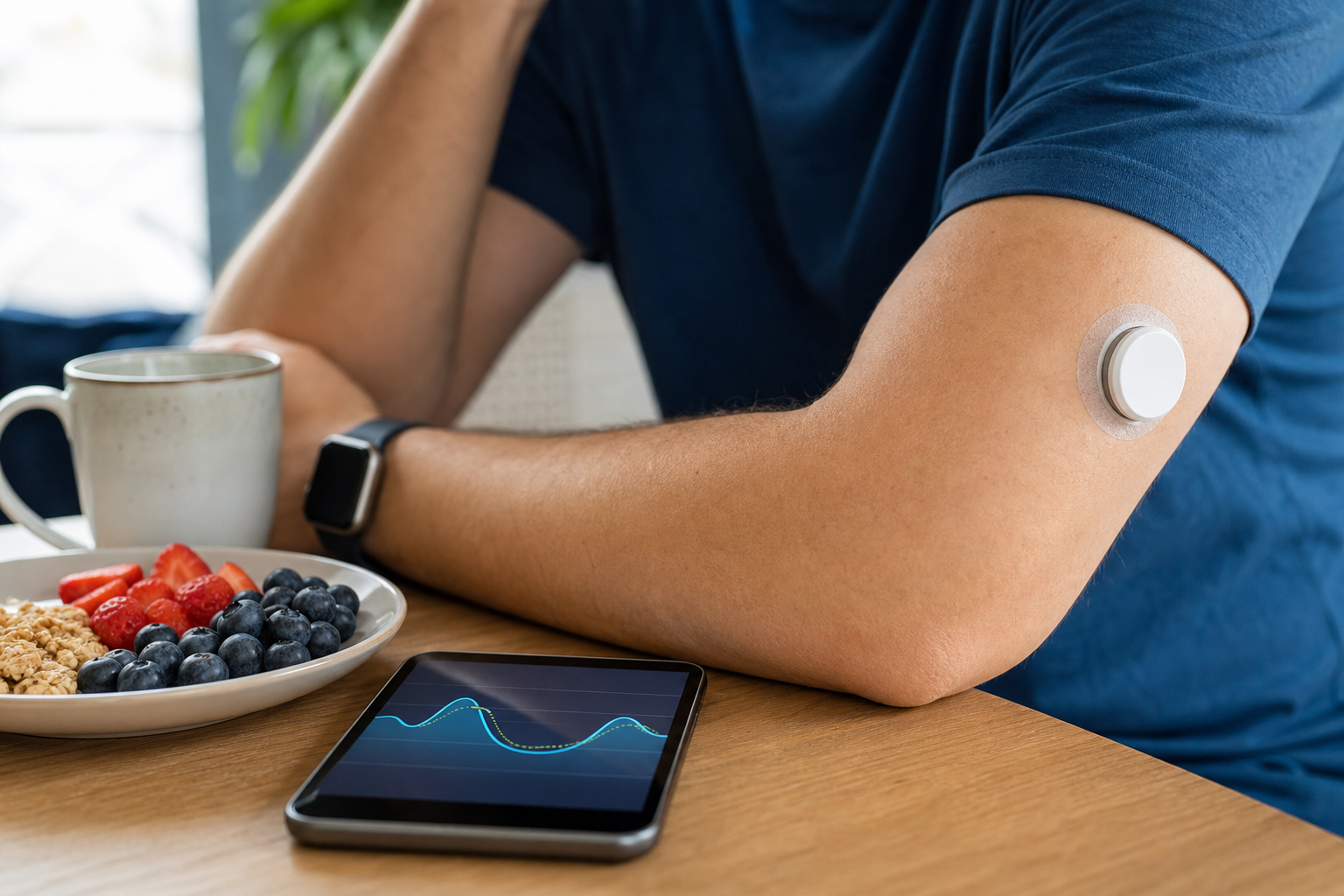
That is the problem a new category of devices is trying to solve. People are starting to search for it as a continuous blood monitor: a wearable that reads your hormones, metabolism and inflammation every few minutes, the way a continuous glucose monitor (CGM) already reads sugar, and streams it to an AI that can actually do something with it. It does not fully exist yet. But the pieces are arriving faster than most people realize, and the companies assembling them are worth knowing by name.
What Is a Continuous Blood Monitor?
Start with a correction that will make you smarter than most of the headlines. Almost none of these devices read blood. They read interstitial fluid, the clear fluid that bathes your cells just under the skin, using microneedles or a tiny filament. Molecules diffuse from your capillaries into that fluid, so its chemistry tracks your blood chemistry, usually with a short lag. A few competitors skip the skin entirely and read sweat or saliva.
So “continuous blood monitor” is the phrase people type, while the scientists say “continuous molecular monitoring” or “continuous biomarker monitoring.” The idea underneath is the same: replace the snapshot with the stream.
The stream is a different kind of data. A sensor that reports once every 15 minutes, the cadence of today’s over-the-counter glucose monitors, produces 96 readings a day and 35,040 readings a year for every marker it tracks. Your annual physical produces one. That is not an incremental improvement in resolution. It is the difference between a photograph and a film.
Why One Blood Draw a Year Misses the Movie
Your blood is not a still lake. It is weather. Three well-documented examples show how much a single sample can miss.
Cortisol wakes up before you do. In a combined analysis of four studies covering 509 adults, free cortisol rose by about 50 percent within the first 30 minutes after waking (Wüst et al., Noise and Health, 2000, PMID 12689474). A sample drawn at 7:05 and one drawn at 7:35 can describe two different stress systems.
Testosterone is a morning hormone. Testosterone runs high early in the day and drifts lower by afternoon. A 2009 study in the Journal of Clinical Endocrinology and Metabolism found that a meaningful share of men who tested below 300 ng/dL after noon had normal levels every time they were tested in the morning, and the authors concluded that testosterone draws should be restricted to morning hours at every age (Brambilla et al., 2009, PMID 19088162, DOI). Same man, same week, two different diagnoses.
Progesterone pulses. In women sampled every 10 minutes for 24 hours during the mid and late luteal phase, plasma progesterone swung between 2.3 and 40.1 ng/mL within a single day, with sharp jumps often arriving within minutes, and the authors concluded that a single progesterone measurement does not accurately reflect how well the corpus luteum is working (Filicori et al., Journal of Clinical Investigation, 1984, PMID 6427277, DOI).
Now layer on real life: the bad night, the hard workout, the stressful meeting, the long flight. A yearly panel misses nearly all of it. The person on the other side of the lab report is a composite of whatever happened in the hour before the needle went in.
Meanwhile, the reasoning side of the equation has already shown up. OpenAI reported in January 2026 that more than 40 million people turn to ChatGPT every day with healthcare questions (OpenAI, AI as a Healthcare Ally). Those systems are brilliant pattern matchers, but they are working from textbooks, a patient’s memory and the occasional lab PDF. The intelligence has arrived. The data feed has not.
Glucose Already Ran This Experiment
If you want to know where continuous biomarker monitoring is headed, look at where glucose has been. It is the cleanest case study of an exponential technology in all of medicine: deceptive for years, then suddenly everywhere.
The first CGMs at the turn of the century were prescription devices for people with diabetes. Early sensors lasted about three days, needed fingerstick calibration roughly twice a day, and often delivered their data after the fact to a clinician rather than live to the wearer. For years the technology looked like a niche tool for a niche population.
Then the curve bent. On March 5, 2024, the FDA cleared Dexcom Stelo as the first over-the-counter CGM, worn for up to 15 days with readings sent to a phone (FDA). Continuous glucose went from a prescription device to something anyone can order online. Abbott followed with Lingo, which we reviewed in our Abbott Lingo review.
And in August 2026 the category took its first real step beyond a single molecule. The FDA authorized Abbott’s Libre Duo 10 Day, the first wearable to continuously monitor ketones and glucose together, for people with diabetes ages 2 and older (FDA). Just as important for anyone tracking this space, the FDA created a new performance standard to go with it, called integrated continuous glucose and ketone monitoring. Regulators do not write a new standard for a one-off. They write one when they expect a category.
The limit is still chemistry. Glucose and ketones are measured with enzymes that happen to produce a clean electrical signal when they meet their target. Nature did not hand us a convenient enzyme for cortisol, estradiol, testosterone or IL-6. The decisions that matter most for healthspan depend on exactly those molecules, and that is the wall the next generation is trying to climb.
Featured Partner
Invest in the Infrastructure Behind Modern Medicine
As healthcare expands beyond hospital walls, the buildings and campuses supporting that shift are generating compelling returns for investors who move early. The Healthcare Real Estate Fund offers qualified investors direct access to a curated portfolio of medical office, outpatient, and specialty care facilities.
Learn More →
How the Next Generation Reads Molecules
The breakthrough most of the field is betting on is a small piece of engineered DNA called an aptamer. Think of it as a molecular hand, a short strand of synthetic DNA or RNA folded so that it grabs one specific target and lets go when the concentration falls. Attach that strand to an electrode, add a chemical reporter, and every grab and release shifts the electrical signal. Because the binding is reversible, the sensor can keep reading, minute after minute, rather than reacting once and dying like a pregnancy test.
The beautiful part is modularity. Change the aptamer and, in principle, you change what the sensor measures while the electronics stay the same. That is why so many of these companies describe themselves as platforms rather than products.
The hard part is time. In a 2026 pilot trial in Nature Biotechnology, six healthy volunteers wore aptamer microneedle patches that tracked the antibiotic vancomycin in interstitial fluid at 5-minute resolution for 24 hours. The patches were safe and nearly pain free, and the continuous data revealed drug distribution and clearance dynamics that sparse blood sampling cannot see. But because of sensor degradation, the authors primarily reported the first 12 hours (Booth et al., 2026, PMID 41639270, DOI). Twelve good hours is a scientific milestone. It is not yet a product you wear for two weeks.
Other teams are attacking the problem from different angles: nanopores that read many molecules through one universal mechanism, sweat sensors that avoid the skin barrier, saliva cartridges read by a phone camera, and machine learning models that infer hormone states from heart rate and temperature. Each trades away something different. That is what makes the competitive map interesting.
Continuity: The MIT Spinout Betting on Nanopores
Continuity, an MIT spinout based in Mountain View and a resident company at The Engine, describes its goal as a body-computer interface that reads biochemistry in real time and streams it to AI systems (The Engine). Its founders are Zeno Fox and Swathi Manda. According to the company, its team has built biosensors at Caltech, Google X, Medtronic, Biolinq and Seer, and it describes itself as DARPA and venture backed.
Its technical bet is distinctive. Rather than one custom chemistry per marker, Continuity says it has repurposed nanopore technology, the method behind real-time genome sequencing, into a single universal mechanism that can read hormones, proteins and metabolites in parallel. The company reports that in vitro data supports the approach and that its first human test was successful. Its first wearable prototype is called Guardian. The roadmap it has shared publicly starts with hormones such as estradiol, testosterone and cortisol, moves to metabolic markers such as glucose and insulin, then to inflammatory markers like hsCRP and IL-6.
Two things stand out. First, the ambition is explicitly AI-native: the sensor is the entry point, and the long-term value is the dataset and the models built on top of it. Second, nothing here is peer reviewed or cleared yet. The claims are company-reported, and the test that matters most, accuracy against lab blood draws over many days of wear, is still ahead.
Who Else Is Racing to Build It
Continuity is not alone. The competitive field splits into four camps, and knowing which camp a company sits in tells you most of what you need about its risk.
Camp One: The Incumbents Expanding Beyond Glucose
Abbott is already there with Libre Duo, the first cleared dual glucose and ketone sensor. It is the clearest proof that the giant CGM franchises intend to add molecules rather than cede them. Abbott says its Libre platform is used by more than 8 million people, which means any new analyte it adds lands on an installed base no startup can match.
Dexcom has been quieter in public, but the talent tells a story. Joshua Windmiller, a Biolinq co-founder, left in 2021 to become Dexcom’s head of new analytes and sensing platforms, according to MedTech Dive. Incumbents do not hire for new analytes unless they plan to ship them.
Biolinq sits between camps. The FDA granted De Novo classification in September 2025 to Biolinq Shine, an intradermal microsensor array worn on the forearm that sits far shallower than traditional CGM filaments and shows glucose range on a built-in color light (FDA DEN240080). The company has raised a $100 million Series C and has presented aptamer work on phenylalanine, an amino acid tied to muscle breakdown, which hints at where its multi-analyte platform is headed.
Camp Two: The DNA Sensor Platforms
Nutromics (Melbourne) is the most clinically advanced aptamer company. Its Lab-on-a-Patch grew out of Kevin Plaxco’s lab at UC Santa Barbara, and it is the company behind the 2026 Nature Biotechnology vancomycin trial described above (DOI). Nutromics has also shown two antibiotics, vancomycin and tobramycin, measured on one device in animal studies, with ICU trials running in Australia and US hospital trials planned. Its beachhead is therapeutic drug monitoring in hospitals, where an error is costly, the buyer is clear and reimbursement logic already exists.
Adaptyx Biosciences (Menlo Park), a Stanford spinout, uses synthetic DNA molecular switches and has raised $23 million in total. At the American Diabetes Association meeting in 2026 it presented what it called the first continuous, multi-day measurement of free cortisol in humans. Across two first-in-human studies, the patch tracked paired venous blood during a hydrocortisone challenge and captured the cortisol awakening response and the overnight low during normal life, according to Drug Delivery Business News. If Continuity has a closest rival on hormones, this is it.
Level Zero Health (London) is building an aptamer patch for hormones in interstitial fluid, including cortisol, progesterone, estrogen and testosterone. It raised a $6.9 million pre-seed round in 2025 and is taking a staged route: a single-use patch for intermittent testing first, with a fully continuous monitor targeted for 2028, according to TechCrunch. Its founders have said they want to show better than 90 percent correlation with blood draws, and they target IVF and testosterone therapy as early use cases.
Camp Three: The Needle-Free Sweat Sensors
Lume Health unveiled a sweat-based wrist sensor for continuous cortisol at TechCrunch Disrupt in October 2026, founded by a former Apple sensor engineer and a physician. It reports a 25,000-person waitlist and a 2027 launch, with estrogen and progesterone planned next. EnLiSense has announced Corti, a passive sweat patch for cortisol and melatonin that grew out of its work on inflammation markers. Sweat removes the needle, which is a huge advantage for consumer adoption. The open scientific question is how faithfully sweat hormone levels track blood across different people, temperatures and activity levels.
Camp Four: The Near-Continuous and the Inferred
Eli Health makes the Hormometer, a saliva cartridge read by a phone camera that tests cortisol, progesterone and testosterone in about 20 minutes. It is not continuous, and it is FDA registered as a low-risk device rather than FDA cleared, but it lets someone take several readings in a day for a few dollars each. Clair Health raised $11.6 million in 2026 for a wrist wearable that does not measure hormones directly at all; it uses machine learning on skin temperature, heart rate, sleep and breathing to estimate estrogen, progesterone, LH and FSH. Measured and inferred are very different claims, and buyers should know which one they are paying for.
Public money is joining in too. Germany’s innovation agency SPRIND opened a 40 million euro Hormone Challenge in 2026 to fund up to eight teams building continuous hormone biosensors over three years, according to Femtech Insider.
The Continuous Biomarker Market at a Glance
| Company | How It Reads | First Targets and Status |
|---|---|---|
| Continuity | Nanopore platform, interstitial fluid | Hormones, then metabolic and inflammatory markers; early human testing |
| Abbott Libre Duo | Enzyme sensor, interstitial fluid | Glucose and ketones; FDA authorized August 2026 |
| Biolinq Shine | Intradermal microsensor array | Glucose range; FDA De Novo 2025; aptamer research |
| Nutromics | Aptamer microneedle patch | Hospital drug monitoring; human trials |
| Adaptyx | DNA molecular switches, patch | Free cortisol; first-in-human data 2026 |
| Level Zero Health | Aptamer patch | Sex hormones and cortisol; continuous device targeted 2028 |
| Lume Health | Sweat, wrist | Cortisol; launch planned 2027 |
| Eli Health | Saliva, phone camera | Cortisol, progesterone, testosterone; on sale, not continuous |
| Clair Health | Inference from vital signs | Estimated reproductive hormones; not a direct measurement |
The Hard Problems Nobody Has Solved Yet
Every exponential technology has a phase where the vision outruns the engineering. Continuous biomarker monitoring is in that phase now, and five problems will decide who wins.
- Durability. The body attacks foreign objects. Proteins coat sensors, aptamers degrade and signals drift. Twelve reliable hours in a peer-reviewed trial is where the public evidence stands; a consumer product needs ten to fifteen days.
- Calibration and lag. Interstitial fluid trails blood, and the lag differs by molecule. Large proteins like IL-6 move more slowly than small molecules like cortisol. Every new marker needs its own validation against gold-standard lab methods.
- Concentration. Hormones circulate at concentrations thousands of times lower than glucose. Detecting them reliably, through skin, in a moving body, is a far harder signal problem.
- Regulation. The FDA has shown it will create new categories, as it did for Biolinq and Abbott. It has also shown it will act when wellness devices drift into diagnostic claims, as WHOOP learned with a warning letter over blood pressure features, which we covered in our WHOOP MG review.
- Meaning. We do not yet have population reference ranges for minute-by-minute cortisol or hourly estradiol. The first users of these devices will be generating the normal curves that medicine will later rely on.
The Investor and Entrepreneur Playbook
The scarce asset in AI medicine is not intelligence. It is continuous, high-quality biological data tied to outcomes. That reframes where the opportunity sits.
If you are an investor, notice that the platform claim is cheap and the second molecule is expensive. Every company in this space says its chemistry is modular. Very few have shown two clinically validated analytes in humans. Watch for the teams that turn the second and the twentieth molecule into cleared products, and watch the clinical beachheads: hospital drug monitoring, IVF cycle tracking and testosterone or menopause therapy titration all have a payer, a decision and a measurable outcome. Consumer wellness can come later and bigger, but it rarely comes first for a Class II device. Also watch the picks and shovels: aptamer discovery accelerated by machine learning, microneedle manufacturing at scale, and the reference datasets that will define what normal looks like. For the funding rounds, valuations and market sizing behind this category, see our sister site’s investor analysis of continuous biomarker monitoring startups.
If you are an entrepreneur, build for the streaming patient before the stream exists. The software that turns 35,040 readings a year into a single decision a doctor will act on is unbuilt. So are the clinical workflows for adjusting a dose based on the last 72 hours of real data, the reimbursement codes for interpreting it and the consumer experience that keeps someone wearing a patch past week two. CGM showed that the sensor company is not always the company that captures the most value. Our guide to sharing wearable data with your doctor shows how fragmented that last mile still is, and Oura’s move to buy Counsel Health, covered in our analysis, shows the device makers racing to own it.
If you run a company, your employee health benefit is probably still a once-a-year physical. Start asking what changes when your people can see their stress and metabolic markers in real time, and what privacy rules you will need before they can.
What This Means for You
None of these devices replaces the fundamentals. Sleep, movement, nutrition, breathwork and mindset still do the heavy lifting for healthspan, and no sensor will change that. What continuous biomarker monitoring changes is feedback. For the first time, you may be able to see whether the fundamentals are working inside your own chemistry, day by day: whether that late dinner moved your glucose, whether the new training block is lowering your morning cortisol, whether a medication is landing where your doctor intended.
Here is how to act on that today:
- Time your current tests. Ask for testosterone and cortisol draws in the morning, note your sleep the night before and repeat a surprising result before acting on it.
- Use what is already continuous. An over-the-counter CGM is the one continuous biomarker you can wear now. Two weeks of data teaches you more about your metabolism than a decade of fasting glucose numbers.
- Read the claim carefully. Measured, estimated, cleared and registered are four different words. Know which one a device is using.
- Pick your marker. Look at your last blood panel and choose the one value you most wish you could watch every day. Ask your doctor about it at your next visit, then watch for the first continuous sensor that tracks it.
This article is for education and is not medical advice. Talk to your doctor about which biomarkers are worth tracking for you.
Frequently Asked Questions
Is There a Continuous Blood Monitor I Can Buy Today?
Not for hormones or inflammation. The continuous molecular monitors on the market measure glucose, and Abbott’s Libre Duo adds ketones for people with diabetes. Continuous hormone monitors from companies such as Continuity, Adaptyx, Level Zero Health and Lume Health are still in development or early testing.
Does a Continuous Blood Monitor Actually Measure Blood?
Usually not. Most read interstitial fluid just under the skin, which tracks blood chemistry with a short lag. Some read sweat or saliva instead.
What Is the Difference Between a CGM and a Continuous Hormone Monitor?
A CGM uses an enzyme that reacts with glucose. Hormones have no equivalent enzyme and circulate at far lower concentrations, so most continuous hormone monitors use engineered DNA strands called aptamers, nanopores or other new chemistries.
How Accurate Are Continuous Cortisol and Hormone Sensors?
The public evidence is early. Adaptyx has reported agreement with paired blood samples in first-in-human studies, and aptamer patches have tracked a drug at 5-minute resolution for about 12 hours in a peer-reviewed trial (PMID 41639270). Multi-day accuracy against lab methods is the benchmark to watch.
When Will Continuous Hormone Monitors Be Available?
Company timelines point to 2027 and 2028 for the first products, with hospital and fertility uses likely to arrive before broad consumer launches.


Similar Posts
Berberine Side Effects: What 60 Studies Report (2026 Evidence Grade)
Across 12 randomized trials that tracked adverse events, gastrointestinal symptoms occurred in 2 to 23 percent of berberine users versus 2 to 15 percent on placebo, and no trial reported…

Your Genome Knows More Than Your Doctor: How Precision Medicine Is Rewriting Preventive Health in 2026
A landmark Science study reveals that genes control over 50 percent of lifespan variation. Meanwhile, the PROACT trial uses polygenic risk scores to find hidden heart disease, and whole genome…

Clonal Hematopoiesis (CHIP): The Cardiovascular Risk Hidden in Your Blood
By age seventy, somewhere between ten and twenty percent of people carry a population of mutated blood stem cells that quietly double their risk of heart disease. The condition has…
How Scientists Are Learning to Reverse Cardiovascular Aging: From Centenarian Genes to Rapamycin
New research reveals that cardiovascular aging can be slowed and even reversed. A centenarian gene rewinds heart age by ten years, rapamycin improves diastolic function in elderly men within weeks,…

Seven Days Off Plastic Cut Endocrine Disruptors in Half: Inside the PERTH Trial
A new Nature Medicine randomized controlled trial shows seven days of avoiding plastic in food, kitchenware, and personal care cut urinary phthalates by more than 44 percent and bisphenols by…

Longevity Escape Velocity, Explained Through Isomorphic Labs
Ray Kurzweil has spent two decades arguing that by 2029, medical progress will add more than a year to your remaining life expectancy for every year that passes. A Nobel-laureate…