
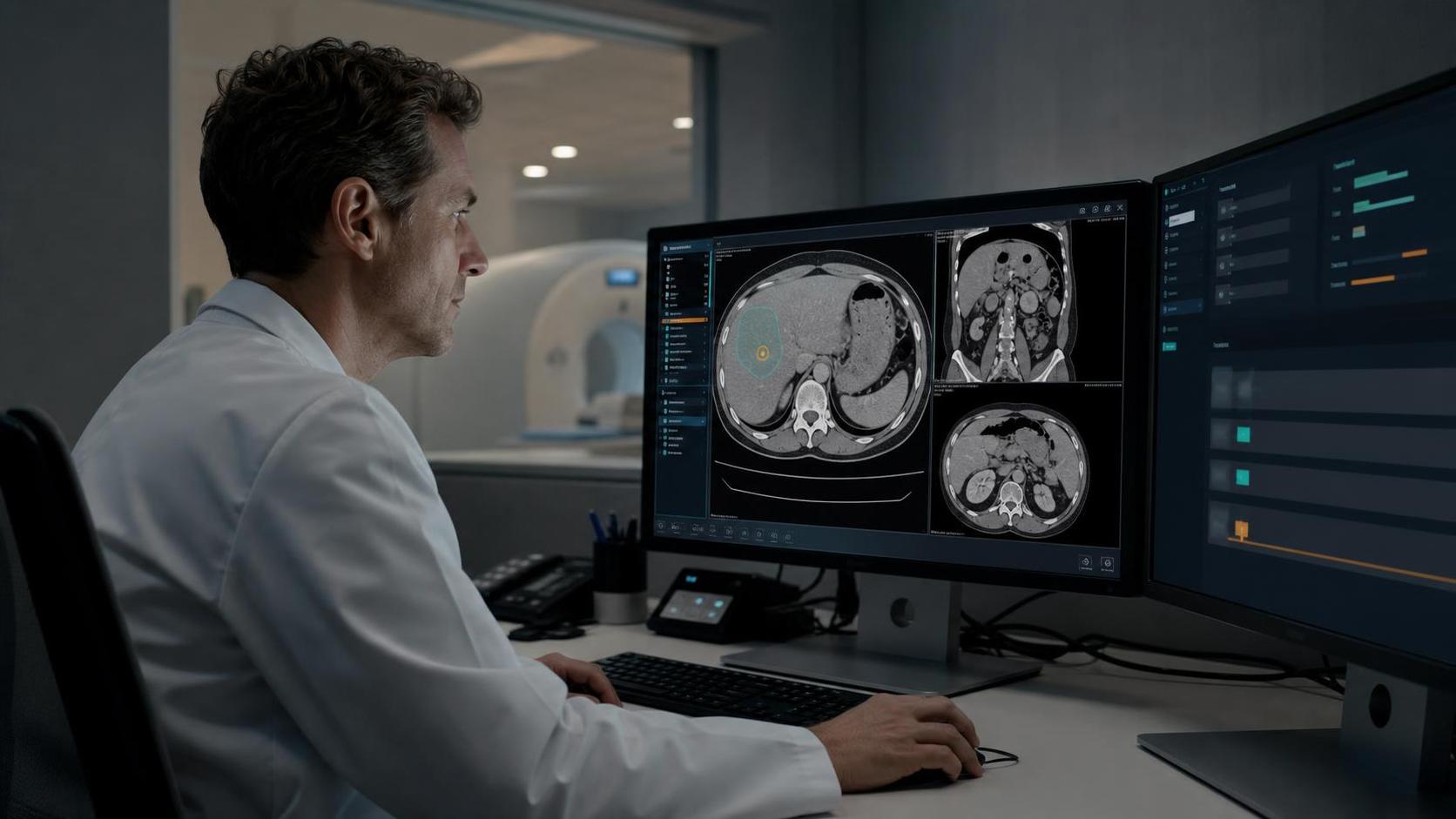
Microsoft AI Diagnosis in Science: What the MAI-DxO Study Has Shown So Far
Microsoft’s diagnosis system beat generalist doctors on hard cases in a peer-reviewed Science paper. Here is what the study shows, what it does not, and where the headlines about it went further than the evidence.
Presented By Our Partners



The short answer: On October 22, 2026, Science published a Microsoft study of an AI system that works through a case step by step, like a panel of physicians choosing which tests to order. It reached 83.2% accuracy on clinicopathological conference cases and 80.3% on emergency department admissions, against 36.1% and 46.8% for generalist physicians. Evidence level: Peer-reviewed. Stage: Clinical care, but in a controlled benchmark, not with real patients. The paper’s own wording stays within its evidence; some headlines do not, including one that claims four times the accuracy of doctors, a figure the published abstract does not support. We have not given it a HYPE Index score yet, because our rules require the full paper and it is not in PubMed Central.
Most diagnosis does not happen in one look. A patient arrives with a few symptoms, a doctor asks questions, orders a test, rethinks, orders another. Every step costs time and money, and some tests carry risk. Older AI benchmarks skipped all of that: they handed a model the full case file and asked for the answer. Microsoft’s study tries to measure the part that looks more like real medicine, the choosing.
What Microsoft Published
Microsoft researchers built an interactive benchmark for sequential diagnosis and an AI system that simulates a panel of physicians, revising its list of possible diagnoses and choosing cost-effective tests as it goes. The paper, by Nori and colleagues, appeared in Science on October 22, 2026 (PMID 42912144). Coverage names the system MAI-DxO (NewsBytes), as does an earlier independent nursing study that tested it (PMID 41620749). Microsoft first reported the system in 2025, before peer review, when HLTH reported about 85% accuracy on complex cases (HLTH). TechCrunch reported the same day that Microsoft’s Mustafa Suleyman says the system outperforms doctors on hard cases as he pursues what he calls medical superintelligence.
All 15 authors list Microsoft as their affiliation, including Suleyman and Eric Horvitz. Affiliations are not a full conflict of interest disclosure. The full text is not in PubMed Central, so this check is built from the abstract and named coverage, and it carries no HYPE Index score.
What’s Proven So Far
The study proves the system scores well on a benchmark its authors built, using past cases. It does not yet show that patients get better or faster diagnoses when doctors use it. The authors say so in the abstract: the findings were obtained in a controlled benchmark setting.
| Result | Partner | Evidence level | Stage | What would prove it |
|---|---|---|---|---|
| 83.2% accuracy on clinicopathological conference cases, against 36.1% for generalist physicians | None named; all authors at Microsoft | Peer-reviewed | Clinical care (benchmark only) | Replication by a group with no tie to Microsoft, on cases the system has never seen |
| 80.3% accuracy on MIMIC-IV-ED emergency department admissions, against 46.8% for generalist physicians | None named; all authors at Microsoft | Peer-reviewed | Clinical care (benchmark only) | A prospective study in real patients, with diagnosis accuracy and time to diagnosis measured |
| Lower-cost diagnostic workups through test selection | None named; all authors at Microsoft | Peer-reviewed | Clinical care (benchmark only) | Costs measured in real care, including tests that were skipped and whether anything was missed |
The accuracy gap is large, and the setting is narrow. On the conference cases, the system’s accuracy was about 2.3 times that of the generalist physicians in the benchmark. On the emergency admissions, about 1.7 times. Both comparisons come from the same controlled setting, so the physicians were working inside the benchmark’s rules, not in a clinic. The abstract does not say what references or tools the physicians could use, so treat the gap as a benchmark result, not a measure of everyday practice.
Cost is in the design, but the abstract gives no figures. The abstract says the system selects cost-effective tests and points to lower-cost diagnosis. It reports no cost numbers, so we report none here.
Featured Partner
Invest in the Infrastructure Behind Modern Medicine
As healthcare expands beyond hospital walls, the buildings and campuses supporting that shift are generating compelling returns for investors who move early. The Healthcare Real Estate Fund offers qualified investors direct access to a curated portfolio of medical office, outpatient, and specialty care facilities.
Learn More →
A patient study is the next step. TechEnclave‘s headline says Microsoft reports the gains on retrospective cases, with a patient study next. That study, not this one, will be the first real test of whether the system helps people.
How This Fits What Other Studies Show
This is not the first Science paper to find a language model beating physician baselines on hard cases. In April 2026, a team led by researchers at Beth Israel Deaconess Medical Center, Harvard and Stanford, with one Microsoft-affiliated author, reported that a large language model outperformed physician baselines across five experiments and in a real-world comparison of second opinions in an emergency room. Their conclusion was that models have eclipsed most benchmarks of clinical reasoning and that prospective trials are urgently needed (PMID 42060751). Two strong benchmark results point the same way. Neither replaces a trial.
How the Wording Compares With the Evidence
The paper’s own wording matches its evidence; the gap opened in executive framing and some headlines. Healthcare Discovery normally grades statements like these with the HYPE Index, but our rules require the full paper before we publish a score, and the full text of this Science paper is not in PubMed Central. Until we can read it, here is a plain comparison against the published abstract, as of October 28, 2026.
| Statement | Who made it | What the published abstract supports |
|---|---|---|
| In a controlled benchmark, the system outperformed generalist physicians and shows promise for more accurate, lower-cost diagnosis | Microsoft authors, Science, October 22, 2026 | Matches the evidence. The authors limit the result to a controlled benchmark and to promise. |
| Diagnostic AI gains on retrospective cases, with a patient study next | TechEnclave headline | Matches the evidence. The cases were past cases, and no patient study has been published. |
| Microsoft’s AI outperforms doctors on hard cases, on the road to “medical superintelligence” | Mustafa Suleyman, as framed in TechCrunch‘s headline, October 22, 2026 | Goes beyond it. The headline drops the benchmark qualifier, and no benchmark measures medical superintelligence. |
| Microsoft’s new AI diagnoses diseases up to 4 times more accurately than doctors | ProPakistani headline, October 23, 2026 | Not supported. The abstract shows about 2.3 times the physicians’ accuracy on one case set and about 1.7 times on the other. |
What the paper does well, and where it falls short.
- The question: Clear and testable. Can a model choose tests and reach a diagnosis better than physicians, at lower cost? It builds on a long tradition of using conference cases to test diagnostic software. The weakness is that the benchmark and the system come from the same team.
- Population and outcome: Two case sets and generalist physicians are stated, and absolute accuracy is reported. The outcome is diagnostic accuracy in a simulation, not patient outcomes, and the cost saving is not quantified in the abstract.
- Peer review and independence: Published in a leading peer-reviewed journal. Every author works at Microsoft, and no independent replication on new cases exists yet.
- Stage and verifier: Clinical AI with retrospective benchmark results. The verifier is a prospective study in patients, then regulatory review if Microsoft offers it for clinical use.
Where the hype entered the chain. The paper is careful. The superintelligence framing is Microsoft’s own: Microsoft AI introduced the system in a post titled The Path to Medical Superintelligence, and TechCrunch’s headline carried that framing without the benchmark qualifier. Some headlines then turned the result into a single multiplier. The figure of up to 4 times does not appear in the published abstract.
What Would Change Our Read
- Results from the planned patient study, with accuracy, time to diagnosis and any harm measured.
- Replication by an academic group with no Microsoft tie, on new cases.
- A comparison against physicians working with their usual tools and references.
- Published cost figures, including what the system skipped and whether anything was missed.
- Full text in PubMed Central or another open source, so the physician comparison can be read in detail and the page can carry a HYPE Index score.
What This Means for You
If you are a patient, this study does not change how you are diagnosed today. The system was tested on past cases, not on people, and we found no announced date for clinical use. If you use a chatbot to think through symptoms, treat it as a second opinion to discuss with a clinician, not a diagnosis.
If you work in care or clinical research, this is one of the strongest benchmark results for diagnostic AI so far, and it measures something closer to real practice than earlier tests did. It still needs a prospective trial. Ask anyone selling diagnostic AI which patients it was tested on, against whom, and what happened to the patients.
Related Coverage
- AI healthcare breakthroughs tracker
- Microsoft healthcare AI timeline
- What HealthBench measures
- OpenAI and ChatGPT healthcare timeline
- HYPE Index methodology
Frequently Asked Questions
What is Microsoft’s MAI-DxO?
MAI-DxO is the name coverage gives to Microsoft’s AI diagnosis system described in Science on October 22, 2026. It works through a case step by step like a panel of physicians, revising possible diagnoses and choosing cost-effective tests.
Is Microsoft’s AI better than doctors at diagnosis?
In a controlled benchmark, yes: it reached 83.2% accuracy on clinicopathological conference cases and 80.3% on emergency department admissions, against 36.1% and 46.8% for generalist physicians. It has not yet been tested in real patients.
Was the Microsoft diagnosis study peer reviewed?
Yes. It was published in Science (PMID 42912144). All 15 authors are affiliated with Microsoft, and no independent replication has been published yet.
Was Microsoft’s diagnosis AI tested on real patients?
No. The cases were past cases in a benchmark. Coverage reports that a patient study is the next step.
Is Microsoft’s diagnosis AI four times more accurate than doctors?
The published abstract does not support that figure. Accuracy was about 2.3 times the generalist physicians’ on one case set and about 1.7 times on the other, both in a controlled benchmark.
Sources
- Nori H, et al. Sequential diagnosis with language models. Science, 2026. PMID 42912144
- Orkaby B, et al. How do dialysis nurses and AI reason clinically? A scenario-based comparative study. BMC Nursing, 2026. PMID 41620749
- Brodeur PG, et al. Performance of a large language model on the reasoning tasks of a physician. Science, 2026. PMID 42060751
- TechCrunch. Microsoft’s Mustafa Suleyman says its AI outperforms doctors on hard cases as he chases ‘medical superintelligence’, October 2026. TechCrunch
- TechEnclave. Microsoft reports diagnostic AI gains on retrospective cases, with a patient study next. TechEnclave
- NewsBytes. Microsoft’s MAI-DxO beats doctors 83% to 36% in science, October 2026. NewsBytes
- ProPakistani. Microsoft’s New AI Diagnoses Diseases Up to 4 Times More Accurately Than Doctors, October 2026. ProPakistani
- HLTH. Microsoft AI diagnoses complex medical cases with 85% accuracy, July 2025. HLTH
- Microsoft AI. The Path to Medical Superintelligence. Microsoft AI
Compiled by Healthcare Discovery from company announcements, named news reports and PubMed. Every PMID on this page was checked against PubMed on October 28, 2026; both studies were read at abstract level because neither full text was available in PubMed Central. Evidence levels follow the scale explained in our AI healthcare breakthroughs tracker. Healthcare Discovery uses AI research tools from several companies on this page, including OpenAI, Anthropic and Google models; no company listed reviewed or paid for this page.


Similar Posts
FDA AI in Sleep, Respiratory, and Anesthesia: Medical AI Moves Into Breathing and the Bedroom
The FDA’s anesthesiology category shows how medical AI is moving into sleep apnea detection, respiratory sound analysis, PAP therapy comfort, bedside monitoring, and the continuous physiology of everyday life.

Your Immune System Is Aging Because Your Mitochondria Are Failing: How Mitophagy Activation Is Reversing Immune Decline in Clinical Trials
A landmark clinical trial published in Nature Aging shows that urolithin A, a natural mitophagy activator, rejuvenated immune cell populations in middle-aged adults in just 28 days. The MitoImmune trial…
A Nasal Spray That Reverses Brain Aging: The Texas A&M Breakthrough Reshaping Alzheimer’s Research
A two-dose nasal spray built from human neural stem cell-derived particles silenced the inflammation signals that drive cognitive decline, restored memory in aged mice, and is now being positioned for…
Gatorade Gx Sweat Patch: Affordable Sweat Sodium Profiling for Athletes
Professional sports teams have spent thousands testing athletes’ sweat composition in labs. A $25 patch and your phone camera now approximate the same insight. Presented By Our Partners For decades,…

GI-MAP: The Functional Medicine Gold Standard for Comprehensive Stool Analysis
What quantitative PCR technology reveals about gut pathogens, digestive function, and immune markers that consumer microbiome tests cannot detect Presented By Our Partners In clinical gastroenterology, the gap between consumer…

The Four-Day Difference: What England’s AI Lung-Cancer Rollout Says About Healthcare Delivery
England’s national AI chest X-ray rollout is a useful test of healthcare AI’s real promise: not just detecting a signal, but moving patients faster from scan to diagnosis, follow-up, and…
