
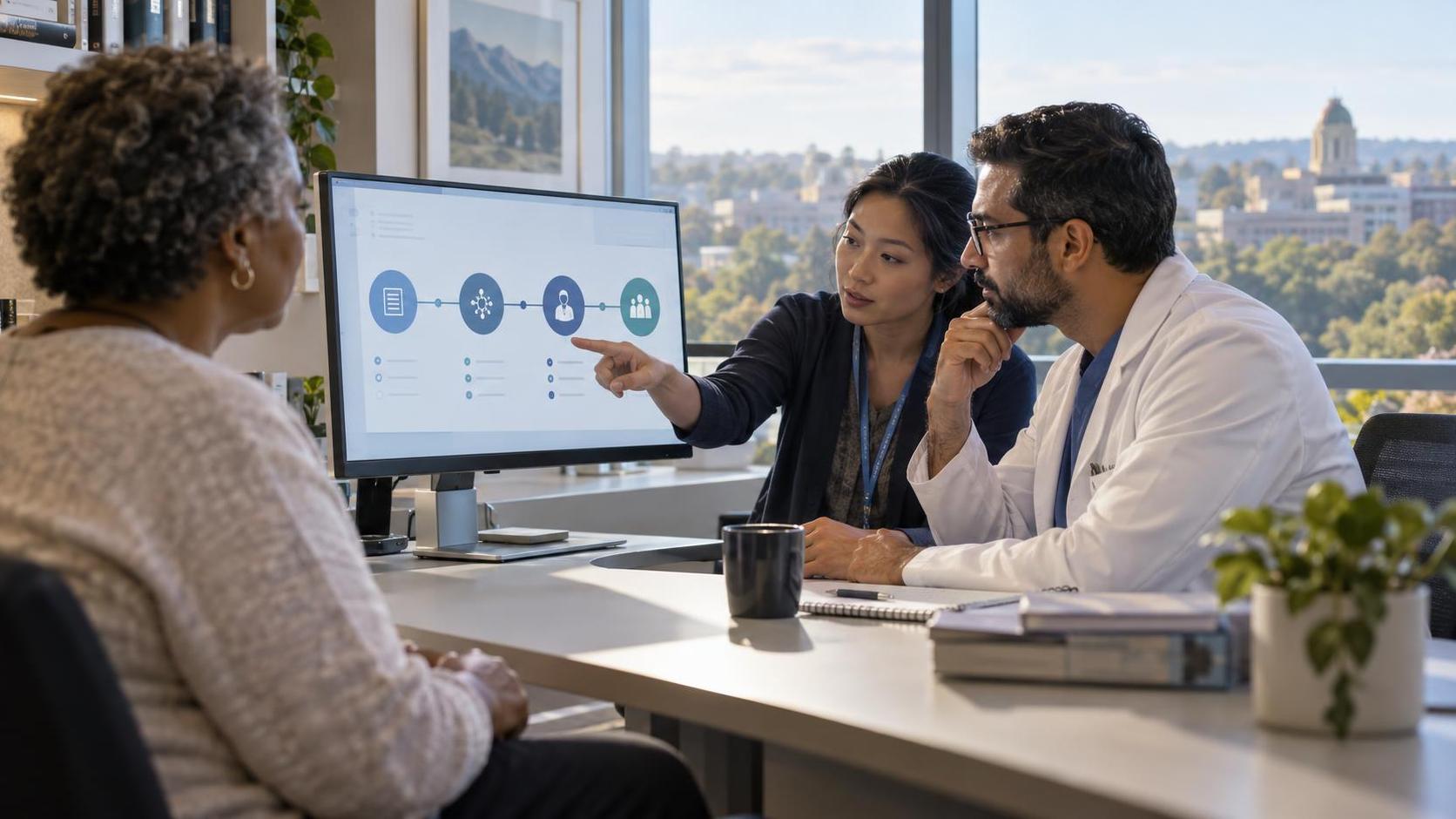
OpenAI Buys Orchestra Bio: Will AI Agents Speed Drug Development?
OpenAI just bought the company built to keep drug programs on schedule. Here is what Orchestra Bio does, what it does not do, and how its promise scores against the evidence.
Presented By Our Partners


The short answer: OpenAI acquired Orchestra Bio on October 20, 2026, for an undisclosed price. Orchestra builds AI agents that monitor the operations of drug programs, from study progress to supplier timelines, and its team and software are being folded into Rosalind, OpenAI’s life sciences product line. OpenAI’s stated goal is to help treatments reach patients sooner. No outcome data has been published to show that yet, and on the Healthcare Discovery HYPE Index the claim scores 60 out of 100: mixed calibration, at the edge of a significant evidence gap.
Picture a production batch failing at a contract manufacturer. Nothing dramatic happens that day. A vial lot is rejected, an email goes out, and somewhere downstream a clinical site that was expecting supply in March will now get it in May. A regulatory filing that depended on that site’s data moves too. The delay travels quietly through the program and often surfaces weeks later, in a status meeting, as a surprise. Drug development is less a single experiment than a relay of thousands of handoffs between research groups, contract research organizations, manufacturers and regulators, and most of the time lost in it is lost between the runners.
Orchestra Bio built software to catch the dropped baton early: agents that notice a failed batch, work out which timelines it touches, and put options in front of the people who decide what happens next. That is the company OpenAI just bought. It is not a molecule machine. It is closer to a nervous system for the business of making medicine.
What Orchestra Bio does
Orchestra Bio was founded around October 2022 by Ashoka Rajendra and is based in San Francisco. It had raised about $20 million as of 2025 from Andreessen Horowitz, Atria and 8VC. The company describes its product as an agentic operations platform for drug development: a shared workspace where scientists and program leaders hand routine monitoring to AI agents that track studies, follow development timelines and flag likely delays. Its software was built for the collaborations that define modern biotech, in which a single program can depend on several outside contract research and manufacturing organizations at once.
Two boundaries matter. First, Orchestra does not design drugs. Its focus is the program around the molecule, not the molecule. Second, the agents monitor and recommend; OpenAI’s announcement describes people delegating tracking work, and it does not say the agents will make program decisions on their own.
Where Orchestra lands inside OpenAI
OpenAI is merging Orchestra’s team and technology into Rosalind, its family of life sciences products. GPT-Rosalind is a reasoning model for biology and chemistry, launched in April 2026, and Rosalind Workbench connects it to scientific tools and data so researchers can analyze results and plan experiments. One way to read the deal: Rosalind helps scientists decide what to test, and Orchestra handles everything that has to happen after they decide. Named Rosalind customers include Moderna, Novo Nordisk, Amgen and Thermo Fisher Scientific.
Several things are still unknown. OpenAI has not disclosed the price, Orchestra’s customer count, whether existing contracts continue unchanged, or when Orchestra’s agents will appear inside Rosalind. The deal also lands six months after Anthropic acquired Coefficient Bio for a reported $400 million in stock (our coverage), and it is one entry in a fast-growing list we maintain in the AI lab biotech deal tracker.
Why the operations layer is worth fighting over
OpenAI says a new medicine typically takes 10 to 15 years to develop. The money tracks the time. A JAMA analysis of drugs approved by the FDA from 2009 to 2018 estimated a median capitalized research and development investment of $985 million per new medicine and a mean of $1.34 billion, after accounting for failed trials; the word capitalized matters, because the estimate charges a cost of capital for every year money sits in a program (DOI). Every month shaved from a program is worth real money even if nothing about the science changes.
Featured Partner
Invest in the Infrastructure Behind Modern Medicine
As healthcare expands beyond hospital walls, the buildings and campuses supporting that shift are generating compelling returns for investors who move early. The Healthcare Real Estate Fund offers qualified investors direct access to a curated portfolio of medical office, outpatient, and specialty care facilities.
Learn More →
Operational friction is a documented source of lost months. Research from the Tufts Center for the Study of Drug Development, reviewed by Kenneth Getz, found that growing protocol complexity and protocol amendments add direct costs, workload and cycle-time delays to clinical development (DOI). That is the kind of problem coordination software is built for.
But time is only one half of the equation. The other half is whether the drug works. An analysis of more than 406,000 clinical trial entries covering over 21,000 compounds found that success rates vary widely by disease area, with oncology among the lowest, and that trials using biomarkers to select patients succeed more often (DOI). AI discovery tools are aimed at those odds. A 2024 analysis found AI-discovered molecules succeeded in phase 1 trials 80 to 90 percent of the time, above historical averages, but about 40 percent of the time in phase 2, roughly in line with history and on a small sample (DOI). Orchestra’s tools act on the calendar, not on the biology. Faster coordination cannot rescue a molecule that does not work. Peer-reviewed sources were retrieved via PubMed.
The HYPE Index grade
We scored four related claims with the HYPE Index, Healthcare Discovery’s method for measuring the gap between what a claim promises and what its evidence has earned. Each axis runs from 0 (fully calibrated) to 20 (largest gap), and the composite runs from 0 to 100 with the Expectation and Evidence axis weighted double. Scores reflect public materials as of October 21, 2026, from a single editorial rater, and will change as evidence appears.
| Claim | Who made it | H | Y | P | E | Composite | Tier |
|---|---|---|---|---|---|---|---|
| Combining Rosalind and Orchestra will help treatments reach patients sooner | OpenAI announcement, October 20, 2026 | 13 | 10 | 15 | 11 | 60 | Mixed calibration |
| AI agents will speed up drug development | Headline framing in coverage of the deal | 13 | 11 | 15 | 15 | 69 | Significant Evidence Gap |
| AI can compress life sciences research and development timelines tenfold | Anthropic’s ambition, as summarized from its life sciences head’s remarks at SynBioBeta 2026 | 14 | 12 | 15 | 13 | 67 | Significant Evidence Gap |
| AI-discovered molecules succeed more often in phase 1 trials than historical averages | Boston Consulting Group authors, Drug Discovery Today, 2024 | 4 | 8 | 9 | 7 | 35 | Largely calibrated |
Why OpenAI’s claim scores 60.
- H, Hypothesis and History (13): The mechanism is stated clearly: coordination failures cost time, and agents can catch them earlier. Missing are any engagement with decades of clinical trial management software, a named success metric, published customer results, or a public test of the idea.
- Y, Yes, but and Yields (10): The users and setting are well defined: biopharma teams running drug programs. No yield is reported, and the claim leaps from process to patients without process measures such as days saved in between.
- P, Peer Review and Proof of Work (15): No peer-reviewed or independent evaluation of the platform is publicly available. Investors are disclosed; evaluation data are not.
- E, Expectation and Evidence (11): The strongest language is a goal, framed around helping and sooner, not a number. That restraint is the main reason the claim sits just below the significant gap line. Nothing published yet corresponds to it.
- Stage and verifier: Deployed software with no published outcome data. The verifier would be program cycle times compared against similar programs, followed by faster approvals.
Where the hype entered the chain. OpenAI’s announcement framed a goal. Some headlines turned the goal into a result, saying the agents will speed up drug development. That single drift adds nine points and crosses into a significant evidence gap. Anthropic’s tenfold ambition scores 67 for the same reason in a different form: a specific, large number attached to a capability that has not yet been measured, even with a promising early discovery from its own lab. The fourth row shows the contrast. A narrow claim, stated with its limits, from a published analysis, scores as largely calibrated even though the sample is small. Healthcare Discovery uses AI tools from both OpenAI and Anthropic in its research workflow and applies the same rubric to both.
What would move the score
- Before-and-after cycle-time data from named Orchestra or Rosalind customers, with comparison programs.
- An independent evaluation by an academic group or an industry consortium.
- A public description of what the agents may do on their own and what always requires a human decision.
- For the tenfold claim, peer-reviewed publication of the lab’s results and measured target-to-clinic timelines.
Orchestra Bio is not Orchestra BioMed
The names collide, and some coverage of the deal has had to spell out the difference. Orchestra Bio is the private San Francisco software startup OpenAI acquired. Orchestra BioMed is an unrelated Nasdaq-listed medical device company, ticker OBIO, developing cardiovascular therapies for hypertension and artery disease. The OpenAI deal involves only Orchestra Bio.
What This Means for You
If you are a patient, this deal changes nothing about the treatments available to you this year. If it works, it would shave months off specific drug programs, which matters, but it will not change whether a drug works. That is still decided by biology and by trials. When you read that AI will bring drugs to patients faster, ask what was measured and against what.
If you work in biotech or at a contract research organization, operations agents are coming to your workflow from more than one direction. Ask any vendor where your program data goes, which actions the agents can take without approval, and how much time the tool has actually saved for a comparable team.
And for everyone following the longevity race, the realistic posture is patient optimism. The drugs these labs are chasing are years away. The habits that keep you healthy until they arrive are available now; that is the bridge Healthcare Discovery writes about in Longevity Escape Velocity, Explained Through Isomorphic Labs.
Related coverage
- OpenAI, Anthropic and Google in Biotech: The 2026 Deal Tracker
- Anthropic Just Bought a Drug Discovery Startup for $400M
- AI Designed This Lung Drug, and It Just Worked in Real Patients
- The First Wave of AI-Designed Drugs Hits Human Trials
- Why the Breakthrough You Read About Never Became a Treatment
- Frontier AI Labs Are the New Strategic Acquirers in Healthcare (the investor’s view, on Healthcare Venture Capital Fund)
Frequently Asked Questions
What is Orchestra Bio?
Orchestra Bio is a San Francisco software startup founded around October 2022 by Ashoka Rajendra. It built an agentic operations platform where drug development teams hand routine monitoring, such as tracking studies, timelines and supplier delays, to AI agents. OpenAI acquired it on October 20, 2026.
How much did OpenAI pay for Orchestra Bio?
The price was not disclosed. Orchestra Bio had raised about $20 million as of 2025 from Andreessen Horowitz, Atria and 8VC.
What is Rosalind Workbench?
Rosalind Workbench is OpenAI’s tool that connects its GPT-Rosalind life sciences model to scientific tools and data so researchers can analyze results and plan experiments. Orchestra Bio’s team and technology are being merged into the Rosalind product family.
Will AI agents make new drugs arrive faster?
Possibly in specific programs, but no outcome data has been published yet. Operations tools can reduce coordination delays, but they do not change whether a drug works, which is still decided in clinical trials. On the HYPE Index, OpenAI’s claim scores 60 out of 100, mixed calibration.
Is Orchestra Bio related to Orchestra BioMed?
No. Orchestra BioMed is an unrelated Nasdaq-listed medical device company, ticker OBIO. Only Orchestra Bio is part of the OpenAI deal.
Sources
- OpenAI: OpenAI acquires Orchestra Bio
- TechCrunch: OpenAI acquires startup Orchestra Bio
- Axios: OpenAI has acquired Orchestra Bio
- The Decoder: OpenAI acquires Orchestra Bio
- Decrypt: OpenAI buys Orchestra Bio
- OpenTools: OpenAI buys Orchestra Bio
- Crypto Briefing: OpenAI acquires Orchestra Bio
- SynBioBeta: Anthropic is hiring biologists and building wet labs
- Wouters OJ, McKee M, Luyten J. Estimated research and development investment needed to bring a new medicine to market, 2009-2018. JAMA, 2020. doi.org/10.1001/jama.2020.1166
- Getz K. Improving protocol design feasibility to drive drug development economics and performance. International Journal of Environmental Research and Public Health, 2014. doi.org/10.3390/ijerph110505069
- Wong CH, Siah KW, Lo AW. Estimation of clinical trial success rates and related parameters. Biostatistics, 2019. doi.org/10.1093/biostatistics/kxx069
- Jayatunga M, et al. How successful are AI-discovered drugs in clinical trials? Drug Discovery Today, 2024. doi.org/10.1016/j.drudis.2024.104009
Scored with HYPE Index Methodology v1.1.


Similar Posts

The Omega 3 Index: What 20 Years of Research Reveal About the Blood Marker Modern Medicine Still Underuses
A 2004 Harris and von Schacky proposal in Preventive Medicine turned omega 3 status into a measurable, modifiable blood marker. Two decades of cohort and trial evidence, from VITAL to…
Abbott FreeStyle Libre 3: Affordable Continuous Glucose Monitoring in the Smallest Sensor
The sensor is the size of two stacked pennies. The data it produces could reshape how 88 million Americans with prediabetes understand their metabolic health. Presented By Our Partners In…
The Daily Rounds: Longevity & Health Care Brief | May 5, 2026
🫀 Thymus Rewritten as Longevity Organ: Two Nature studies of 27,000 people found that adult thymic health predicts 50% lower mortality, 63% lower cardiovascular death, and 36% reduced lung cancer risk. 🩸 Blood Test Could Flag Depression Before Symptoms Peak: Accelerated aging in monocytes tracks closely with the cognitive and emotional symptoms of depression, pointing toward a future diagnostic blood biomarker. ⚠️ Alzheimer's Drug Controversy Deepens: A Cochrane review of 17 trials found anti-amyloid drugs show no meaningful benefit on cognitive decline while raising brain bleed risk, drawing fierce pushback from researchers and manufacturers. 🧠 Weight Control Protects the Aging Brain: A 24-year study of 8,200 adults found that managing BMI can measurably slow cognitive decline within two years, making weight a frontline tool for brain health. 🏋️ Strength Training Simplified for Longevity: ACSM's first resistance training update in 17 years finds that two sessions per week across major muscle groups is the primary driver of strength and metabolic health gains.

The Sauna Prescription: What 30 Years of Finnish Research Reveal About Heat Exposure, Cardiovascular Mortality, and the Recovery Science That Rewrites Hormesis
Three decades of Finnish cohort research, anchored by the Kuopio Ischemic Heart Disease cohort and a 2015 JAMA Internal Medicine paper, have transformed sauna bathing from a cultural ritual into…
BioTelemetry MCOT Patch: 30-Day Continuous ECG for Arrhythmia Detection
When a two-week cardiac monitor is not enough, the BioTelemetry MCOT Patch extends the diagnostic window to 30 continuous days of real-time ECG surveillance. Presented By Our Partners In 2019,…

Senolytics in 2026: How the Science of Killing Zombie Cells Reached Its First Human Proof of Concept
A decade of senolytic research is converging into something new. Inside the Mayo Clinic dasatinib quercetin work, the AFFIRM-LITE fisetin trial, Rubedo’s March 2026 Phase 1 readout of RLS-1496, and…
