
Withings BPM Vision Review 2026: $150 Price, Accuracy Evidence, HSA/FSA Status
Withings put a large color screen on an upper-arm blood pressure cuff so readings are easier to take and understand. The cuff method behind it has a strong validation record on earlier Withings monitors, but the BPM Vision itself has no published accuracy study yet.
Presented By Our Partners



Withings introduced the BPM Vision at CES 2025, and TechCrunch described it as a $130 home blood pressure monitor (TechCrunch). Engadget reported that Withings updated its blood pressure monitor and launched a Cardio Check-Up feature alongside it (Engadget). MedPath later reported that the BPM Vision received FDA clearance and launched in the US market (MedPath), Digital Trends reported that the $150 monitor is FDA approved and out now (Digital Trends), and Withings published a BPM Vision US availability announcement (Withings). This review looks at what published studies show about Withings cuffs and what that means for the BPM Vision.
First look. No peer-reviewed study has tested the BPM Vision itself yet; a PubMed search on October 28, 2026 found none. The accuracy section draws on independent validation studies of the Withings BPM Connect, BPM Core, BPM Pro 2 and the older BP-800, which are also upper-arm oscillometric cuffs. The BPM Vision may perform the same, better or differently.
The short answer: The Withings BPM Vision is an upper-arm blood pressure cuff with a built-in color screen, announced at about $130 and now sold in the US at $150, according to Digital Trends, which reported it as FDA approved. Three earlier Withings cuffs passed the international Universal Standard validation protocol, with average errors of about 1 mmHg or less for systolic pressure. No study has tested the BPM Vision itself yet.
- Best for: Adults who check blood pressure at home, especially people who find small cuff displays or app-only readings hard to use.
- Not for: Anyone who wants a wearable that measures without a cuff, or buyers who need a monitor already proven in pregnancy or with very large arms.
- Price (October 2026): $150 at US launch, per Digital Trends; about $130 when first announced at CES 2025.
- Regulatory status: MedPath reported FDA clearance and a US launch. We did not find the BPM Vision’s own FDA 510(k) record in our searches, so check the listing for the model you buy.
- Evidence: Strong for the Withings cuff platform (BPM Connect, BPM Core and BPM Pro 2 all passed the Universal Standard); none published for the BPM Vision itself.
What Is the Withings BPM Vision?
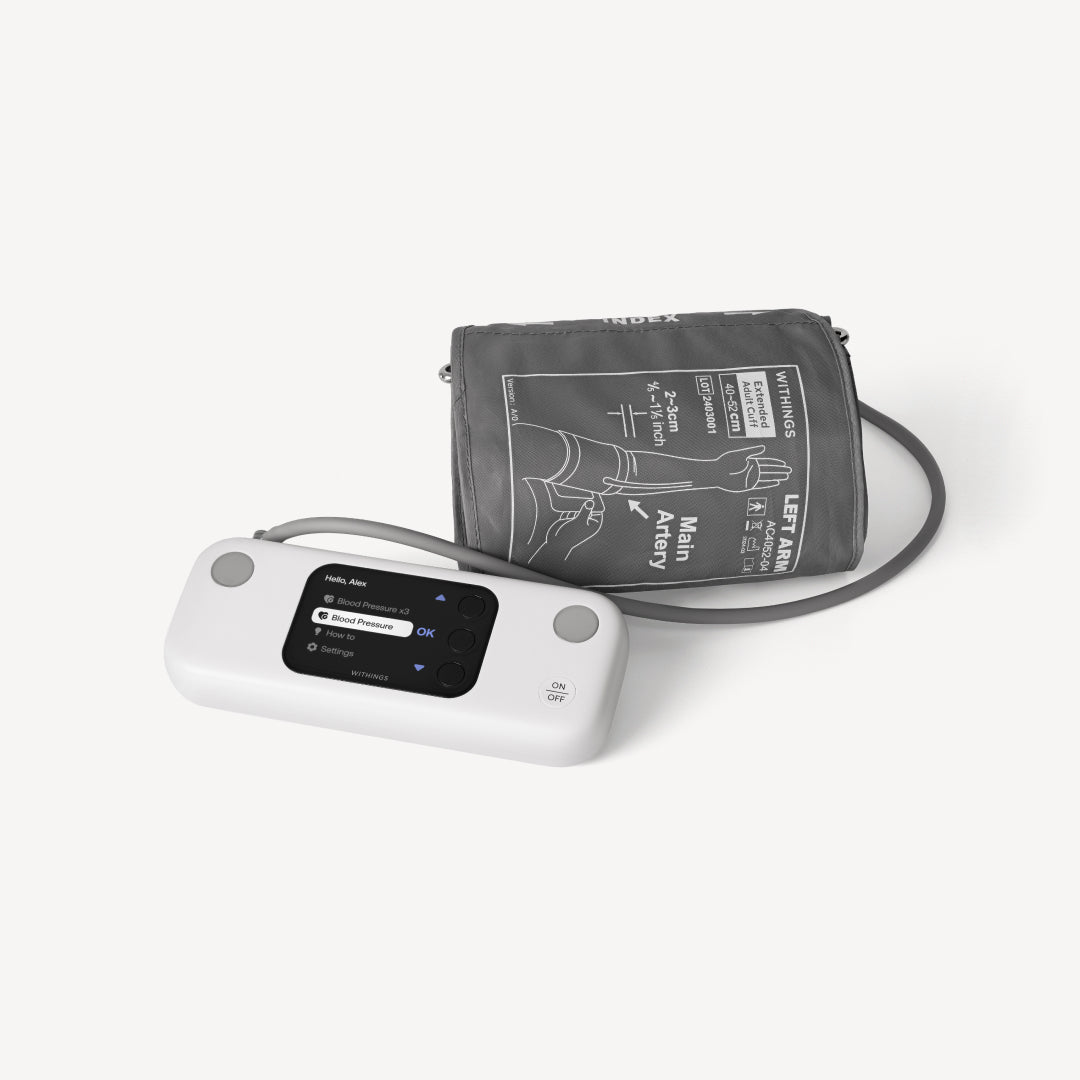
The Withings BPM Vision is a home blood pressure monitor that measures at the upper arm with an inflating cuff and shows results on a built-in color screen, then syncs readings to the Withings app.
Heise’s headline says Withings launched a smart blood pressure monitor with an HD display for easy operation (heise), and Withings markets it as “the easiest blood pressure experience” on its US product page (Withings). Wareable covered it as part of a double cardio announcement at CES 2025 (Wareable). German site mobiflip’s launch headline describes the BPM Vision as measuring blood pressure and ECG (mobiflip); we could not confirm from US sources which heart features the US model includes, so check the US listing. These details come from the publications’ headlines and were not tested by Healthcare Discovery.
Hands-on reviews so far are positive. The Gadgeteer published a full review in May 2025 (The Gadgeteer), and HomeTechHacker called it a smart addition to your health journey (HomeTechHacker).
Can your doctor see this data? Partly, if you share it. Withings runs a clinician RPM program and an athenahealth RPM partnership; this model's inclusion was not confirmed. Ask your clinic whether it supports this model for remote patient monitoring.
How Does the Withings BPM Vision Work?
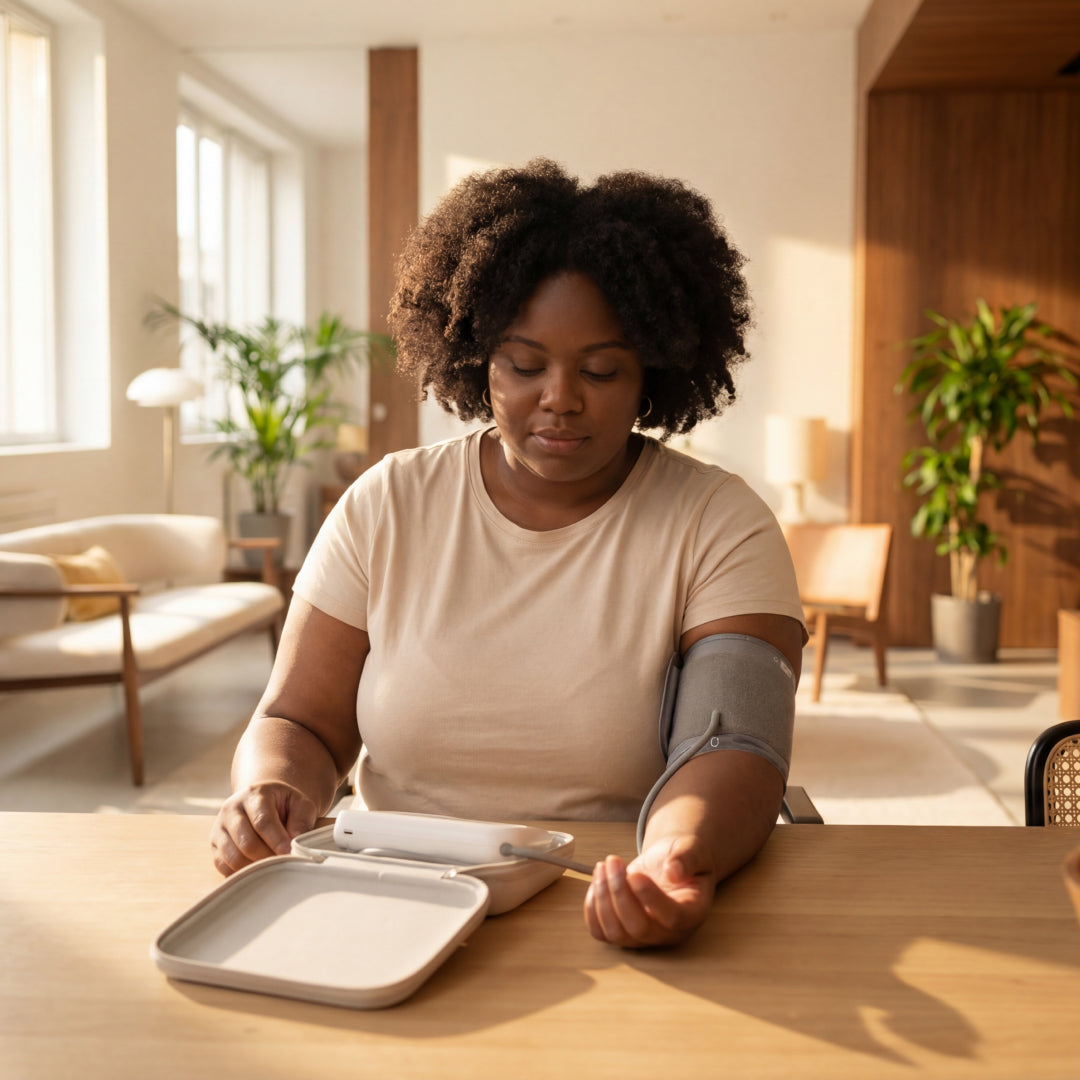
The BPM Vision works like most home cuffs: it squeezes the upper arm, then reads the small pressure waves in the cuff as it deflates to calculate systolic and diastolic pressure. This is called the oscillometric method. The screen shows the result, and the app keeps a log you can share with a clinician.
Unlike a smartwatch or ring, a cuff does not estimate blood pressure from a light sensor. It measures pressure directly against the artery, which is why validated upper-arm cuffs remain the reference for home monitoring. The catch is technique: the cuff must fit your arm, you should sit quietly with your back supported and arm at heart level, and readings taken over several days tell you more than any single number.
The Universal Standard (ISO 81060-2:2018) is the international test a cuff should pass before you trust its numbers. Investigators compare each device against two trained observers using a reference sphygmomanometer in at least 85 people. To pass, the average difference must be within 5 mmHg, with a spread (standard deviation) of no more than 8 mmHg, plus a second per-person test. A 2026 update from the ESH Working Group and STRIDE BP notes that this standard was written for cuff devices and is inadequate for cuffless ones (PMID 42853222).
How Accurate Is the Withings BPM Vision? What the Research Shows
No study has tested the BPM Vision yet. Three earlier Withings upper-arm cuffs passed the Universal Standard with average systolic errors of about 1 mmHg or less, and one passed a pregnancy validation. An older Withings cuff failed in pregnancy and over-read in women with larger arms, a reminder that accuracy is model specific.
Withings BPM Core. In 85 adults tested to the Universal Standard with its 2020 amendment, the BPM Core read systolic pressure an average of 0.6 mmHg low with a standard deviation of 4.8 mmHg, and diastolic 0.1 mmHg high with 3.7 mmHg. It passed both criteria (PMID 37426327).
Withings BPM Connect. In 85 adults, the BPM Connect differed from the reference by 0.6 plus or minus 5.3 mmHg for systolic and 2.1 plus or minus 4.3 mmHg for diastolic pressure, meeting the Universal Standard (PMID 35386428). A separate study of 45 pregnant women in the second and third trimester, including 15 with pre-eclampsia, found differences of minus 0.5 plus or minus 5.7 mmHg systolic and minus 0.8 plus or minus 3.8 mmHg diastolic, and the authors recommended it for home use in pregnancy (PMID 35370407).
Withings BPM Pro 2. The newest Withings cuff with a published study was tested in 87 adults under the 2024 amendment of the Universal Standard. It read 1.0 plus or minus 4.9 mmHg high for systolic and 0.6 plus or minus 4.1 mmHg high for diastolic pressure, passing both criteria (PMID 41777561).
Featured Partner
Invest in the Infrastructure Behind Modern Medicine
As healthcare expands beyond hospital walls, the buildings and campuses supporting that shift are generating compelling returns for investors who move early. The Healthcare Real Estate Fund offers qualified investors direct access to a curated portfolio of medical office, outpatient, and specialty care facilities.
Learn More →
Older Withings cuff, and how it compared with Omron. Under the older ESH International Protocol, the Withings BP-800 differed from mercury readings by minus 0.2 plus or minus 5.0 mmHg systolic, in the same range as two Omron cuffs tested alongside it (Omron M6 Comfort, minus 1.8 plus or minus 5.1 mmHg; Omron HEM-7420, 2.5 plus or minus 4.6 mmHg), and all four devices passed (PMID 24476688). In 47 pregnant women, however, the same BP-800 failed the British Hypertension Society protocol, and its error grew with larger arm circumference, tending to over-read (PMID 27939491).
Cuff versus cuffless. A 2026 European Society of Cardiology scientific statement on cuffless blood pressure devices does not recommend using them for clinical decisions because of insufficient accuracy validation (PMID 41739846). The European Society of Hypertension wrote in 2023 that there were no generally accepted validation protocols for cuffless devices and proposed six separate tests (PMID 37303198). That gap is the main reason a validated cuff like the BPM Vision’s predecessors is still the better tool for confirming high blood pressure.
The BPM Vision itself. We found no peer-reviewed validation of the BPM Vision on PubMed as of October 28, 2026. Until one is published, its accuracy is inferred from related Withings cuffs, not shown.
Company ties: none of the Withings cuff validation studies above lists a Withings employee among its authors; the BPM Connect, BPM Core and BPM Pro 2 studies come from the same research group in Yerevan, Paris and Geneva (PMID 35386428, PMID 37426327, PMID 41777561), and the abstracts do not state who funded them. The other studies list academic or hospital affiliations only. PubMed affiliations are not a full disclosure of funding or conflicts.
What the Withings BPM Vision Gets Right
The BPM Vision gets the fundamentals right: it measures at the upper arm with a cuff, the method guidelines rely on, it comes from a maker whose recent cuffs have passed independent validation, and it puts readings on a screen instead of only in an app.
A cuff platform with independent validation. The BPM Connect, BPM Core and BPM Pro 2 all passed the Universal Standard with average systolic errors at or under 1 mmHg (PMID 35386428, PMID 37426327, PMID 41777561). Few consumer health brands have that many published cuff validations.
A screen that makes readings easier. Reviewers and launch coverage lead with the display, which heise describes as an HD screen for easy operation. For older adults or anyone who does not want to open an app for every reading, that matters.
A logbook your doctor can use. Home readings over days and weeks are more useful to a clinician than a single office reading, and syncing to an app makes that log easy to keep and share.
Where the Withings BPM Vision Falls Short
The weaknesses are no published validation of the BPM Vision itself, no pregnancy data for this model, and a higher price than basic validated cuffs.
No study of this model. Every accuracy number above comes from another Withings cuff. Validation is model specific, as the older BP-800 showed when it passed in general adults but failed in pregnancy (PMID 24476688, PMID 27939491).
Pregnancy and large arms are unproven. The BPM Connect passed a pregnancy validation (PMID 35370407), but no such data exist for the BPM Vision. If you are pregnant or have a large upper arm, ask your clinician which cuff and cuff size to use.
You pay for the screen. At $150 in the US, the BPM Vision costs more than many basic validated cuffs. If you only need accurate numbers, a validated basic cuff does the core job.
Withings BPM Vision vs BPM Core vs BPM Connect vs Omron vs Cuffless Wearables
The BPM Vision, BPM Core and BPM Connect are all Withings upper-arm cuffs; only the Core and Connect have published validations. Omron cuffs have a long validation record. Cuffless wearables are convenient but not yet recommended for clinical decisions.
| Feature | Withings BPM Vision | Withings BPM Core | Withings BPM Connect | Omron upper-arm cuffs | Cuffless wearables (e.g. Hilo Core) |
|---|---|---|---|---|---|
| How it measures | Upper-arm cuff, oscillometric | Upper-arm cuff, oscillometric | Upper-arm cuff, oscillometric | Upper-arm cuff, oscillometric | Optical or pulse wave sensors, no cuff |
| Published validation | None found (October 2026) | Passed Universal Standard, 85 adults | Passed Universal Standard, 85 adults; passed in pregnancy | M6 Comfort and HEM-7420 passed ESH protocol | No generally accepted protocol; not recommended for clinical decisions |
| Screen | HD color display per heise | Not verified for this review | Not verified for this review | Varies by model | Varies by device |
| FDA status | Reported FDA cleared (MedPath) | Not verified for this review | Not verified for this review | Not verified for this review | Varies by device |
| Price (October 2026) | $150 at US launch | Not verified for this review | Not verified for this review | Not verified for this review | Not verified for this review |
If you want to understand cuffless options, see our reviews of the Hilo Core blood pressure wearable, the Signal Ring and the Happy Ring. Ring buyers can also read our Oura Ring 5 price and blood pressure guide, and iPhone owners can compare the hypertension notifications in our Apple Watch Series 12 review. Every device we track is in our healthtech wearables guide.
How Much Does the Withings BPM Vision Cost, and Is It HSA or FSA Eligible?
TechCrunch reported a price of about $130 when Withings announced the BPM Vision at CES 2025 (TechCrunch); Digital Trends later reported a $150 US price when it went on sale (Digital Trends). We did not find a lower current US price in our search. Withings’ own BPM Vision page is titled FSA-HSA Eligible (Withings).
Blood pressure monitors are a common HSA and FSA purchase, but plan rules differ, so confirm with your administrator before you pay with pre-tax funds.
Who Should Buy the Withings BPM Vision, and Who Should Skip It?
The BPM Vision suits adults who measure blood pressure at home and want a large, readable screen with an app log. It is a weaker fit for people who need a model validated in pregnancy, for buyers on a tight budget, and for anyone hoping to skip the cuff entirely.
Good candidates:
- Adults told to check blood pressure at home to confirm or rule out high blood pressure.
- People on blood pressure medicine who want a clear log to share with their clinician.
- Older adults or family caregivers who find small displays or app-only cuffs hard to use.
Better served by something else:
- A very high reading with chest pain, shortness of breath, weakness, vision change or trouble speaking: that is an emergency. Call 911; do not keep re-measuring.
- Pregnant people: use a cuff validated in pregnancy, such as the BPM Connect in the study above, or the one your obstetric team recommends.
- Budget buyers who only need accurate numbers: a basic validated upper-arm cuff costs less.
- People who want blood pressure without a cuff: cuffless devices are not yet recommended for clinical decisions, so use them for trends only.
If your readings send you looking for a cardiologist or primary care doctor, the Healthcare Discovery doctor directory lists clinicians by state and specialty.
What This Means for You
A validated upper-arm cuff is still the most reliable way to know your blood pressure at home, and Withings has one of the better validation records among consumer brands. The BPM Vision adds a screen that makes readings easier, and launch coverage reports FDA clearance, but no study has tested this exact model yet. For the wider picture of what drives heart risk, see our heart health evidence review.
If you buy it, use good technique: the right cuff size, five quiet minutes seated first, two readings a minute apart, morning and evening for a week before a doctor’s visit. Treat any cuffless wearable as a trend tracker, and confirm a high number with a cuff.
Compiled by Healthcare Discovery from the cited PubMed studies and Withings’ launch materials. Every PMID, study size and result on this page was checked against PubMed on October 28, 2026. Launch, price, specification and review details come from the named publications’ headlines and listings and were not independently tested. This is a first look; no Healthcare Discovery hands-on testing was done.
Is the Withings BPM Vision accurate?
No study has tested the BPM Vision itself yet. Earlier Withings upper-arm cuffs passed the international Universal Standard: the BPM Core read systolic pressure 0.6 mmHg low on average in 85 adults (PMID 37426327), the BPM Connect 0.6 mmHg high (PMID 35386428) and the BPM Pro 2 1.0 mmHg high (PMID 41777561).
Is the Withings BPM Vision FDA cleared?
MedPath reported that the BPM Vision received FDA clearance and launched in the US. We did not find its FDA 510(k) record in our searches, so check the listing for the model you buy.
How much does the Withings BPM Vision cost?
Digital Trends reported a $150 US price when the BPM Vision went on sale, after TechCrunch reported about $130 at its CES 2025 announcement. Check Withings for current pricing.
Is the Withings BPM Vision HSA or FSA eligible?
Withings labels its BPM Vision page FSA-HSA Eligible. Plan rules differ, so confirm with your HSA or FSA administrator before paying with pre-tax funds.
Is a cuff better than a cuffless blood pressure wearable?
Yes, for now. A 2026 European Society of Cardiology statement does not recommend cuffless devices for clinical decisions because their accuracy is not yet adequately validated (PMID 41739846). Validated upper-arm cuffs remain the reference for home readings.
Can I use the Withings BPM Vision during pregnancy?
It has not been validated in pregnancy. The Withings BPM Connect passed a validation in 45 pregnant women (PMID 35370407), while the older Withings BP-800 failed one (PMID 27939491), so ask your obstetric team which cuff to use.
Sources
- Hakobyan Z, et al. Validation of the Withings BPM Core device for self-blood pressure measurements in general population according to the Association for the Advancement of Medical Instrumentation/European Society of Hypertension/International Organization for Standardization Universal Standard. Vascular Health and Risk Management, 2023. PMID 37426327
- Topouchian J, et al. Accuracy of the Withings BPM Connect device for self-blood pressure measurements in general population: validation according to the AAMI/ESH/ISO Universal Standard. Vascular Health and Risk Management, 2022. PMID 35386428
- Zelveian P, et al. Clinical accuracy of the Withings BPM Connect for self-blood pressure measurements in pregnancy and pre-eclampsia: validation according to the AAMI/ESH/ISO Universal Standard. Vascular Health and Risk Management, 2022. PMID 35370407
- Zelveian P, et al. Accuracy of the Withings BPM Pro 2 (WPM07) device for self-blood pressure measurements in the general populations according to the ISO Universal Standard (ISO 81060-2:2018/AMD 2:2024) protocol. Vascular Health and Risk Management, 2026. PMID 41777561
- Topouchian J, et al. Validation of four devices: Omron M6 Comfort, Omron HEM-7420, Withings BP-800, and Polygreen KP-7670 for home blood pressure measurement according to the European Society of Hypertension International Protocol. Vascular Health and Risk Management, 2014. PMID 24476688
- Hay A, et al. Validation of the Withings BP-800 in pregnancy and impact of maternal characteristics on the accuracy of blood pressure measurement. Pregnancy Hypertension, 2016. PMID 27939491
- Parati G, et al. Cuffless blood pressure monitoring devices: technical foundations and clinical implications. European Journal of Preventive Cardiology, 2026. PMID 41739846
- Stergiou GS, et al. European Society of Hypertension recommendations for the validation of cuffless blood pressure measuring devices. Journal of Hypertension, 2023. PMID 37303198
- Stergiou GS, et al. Updated practical guide for validation studies of automated cuff blood pressure monitors according to the Universal Standard (ISO 81060-2:2018) and Amendments 1:2020 and 2:2024. Journal of Hypertension, 2026. PMID 42853222
- Digital Trends. Withings $150 blood pressure monitor is FDA approved and out now. Digital Trends
- TechCrunch. Withings launches BPM Vision, a $130 home blood pressure monitor, at CES 2025, January 2025. TechCrunch
- Engadget. Withings updates its blood pressure monitor and launches a cardio check-up feature. Engadget
- Wareable. Withings double drops cardio tech announcements at CES 2025. Wareable
- MedPath. Withings BPM Vision blood pressure monitor receives FDA clearance and launches in US market. MedPath
- Withings. BPM Vision US availability. Withings
- Withings. The easiest blood pressure experience (BPM Vision, US). Withings
- Withings. FSA-HSA Eligible (BPM Vision). Withings
- heise. Withings starts smart blood pressure monitor with HD display for easy operation. heise
- mobiflip. Withings BPM Vision zur Blutdruck- und EKG-Messung startet in den Markt. mobiflip
- The Gadgeteer. Withings BPM Vision smart blood pressure monitor review, May 2025. The Gadgeteer
- HomeTechHacker. Withings BPM Vision blood pressure monitor review: a smart addition to your health journey. HomeTechHacker


Similar Posts

Oura Ring Gen 4: Readiness Scoring, HRV Tracking, and Recovery Intelligence
Recovery does not announce itself with a sensation. It reveals itself in data: the subtle shift of autonomic balance that determines whether today is a day to push or a…
Polar Grit X2 Pro Review 2026: Price, Battery, Accuracy, HSA/FSA Status
Polar Grit X2 Pro first look: price, what studies of Polar watches show about resting heart rate, HRV, sleep and calorie accuracy, FDA status and HSA/FSA.

Jamie Justice and the Longevity Revolution’s Most Unpopular Truth
Jamie Justice and the Longevity Revolution’s Most Unpopular Truth Presented By Our Partners There is a strange tension at the heart of the modern longevity movement. On one side are…

Muscle Is a Longevity Organ: What the Science of Strength Training Reveals About All-Cause Mortality
Grip strength outperforms blood pressure as a mortality predictor. A 2022 BMJ meta-analysis found that 30 to 60 minutes of resistance training per week cuts all-cause mortality by 15 percent….
Tempdrop 2.0 Fertility Monitor: Wearable BBT Tracking for Cycle Intelligence
Continuous overnight temperature sensing is transforming how women understand their cycles, but the science behind basal body temperature reveals both remarkable potential and persistent gaps. Presented By Our Partners Every…

Headspace Review: Is It Worth It? Price, Research, Verdict
Headspace is a guided meditation and sleep app with more randomized trials than its rivals; it helps modestly, and only if you use it several times a week.
